59
Views
0
Likes
0
Shares
0
Comments
StayCurrentMD
View profile →
Hepatoblastoma
Published:
Topic overview
Expert discussion on hepatoblastoma diagnosis and management in children, covering differential diagnosis of pediatric liver masses, role of alpha-fetoprotein testing, and surgical decision-making for biopsy versus upfront resection. Emphasizes age-specific considerations and proper biopsy technique to avoid tumor seeding.
Timestops
0:07
Introduction and Case Presentation
1:55
Differential Diagnosis by Age
5:07
Biopsy Techniques and Considerations
10:27
PRETEXT Staging System Explained
19:53
Histologic Subtypes and Risk Stratification
31:01
Management of Pulmonary Metastases
36:32
Surgical Techniques and Vascular Control
42:57
Transplant vs Extreme Resection
Key takeaways
- Elevated alpha-fetoprotein in a 1-year-old with liver mass strongly suggests hepatoblastoma; AFP testing is crucial for diagnosis.
- Needle biopsy should traverse normal liver tissue that will be resected; avoid crossing tumor-free left lobe to prevent seeding.
- Rhabdoid tumor is a critical differential in young children; it requires upfront resection as chemotherapy is ineffective.
- Hepatocellular carcinoma in young children often associates with inborn errors of metabolism, particularly tyrosinemia.
- Very low-risk hepatoblastoma may warrant upfront resection without biopsy; large masses require biopsy before neoadjuvant therapy.
Keywords
Hashtags
Transcript
Click "Show Transcript" to view the full text (46471 characters)
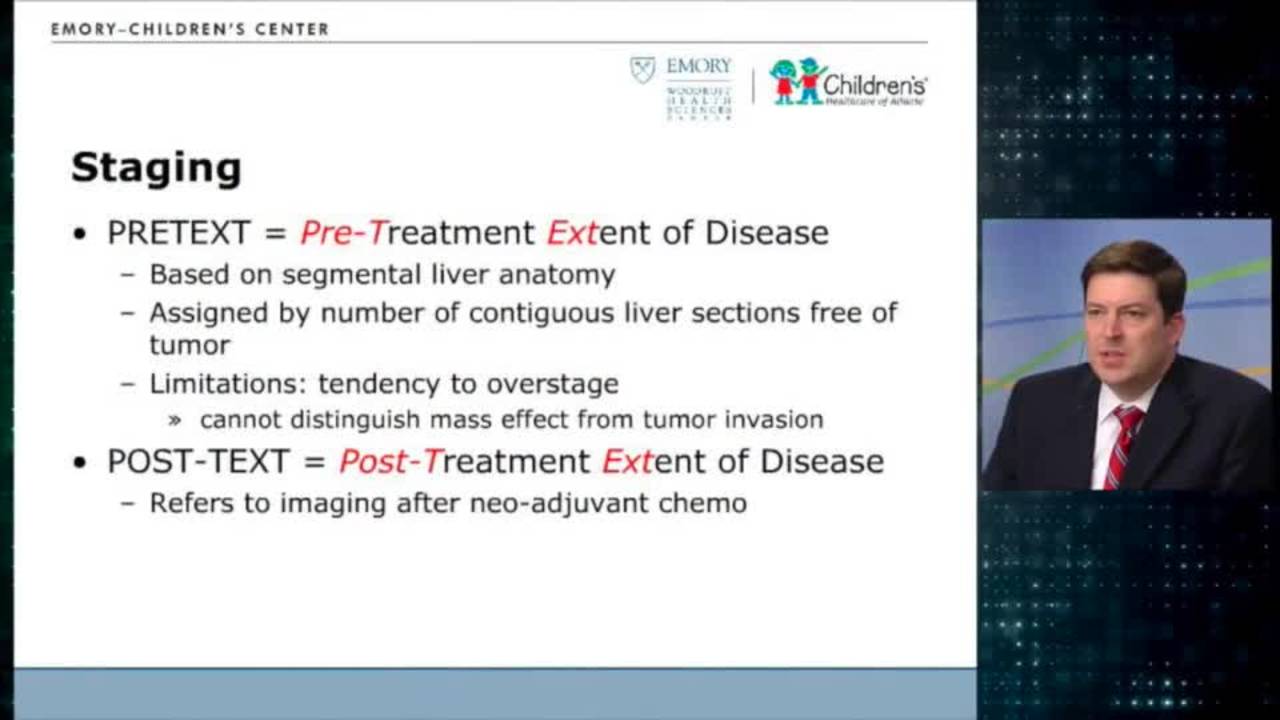
Stay Current is a multimedia publication designed to keep healthcare professionals up to date with standards of care and new emerging ideas. This chapter is created and edited by Todd Ponsky, Sophia Abdulhai, Abdulruf Lamoshi, and Rajavendra Rao and is recorded and produced at Akron Children's Hospital in Akron, Ohio. This is Todd Ponsky with State Current and Pediatric Surgery, and today we are broadcasting live from Akron Children's Hospital, and we have with us a true expert in the field, Doctor Max Langham. A who is professor of surgery and pediatrics and vice chairman, department of surgery, University of Tennessee Health Science Center, and he's going to talk to us today about hepatoblastoma. Max, thanks for joining us today. It's my pleasure. Good morning, Todd. You know, Max, this is a tough thing for a lot of us because many of us don't see this very often. So this is a particularly important chapter in this book because I think a lot of us will refer to this when we don't know this isn't on the back of our hand like a hernia, for example. So We are very appreciative that you're here with us. And so let's dive right into it. Let's take a situation where you're, you are presented with a child who's about one year of age who comes in. They, they had an abdominal mass that mom noticed, and they get a CAT scan and they see a large liver mass. How do you approach that child and is that usually how they come to you? Frequently, you know, liver tumors are rare in kids, and one of the big challenges in taking care of them is, is sorting out the diagnosis, which is crucial for good outcomes. So a one year old is likely to be a hepatoblastoma, although there are other malignancies that can occur that young, including rhabdoid tumor, which is a really bad actor. So I would want to have an alpha fetoprotein, and if the alpha fetoprotein is quite high, it's very elevated, then the presumptive diagnosis in a 1 year old would be hepatblastoma. You know, the and hepatoblastoma presents from the first year of life through perhaps 10 years of age, although there are a few that have been done older than that. Once the alpha fetoprotein narrows down our look at it. The surgeon really has an important responsibility in determining whether or not this is an easily resectable lesion or not. We'll talk a little bit later on about pretext and so forth, but if, if this is a rhabdoid tumor, chemotherapy is not important and the lesion needs to be resected. If it's a very low risk, and we'll talk about risk stratification. Aboutpaoblastoma, it's a very low riskpaoblastoma. Probably it doesn't need a biopsy. It needs an upfront resection. But let's say that it's a large mass that the surgeon's not comfortable with excising with a good margin. Then the next step would be a biopsy. And we will talk during the cast about the FIT study, which is a pediatric hepatic International tumor Trial that is being designed. Greg Chow has really been doing yeoman's work organizing and also about AHE 0731. where Chris Walden has looked at some of the biopsy things. In general, most people favor needle biopsy of the liver rather than an open biopsy or a laparoscopic biopsy. Ideally, the biopsy ought to be done under ultrasound or image guidance, and the biopsy should go through the normal part of the liver that will be resected with a specimen. So if this is a right-sided liver, you want to approach it from the right. You do not want. Want to cross the left lobe of the liver if the left lobe doesn't have tumor in it because poblastoma will seed and it can create big issues for future resection and cure. So let me go back to the beginning again. So that when you mentioned that in this age group, you're, you know, even before you've drawn the AFP, you have a high suspicion that given he's one year of age, that this is going to be a hepatoblastoma. Talk to me about what else would be in your differential at different ages. What about a newborn or a 6 month old? Sure, well, newborns, fascinating group. There have been prenatal diagnosis of hepatblastoma, not super rare, not very common. So, so for sure a newborn could have a hepatolastoma. The other malignancy that is more common in very young children is rhabdoid tumor, which is a small blue round cell tumor that is a bad actor, but there are other tumors in newborns, including rapidly involuting congenital hemangiomas that are benign, and mesenchymal hematomas can occur in the first year of age. So there's a variety of both benign and malignant lesions, hepatocys. Cellular carcinomas can occur in young children. Usually this is an association with an inborn error of metabolism, and the prototype is thyros anemia. So a baby with thyros anemia will develop a hepatocellular carcinoma if they are not transplanted, usually in the first couple of years of life. But for most patients with hepatocellular carcinoma, you're going to see those children later on in life. There is a mixed tumor that has features of hepatoblastoma and hepatocellular carcinomas that we're learning a lot about in biology that tends to occur in children over 6 years of age, and there are a variety of other kind of oddball tumors that will show up in the liver, including metastatic tumors. So when you're Developing your differential diagnosis, you need a good history, good physical look over things, you know, the one in a newborn that everybody's heard about are metastatic neuroblastomas, so skin lesions or any other lesion will raise a question about it. But if you, if you've got an isolated liver tumor in a 1 year old, the most common diagnosis is going to be a hepatoblastoma. That sounds great. And so just to reiterate and, and maybe make sure I'm saying this right, so a newborn, usually it's gonna be a hemangioma. If it's a child that's, let's say less than a year of age and they have a solid cystic mass, it's probably gonna be a mesenchymal hematoma. I don't know if you would agree with that. Well, you know, probably I think those diagnoses are there. Again, I think that you have to look at the totality. Alpha fetoprotein ought to be just automatic, you know, because that'll help us. A newborn is going to have an elevated. alpha fetoprotein, it's probably not going to be 3 or 400,000. And so there's normal nomograms that you can follow. So that's a super helpful test even in a newborn and there is a predisposition which we don't understand. Of premature infants to getting hepatolastomas. Interestingly, they usually get them not in the nursery, but in the first year or two of life. But other aspects of the history are really important, you know, if it's the child's a preemie, that ups the chance of this being a hepatolastoma. Oh, that's interesting, OK. So I want to go back then so we're, before I interrupted you, so you have this child, it's a 1 year old, they have a CAT scan that you would have to decide whether or not it's something that looks like it's resectable up front or not, and if it looks like it's not, then you would probably proceed with a needle biopsy, but making sure it's not through the normal side of the liver going through the affected side. Is that right? Exactly right, and I would encourage all of our listeners to to become involved with the children's psychology group in the US, Copel in Europe, the Japanese liver tumor Group in Japan, China's developing clinical trials. You know, I think that these are uncommon problems, and we all need to learn more about them. The for the biology arm of the children's oncology group, they want 10 core biopsies, so we're not talking about just one biopsy with histology. And if people are uncomfortable with that, an open biopsy with a centimeter cubed or so of tumor is OK. But you just have to recognize the complication rate and in fact some mortality seems higher with open biopsies than it does with the needle technique. Interesting. I don't think you ought to do this as an outpatient and for sure the complication that you're worried about is going to be bleeding, you know, whether it's your interventional radiologist or so forth, but I think that a multidisciplinary. surgery, oncology, interventional radiology ought to be on board and talk through the plans, and I would do that in consultation with the pathologist to make sure the pathologists are ready to process the specimen. And I would also add that both for the initial biopsy and for later on when we're talking about margins, there's really no role here for a frozen section. OK, so your child then has a, a needle biopsy, let's say it's, it doesn't look like it's resectable up front and actually let me ask you about that. What would you look at on the scan to make the decision that this is something that you can resect upfront? So, uh, the most important thing for everybody to take home from this podcast, Todd, is that the overarching goal of treatment for hepatblastoma is to get the kids to a safe resection. That's the most. Important thing. And, and so when we're talking about safe resection, most of the folks who I work with and have had the privilege of being involved with some of the trials with are using the pretext system, which is pre-treatment extent of disease. It's a radiographic imaging-based system that was developed in Europe during Cyopel 1. And it actually talks about and Chris Weldon and Greg have set up really nice surgical resection guidelines in consultation with folks in Europe and Japan that are based on pretext. So, so I would be looking at the CT scan that we've gotten, and I would be trying to understand the anatomy of this tumor in conjunction with the anatomy of the liver. Mhm so let's talk about that now then can you explain in more detail the pretext system? Yeah, so the pretext system is actually it was made possible by Queno's description of the sexal anatomy of the liver, and I would refer the readers to Strasbourg, who has written about standardized nomenclature on hepatic resections and so forth. But the bottom line is that Quino recognized that the Liver anatomy was reasonably constant. For those of you who like to travel, we talked about that earlier. He based the numerology of the segments of the liver on the street map of Paris. So it doesn't make a lot of sense to people until you know that, but the caudate lobe, which is segment one, which is between the portal vein and the IVC is the Ile de Paris where Notre Dame is, and then the left bank is 23, 4A, 4B. Right bank is 567, and 8, and it's, you look at Paris, that's where it came from. Oh, that's great. I didn't know that. Yeah, so anyway, a pretext 1 lesion has three contiguous sectors of the liver that are free. So the only way you have a pretext one is you have a lesion out in the left lateral segment or the left lateral sector or the right posterior sector because the key thing that people make mistakes in the pretext is that a pretext one is 3 adjoining sectors free. A pretext 2 is 2 adjoining sectors free. That can happen. Three ways you can have a right sided lesion with the left hemi liver free. You can have a left sided lesion with the right hemi liver free, or you could have a right posterior lesion and a left lateral sector lesion with the right anterior and the left free. So you've got those two that are joining free. So with pretext 3, there is only one sector free of disease, and there are a variety of ways that can happen, but the bottom line is that pretext 3 means that you've got one sector free of disease. And in pretext for all of the sectors are involved, so there are no sectors of the liver that are free of disease, you know, so left lateral, left, right anterior, right posterior are all involved in a pretext for lesion. As a surgeon looking at a new CT scan, you have to recognize the tumor is going to compress normal liver. And it's more common for people to overread pretext and underread, but in order to have a study that allows you to evaluate the pretext, you've got to have good opacification of the portal venous system and the hepatic venous system so you can actually see where the sectoral boundaries are. And in the AE 0731. And in the new FIT trial, we have said it was OK to do an upfront resection if it was a conventional hemihepatectomy or less. There was clearly a 1 centimeter of normal liver between the hepatic vein, the middle hepatic vein and the tumor, and there were no annotation factors, so you didn't have any involvement in the vena cava, portal vein, and so forth. So if this is a lesion that is on the baby's left lateral sector and you can do a left hepatectomy and it's just one lesion, then probably an upfront resection is a better choice than a biopsy because if you have an upfront resection, and the histology shows that it is a well differentiated pure. Fetal histology, that baby's done. There is no need for any chemotherapy at all, and survival in that instance is 100%. And you have to make sure that it is in fact pure fetal histology, and Milt Feingold at Texas Children's Hospital has published a lot about what the criteria are for making that determination. But the deal is if it's a safe resection, you can limit the toxicity of therapy overall by decreasing the chemotherapy needed for these very low risk and low risk lesions that can be resected upfront. How do you use your pretext scoring to determine which ones you can resect upfront, right? So I think that that is a question that has Become increasingly well defined, if you will. And so in the FI protocol, and again I would encourage everybody taking care of kids with liver tumors to be involved if you can with the FIT protocol because it has not only hepatoblastoma but hepatocellular carcinoma involved. But with a pretext one disease, the surgical guidelines as they stand right now, you have to look for metastatic disease, and this is something that I haven't talked about that should have mentioned already, Todd, is that along with the imaging, if you think you've got a patient with hepatoblastoma, you need to have a chest CT. Pulmonary. Mets make up the vast majority of the metastases in these lesions, and even small liver tumors can metastasize. So if you have a pretext 1 lesion with what appears to be a metastatic disease in the lungs, that's a high risk patient. But let's say that the lungs are clear. They look just fine, and you've got a pretext 1 lesion. It doesn't matter what the alpha fetoprotein is, OK, again, we're not positive this is a hepatoblastoma. If there are no involvement of the vena cava, the confluence of the hepatic veins, or the portal vein, and the surgeon judged that it's resectable at diagnosis, then it should be resected. With an anatomic resection, and that child is going to be in a very low risk group, may or may not get any chemotherapy. That will be decided based on the histology of the tumor. If the if the lesion is not resectable for some reason, the surgeon is not comfortable with it, then you biopsy, go to chemotherapy that increases the exposure of the child to chemotherapy, but should still be a low risk lesion if there are not any metastases. Now you can get a pretext one lesion that's sitting, for instance, a right posterior lesion. That's sitting right on the cava that, you know, is pushing the cava and you don't think there's any margin between that and the cava. In that instance, you know, you need to biopsy it, chemotherapy and the and in the current risk-based stratification, that child would be considered an intermediate risk patient because of the vascular involvement. Now if the same patient is over 8 years of age. That moves that patient into a higher risk environment. So age is a factor in doing this risk assignment. But there's a beautiful, you know, as this, and it's getting close to being published as AEP 1531. There will be beautiful flow diagrams that will take surgeons straight through this kind of logic that's been developed based on evidence published to date. So I want to review and make sure I got this right so far. The patient comes in, they've got a CT that let's say it looks like it's a resectable tumor, and I want to just make clear the pretext staging helps to stage the patient in a high risk or low risk. But doesn't necessarily correlate with which ones are upfront resectable or not. Is that correct? Yeah, I think that it's correct in that all pretext ones are not resectable up front, and there are some pretext 2s that are resectable up front. So, so the pretext system that we went over that talks about which sectors are free. How many adjoining sectors are free is part of it. The other part of the pretext is, are these annotation factors, OK, and the annotation factor, the V is for vena cava hepatic veins. If they're more than 1 centimeter away from the vena cava, there is no annotation factor. And when we're talking about upfront resection, we're talking about lesions that have no annotation. Factors, OK, but let's say that the lesions within 1 centimeter of the cava or the confluence hepatic veins, that's a V0. So that patient's no longer eligible for upfront resection. A V1 means that it's abutting either the vena cava, like the example we talked about, or the three hepatic veins. V2, the tumor is big enough it's distorting or pushing them away. And V3, which is a particularly problematic area, is that there is evidence of tumor thrombus that extends out of that vein. Hepatoblastoma is like Wilms. You can get direct extension of big tumor thrombus out of the hepatic veins into the vena cava, and even up into the heart with patients with hepatoblastoma. So you have to be looking for that to see if there's any evidence of V3, OK. So in a patient that presents with an annotation they're not going to be getting an upfront resection, correct? OK. So if, if they have a pretext one that has no annotations, and it is usually the situation that you can do an upfront resection without a biopsy, yep, OK, that's exactly right. And like you said, you're first going to get a CT of the chest to make sure that there's no coexisting pulmonary lesions because if there are, you also at that point would not do an upfront resection as well. That's correct, OK. So if they have, and we'll take these different situations, if they have a pretext 1 with no annotations, they have a resectable tumor, no pulmonary lesions, you will proceed with an upfront resection. And if they are favorable pure fetal histology, they're done. Yep, it's a wonderful outcome for everybody. All right, so you mentioned pure fetal histology. Can you go over the different histologic subtypes? Well, I am for sure not an expert and. Different histologic subtypes, and there are a bunch of them, but briefly, most hepatoblastomas are a mixture of fetal and embryonal histologies. You can have pure fetal, you can have pure, you know, it's uncommon to have pure embryonal, but I guess that's possible. The most common adverse finding is patients that have small cell undifferentiated or STU, but small cell undifferentiated is a primitive tumor and it's got this. All blue cell morphology with high nuclear cytoplasmic ratio and the pathologist, and there is a lot of immunohistochemistry that's being added into this, but that small cell undifferentiated histology makes us a much more high risk lesion. There are some crowded fetal components that aren't quite low risk fetal. There is macular trabecular or pleomorphic are descriptors that are used for this, so with other epithelial components. Wow, there's a lot of subtypes, a lot of. Subtypes. So, so having a good pathologist who really knows this and and even at Saint Jude and and Labana we frequently get second opinions on the histology because it really does inform the type of risk and the type of chemotherapy people need. So what I'm hearing is what we need to know is it's pure fetal or not, because pure fetal, you're done, and if it's not pure fetal, let's say it's a mix of. Uh, fetal and embryonal subtype. What happens to that patient? That patient will get chemotherapy and, and, and AHE 0731, this was a first step towards dose reduction for, for low risk patients. Uh, we treated those patients with two courses of chemotherapy. That manuscript is in preparation, but the results with just two courses of cisplatin-based chemotherapy after upfront resection with negative margins were excellent. OK, so Max, if you have this patient, a 1-year-old that has a resectable tumor, pretext 1 with no. Uh, annotations, you go to the operating room, resect the tumor. You don't put in a central line at that point because there's a chance they may need nothing. That, yeah, I certainly wouldn't put in a port or a long term line. You may want to have a central line for the resection, but got it. OK, so let's talk about then the patient that presents with what looks like an unresectable tumor. And uh you do a needle biopsy. Tell me how you proceed with that patient with what you might find and what you might have to do with that patient and when the surgeon becomes involved again. it depend on how, how you're set up and. or wherever our listeners are. So if, if the diagnosis is apatoblastoma, the child needs long-term central access, will have two rounds of cisplatinum-based chemotherapy in the United States, and then be reimaged. And the goal then is for the surgeon to make a call after two rounds of chemotherapy as to whether this is definitely going to be resectable or not. If it's not going to be resectable or there's any question it's not going to be resectable, we encourage people to refer that patient to a liver transplant center. Because again, going back to the take home message that we've got to get this kid to resection for the outcome to be good, we want to do that with as little long term chemotherapy related toxicity as possible, and the data is good. Olivon and a number of other folks have shown that most of the bang that you're going to get with shrinkage of the tumor is going to happen in the first two rounds of chemotherapy. So, uh, 2 rounds of chemotherapy reimaging, the surgeon ought to look at that and at that point, make a commitment. Say this is a kid that I can resect. Then you do 2 more rounds of chemotherapy, resect it after 4, gets 2 consolidation rounds of chemotherapy. So you get completely resected with 6 rounds of therapy on, Exactly the template that's laid out in Ahab 0731 or the surgeon says, you know, I'm not sure I can get this out because the cave is involved, the portal vein's involved. If it's a multifocal tumor, I would urge all multifocal tumors to be referred to transplantation because I've had a multifocal tumor that You know, kind of went away, biopsied the area that I thought was there, decided to do a resection instead of a transplant, even though we had the ability to do the transplant. Bad mistake. That kid recurred and just didn't do well at all. So multifocal tumors, I would urge people to send them straight away to a transplant center. That's a great summary there is basically if you're at the point that you Ever get to the point where you decide that you've done your chemotherapy, it still does not look resectable, that's the point that you would transfer to a transplant center. Yep. And again, we'll just emphasize that I think that most of our colleagues, you'll be able to make that call at the end of two rounds of chemotherapy. You need to have a high quality CT scan or MRI. But you know your capabilities, the OR capabilities. I know mine. I refer some kids. I used to do transplants, but I still refer probably 20% of the kids that I get sent with chemotherapy. I refer them to somebody else to do transplants now. So it's not a defeat. It's just like you just need to know what your system is capable of and again, safe resection. Got to emphasize patient safety. Perfect. I think that's a great point. So Max, what other risk factors are important in developing a treatment roadmap? So Todd, the baby we've been talking about, the one year old, is straightforward and, and that baby's risk factors are going to be dependent on presence of metastases, which always gets you at high risk and histology. But there are children that develop these tumors when they're older, and a child that is 6 years of age or older with hepaoblastoma is going to be a higher risk patient, significantly higher risk patient. So older age is an issue, you know, there are two different types of risk factors. One is a risk factor that the surgeons are worried about. And a premature baby with a bad case of bronchopulmonary dysplasia is going to be a higher risk surgical patient for sure. The risk strata that the oncologists are looking at are biology of the tumors, and the biology of the tumors are metastases which always gets you to high risk. They are involvement of vessels that will get you to intermediate or high risk, and then children who are 8 years of age or older, and I misspoke earlier, but it's 8 years of age or older, are going to be high risk. And then there's this group of children that are interesting that have hepatblastoma that have normal or near normal alpha fetoproteins. So if the patient has a hepatoblastoma, but the alpha fetoprotein is less than 100, that patient's going to be a high risk patient. So to repeat that, let me see if I got this right, Max. So age over 8. Vascular involvement or near the vasculature, pulmonary mets and AFP less than 100, those are the high risk patients. OK, those are the high risk patients, OK. And again to reiterate, those are high risk biologic patients, not necessarily high risk from a surgical standpoint, but high risk tumor. Exactly. All right, so let's say Max, you, you do get that chest CT and they do have a pulmonary mat. How, how do you approach that? So the pulmonary metastases are not good news, but you can have superb results with that, and the current AHEP results are looking kind of like pulmonary mets do with Wilms tumors. And so since listeners will be more likely to be up on Wilms tumors, I kind of think about them. In a similar way, there are going to be kids that have some pulmonary mets, biopsy them, you initiate chemotherapy, and the mets are going to disappear. Those rapid responders are great, and they probably should be treated with resection or if necessary with transplantation if they're pretext for or have very complicated anatomy. And are not going to need any specific pulmonary therapy. A child where the mets get smaller but hang out is going to need a pulmonary metastectomy, and that can be done with a thoracoscopy, a minimally invasive approach, or open that hasn't been delineated. But unlike the osteoid tumors that in Ewing sarcoma, where there's a big debate about open versus thoracoscopic, either is fine. Interestingly, the Japanese have published using endocyanine green as a marker for thoracoscopic things because that is concentrated in the liver and it lights up. I haven't done that myself. I'm waiting to be able to do that because. Cool idea. And the bottom line is that if the mets don't disappear, you want to get them biopsied to confirm that in fact they are a metastatic disease and you're not dealing in the Mississippi Valley with histoplasmosis or some other lesion that's just a red herring. But you want to try to clear the lungs of the metastatic disease surgically. I want to make sure I'm understanding this. So they just presented to you, you have your abdominal CT and your chest CT. They have a potentially resectable tumor, but they have a pulmonary met. You're going to go in and biopsy that, right? Not just treat. You're going to confirm that that's a metastatic hepatolastoma. So that's not spelled out in the guidelines, but I think that's a really good approach, Todd, and I would be fully supportive of that because, you know, if there's any question about whether that's, you know, if it's one isolated lesion, there's a question about whether it's a real met or not. It's going to drive chemotherapy decision making, and there's going to be a big difference in the chemotherapy decision making. So making absolutely certain it's a metastatic lesion is important, OK. And once you treat it and it's residual tumor there still, do you have to go back and re-biopsy that again? Or so all of these metastectomies will be non-anatomic, and I would recommend if you end up doing a biopsy on a pulmonary met, you just take it out. Yeah, it's almost the same thing, the excisional biopsy, so. All right, so this patient had a pretext 1, but they had a pulmonary met. You biopsied it. It was confirmed. Now the weird part is you did a biopsy. You basically removed it, so that gets confusing because you're going to treat with chemo and, and you probably won't see anything when you're done. I think that the thing for the listeners there is that what you've learned about this particular baby and the tumor is that the tumor is a high risk biology tumor. That tumor, there may be no evidence of disease in the lung. But the tumor has metastasized. So from a biologic standpoint, that's a high risk tumor and needs to have high risk chemotherapy. Got it. So it's an indicator. It's an indicator. OK. So you do the biopsy, you treat with your two rounds of chemo. your cisplatin-based chemo, you reimage the chest, you don't see any residual lesions, then it is OK to go in and resect the tumor at that point. You can resect it then, or you can wait till after 44 cycles of chemotherapy and resect at that point. Got it. But a child. A metastatic lesion in the lung is going to get a total of 6 courses of chemotherapy, and you would like to have them resected no later than the end of the 4th cycle. That's a great key point, no later than the 4th. So you can go after the 2nd or the 4th, but you do want to go after that point. And if it's not resectable, then you would send it to a transplant center. If there was residual lung lesion, would you go at the same time as your resection to take out that lung lesion? I usually stage them. I usually do the liver resection and then go back and do the pulmonary, uh, work at a later date. I think there are people who do at the same time. That's a big operation. Let's talk about. Actually in the operating room, what maneuvers can improve the safety and the success of the liver resection? Yeah, so you know, I started off my career in transplant and this is, this is something that has served me well. You want to be able to get early on an assessment, which is usually made radiographically that you're going to go for the transplant. You get into the abdomen and there are no contraindications that are obvious, and so you're a go. I would strongly urge folks in the College has got a course. There are other places they're not comfortable with intraoperative ultrasound to get comfortable and use it because it's great modality for allowing you to see the edge of the tumor, see where the vasculars are, the veins are, and so forth. It provides you great navigational assistance. The next thing I would say is that before I do anything of consequence with the liver, I make sure I can vascularly isolate the liver. So dissect up along the falciform ligament to the suprapatic vena cava, free up the suprapatic vena cava from the diaphragmatic attachments, and put an umbilical tape all the way around the cava above the liver so that you can clamp the liver out if you get in trouble. Same thing at the suprarenal infrahepatic. vena cava. So just above the right renal vein, dissect out the vena cava, get a loop completely around it so you can pick up and do that. Then if you have a problem later on, you can simply isolate the liver. Usually you can use a Pringle maneuver with a soft clamp. You don't have to dissect out the port of hepati. But if there is anything anatomically that would keep you from doing a Pringle maneuver to get rid of the inflow, um, that's fine. But the disasters that have happened and that shouldn't really happen during liver resection are because of, of big time bleeding or because of air embolism. Because the vena cava is going to be a low pressure system. You get a big bunch of air in through a hole in the vein that can lead to an intraoperative cardiac arrest that is salvageable, but it's not. It's it's a high risk environment. So, so you really want to have vascular control of the entire liver before you start your dissection. I would say that in all of this, the team is really important and multidisciplinary care is really important, and that extends to anesthesiology. And the anesthesiologist that's not comfortable with you and is nervous can can make the operation both more dangerous and more difficult by giving lots of fluid. You want to use, and this is, there are several references in the literature, but you want to use a hypovolemic type of anesthesia, preserving your transfusions till later in the case and keeping the CVP low, because a high CVP, the liver will swell, particularly in a baby. It gets very turgid and bleeds a lot more, and the veins are much, much harder to dissect. So you'd like to. Do this operation with vascular control, a low CVP, and really good knowledge of the anatomy based on ultrasound that's in your hand that you're looking at the monitor. That's great. Yeah. Past that, then the rules are fairly straightforward. You want to take inflow before you get outflow, so you don't want to interrupt the hepatic veins before you control the inflow because the liver will swell on you. And, and you want to use anatomic resections. I am not a fan of non-anatomic resections. There are occasions when a non-attomic resection is OK if it's just a lesion that's hanging off the bottom edge of segment 5 or segment 3, something like that. But in general, you want to use an anatomic resection. How you go through the parenchyma is everybody's choice. I like a little handheld harmonic. The adult guys use for doing thyroidectomies. It's fast. Hemostasis is excellent. You use it to dissect. The Cusa is really good for dissecting around veins and clearing up your anatomy, but doesn't provide any hemostasis. But if you, if you want to, if you're trying to Make sure that you know exactly where the insertion of the middle and left hepatic vein are into a common trunk, using the Cusa to make that dissection is, is a helpful thing. But you know, I think that the how you get through the parenchyma is dealer's choice. It's just that, you know, I, I would take the inflow. Then take the outflow for the segment you're taking before I get to that. Then I do the parenchymal dissection. OK, so you don't usually use staplers to divide the parenchyma in your practice. So I have used them, and I think that they're cool and work well, particularly in older kids and adults. The problem in babies is that the width of the stapler is wider than the margin is sometimes, and you can get it crushed when you put the stapler down, and that can give you either a false positive margin or or get you out into a vessel that you don't need to be in. So I think that with the babies, the anatomy isn't perfect for them. The vascular staples work great for like taking the right hepatic vein, for taking the left. Or right portal bundle, and I've used staplers. If the margin's not a problem, you can swing all the way around bile duct, artery, portal vein, you know, do a test clamp, make sure that you've got exactly what you want to do, and then staple across that whole pedicle. It's fast. It works really well, but just watch out for staplers if you've got a close margin. That's a great point, actually. So what is the role for vascular reconstruction or extreme resection in the treatment of hetoblastoma? We don't know is the short answer for that. And this is one of those dilemmas that is a source of animated conversation over glasses of wine by people who are really into liver tumor and surgery and kits. A liver transplant has grade 3 and 5 year disease-free survival. It comes at the expense of requiring lifelong immunosuppression and problems down the road with potential for rejection, secondary malignancies, like post-transplant lipoproliferative disorders, and so forth, but it is a great oncologic operation. An extreme operation which I have done a fair number of and like where you are resecting the cava to get a cava margin and reconstructing the vena cava where you're doing a hepatic vein margin or reimplant of the hepatic vein, those operations can provide equivalent, I think. Oncologic results to transplant without the immunosuppression, and this is unpublished data, but something that I am, as you get older, you follow your patients a long time. There have been several of my patients who developed portal hypertension or other problems late after these extreme resections that have required either transplant or other therapy, and there's no question. The complication rate of the extreme resections are higher. So I think that the key deal that we don't know are truly, you know, again overriding take home message here is that treating hepatoblastoma is all about safe resection with where possible opportunity to minimize chemotherapy exposure. Both liver transplants and extreme resections can result in good oncologic outcomes. Which is best is going to depend on late effects for transplant that include rejection and secondary malignancies. For extreme resections include problems with vascular thrombosis, portal hypertension, and small residual liver remnants. We don't know which one of those is best. I think that in general the best folks to make those decisions are people who can do either one of them, and they will be folks who ultimately teach us all which which are best long term. So what's the surgeon's role in treating the relapse disease? Well, one of the things that we don't want to deal with but occasionally comes up is what you do with a positive margin. Having a grossly positive margin, getting into an operation and leaving gross residual disease behind is not acceptable. And if you follow the surgical guidelines and a. 0731 or fit or you know that shouldn't happen, but it has happened and and the place where it happens most often are in older kids where they have trauma where instead of mom finding this in the bathtub, kids playing peewee football and gets tackled and ruptures a liver tumor. In those instances, going back and after stabilizing a child, re-resecting the margins to getting negative margins is important, I think. So there are two places that kids relapse, either relapse locally in the liver or they relapse in the lungs. If they have a negative margin resection and they relapse locally in the liver. I would refer them for transplantation. Salvage transplantation is not optimal, but it probably is going to be better than re-resecting them. Now, having said that, I've had people who have had multiple local recurrences in the same spot that have gotten sent to me where we've re-resected that area instead of transplanting. So it depends on where in the liver the recurrence is. Pulmonary metastectomy, if they recur in the lungs, treating with chemotherapy is important, but you're probably going to need to go back and re-excise the pulmonary meds. What's the role of radiation? So radiation for hepatoblastoma has not been explored a whole lot, and I know of very Almost no anecdotal data of it being used in the lungs. In general, hepatoblastoma is not thought to be radiation sensitive. OK, just to finish up here then, so then after you've done your resection. And let's say you've done this after they've done 4 rounds of chemotherapy, you've done your resection, and you have clear margins, no residual tumor. What is the rest of their treatment plan? Usually they have 2 courses of consolidation chemotherapy and then kind of long term follow up for at least 5 years. Most of the recurrences will happen within the 1st 3 years of therapy, OK. And I want to make sure that in the beginning I want to make sure I was using the right terminology. So I kept referring to, you know, the patient has the pretext one lesion. You go in and you do a resection. You don't really use pretext as a descriptor to determine about resectability or not. That's more of a treatment plan. Including the whole, the whole treatment plan, including chemotherapy and everything, is that correct? No, I think pretext actually is the roadmap for deciding resectability. OK, so basically a pretext 3 or 4, you pretty much have decided that's not resectable, but some pretext 2's can be resectable, right? I want to make sure that this is an important distinction, Todd, that causes a lot of confusion. So upfront resection before chemotherapy is pretext 1 or 2. After a child has been said we're not eligible for upfront chemotherapy, it's got a pretext 3 lesion or even a pretext 4 lesion, gets two cycles of chemotherapy, gets restaged, referred to a transplant center or not. After 4 courses of chemotherapy, whether it's a pretext 23, has annotation factors, whatever, the surgeon's job is to resect that patient. And they're the pretext for lesions in a recent Cyopel study. Nearly half of them were resected with conventional resections and did not need liver transplants. Now in the US, for pretext for an AHE 0731, we transplanted about 90% of those patients. But, but the fact that a patient is a pretext 3 or a pretext 4 does not mean that they cannot be resected ultimately. It just means they need chemotherapy first. Got it. And then you use the pretext annotation to figure out, for instance, what segment you're going to leave. It's pretext 3, you've only got one free sector, so it's either going to be the left lateral sector or the right posterior sector. And you know I guess you could have a meso hepatectomy where you've got middle of the left, but you, you're using that to plan the resection, but the pretext 3s and 4s should be resected generally after 4 courses of chemotherapy, OK? And, and again, if you do your upfront chemotherapy and they still look unresectable, that's when you would refer them to a transplant center, correct? OK. So this has been great for me. I want to see if I can go through the big points. The age group is usually about 1 to 3 years of age. It can go up much higher, but once you get above 8 years of age, your, your risk goes up. The plan is to get an AFP level and an imaging study, CT scan of the chest and abdomen. The CT scan of the chest to look for pulmonary mets. If they have pulmonary mets, then they are not a candidate for upfront resection. They'll need upfront chemotherapy and a reevaluation. It's dealer's choice if you want to get a biopsy in the beginning of that pulmonary met to confirm that it is actually a metastasis. And if it is someone who has no pulmonary mets, they have a pretext 1 lesion of the liver, and it looks resectable, you can do upfront resection. If it's pure fetal, then you're probably done. If not, they may need postoperative chemotherapy. If you can't resect it up front, you can try preoperative chemotherapy, do 2 to 4 rounds. If after 2 to 4 rounds of chemotherapy. Therapy, it still looks unresectable, then you should probably refer to a transplant center or even earlier than that if this is not something you do a lot of are comfortable with regarding risk factors. The risk factors were any subtype other than pure fetal age greater than 8, vascular involvement, and I think was the other one's high pretext. It was, yeah, small cell undifferentiated histology, OK, so. So there's kind of very low risk histology which is well differentiated pure fetal. Most histologies are kind of in the middle, and then you have these high risk histologies that are really bad actors. OK. All right, that's great. And we talked about the maneuvers of getting proximal and distal control in the operating room, stopping inflow before outflow, and dealer's choice of whatever. The technique you like to use to come through the parenchyma, you prefer to use the harmonic, and there's some talk now of doing an extreme more involved resection with vascular reconstruction that some people may believe may be better than than transplant because you're avoiding the immune suppression postoperatively, but that decision should be made by someone who does both so they can make a good decision which which technique is appropriate. I think that is a good summary. I can tell you, Max, and I'll let you have the last word here, but I can tell you that this has been wonderful for me. What a great summary for something that I don't do very often at all. You very clearly summarized all of this for me, so this has been fantastic. Do you have any final thoughts of things that we did not cover? No, I I thoroughly enjoyed the hour, Todd. I appreciate your getting this information out to everybody. Just want to emphasize that the children's psychology group here in the United States and the international trials are a great resource. The community of our peers who are who are driving these studies. These are wonderful resources, and most of the tumors that I see and take care of, I send out questions to Rebecca Myers, Greg Chow, Chris Weldon, Steve Dunn, a group of people there and, and everybody, because these are uncommon problems, everybody likes to look at them. And are very supportive in helping out. So I would encourage surgeons who are seeing patients who are interested in participating in this to be involved with the group. That's the best advice of all. And and actually what we can do is put a lot of the things in the associated text that can have some of the articles you referenced and contact information to either yourself and also the other surgeons you mentioned and also to the children's oncology group. So again, I want to thank you very much for taking time out of your day to do this chapter and we hopefully if we have questions for you we'll be sending them your way, but I hope you enjoy the rest of your day and thanks again for spending time with us. Thanks Todd appreciate it. All right, have a good one bye bye bye. We hope you enjoyed this episode of Stay Current in Pediatric Surgery. You can listen, watch, or read all content by downloading the Stay Current in Surgery app. Please send questions or comments to us attacurrent podcast@gmail.com. We'll see you next time.
Comments