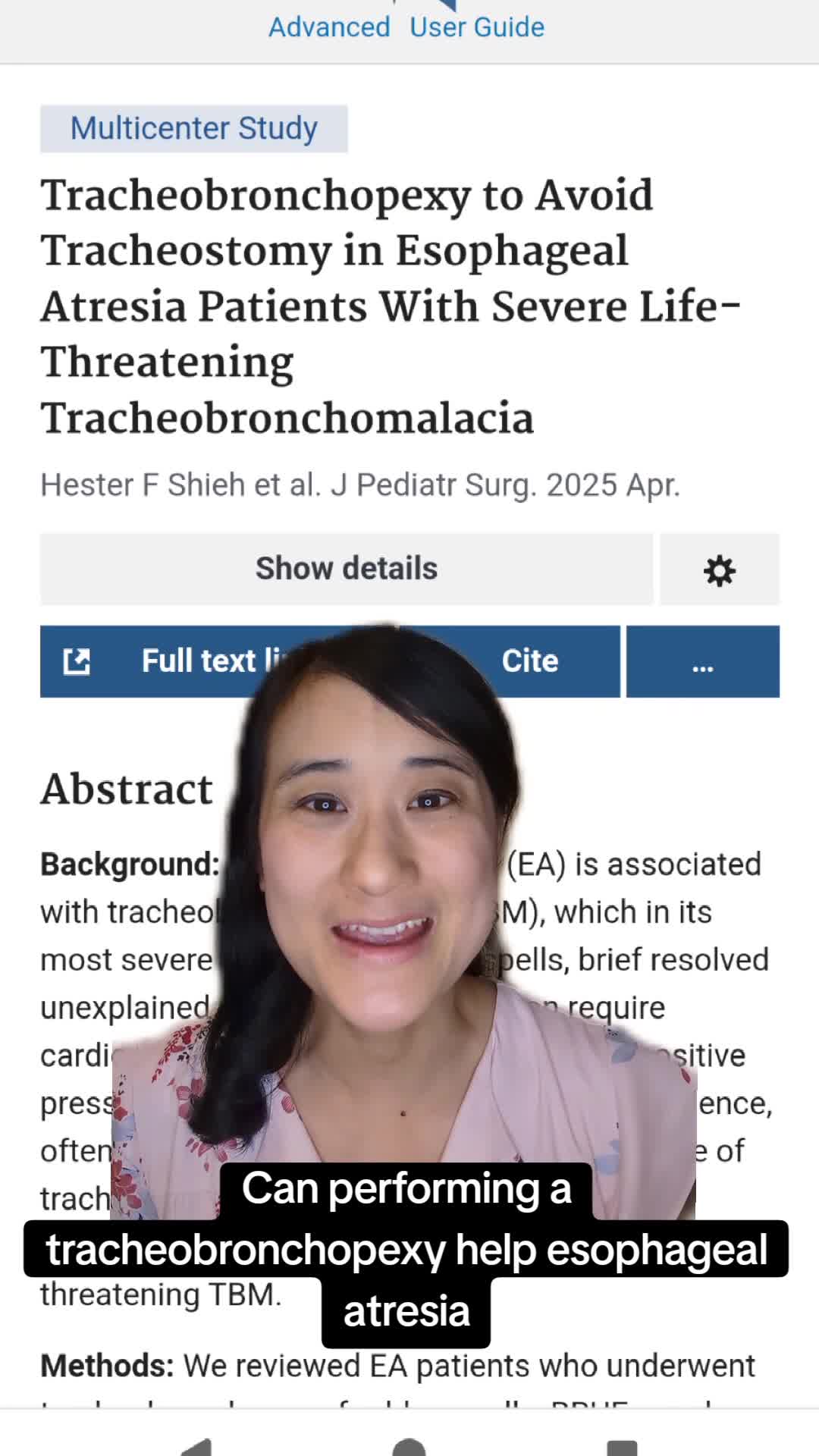
Welcome back to the Journal of Pediatric Surgery article Review podcast. I am your host Em Goddy from Cincinnati Children's, and in this episode we have three publications from the second quarter of 2025 April, May, and June issues that show how data and collaboration can drive meaningful. Change in pediatric surgery. First, we review one of the largest reported series of tracheal bronchopexies for children with severe airway collapse after esophageal atresia repair, a procedure that can make the difference between life with a tracheostomy and breathing independently. Next, we turn to Canada, where researchers have mapped pediatric surgical outreach programs across the country, revealing who gets care close to home and who's still left behind. And finally, we look at a study of more than 3000 gastrostomy tube placements using national data to identify where practice varies most and where there's room for quality improvement. As always, please check the link in the description below to read each paper. If you're ready, let's start with our first one. Tracheobronchopexy to avoid tracheostomy with severe life threatening tracheobronchoalacia from JPS April 2025 issue, and Doctor Holcomb chose this article for us to highlight. This is uh George W. Holcomb the 3rd. Uh, I'm the editor in chief of the Journal of Pediatric Surgery. Esophageal atricia repair can be a life-saving procedure, but for some children, it's only the beginning. A subset of these patients experienced severe airway collapse, leaving them ventilator dependent or suffering repeated cyanotic spells. These postoperative spells, they're really a subset of patients. That Really, there's not been a whole lot of case series on. In this paper, one of the largest such series ever published, authors reviewed outcomes for 80 children who underwent tracheal bronchopexy. I mean, 80 patients with this problem is a huge number. I think most pediatric surgeons, they won't see 10 of these patients, I don't think in their career, and many of us wouldn't see 5 of them. These patients were from two high volume centers, most of whom had type C esophageal atresia. A dynamic bronchoscopy, 90% of them showed a complete airway collapse. And 3/4 were posterior approach. And they did the tracheal bronchiopexy and thoracic trachea alone in over half the patients, but had to extend it onto the bronchi in 40% of them, and the outcomes were striking. 94% of the patients avoided tracheostomy with a mortality rate of 5%, and they had a significantly reduced the pressure ventilation and ventilator dependence. Dr. Holcomb emphasizes that these results reflect the expertise of the centers involved. This paper shows that in experienced hands, and I think that's very important, who have done numerous or hundreds of these type procedures, that you can have a very good outcome for patients with these symptoms. Like mentioned before that many pediatric surgeons may only encounter a handful of these patients in their careers. That's what makes this paper a critical benchmark. It's good to have a reference paper that shows really excellent outcomes with their approach to give this information to pediatric surgeons when they encounter such patients. With this study we saw that with experienced teams, tracheal bronchopexy can significantly improve outcomes for children with severe airway collapse after esophageal atresia repair, offering a clear benchmark for care and a model for referral to high volume centers. Let's move to the next one, pediatric surgical outreach, an underutilized resource for increasing children's surgical capacity in Canada. First, we'll hear from the JPS editor who selected this article for us to highlight. I'm Ilana Barris. I'm an associate professor of pediatrics and surgery at Drexel University College of Medicine. I work at St. Christopher's Hospital for Children in Philadelphia, Pennsylvania, and I'm the CAPS publication chair. CAAPS is the Canadian Association of Pediatric Surgeons. We also talked to the first author, Preet Bir. I'm a surgery fellow in pediatric surgery at BC Children's Hospital and the senior author of this paper. And hi, I'm Eric Skarsgard. I'm a pediatric surgeon at BC Children's Hospital where I'm also head. Of the Department of Surgery. It's interesting the philosophy about why to have outreach, and I think sometimes in the US it's about capturing your market share or trying to increase your patient volume, you know, it's sort of all revenue driven a little bit, especially if you live in a bigger city. But in this article, we noticed that in Canada, outreach is not really revenue or financially driven. It's all about providing care for patients who can't easily access care. People think of Canada as a small country because population-wise we're smaller than the state of California, but geographically Canada's the 2nd largest country in the world. You know, the majority of the population lives within 200 kilometers of the US border. There are definitely lots of children in remote communities, and it is not easy for them to access care because of multiple things. But what exactly does outrage mean in this context? We asked the study authors to define it. From our study and Canadian context. The definition is more so whether the pediatric surgery service is provided outside of the main pediatric surgery tertiary center, and it's not necessarily tied to the geographic distance or access to care. So the authors wanted to know, where is outreach happening? Who's providing it? And how far out from the tertiary centers are they really reaching? We conducted a national electronic survey of all 18 Canadian children's hospitals, and we asked each of the surgical leaders on those sites about inpatient and outpatient outreach services, including clinics and inpatient surgeries that were performed outside of the tertiary centers, and the findings were eye opening. We found that outreach services were present in only 7 out of 10 provinces, but only 8 out of 18 children's hospitals provided the outreach services. And so that was about 44% of children's hospitals in Canada. A significant number of outreach services are located within 50 kilometers of a children's hospital, leaving vast regions without access to pediatric surgical care. As a result, many families must travel hundreds or even thousands of kilometers for basic procedures. One thing that we've acknowledged that we didn't address is surgical care provided to children in remote communities by non-pediatric surgical specialists. These are practitioners who work at a children's hospital, and we do know that a number of adult specialist surgeons will care for some children. In most places in Canada, no one would ever transfer a 16 or 17 year old, quote unquote child with appendicitis to a children's hospital for surgery, physiologically and every other way. They're an adult and clearly do not need the expertise of a pediatric surge. Surgeon Access to surgical care for children in Canada is something that we've been aware that was in need of improvement for actually decades. It's maybe a misconception that the Canadian healthcare system ensures timely care. It actually doesn't. And children wait for surgery beyond their wait time target, but some provinces offer models worth replicating. I think Newfoundland and Labrador is really the best setup. There's only two pediatric surgeons out there, but one of them has been out there for a very long time. And they have outreach clinics all over the province, and they're probably the most well established and really a model to everybody else. And that's because the population of Newfoundland and Labrador is really, really rural and really spread out and geographically. And weather wise it can be impossible sometimes to access care or financially just devastating. The team also used geospatial mapping to identify the country's surgical deserts. We use the RGIS geospatial mapping to identify. Distribution of the outreach sites nationally across Canada. The study creates a national awareness of the gaps. Dr. Bra has identified in terms of what are the costs of living remote to accessible, high quality care, and there are measurable costs in terms of Time required to be seen and actual the clinical outcomes. So, the next thing I think they have to do is each province look at their waitlist, look at what their needs are, and look at where those patients are located geographically, and slowly start to say, hey, we have 100 kids on the waitlist and 20 of them happen to be. In near this town in this northern part of the city, is there a hospital or a health center there? Is there something we can partner with? I think opening the spigot a little bit on the workforce so that we could hire more pediatric surgeons in the children's hospitals, and part of their mandate would be to provide outreach care would help a lot. I think we should. Build upon all of Canada's universal healthcare. So what applies in Newfoundland and Labrador fiscally should really reflect mostly on what applies in other provinces and can really use them as a model, and I don't think you need to reinvent the wheel. While this study focuses on Canada, its message resonates everywhere. Geography can be a major barrier to timely pediatric surgical care, and mapping where outreach exists and where it doesn't. Is a critical first step towards building equitable region-specific solutions in any healthcare system. For our last paper of the day we'll talk about one of the most common procedures in pediatric surgery, gastrostomy tube placement. This paper called Identifying Quality Improvement Targets after Pediatric Gastrostomy Tube Insertion, a Nesqui pediatric pilot study from JPS June 2025 issue. Let's hear from the editor who picked this article for us to highlight. I'm Sean Kunisaki. I'm a pediatric surgeon, uh, based at Johns Hopkins Children's Center in Baltimore, Maryland. I'm also the chair of the AAP Publications Committee. AAP is the American Academy of Pediatrics. To discuss this paper, we talked to the first author. My name's Anusha Maturu. I'm a general surgery resident at Stanford Healthcare and a clinical scholar at the American College of Surgeons and the senior author. Uh, my name is Derek Wakeman. I'm an associate professor of surgery and pedia. at the University of Rochester in Rochester, New York. Gastrostomy tube or G tube insertion is just one of the most common operations performed in pediatric surgery, but until now, there wasn't really a great national clinical sample of data that captured both the care processes and outcomes that are specific to G tubes. And so to address this gap. The children's surgery team within the American College of Surgeons started to collect some G tube specific variables through the National Surgical Quality Improvement Program. This was a retrospective study. We used 71 Nisqua pediatric hospitals that participated in that G-tube pilot that started in. 2023. In this Nisquip database, 5% of all pediatric procedures were G tube. That's actually a pretty sizable percent of this. We use descriptive statistics to look at process measures, for example, how frequently an upper GI study was performed. And we also looked at outcome measures like G-tube dislodgements from 0 to 60 days, and we essentially use these descriptive statistics to look at the variability among the hospitals and looking at this degree of variability helped them determine what may be good targets for quality improvement. So, this was really the first time using a major QI database that you could actually look at outcome measures specific to GTube that people care about. I believe the study was a one year's worth of data in 2023. Authors looked at 4,612 G tube placements. We looked at a number of G tube specific variables, for example, how many G tubes were first time G tubes as opposed to redos, 77% of these cases being first-time G tubes. We also looked at some preoperative measures like whether or not an upper GI study was obtained. Upper GI studies were obtained in 45% of first-time G tube cases with substantial interhospital variability from 0 to 99%. Some heterogeneity, I think, is welcomed and appreciated, and there certainly are clinical. Indications that could explain it. The heterogeneity in terms of various things like the use of preoperative upper GIs was extremely broad, and there's really no reason to that. So that indicates a potential teaching moment. And then we have a couple of Traditional outcomes like 0 to 30 day ED visits, readmissions, 0 to 30 day dislodgements, 30 to 60 day dislodgements. The database showed that 14% of G tube cases resulted in an ED visit within 0 to 30 days and 5.2% involved G tube dislodgement. And then looking at the 31 to 60 day period, an additional 5.5 G tubes were dislodged, it is higher than the rate of readmissions or IR interventions or the other outcomes and so looking at dislodgements is, I think, another great QI target for the hospitals in the cohort and beyond. They kind of go hand in hand. If you can get dislodgements down, the ED visits go down. Of course, when the dislodgements happen that early, we tell them they have to come back to the ED. The study highlights areas where collaboration could improve outcomes, from standardizing pre-op workups to reducing early dislodgement rates. And what we did was mechanical barriers to dislodgement, a lot of education, standardizing care preoperatively, intraoperatively, postoperatively, and I think the language. In court care is also really important because if people don't understand what you're telling them, it's pretty hard for them to do what you're telling them to do. The main thing to add is just that quality improvement is possible in this space. And so I think that's part of why these variables are such good targets. Like that is, you could actually do something about them. Future modules that can better capture some of the longer term complications, I think is something that is worthy to explore in these kinds of studies. So, if you're a participant in NSCO Pediatric and or a participant in the PSQC keep an eye out for these exciting G2QI projects that will hopefully improve children's surgical care and provide collaborative benefits and tools and resources. Today we covered some impactful and practice changing research. First we examined how tracheal bronchopexy, when performed by experienced teams, can dramatically improve outcomes for children with severe airway collapse after oesophageal atragia repair. Then we explored a national survey mapping pediatric surgical outreach across Canada, highlighting where access is strong, where it falls short, and how geospatial data can guide expansion to underserved communities. Finally, we reviewed a large multi-institutional analysis of gastrostomy tube placements that revealed key variations in practice and complications, pointing the way towards standardization and collaborative quality improvement efforts in one of the most common pediatric procedures. Thanks for joining us. We hope you liked this episode. Please follow Stay Current MD on social media, give us a rating, and subscribe to the YouTube channel. And don't forget to download the Stay Current app on the App Store or Play Store for tons of content. Global Cat MD along with Cincinnati Children's Hospital, sharing knowledge to improve child health around the globe.
Comments