
Neuroblastoma
With Dr. Dan Von Allman & Dr. Erica Newman & Dr. Tony Sandler · hosted by Dr. Ray Hanke & Dr. Todd Ponsky · StayCurrentMD
Cued at 2:32 · stops at 3:17 · press play
Educational content from recorded physician discussions — not medical advice. Talk to your (or your child's) care team about your situation.
Video
Neuroblastoma
CCHMC Pediatric Surgery · Published May 2020
Podcast
Topics in 10: Neuroblastoma
10 min · Published Sep 2019
Video
Management of Asymptomatic Lung Lesions: Pediatric Thoracic Surgery Part...
Dr. Todd Ponsky · 20 min · Published Jul 2017
Video
Neuroblastoma with Dr. Meera Kotagal
14 min · Published Sep 2024
Video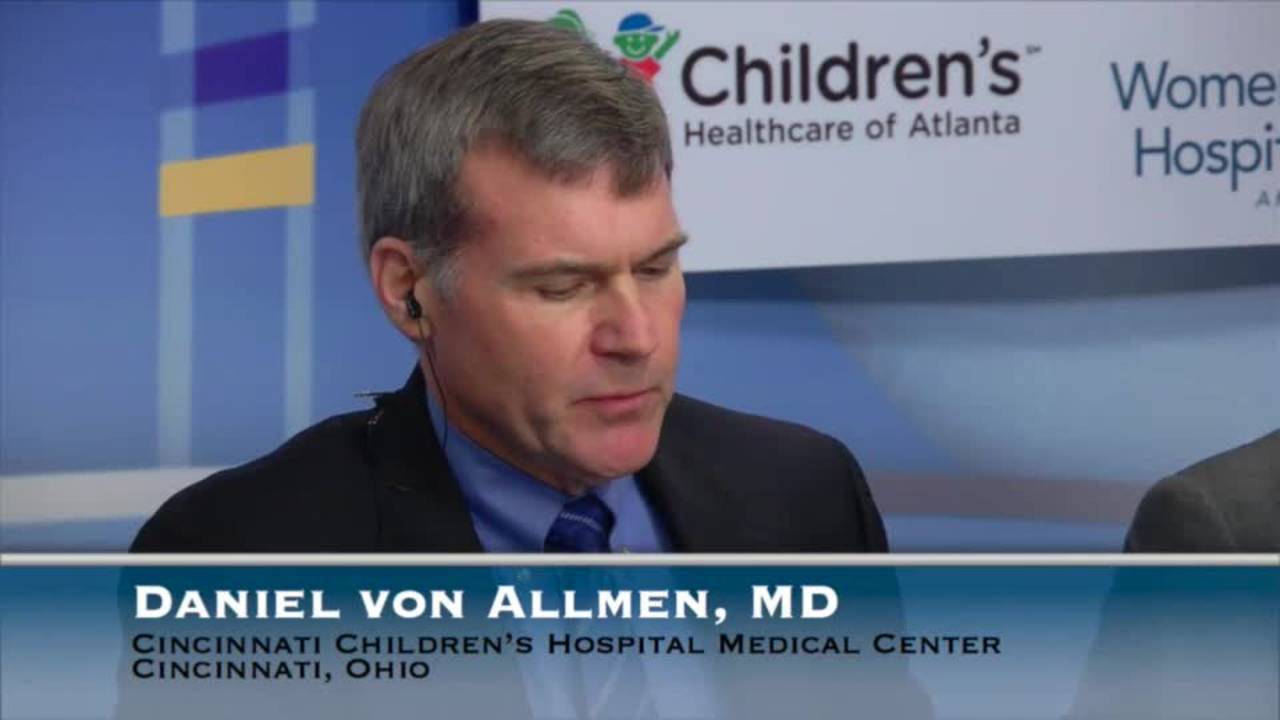
Neuroblastoma: Update Course 2016
CCHMC Pediatric Surgery · 25 min · Published Jul 2017
Video
Postnatal Management of Lung Lesions Part III: Pediatric Thoracic Surgery...
Dr. Todd Ponsky · 27 min · Published Aug 2017
Only a few other public items share this expert — go deeper there →
Video
Pediatric Surgical Oncology Research Collaborative (PSORC): Studying Rare Pediatric Tumors
56 s · Published May 2026
Video
Update Course Rewind 2025: Hirschsprung + ARM: Rare but Real
1 min · Published May 2026
Video
Update Course Rewind 2025: Hirschsprung + ARM: Rare but Real
1 min · Published May 2026
Video
Pooling Patients to Study Rare Pediatric Tumors: An Introduction to PSORC
56 s · Published May 2026
Video
The fetal frontier: A review of current and emerging fetal therapies for genetic diseases
44 s · Published May 2026
Video
Indocyanine green assists with sentinel lymph node mapping in pediatric and adolescent patients
1 min · Published May 2026
What the experts said
Adrenal hemorrhage is the most common cause of prenatal suprarenal mass, especially with history of fetal stress
Familial neuroblastoma occurs in approximately 1% of patients
The GetNucturne study showed that prenatal/neonatal neuroblastomas can be safely observed with careful ultrasound surveillance, with many patients spared surgery
In the GetNucturne observation study of 84 patients, 16 (approximately 20%) underwent resection for growth or family preference, with 98% event-free survival and 100% overall survival
Surveillance protocol for observed neonatal masses: ultrasound and catecholamines at birth, 3 weeks, 6 weeks, 12 weeks, then spacing out through first year, then every 6 months, then yearly
Five centimeters is the size cutoff where most experts recommend surgical resection of neonatal neuroblastoma
Criteria for surgery in observed neonatal neuroblastoma: >50% volume increase or >50% increase in VMA or HVA
Lymph node status in neuroblastoma does not change therapy, unlike Wilms tumor
Stage MS (formerly 4S) neuroblastoma with liver and skin metastases in neonates has good biology and can be observed unless respiratory compromise develops from hepatomegaly
Treatment options for MS neuroblastoma with respiratory compromise include chemotherapy, radiation, or emergent decompressive laparotomy
Approximately 10% of neuroblastomas are not MIBG-avid, which is when PET scan may be useful
Open biopsy via retroperitoneal approach allows adequate tissue for NMEC amplification, ALK mutation, ploidy, and 11q status
Approximately 50% of children's hospitals now use percutaneous biopsy for suspected neuroblastoma
Percutaneous biopsy is equivalent to open biopsy for diagnosis and NMEC determination but may fail for 11q loss of heterozygosity assessment
Optimized percutaneous biopsy technique requires 10-12 cores, higher gauge needle, and pathologist present for frozen section to confirm viable tumor
Open biopsy patients have higher risk of blood transfusion, higher narcotic use, and more frequent hospital admission compared to percutaneous biopsy
NMEC amplification automatically means high-risk neuroblastoma regardless of other factors
Loss of heterozygosity at 11q is the most common segmental chromosomal alteration in neuroblastoma and can elevate risk category
Age cutoff for neuroblastoma risk stratification is 18 months (previously was 12 months)
High-risk neuroblastoma patients require double-lumen external catheter (not port) for bone marrow transplant
After 5-6 cycles of chemotherapy, neuroblastomas become more fibrotic and harder to resect
Tumor shrinkage in neuroblastoma plateaus after cycle 2-3 of chemotherapy per LaQuaglia and Von Allman studies
COG high-risk study showed >90% resection improved event-free survival but not overall survival (approximately 245 patients)
European neuroblastoma group study (approximately 1000 cases) showed >90% resection improved both event-free survival and overall survival
Stem cell harvesting for high-risk neuroblastoma typically occurs after cycle 2 of chemotherapy
Approximately 70% of high-risk neuroblastoma patients can achieve >90% resection
Recent German/European publication stated unequivocally that extent of resection does not make a difference in neuroblastoma outcomes
High-risk neuroblastoma patients die of metastatic disease, not local disease recurrence
Neuroblastoma theoretically does not invade vessel adventitia, though invasion has been observed
There is zero correlation between surgeon operative note description of resection extent and post-operative imaging findings
Nephrectomy should be avoided in neuroblastoma resection because kidney removal requires chemotherapy dose reduction
Anti-GD2 monoclonal antibody improved high-risk neuroblastoma two-year survival from 46% to 60%
Checkpoint inhibitors have not been successful in neuroblastoma because it is not an immunogenic tumor