
Colorectal Cancer
With Dr. Conor Delaney · hosted by Dr. Jeffrey Ponsky · Jeffrey Ponsky
Cued at 9:03 · stops at 9:48 · press play
Educational content from recorded physician discussions — not medical advice. Talk to your (or your child's) care team about your situation.
Podcast
Colorectal Cancer
Jeffrey Ponsky · 26 min · Published Jun 2016
Podcast
Colorectal Cancer
Jeffrey Ponsky · 26 min · Published Jun 2016
Video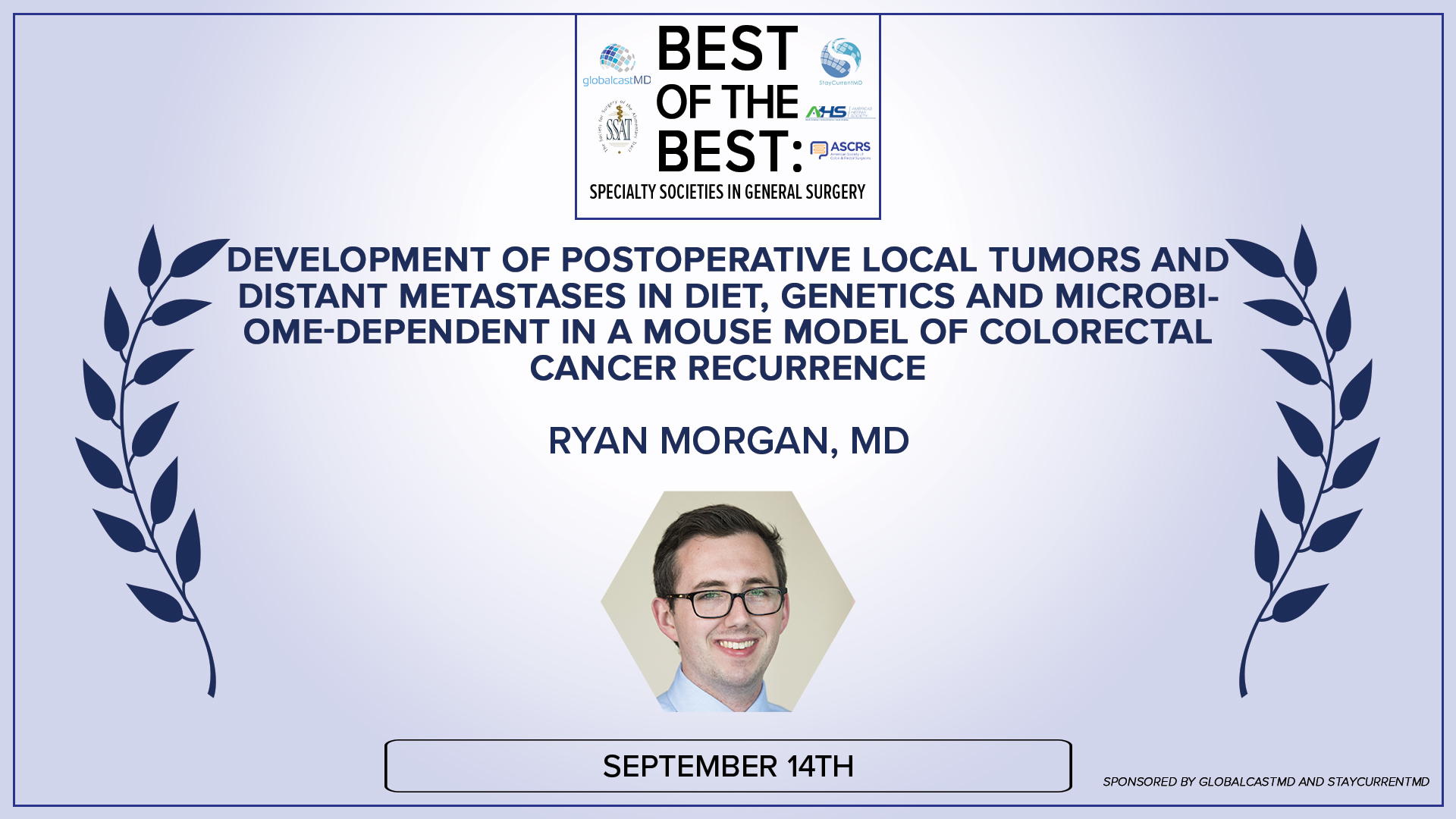
Best of the Best Gen Surg - Development of postoperative local tumors and distant metastases in diet, genetics and microbiome-dependent in a mouse model of colorectal cancer recurrence - Dr. Morgan
12 min · Published Sep 2022
Podcast
Long-term obstetric and gynecologic care for patients with anorectal malformations
21 min · Published Sep 2026
Video
V119 Use of transoral incisionless fundoplication for recurrent reflux after foregut surgery
Jeffrey Ponsky · Published Jul 2026
Video
From Idea to Ubiquity
Jeffrey Ponsky · Published Jul 2026
Video
Intra-operative Bile Leak During Cholecystectomy
Jeffrey Ponsky · Published Jul 2026
Video
Acute Cholecystitis
Todd Ponsky · Published Jul 2026
Podcast
Behind The Knife: The Surgery Podcast / Innovations in Surgery: PEG Tube
Jeffrey Ponsky · Published Jul 2026
Podcast
Spotify – Web Player
Jeffrey Ponsky · Published Jul 2026
Only a few other public items share this expert — go deeper there →
Video
Jeffrey L. Ponsky Master Educator in Endoscopy
Jeffrey Ponsky · Published Jul 2026
Podcast
Butts & Guts
Jeffrey Ponsky · Published Jul 2026
Video
StayCurrent Forums
Jeffrey Ponsky · Published Jul 2026
Video
V119 Use of transoral incisionless fundoplication for recurrent reflux after foregut surgery
Jeffrey Ponsky · Published Jul 2026
Video
StayCurrent Forums Trailer
Jeffrey Ponsky · Published Jul 2026
Podcast
Update Course Rewind: Pediatric Biliary Stones - Preventing Gallstone Pancreatitis 2024
Jeffrey Ponsky · 3 min · Published Aug 2025
What the experts said
Colonoscopy is still the best test for colon cancer detection, with approximately 90-95% accuracy for finding cancers and polyps, though not perfect.
Serrated adenomas (previously misclassified as hyperplastic polyps) have a very high risk of cancer and are associated with genetic predisposition and family cancer syndromes.
Serrated adenomas require family assessment, may necessitate altered colonoscopy frequency, and family members may need colonoscopy or other testing.
Serrated polyps are often flat and difficult to see; retroflexion in the cecum is useful because they are often on the inferior or superior side of the valve or on folds.
For rectal cancer, distal margin requirements are 5 cm if achievable, 2 cm if achievable, and for very low tumors 1 cm is acceptable as long as they are not poorly differentiated.
Six centimeters from the anal verge can mean different things depending on patient size: in a small elderly female it may be mid-rectum, while in a large male it can be near the dentate line.
Upper third rectal cancers likely do not need preoperative therapy or stoma, while middle and lower third cancers have a good chance of needing neoadjuvant therapy and temporary or rarely permanent stoma.
Distant staging for rectal cancer is best done with CT abdomen for liver assessment and CT chest (now preferred over chest x-ray per most guidelines).
MRI with high-resolution, high Tesla magnet and standardized protocol (developed by Bill Heald and Gina Brown at Royal Marsden) is now the standard for local staging of rectal cancer.
MRI is approximately 90-95% accurate for T staging and high 80s to 90% accurate for nodal staging in rectal cancer.
Historical local recurrence rates for rectal cancer from good institutions were 20-38%, with some up to 50%, but with optimized surgery and imaging should now be under 10%.
Cleveland Clinic's local recurrence rate for rectal cancer over the last 10 years was approximately 3%.
Circumferential resection margin is the most important margin in rectal cancer surgery; a negative pathological margin results in low chance of local recurrence.
Total mesorectal excision (TME) can be performed with about 5 mL of blood loss because it is a bloodless plane; bleeding indicates being outside that plane or deliberately in the wrong plane.
Endoscopic ultrasound is only about 70% accurate for predicting nodal involvement in rectal cancer and is much more operator dependent than MRI.
Neoadjuvant therapy is indicated for rectal tumors that are T3 (outside the wall) or node positive.
Stage I rectal cancer (node negative and T1 or T2), particularly if upper third, does not require preoperative radiation.
Historical local recurrence rates for transanally excised rectal cancers were approximately 18%, remarkably consistent across several major centers.
Transanal resection is appropriate for tumors less than one-third circumference, ideally less than 2 cm, that are T1.
For young, curable patients, radical resection is generally favored over transanal resection; transanal approaches are reserved for patients unfit for rectal resection or those whose tumor location would require permanent stoma.
Rectal cancer requires full-thickness excision; endoscopic submucosal dissection (ESD) would never be used for proven or high-risk cancer, only for benign polyps.
Short-course radiation (5×5 Gy over 5 days, surgery 1-2 weeks later) is preferred in Europe, while long-course chemoradiation (40-45 Gy over 6 weeks with 6-8 week wait) is preferred in the U.S.
25 Gy over a short period is radiotherapeutically equivalent to 40-45 Gy over a longer period, but long-course therapy produces greater tumor downstaging and is preferred for bulky tumors.
For colon cancer, surgeons should aim for at least 12 lymph nodes, though many hope for at least 16.
High ligation of the inferior mesenteric artery (above the takeoff of the left colic artery) is performed in sigmoid colectomy, with protection of autonomic nerves to preserve sexual function.
Total mesocolic excision should be performed in the plane between Toltz fascia (retroperitoneal embryological peritoneum) and the mesocolon peritoneum, achieving complete mesocolic specimen with minimal blood loss.
Scandinavian data showed local recurrence rates for colon cancer were higher than for rectal cancer (despite rectal rates of high 20s) because adequate colon cancer surgery technique was not being performed.
For mid-sigmoid cancer (35-40 cm), resection can extend from mid-descending colon to rectosigmoid junction without necessarily taking the splenic flexure, provided there is good vascularity with pulsatile flow.
For cecal tumors, 10 cm of small bowel should be taken; for mid-ascending colon tumors, 5 cm of small bowel is adequate.
Extracorporeal stapled anastomosis through the extraction site for laparoscopic right colectomy has achieved leak rates of 0.8% over 1,000 cases at Cleveland Clinic.
Cleveland Clinic has a low threshold for genetic assessment, consulting coordinators when patients meet Bethesda criteria, have first-degree relatives with cancer, young family members with cancer, or multiple cancers in the family.
Genetic diagnosis may change the surgical approach: patients with multiple polyps or significant family history may be better served with subtotal colectomy (ileosigmoid or ileorectal anastomosis) rather than segmental resection.