
Cardiopulmonary Impact of the Minimally Invasive Repair of Pectus Excavatum in Pediatric Patients: A Prospective Pilot Study
hosted by Dr. Lizzie Lee · StayCurrentMD
Part of
Pectus Excavatum 58 items
Cued at 0:24 · stops at 1:09 · press play
Educational content from recorded physician discussions — not medical advice. Talk to your (or your child's) care team about your situation.
Video
Novel index to estimate the cephalocaudal extent of the excavation in pectus excavatum - JPS article
1 min · Published May 2023
Video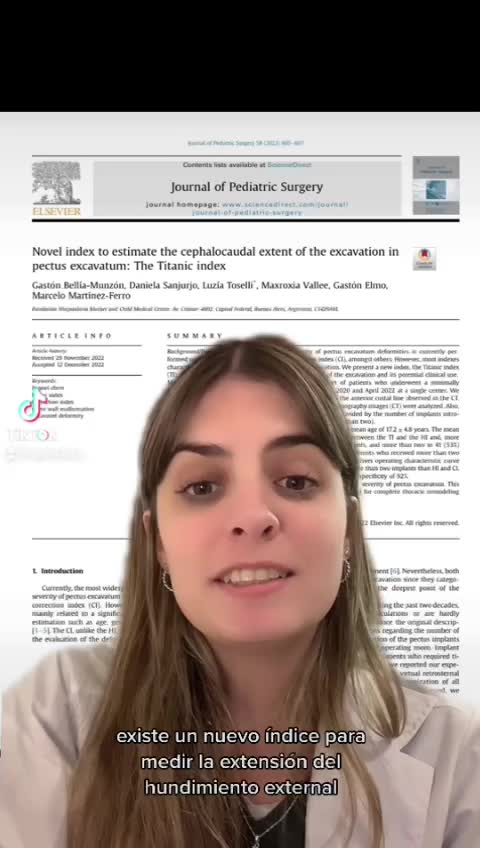
Novedoso indice para estimar la extensión cefalocaudal del hundimiento esternal en el pectus excavatum: El Índice Titanic
Published May 2023
Video
Quick Literature Updates Episode 13
4 min · Published Nov 2023
Video
Impact of Cryoanalgesia Use During Minimally Invasive Pectus Excavatum Repair on Hospital Days and Total Hospital Costs Among Pediatric Patients
59 s · Published Jan 2024
Video
BOB Ped Surg 2023 - Brittany Hegde, PAPS - Presentation
Published Feb 2023
Video
Criteria for Pectus Repair: Update Course 2015
55 s · Published Nov 2015
Video
Pediatric Surgical Oncology Research Collaborative (PSORC): Studying Rare Pediatric Tumors
56 s · Published May 2026
Video
Update Course Rewind 2025: Hirschsprung + ARM: Rare but Real
1 min · Published May 2026
Video
Pooling Patients to Study Rare Pediatric Tumors: An Introduction to PSORC
56 s · Published May 2026
Video
The fetal frontier: A review of current and emerging fetal therapies for genetic diseases
44 s · Published May 2026
Video
Indocyanine green assists with sentinel lymph node mapping in pediatric and adolescent patients
1 min · Published May 2026
Video
Tricuspid valve surgery in transposition of the great arteries with a systemic right ventricle
46 s · Published May 2026
What the experts said
This was a prospective pilot study
Study included patients under 18 who had cardiopulmonary exercise testing before minimally invasive repair of pectus excavatum and then after removal of their pectus bar
25 patients total completed both tests
Results showed a significant improvement in O2 pulse after the repair
O2 pulse is a measure of how much oxygen the heart pumps per beat
Improved O2 pulse suggests better heart function after the repair
The improvement may reflect relief of cardiac compression that was present preoperatively due to pectus excavatum
Minimally invasive repair of pectus excavatum does appear to improve heart performance during exercise