
Pain Management: Pectus Innovations
With Dr. Centel Sadai · StayCurrentMD
Cued at 44:26 · stops at 45:11 · press play
Educational content from recorded physician discussions — not medical advice. Talk to your (or your child's) care team about your situation.
Video
Pectus Excavatum Pain Management at Cincinnati Children's Hospital
CCHMC Pediatric Surgery · 54 min · Published Nov 2018
Podcast
Chest Wall Deformities with Dr. Robert Kelly
46 min · Published Jan 2017
Podcast
Chest Wall Deformities with Dr. Robert Kelly
46 min · Published Jan 2017
Video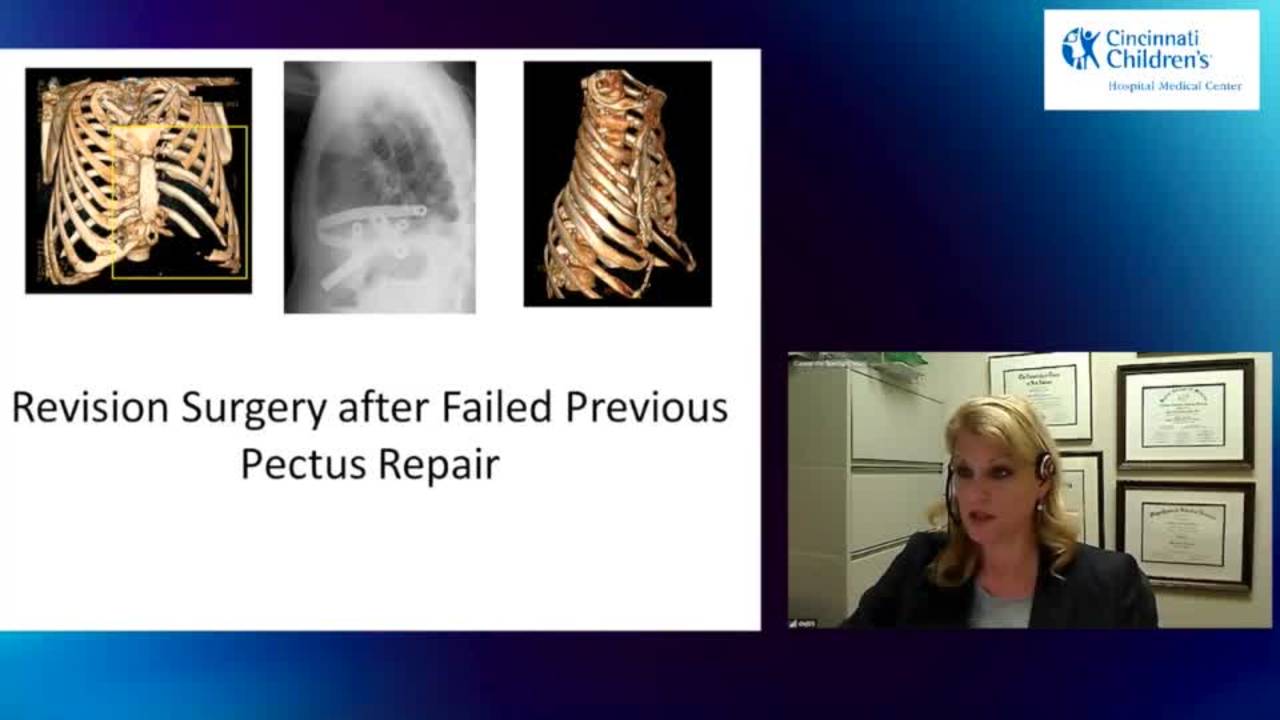
Pectus - Surgical Approaches for Failed Repair
44 min · Published Nov 2018
Video
Pectus-Patient Testimonial and Experience
CCHMC Pediatric Surgery · 14 min · Published Mar 2022
Video
Interesting Cases & Surgical Approaches: Pectus Innovations
44 min · Published Oct 2015
Only a few other public items share this expert — go deeper there →
Video
Pediatric Surgical Oncology Research Collaborative (PSORC): Studying Rare Pediatric Tumors
56 s · Published May 2026
Video
Update Course Rewind 2025: Hirschsprung + ARM: Rare but Real
1 min · Published May 2026
Video
Update Course Rewind 2025: Hirschsprung + ARM: Rare but Real
1 min · Published May 2026
Video
Pooling Patients to Study Rare Pediatric Tumors: An Introduction to PSORC
56 s · Published May 2026
Video
The fetal frontier: A review of current and emerging fetal therapies for genetic diseases
44 s · Published May 2026
Video
Indocyanine green assists with sentinel lymph node mapping in pediatric and adolescent patients
1 min · Published May 2026
What the experts said
Nothing is as good as epidural analgesia for pectus patients; On-Q pumps come second to epidural.
More than 95% of Cincinnati's pectus patients do not get a PCA along with epidural.
Older patients and young adults have more pain after pectus repair because of chest wall rigidity.
Patients with Ehlers-Danlos syndrome have extensive pain and often have pain even before surgery.
Most neurological risk with epidural in children is from hypoperfusion of spinal cord, not from traumatic placement.
On-Q pump outcomes depend on multiple factors: catheter size and length (5 cm too short, 7.5 cm better), introducer width (wider causes backflow leak), delivery rate, and location.
Most On-Q data in thoracic surgery is from thoracotomy with subpleural tunneling, making it hard to extrapolate to pectus applications.
Exparel (liposomal bupivacaine) is safer than plain local anesthetic because the treatment for local anesthetic toxicity is intralipid, and Exparel is already in intralipid.
In Cincinnati's donor nephrectomy experience with Exparel TAP blocks, patients go off PCA one day earlier, have less opioid-related adverse effects, and use less opioids.
Exparel is not approved for pediatric use by the FDA.
Some patients have localized reactions to Exparel impressive enough to require steroids, lasting 3 days.
Cincinnati allows patients with epidurals to walk inside the room and outside with help; Foley catheters are removed the next day after surgery.
Cincinnati's surgical pain service sees patients minimum 3 times daily (morning, afternoon, evening rounds) and is available 24/7.
About 20-30% of pectus patients experience chronic persistent post-operative pain, defined as pain score of 3 or more two months after surgery.
If a patient is on 5 days in a row of oxycodone or any other opioid, the risk of dependence goes up significantly.
Cincinnati takes 10-15 minutes to place an epidural and achieves more than 95% success rate.
With a good working epidural, Cincinnati sees zero pain scores immediately after surgery in the first 2-3 days, which was unheard of 10-15 years ago.
Cincinnati uses local anesthetic-only epidural solution which does not cause urinary retention and is very dermatomal, blocking only thoracic dermatomes.
Most Cincinnati pectus patients go home on the 3rd or 4th day after surgery.
Cincinnati's epidural success rate is more than 95%, and the number of patients needing PCA on top of epidural is now less than 5% (was 14% in 2013).
Cincinnati uses IV methadone at lower doses (5 mg max) than adults (15-20 mg) because higher doses caused too much sedation in teenage pectus patients.
Methadone can cause prolongation of QT interval with reports of ventricular arrhythmias, so Cincinnati monitors with EKG to ensure QT doesn't exceed 480 milliseconds.
The number of Cincinnati patients needing any IV opioid in the first 2-3 days when they have epidural is less than 5%.
Cincinnati stops epidurals at 6 AM on post-op day 3 without weaning (from 8 mL/hour to zero immediately).
The advantage of not using opioids in epidural solution is minimal; opioids cause more problems (itching, urinary retention) than benefit. Clonidine can provide the same pain relief without those side effects.
Cincinnati uses high concentration ropivacaine (0.2%) for epidural; lower concentrations (0.12% or 0.15%) don't provide adequate pain relief.
About 50% of Cincinnati's pectus patients get constipation the moment oxycodone is started.
Naloxegol is a medication similar to naloxone that doesn't cross the blood-brain barrier, so it relieves opioid-induced constipation without reversing analgesia.
In spine surgery patients (equally or less painful than pectus) who get PCA instead of epidural, about 15% have respiratory depression (respiratory rate <8, oxygen saturation <90%) despite multimodal analgesia.
Thoracic surgery including pectus is considered high risk for persistent post-operative pain; about 20-30% of pectus patients develop chronic pain (pain score >3 at 2 months post-op).
When pain is managed without regional anesthesia, the barrage of noxious stimuli to the brain precipitates neuroplasticity, causing the brain to remember pain long-term (6-12 months after surgery).
Higher amounts of preoperative opioid use increase the risk for persistent pain; high opioid doses turn down opioid receptor genes, which is connected with persistent pain.
Cincinnati performs preoperative CYP2D6 genetic testing; saliva or blood sample taken at surgical clinic, results available in EPIC within 2 days, covered by most insurance.
CYP2D6 is the major liver enzyme that metabolizes most oral opioids including codeine, tramadol, oxycodone, and hydrocodone.
Ultra-rapid metabolizers are not good candidates for codeine, tramadol, or hydrocodone, but they are okay with morphine and hydromorphone.
Cincinnati can reliably predict who will have respiratory depression by looking at their genes and genetic signature.
In Cincinnati population, only 1-2% are ultra-rapid metabolizers; in African American and especially Ethiopian populations, ultra-rapid metabolizers can be as high as 29%.
The FDA has warned against use of codeine following tonsillectomy; tramadol and hydrocodone warnings are under FDA review.
Among currently available opioids, oxycodone is the least affected by CYP2D6 metabolism.
Even extensive metabolizers (normal population) are at high risk for sedation and respiratory depression if they have coexisting morbidity like asthma or sleep apnea.
Sedation always precedes respiratory depression; Cincinnati nurses monitor sedation using Ramsay sedation scale every shift to prevent respiratory depression.
Cincinnati has not used naloxone for any pain patients in more than 3 years despite using maximum opioid amounts, attributed to aggressive monitoring.
The 50-gene genetic panel costs $50; CYP2D6 testing costs less than $1 per gene.
One gene (fatty acid amide hydrolase) associated with nausea, vomiting, and prolonged PACU stay saves more than $100 per patient when used to guide dosing, exceeding the cost of genotyping.
Intercostal blocks are still good and better than nothing for preemptive pain control, but may miss one or two intercostal nerves and don't provide pain relief as good as epidural.
Higher concentration of local anesthetic is better for preemptive analgesia, which is why Cincinnati places epidurals before surgery with high-concentration ropivacaine.
Seattle Children's Hospital has gone from epidural to On-Q pump recently and is having some issues.
Recent literature shows that if a child and their parent have pain catastrophization (anticipating negative outcomes), they are more likely to have more pain after surgery.
There is evidence in medical literature that meditation benefits include minimizing pain, anxiety, and improving immune function after surgery.
A meta-analysis of 6 studies published last year found that compared to PCA, epidural provided better pain control the first 2 days after pectus repair.
Two studies from Kansas with 22% and 35% epidural failure rates showed epidural didn't help relieve pain as well as PCA, likely due to poor epidural placement success.
There is evidence that if you give pregabalin or gabapentin one hour before surgery, it decreases pain after surgery significantly and need for opioid is significantly less.
Mark Saxton reports that without routine Foley catheters, 1 in 7 pectus patients need to be catheterized for urinary retention.
There is evidence that if you use even one dose of methadone in the OR, it cuts back on opioid use significantly and improves pain control in the next two days.
Children and young adults have higher risk of persistent post-operative pain than elderly patients.
Seattle studies show that if a child doesn't sleep well before surgery (disturbed sleep, short duration), they are at high risk for persistent pain.
There is evidence that codeine, tramadol, and hydrocodone are not safe in ultra-rapid metabolizers.