
 Dr. Jeffrey Ponsky
DVT
Everything in the library about DVT — built automatically from the recorded discussions that name it
Educational content from recorded physician discussions — not medical advice. Always talk to your child's care team about your child's situation.
Content of this collection
Acute Management
2 items

Venous Thromboembolism Prophylaxis In Trauma Patients: Practice Gap...
Watch →
At the 6th Annual Pediatric Surgery Update Course, Drs Charles Snyder, Craig Lillehei and David Powell discussthe top ten practice gaps of 2018. Here they discuss venous thromboembolism prophylaxis in the trauma patient, focusing on VTE ris
video10:38 · Sep 2018
Update Course Rewind: DVT Prophylaxis 2024
Watch →
In this recap from the 12th Annual Pediatric Surgery Update Course, Drs. Regan Williams and Katie Russell delve into the latest approaches to deep vein thrombosis (DVT) prophylaxis in pediatric trauma patients. Learn when to start chemical
video · Nov 2024
Complications
1 item

Pediatric Vascular Access
Listen →
podcast35:43 · Nov 2022
Evidence & Research
3 items
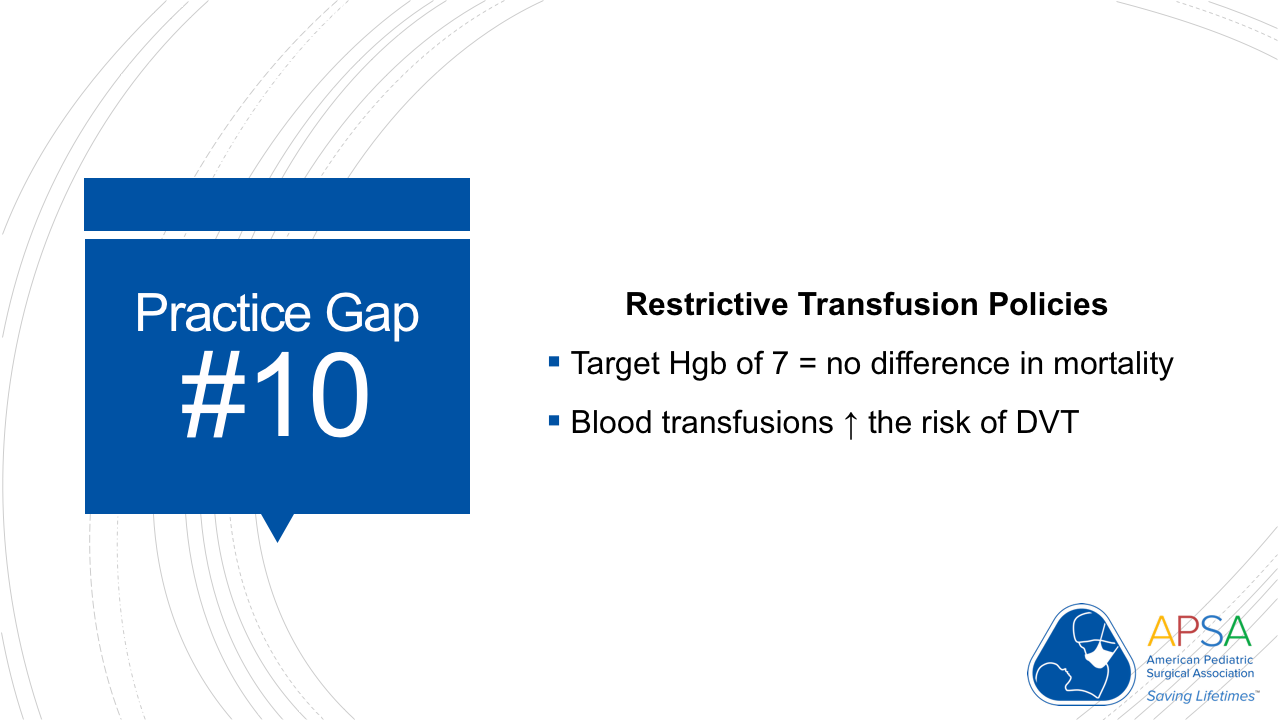

Restrictive Transfusion Policies: 2018 Pediatric Surgery Practice Gap #10
Watch →
Drs Todd Ponsky, Alex Casar, Alex Gibbons and Rae Hanke review Practice Gap #10 from 2018, as identified by APSA's Professional Development Committee.
video · Jun 2019
Journal Club: Review of 2018 Pediatric Surgery Practice Gaps
Watch →
Drs Todd Ponsky, Alex Casar, Alexander Gibbons and Rae Hanke review the top ten practice gaps from 2018, as identified by APSA's Professional Development Committee.
video · Aug 2019
APSA 2018 Practice Gaps
Watch →
At the 7th Annual Pediatric Surgery Update Course, Drs Rae Hanke, Alexandra Casar Berazaluce and Alexander Gibbons recap the 2018 practice gaps identified by the American Pediatric Surgical Association’s Professional Development Committee.
video · Mar 2020
Summaries and takeaways+ Show
The doctors in this collection+ Show
All expert statements+ Show
Every expert statement below comes from the recorded discussions, with its speaker and moment.
Venous Thromboembolism Prophylaxis In Trauma Patients: Practice Gap...
Pediatric surgeons historically did not routinely address VTE prophylaxis, with general teaching some time ago being that kids just didn't get this problem.
opinionTodd Ponsky0:31 ↗
Recognition of pediatric VTE has increased significantly over the last 10-20 years, possibly to the point of overuse (e.g., SCDs for 30-minute inguinal hernia repairs).
opinionTodd Ponsky0:31 ↗
The Midwest Pediatric Surgery Consortium is conducting a multi-center study (at 11 centers) of a standardized VTE prophylaxis protocol involving chemoprophylaxis with antithrombin 1A, compression devices, and daily ultrasound evaluation.
clinical2:55 ↗
The number of DVT complications in pediatric patients is very small but catastrophic when they occur.
epidemiological2:55 ↗
The vast majority of pediatric DVTs occur around central lines, and all central lines have a fibrin sheath if examined closely.
clinical3:56 ↗
The theoretically correct answer for the case is screening ultrasound on ICU day 7, because pharmacologic prophylaxis is contraindicated due to significant head bleed.
host_summaryTodd Ponsky4:37 ↗
A 2017 seminars summary by Dr. Perry (current chair of the Abstinence trauma Committee) provides a comprehensive review of pediatric VTE prophylaxis in trauma.
host_summaryTodd Ponsky4:37 ↗
VTE incidence in pediatric trauma patients is estimated between 0.16% and 1%, probably on the order of 1% or less in general.
host_summaryTodd Ponsky4:37 ↗
In adult trauma patients, VTE incidence is about 3-5%.
host_summaryTodd Ponsky4:37 ↗
In adult neuro trauma patients, VTE incidence is significantly higher at 10-15%.
host_summaryTodd Ponsky4:37 ↗
Pediatric VTE risk factors include central catheters, inflammatory bowel disease (chronic inflammatory states), blood transfusion, and obesity.
host_summaryTodd Ponsky4:37 ↗
According to the Landish schema, high-risk patients are defined as those greater than 12 years with one or more risk factors, or less than 12 years with more than 4 risk factors.
host_summaryTodd Ponsky4:37 ↗
For high-risk patients without bleeding concerns, treatment is low molecular weight heparin plus SCDs until ambulatory.
host_summaryTodd Ponsky4:37 ↗
For high-risk patients who are not candidates for pharmacologic prophylaxis, treatment is SCDs until ambulatory plus screening ultrasound on day 7.
host_summaryTodd Ponsky4:37 ↗
SCDs should be activated prior to induction of anesthesia in the operating room.
guideline8:30 ↗
The Landish article (David Gourlay's article) is probably the best protocol available for pediatric VTE prophylaxis and forms the basis for the MWPSC multi-center study.
opinion10:00 ↗
Pediatric Vascular Access
In micro-preemies (1000g to 2kg), a 3-French soft silastic catheter is preferred because larger catheters as big as the vessel can cause vessel thrombosis.
clinicalMark Wulkan1:30 ↗
Needle-hole venotomy technique: isolate the internal jugular vein, make a needle hole with the kit needle, and slide the pre-tunneled catheter into that hole without ligating the vein, preserving it for future access.
clinicalMark Wulkan2:33 ↗
Beveling the catheter end is associated with slightly more catheter thrombosis than cutting straight across, but may be worth it to preserve the vein in micro-preemies.
clinicalMark Wulkan3:23 ↗
The atrial-caval junction is actually much deeper on chest X-ray than most surgeons think, not at the visible indentation where the silhouette widens.
host_summaryMark Wulkan9:13 ↗
A 2013 JACS study by Sanj Dutta, Sean St. Peter and others showed ultrasound guidance achieved first-stick success in 65% of patients versus 45% with landmark technique, and 95% success by three attempts versus 74%.
host_summaryMark Wulkan10:25 ↗
In the adult literature, the number of needle sticks is a good proxy marker for the risk of complications.
host_summaryMark Wulkan11:25 ↗
Subcutaneous ports (port-a-cath, meta-port) are used for most intermittent chemotherapy; cuffed lines (Broviac) are used for highly toxic agents like Adriamycin that cause tissue necrosis if infiltrated.
guidelineMark Wulkan13:36 ↗
Bone marrow transplant patients often require three lumens: a double-lumen perm-cath plus a single-lumen line.
clinicalMark Wulkan14:32 ↗
The smallest mini-port available is 5-French and can be placed in a 7-8 kg infant, though it requires special order.
clinicalMark Wulkan14:57 ↗
MRV is the gold standard for pre-operative vascular imaging in patients with multiple prior lines or history of DVT.
guidelineMark Wulkan15:34 ↗
A glide wire can sometimes pass through venous thrombosis when a standard wire cannot, finding a channel through the clot.
clinicalMark Wulkan17:53 ↗
Femoral lines in babies often result in leg swelling and DVT, so they are avoided in that population.
clinicalMark Wulkan22:03 ↗
Institutional heparin lock protocol: 10 units/mL for accessed lines (ports or cuffed lines), 100 units/mL for buried ports, and 1000 units/mL for dialysis catheters (which is withdrawn before use).
guidelineMark Wulkan24:40 ↗
Ethanol lock therapy has substantially decreased line removal rates and has very high success rates for treating line infections.
clinicalTodd Ponsky25:31 ↗
What's new+ Show