14 views 0 likes

StayCurrentMD

GCMD Space · View profile →

Wilms Tumor Rapid Fire: Update Course 2015

Video Published 2019-01-11 Updated 2026-06-25

Timestops (23)

0:00
Symposium for the rapid fire session
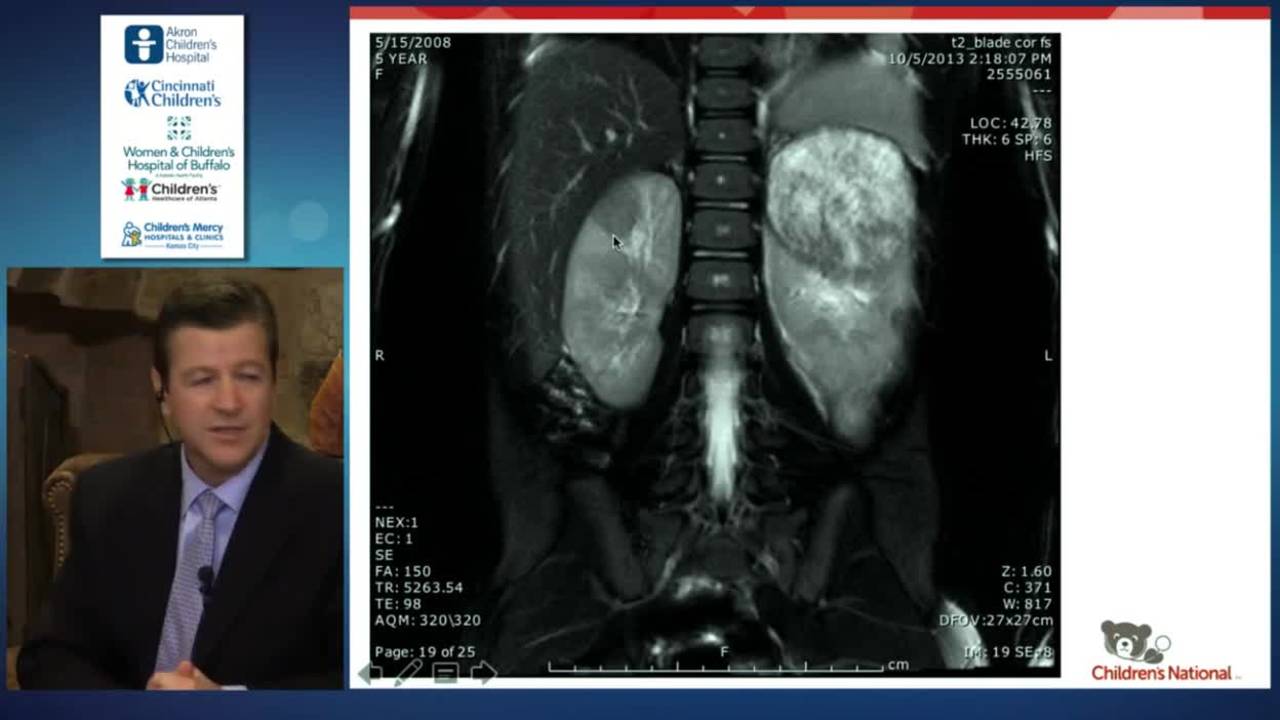
Symposium for the rapid fire session, a child presents who's 5 years old with what I call giant bilateral kidney tumors,…
0:26
Uh
Uh, 3 quarters of the abdomen and then on the right side you've got 2 tumor lesions on the right kidney. So my question …
0:47
Any other opinions?
Any other opinions? So no one here would biopsy it. So, correct, uh, the, the current status is just to start chemothera…
1:14
Uh
Uh, and you have what, what you can see on residual, the very still large left renal tumor. And on the right side, you c…
1:35
Would you remove the left kidney and try do nephron sparing …
Would you remove the left kidney and try do nephron sparing surgery on the right kidney? Um, or would you continue with …
1:52
So I want Dan to answer this because he knows this much bett…
So I want Dan to answer this because he knows this much better. Would you, Dan, would you, would you remove the primary …
2:21
It certainly doesn't look like you could do it on the centra…
It certainly doesn't look like you could do it on the central one, although you might be able to. The other issue is whe…
2:49
The problem with biopsy is they're heterogeneous tumors and …
The problem with biopsy is they're heterogeneous tumors and you might miss foci of of um. Um, anapplasia, so some would …
3:12
Um
Um, to take out the lift and leave the just leave the right, so take out the left, find out if there are any elements th…
3:41
So
So, so in general, what we, what we do is, uh, if it stops shrinking, and because most of these are favorable histology …
4:07
So what we do is we always try to do bilateral nephron spari…
So what we do is we always try to do bilateral nephron sparing, and most of the time, surprisingly, you can actually do …
4:37
So that's what we did.
So that's what we did. We saved both sides, uh, and did the left upper pole, and this is the pathology that came back th…
4:54
So now that you know that there was some anaplastic tumor in…
So now that you know that there was some anaplastic tumor in the left side, uh, what is your next, your next stage? What…
5:12
So what
So what, what would your, what would anyone, uh, recommend doing, uh, at this point? Let me, let me cut to the chase. I …
5:28
Um
Um, I, I, uh, I actually, uh, went away about 4 days later and in the 5th or 6th day, the pathology came back as anaplas…
5:54
Nevertheless
Nevertheless, one of my partners went back, I did the left kidney, and there was no tumor in the remaining left kidney, …
6:10
You have to look a lot.
You have to look a lot. That's very true, because recurrence for an anaplastic recurrence would be a very, would portend…
6:24
So I think in general
So I think in general, although we have one now, uh, who does have some anaplastic elements, but it's in the central par…
6:44
I
I, again, you have to go with the philosophy that you're doing the best you can to preserve renal tissue when you have b…
7:11
But you get anapplasia
But you get anapplasia, then it really becomes a question because, as I said, once you get a recurrence, it's very hard …
7:37
You also have multifocal tumors
You also have multifocal tumors, which is also another poor, you know, I think. And I can't quote you the data on it. Yo…
8:06
Another child
Another child, just briefly before I sum up, a 12-month-old child who presented from, from the Middle East with these la…
8:35
Um
Um, nephron sparing surgery, you don't need chemotherapy upfront because 97% of these cases are Wilms tumor, and there's…

Topic Overview

A rapid-fire case discussion of a 5-year-old with giant bilateral Wilms tumors, positive lymph nodes, and lung metastasis. The panel addresses initial management (chemotherapy without biopsy), surgical timing after incomplete response, the technical feasibility of bilateral nephron-sparing surgery, and the challenge posed by heterogeneous pathology showing both favorable histology and anaplastic elements. A key clinical tension emerges: preserving renal tissue in bilateral disease versus the risk of leaving anaplastic tumor behind, which portends poor salvage outcomes if recurrence occurs.

Key Takeaways

  • Bilateral Wilms with mets: start chemo without biopsy; 97% are Wilms, preserving renal tissue is priority over upfront histology. (0:54)
  • If tumors stop shrinking on chemo, pursue surgery—often mesenchymal differentiation, but get tissue to rule out anaplasia. (3:41)
  • Bilateral nephron-sparing surgery is feasible in most cases using ice, vessel clamping, and sharp dissection. (4:07)
  • Anaplastic recurrence has very poor salvage outcomes; heterogeneous tumors may harbor focal anaplasia missed on biopsy. (2:49)
  • Stage 3 local disease requires bilateral radiation; mutations in WT1/WT2 increase risk for additional tumors. (5:03)

Inside this episode

Kai, the Library's AI content creator, listened to this episode and mapped who's speaking, the chapters, key claims, and cases. Every item links to the exact moment in the recording.

AI-enriched

Who's speaking

  • Speaker 1 — host
  • Speaker 2 — guest
  • Dan — guest
  • Speaker 4 — guest

Chapters

  • 0:00Initial presentation and management decision — 5-year-old with bilateral giant Wilms tumors, positive nodes, lung metastasis. Panel consensus: start chemotherapy without biopsy. After 2 cycles, tumors stopped shrinking at 50% size reduction.
  • 1:45Management of chemotherapy-resistant bilateral disease — Discussion of surgical options when tumors stop responding: bilateral nephron-sparing vs. unilateral nephrectomy with contralateral nephron-sparing. Debate over biopsy vs. changing chemotherapy regimen for potential anaplastic elements.
  • 3:41Surgical approach and pathology results — Bilateral nephron-sparing surgery performed using on-ice technique with vascular clamping. Pathology revealed heterogeneous disease: left upper pole favorable, left lower pole anaplastic, right tumors favorable, lymph node anaplastic. Stage 4 disease requiring radiation.
  • 5:19Management of residual kidney after anaplastic pathology — Debate over completion nephrectomy of left kidney given anaplastic elements. Left nephrectomy performed showing no residual tumor. Discussion of recurrence risk, salvage difficulty with anaplastic disease, and whether anaplasia was primary or chemotherapy-induced.
  • 7:38Outcomes and summary principles — Patient outcomes shown: first case with left nephrectomy and preserved right kidney, second case (12-month-old) with bilateral nephron-sparing showing good function at 7 months. Key message: nephron-sparing surgery feasible for large bilateral tumors; chemotherapy upfront not always necessary given 97% are Wilms tumor.

Key claims

  • 0:54Current standard for bilateral Wilms tumors with metastases is to start chemotherapy without biopsy — Speaker 1
  • 1:00Tumor shrinkage is defined as a decrease of 50% in tumor size — Speaker 1
  • 3:41When tumors stop shrinking after chemotherapy, surgical intervention is typically pursued, often because of mesenchymal differentiation rather than anaplastic tumor — Speaker 1
  • 4:07Bilateral nephron-sparing surgery is feasible in most cases of bilateral Wilms tumor — Speaker 1
  • 4:15Surgical technique for nephron-sparing involves placing kidneys on ice, clamping vessels, and sharp dissection to remove tumor — Speaker 1
  • 2:49Wilms tumors are heterogeneous and biopsy may miss foci of anaplasia — Dan
  • 2:25More aggressive chemotherapy regimen may be considered if anaplastic elements are suspected and tumor is not responding — Dan
  • 5:03Stage 3 local tumor requires radiation on both sides — Speaker 1
  • 6:10Anaplastic recurrence portends a very bad outcome — Dan
  • 6:18Salvage is difficult with anaplastic tumor despite chemotherapy — Dan
  • 6:44Philosophy for bilateral tumors is to preserve as much renal tissue as possible, which is why upfront biopsy is no longer performed — Dan
  • 6:56If tumor is not responding to chemotherapy, tissue is needed to rule out anaplasia — Dan
  • 7:11Once anaplastic tumor recurs, it is very hard to salvage — Dan
  • 7:24Most pathologists think anaplasia is present primarily rather than induced by chemotherapy — Speaker 1
  • 7:37Multifocal tumors raise concern about underlying embryology of the kidney and risk for developing additional tumors — Dan
  • 7:53Mutations in WT1 or WT2 increase risk for additional tumors — Speaker 1
  • 8:3197% of large bilateral kidney tumors in children are Wilms tumor — Speaker 1
  • 8:31Chemotherapy upfront is not always necessary for bilateral Wilms tumors given the high likelihood of Wilms diagnosis — Speaker 1

Cases discussed

  • 0:005-year-old with giant bilateral Wilms tumors, positive lymph nodes, and lung metastasis
  • 8:0612-month-old from Middle East with large bilateral tumors

Points of disagreement

  • 5:37Whether to perform completion nephrectomy after finding anaplastic elements
    • Speaker 1: Argued against completion nephrectomy because lymph node had anaplastic tumor (already outside kidney) and nephron-sparing surgery had removed gross tumor
    • Felt completion nephrectomy was necessary due to anaplastic differentiation

Open questions

  • Was the anaplasia present initially or did it develop secondary to chemotherapy (chemotherapy-induced differentiation into anaplastic phenotype)?
  • How can pathologists ensure no residual anaplastic tumor remains after nephron-sparing surgery given the need to extensively section the remaining kidney?
  • What is the optimal chemotherapy regimen when bilateral tumors stop responding after initial cycles?
  • What are the outcomes for multifocal bilateral Wilms tumors with respect to risk of developing additional tumors?
This episode was analyzed and enriched by Kai, the Library's AI content creator. Every item links to the moment it comes from — click a timestamp to listen in context.
Written for:

Bilateral Wilms Tumor: When to Preserve Kidneys and When to Sacrifice Them

The episode's main topic retold as a plain-language walkthrough — what it is, why it matters, and what the speakers concluded. Written by Kai from the episode transcript and reviewed before publishing.

For the care team · Explainer · AI-written, human-reviewed

Why bilateral Wilms tumor demands a different approach

Pediatric oncology has few scenarios where the margin between cure and lifelong dialysis is measured in millimeters of preserved cortex 4:07. Bilateral Wilms tumor — simultaneous tumors in both kidneys — forces a choice most oncologic surgery avoids: accept incomplete resection to preserve renal function, or pursue complete excision and guarantee end-stage kidney disease in a child 6:44. The North American approach has evolved toward maximal nephron preservation, but that philosophy fractures when pathology reveals anaplastic histology 4:07 6:44.

The core tension: tissue preservation versus oncologic adequacy

Current practice starts with chemotherapy without biopsy when imaging shows bilateral disease with metastases 0:54. The goal is tumor shrinkage — defined as 50% volume reduction — to create a surgical plane that permits nephron-sparing resection 1:00. Most tumors respond predictably 3:41. When they stop shrinking, the standard move is surgical intervention, typically because of mesenchymal differentiation rather than treatment resistance 3:41.

The technical approach involves surface cooling, vascular clamping, and sharp dissection to shell out tumor while leaving functional parenchyma 4:15. This works surprisingly often 4:07. But the strategy rests on an assumption: that 97% of large bilateral kidney masses in children are favorable-histology Wilms tumor 8:31. When that assumption fails — when pathology returns showing anaplastic foci — the calculus inverts 6:44.

The anaplasia problem

Wilms tumors are heterogeneous 2:49. A tumor that appears uniform on imaging may harbor scattered foci of anaplastic cells, and a biopsy needle may miss them entirely 2:49. This matters because anaplastic recurrence is nearly unsalvageable 6:10 6:18. As one discussant put it: "Once you get a recurrence, it's very hard to salvage that job" [q4]. The question becomes whether to accept residual kidney tissue that might contain microscopic anaplasia, or perform completion nephrectomy and consign the child to single-kidney physiology — or worse, if bilateral disease requires bilateral completion 7:11.

The case that crystallizes this dilemma: a five-year-old with bilateral giant tumors, positive nodes, and lung metastases underwent bilateral nephron-sparing surgery after chemotherapy 4:07 4:15. Pathology showed favorable histology in three of four tumor sites, but anaplastic differentiation in the left lower pole and in a lymph node 6:44. The surgical team had achieved what looked like complete gross resection 7:11. The oncology team, facing anaplastic disease, recommended completion nephrectomy of the left kidney 7:11. At reoperation, the remaining left kidney showed no residual tumor — neither favorable nor anaplastic — on extensive sectioning 7:11.

Was the second operation necessary? The discussants frame it as a judgment call 7:11. "You have to go with the philosophy that you're doing the best you can to preserve renal tissue when you have bilateral tumors, and that's why we no longer biopsy them upfront" [q3]. But if a tumor is not responding to chemotherapy, tissue diagnosis becomes essential to rule out anaplasia 6:56. The problem is that by the time you have tissue, you have already committed to a nephron-sparing approach that may be inadequate if anaplasia is present 6:44 7:11.

When to escalate chemotherapy versus when to operate

If tumors plateau after two cycles of standard chemotherapy, two paths diverge 2:25. One option: escalate to a more aggressive regimen on the assumption that occult anaplasia is driving resistance, and hope for further shrinkage that permits safer resection 2:25. The other: proceed to surgery, use the resected specimen as your tissue diagnosis, and adjust systemic therapy based on final pathology 6:56. The first approach risks delaying definitive local control; the second risks inadequate resection if anaplasia is present and you have already committed to nephron preservation 6:44 7:11.

Most pathologists believe anaplasia is present from the outset rather than induced by chemotherapy 7:24, which means the tumor's biology is fixed before treatment starts. Multifocal tumors raise additional concern about the underlying embryology of the kidney and the risk of developing new primaries, particularly in children with WT1 or WT2 mutations 7:37 7:53.

When to involve pediatric surgical oncology

Any child with a large renal mass, bilateral disease, or imaging findings suggesting Wilms tumor should be referred before biopsy 0:54 8:31. The North American approach differs fundamentally from European protocols, and starting chemotherapy without coordination with a center experienced in nephron-sparing technique forecloses options 0:54 4:15. If a child has received chemotherapy and imaging shows inadequate response — stable or slowly responding disease after two to three cycles — surgical consultation should occur before further dose escalation 3:41 2:25. The decision to biopsy, escalate therapy, or proceed to resection is not sequential; it is a simultaneous choice that depends on tumor geography, remaining renal parenchyma, and institutional experience 6:56 7:11.

Stage 3 local disease or stage 4 metastatic disease will require radiation to both renal beds 5:03, which adds urgency to preserving functional tissue before radiation-induced nephropathy compounds surgical loss. The margin for error is narrow, and the consequences of getting it wrong — either oncologic failure or dialysis dependence — are permanent 6:10 6:18 7:11.

Takeaways from this story

  • Bilateral Wilms tumor is treated with upfront chemotherapy without biopsy; surgery is pursued when tumors stop shrinking at 50% reduction.
  • Nephron-sparing surgery using on-ice technique with vascular clamping is feasible in most bilateral cases despite large tumor size.
  • Anaplastic histology discovered after nephron-sparing resection creates a dilemma: completion nephrectomy risks dialysis, but residual tissue risks unsalvageable recurrence.
  • Wilms tumors are heterogeneous and biopsy may miss anaplastic foci; if tumors don't respond to chemotherapy, tissue diagnosis is needed before escalating therapy.

Keywords

Hashtags

Transcript

Comments

Loading comments…