


From
StayCurrentMD
Wilms Tumor Protocol Violations: Practice Gap discussion at Update Course 2018
With Dr. Ken Wong · hosted by Dr. Todd Ponsky
Chapter 1 of 4 · Case-Based Learning
Case presentation
Case presentation and audience polling on management of metastatic Wilms tumor
Expert statements on this page
No expert statements were drawn from this page.
Host summaries · secondary, not cited in answers
Educational content from recorded physician discussions — not medical advice. Talk to your (or your child's) care team about your situation.
Video
Wilms Tumor Protocol Violations: 2018 Pediatric Surgery Practice Gap #3
Dr. Todd Ponsky · Published Jun 2019
Video
2025 Pediatric Surgery Update Course - Updates in Oncology
21 min · Published Aug 2025
Video
Updated Favorable histology Wilms tumor risk stratification: Rationale for future Children’s Oncology Group clinical trials
53 s · Published Apr 2026
Podcast
Topics in 10: Wilms Tumor
12 min · Published Aug 2019
Video
Clinical & Research Update: Renal Tumors with Drs. Ethan Smith, Lindsay Haacker, Michael Daugherty, and Meera Kotagal
71 min · Published Sep 2026
Video
Impact of Pulmonary Tumor Burden in Favorable Histology Wilms Tumor Outcomes: A Report From the Children's Oncology Group Study AREN053
1 min · Published Mar 2026
Video
Oncology Tumor Board Showdown: Pediatric Oncology 5 Question Quiz
1 min · Published Oct 2026
Video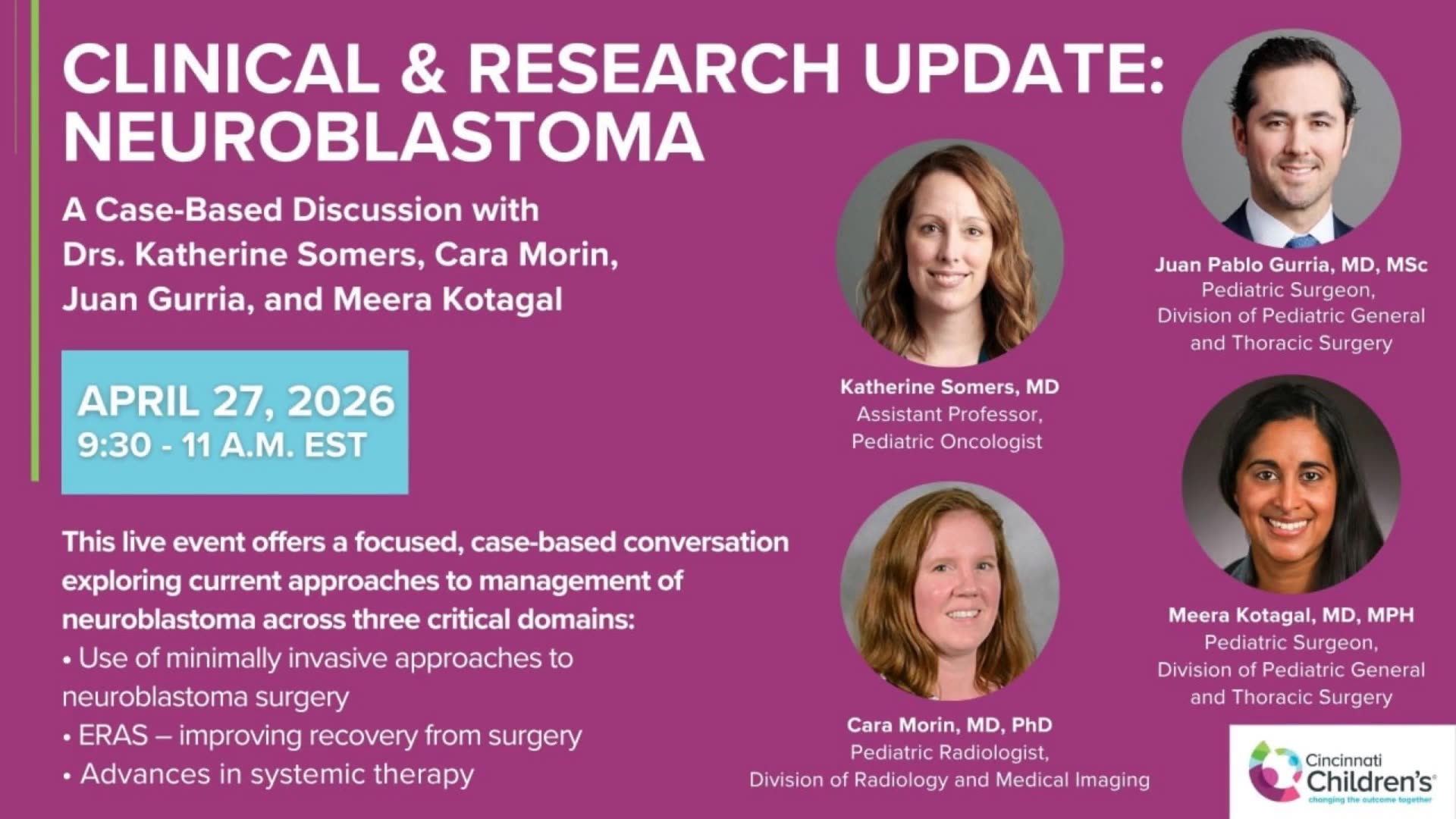
Clinical & Research Update: Neuroblastoma with Drs. Katherine Somers, Cara Morin, Juan Gurria, and Meera Kotagal
67 min · Published Sep 2026
Video
Clinical & Research Update: Sarcoma w/ Drs. Roshni Dasgupta, Joseph Pressey, Arthur Meyer, Luke Pater
66 min · Published Sep 2026
Video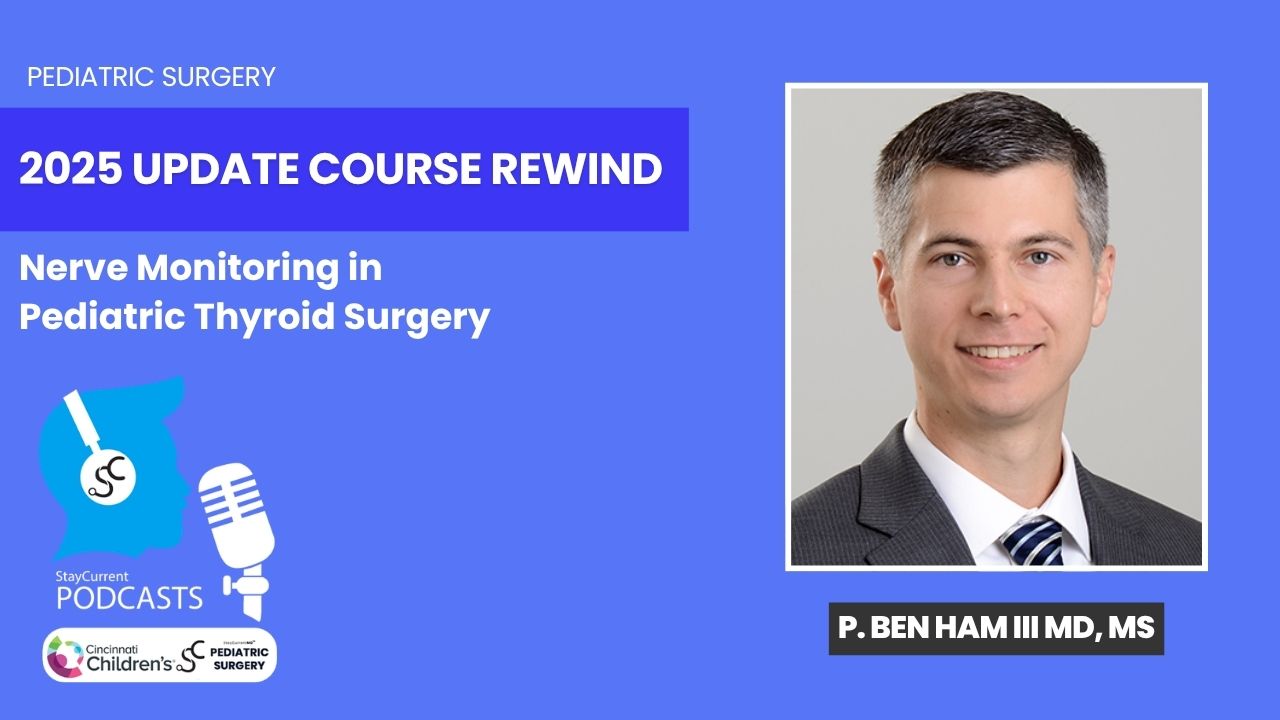
Update Course Rewind 2025: Nerve Monitoring in Pediatric Thyroid Surgery
6 min · Published Jul 2026
Video
Journal of Pediatric Surgery Article Review: June 2023, AAP Issue
Todd Ponsky · 13 min · Published Jul 2026
Podcast
Update Course Rewind 2025: Robotics in Pediatric Surgery: Which indications benefit the most?
Juan Pablo Gurria · 4 min · Published Jun 2026
Video
Intestinal Atresia Types Explained: Grossfeld Classification for Pediatric Surgery
1 min · Published Sep 2026
Video
Derivation and validation of the Pediatric Community-Acquired Pneumonia Severity (PedCAPS) score: A prospective cohort study
50 s · Published Sep 2026
Video
FETO for Late-Diagnosed Severe Congenital Diaphragmatic Hernia (CDH) at Cincinnati Children's with Dr. Beth Rymeski
4 min · Published Sep 2026
Video
Severe Congenital Diaphragmatic Hernia (CDH) Case: FETO Management & Unexpected Findings with Dr. Beth Rymeski
3 min · Published Sep 2026
Video
Fetoscopic Endoluminal Tracheal Occlusion (FETO) Procedure: Step-by-Step Guide with Dr. Beth Rymeski
4 min · Published Sep 2026
Video
Choledochal Cyst Types Explained: Pediatric Surgery Fundamentals
1 min · Published Sep 2026
What the experts said
The management approach discussed is based on US protocols, which differ from European SIOP protocols.
In Hong Kong, for Wilms tumor they tend to follow American protocols, though for various tumors they use either European or American protocols.
When there are multiple lung masses, a correct assumption can be made that they represent metastases without biopsy.
If you treat the patient and lung nodules go away, you presume that represents metastatic disease; if there is a residual nodule after treatment, that is an indication to resect it.
Previously, if a nodule was not present on plain film it was not considered significant even if seen on CT, but now CT is the diagnostic test of choice and impacts therapy.
For a single lung nodule, patients are treated and if it resolves, it is presumed to be metastatic Wilms tumor.
What is avoided by proving a nodule is not metastatic is radiation therapy to the lungs, not chemotherapy.
If lung nodules resolve after 6 weeks of treatment, regardless of how many there are, no radiation to the lungs is given.
For lung nodules to avoid radiation therapy, they must completely disappear; if there is a residual nodule, you cannot distinguish scar from active tumor and must biopsy or continue therapy with radiation.
APSA has addressed the lymph node sampling practice gap through expert questions, the NAT exam, and annual meeting educational efforts.
When performing nephrectomy for Wilms tumor, lymph node sampling is mandatory according to protocols.
If histologically negative lymph nodes are not documented during Wilms tumor nephrectomy, they are assumed to be positive, which increases the stage and requires increased chemotherapy.
Failure to sample lymph nodes during Wilms tumor nephrectomy is an identified practice gap by the Cancer Committee and COG publications.
The presence of metastatic disease in the lung does not preclude treating the primary tumor with nephrectomy, because this affects whether radiation therapy is required.
There is both a local stage and a patient stage for Wilms tumor.
On the ACS pediatric surgery blog, a similar question showed that overwhelmingly the presence of lymph node metastases led people to choose biopsy and chemotherapy, which is incorrect.
Regardless of pulmonary metastatic disease, if the primary tumor can be removed without removing other organs, nephrectomy should be performed because it decreases radiation therapy requirements.
The child will receive stage 4 metastatic chemotherapy regardless, but performing biopsy counts as local spillage and requires radiation therapy to the flank or abdomen.
Local disease should be treated differently than systemic disease in Wilms tumor.
Oncologists want measurable disease to assess response to chemotherapy.
According to Dr. Shamberger, there are radiographic criteria for single lung nodules; if it looks like a metastasis you proceed, but if it does not look like a metastasis you can biopsy it to prove it is not a met and avoid chemotherapy.
In SIOP protocols, they perform percutaneous biopsy of the primary tumor and treat with chemotherapy.
The American College of Surgeons registry data shows improvement with fewer patients receiving nephrectomies without lymph node sampling since educational efforts began.