


From
StayCurrentMD
Update Course Rewind 2025: Perineal Body–Preserving PSARP: The New Standard?
hosted by Dr. Jill Knepprath
Chapter 1 of 4 · Fundamentals
Introduction
Introduction and Session Overview
Expert statements on this page
No expert statements were drawn from this page.
Host summaries · secondary, not cited in answers
Educational content from recorded physician discussions — not medical advice. Talk to your (or your child's) care team about your situation.
Video
2025 Pediatric Surgery Update Course - Updates in Colorectal: Debunking Dogma
30 min · Published Aug 2025
Video
Validation of an anorectal malformation trainer - Can a high-fidelity model simulate real life?
1 min · Published Jun 2026
Podcast
Colorectal Quiz: Episode 2
Marc Levitt · 18 min · Published Jan 2021
Video
Update Course Rewind 2025: Hirschsprung + ARM: Rare but Real
1 min · Published May 2026
Video
Rectal Prolapse Repair Following a Posterior Sagittal Anorectoplasty
4 min · Published Jan 2025
Video
Posterior Rectal Advancement Anoplasty (PRAA) in a male with an anorectal malformation and rectoperineal fistula
9 min · Published Mar 2026
Video
Complications and Long-Term Outcomes of Patients With Cloacal Malformation After Bowel Neovagina...
1 min · Published Jun 2026
Video
Safety and utility of long-acting steroid injection for management of post-operative stricture...
1 min · Published Jun 2026
Video
Association Between Social Determinants of Health and Choice of Urinary Reconstruction in Children
1 min · Published Jun 2026
Video
The Perineal Body Preserving PSARP (PPP)
11 min · Published Jun 2026
Video
Update Course Rewind 2025: Botox for Hirschsprung’s: Where, When, and Why
1 min · Published May 2026
Video
Update Course Rewind 2025: Hirschsprung’s Pull-Through: Why Family Training May Save Lives
2 min · Published May 2026
Video
Intestinal Atresia Types Explained: Grossfeld Classification for Pediatric Surgery
1 min · Published Sep 2026
Video
Derivation and validation of the Pediatric Community-Acquired Pneumonia Severity (PedCAPS) score: A prospective cohort study
50 s · Published Sep 2026
Video
FETO for Late-Diagnosed Severe Congenital Diaphragmatic Hernia (CDH) at Cincinnati Children's with Dr. Beth Rymeski
4 min · Published Sep 2026
Video
Severe Congenital Diaphragmatic Hernia (CDH) Case: FETO Management & Unexpected Findings with Dr. Beth Rymeski
3 min · Published Sep 2026
Video
Fetoscopic Endoluminal Tracheal Occlusion (FETO) Procedure: Step-by-Step Guide with Dr. Beth Rymeski
4 min · Published Sep 2026
Video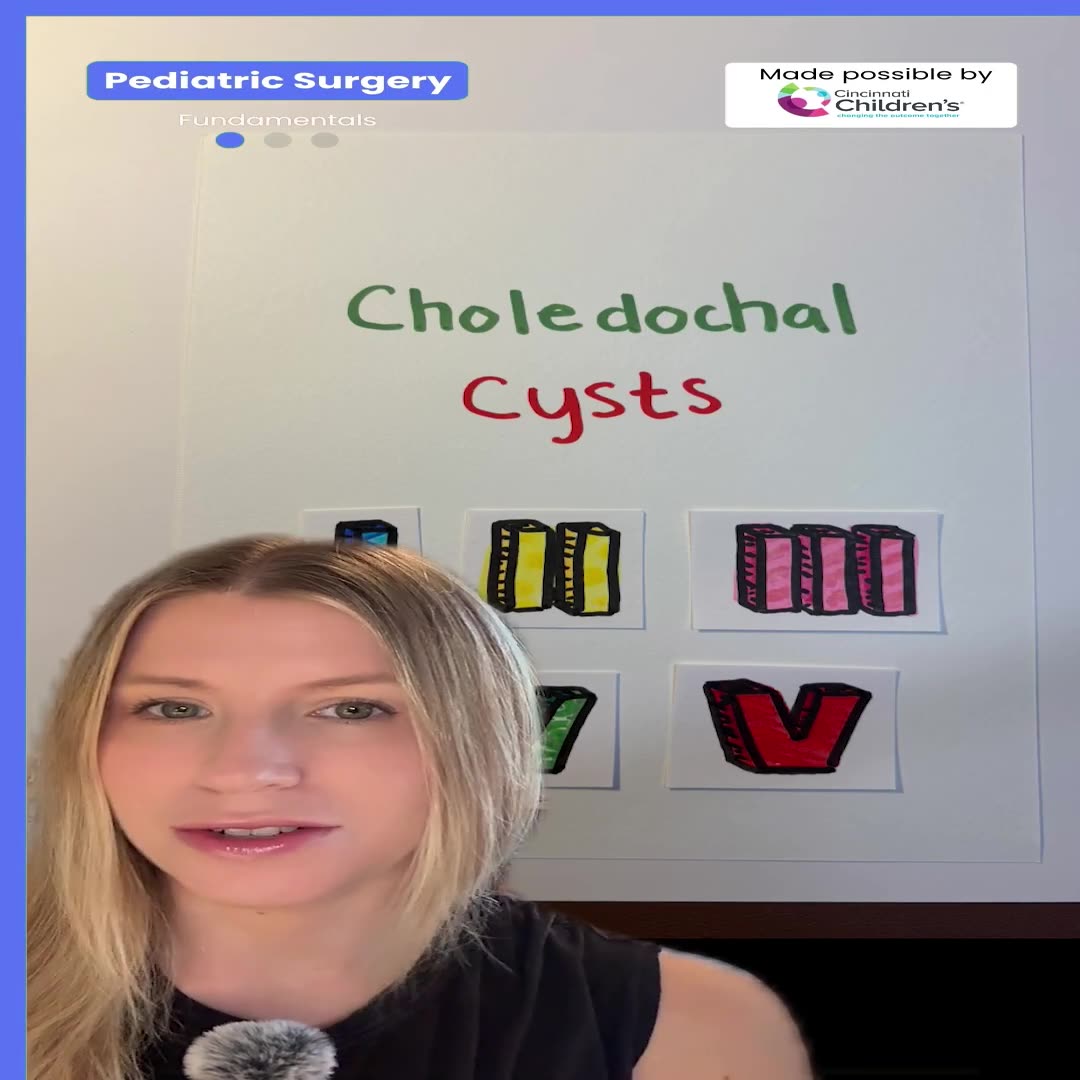
Choledochal Cyst Types Explained: Pediatric Surgery Fundamentals
1 min · Published Sep 2026
What the experts said
Perineal body-preserving PSARP is basically the same technique one would do in a bulbar fistula, but applied to a vestibular fistula, cleaning up the lateral planes before coming around the front.
Perineal body-preserving PSARP allows patients to go home earlier compared to classic PSARP.
With perineal body-preserving PSARP, the surgeon does not have to worry about breakdown in the perineal body postoperatively.
Perineal body-preserving PSARP is harder technically than opening it all the way anteriorly in a standard PSARP.
If the surgeon is not sure where the anterior rectal wall is and where the vagina is during perineal body-preserving PSARP, conversion to a standard PSARP is appropriate.
2023 publications on perineal body-preserving PSARP demonstrated at one year follow-up: no dehiscence, no prolapse, and only 13% of patients required revision of their anal stricture.
Two-thirds of patients undergoing perineal body-preserving PSARP went home on postoperative day one.
Perineal body-preserving PSARP is a good choice for patients but can be a trickier approach than standard PSARP.
Conversion to the standard PSARP approach is a valid pivot when there is doubt about anatomy during perineal body-preserving PSARP.