33 views 0 likes

Dr. Todd Ponsky

Pediatric Surgery · View profile →

Update Course Rewind: 2024 Top Ten Key Takeaways

Video Published 2025-06-03 Updated 2026-08-01

Timestops (10)

0:01
Introduction and Takeaway #10
Introduction to the 2024 update course top 10 takeaways. Discussion of image-guided surgery combining surgical and inter…
2:03
Takeaway #9: Top AI Tools of 2024
Review of AI applications in surgical research, including ChatGPT for systematic review article screening, Jenny AI for …
4:17
Takeaway #8: Cryoanalgesia in Pectus Surgery
Technical details of cryoanalgesia for pectus procedures, including double-lumen tube use, thoracoscopic guidance, T3-T8…
5:39
Takeaway #7: ECMO in Severe Congenital Diaphragmatic Hernia
Clinical decision-making for ECMO initiation in severe CDH, comparison of VA versus VV ECMO, prenatal counseling protoco…
7:59
Takeaway #6: CO2 Laser in Surgical Procedures
Applications of CO2 laser (920-1400 nm spectrum) in pediatric surgery, including circumcision (56 cases, 3% complication…
9:12
Takeaway #5
Use of autofluorescence and ICG angiography during thyroidectomy to identify parathyroid glands and assess perfusion, wi…
11:09
Takeaway #4
Surgery-first approach for pediatric cholelithiasis with 86% stone clearance rate via intraoperative cholangiogram, redu…
12:48
Takeaway #3: MMP-7 as Diagnostic Tool in Biliary Atresia
MMP-7 biomarker for early biliary atresia diagnosis, with data showing 20% outcome worsening per 10-day treatment delay.…
14:45
Takeaway #2: REBOA in Pediatric Trauma
Resuscitative endovascular balloon aortic occlusion (REBOA) technique and comparison to resuscitative thoracotomy in ped…
16:07
Takeaway #1
Non-surgical management of pilonidal disease emphasizing weekly hair removal (clipping preferred), meticulous hygiene, a…

Topic Overview

This recorded session presents the top 10 clinical and technical takeaways from the 12th annual update course in pediatric surgery held in August 2024 at Cincinnati Children's Hospital. The discussion covers emerging and established practices across a range of pediatric surgical topics, including image-guided surgery with interventional radiology collaboration, AI tools for research and systematic review, cryoanalgesia for pectus procedures, ECMO strategies for severe congenital diaphragmatic hernia, CO2 laser applications in pediatric urology and general surgery, autofluorescence and ICG angiography for parathyroid identification during thyroidectomy, surgery-first approaches to pediatric cholelithiasis, MMP-7 as a diagnostic biomarker for biliary atresia, REBOA in pediatric trauma, and non-surgical management of pilonidal disease. Each topic is classified by evidence level (green circle for established practice, blue square for promising newer practice, black diamond for unproven/early adoption) to guide clinical decision-making.

Key Takeaways

  • AI tools like ChatGPT can screen thousands of articles for systematic review with decision rationale, streamlining literature analysis. (2:20)
  • Cryoanalgesia for pectus targets T3-T8 with 2-min freeze cycles; requires double-lumen tube and proper positioning to avoid block failure. (4:46)
  • Michigan SER Protocol showed ECMO and comfort care had equivalent survival for severe unilateral CDH based on prenatal criteria. (6:43)
  • Autofluorescence during thyroidectomy reduced hypocalcemia rates by ~50% without requiring contrast injection. (9:37)
  • Surgery-first for pediatric cholelithiasis achieved 86% stone clearance, reducing MRCP use and avoiding 10% ERCP pancreatitis risk. (11:33)

Inside this episode

Kai, the Library's AI content creator, listened to this episode and mapped who's speaking, the chapters, key claims, and cases. Every item links to the exact moment in the recording.

AI-enriched

Who's speaking

  • Speaker 1 — host
  • Speaker 2 — guest
  • Speaker 3 — host
  • Speaker 4 — guest
  • Speaker 5 — guest
  • Speaker 6 — guest

Chapters

  • 0:01Introduction and Takeaway #10: Collaboration of Surgery and Interventional Radiology — Introduction to the 2024 update course top 10 takeaways. Discussion of image-guided surgery combining surgical and interventional radiology expertise, including ultrasound guidance for vascular access, hybrid OR capabilities, and cone beam CT applications.
  • 2:03Takeaway #9: Top AI Tools of 2024 — Review of AI applications in surgical research, including ChatGPT for systematic review article screening, Jenny AI for academic writing assistance, and ChatGPT-based training modules from clinical guidelines.
  • 4:17Takeaway #8: Cryoanalgesia in Pectus Surgery — Technical details of cryoanalgesia for pectus procedures, including double-lumen tube use, thoracoscopic guidance, T3-T8 nerve targeting with 2-minute freeze cycles, and adjunctive subpleural marcaine blocks.
  • 5:39Takeaway #7: ECMO in Severe Congenital Diaphragmatic Hernia — Clinical decision-making for ECMO initiation in severe CDH, comparison of VA versus VV ECMO, prenatal counseling protocols, and timing of surgical repair (8-24 hour window) while on ECMO with biovalrudin.
  • 7:59Takeaway #6: CO2 Laser in Surgical Procedures — Applications of CO2 laser (920-1400 nm spectrum) in pediatric surgery, including circumcision (56 cases, 3% complication rate), frenulectomy (47 patients), perianal fistulas, pilonidal cysts, labial fusion, and condylomatosis.
  • 9:12Takeaway #5: Autofluorescence and ICG Angiography for Parathyroid Identification — Use of autofluorescence and ICG angiography during thyroidectomy to identify parathyroid glands and assess perfusion, with evidence from French RCT showing 50% reduction in hypocalcemia rates.
  • 11:09Takeaway #4: Surgery-First Mindset in Pediatric Biliary Stone Disease — Surgery-first approach for pediatric cholelithiasis with 86% stone clearance rate via intraoperative cholangiogram, reducing need for preoperative MRCP and avoiding 10% ERCP-associated pancreatitis risk.
  • 12:48Takeaway #3: MMP-7 as Diagnostic Tool in Biliary Atresia — MMP-7 biomarker for early biliary atresia diagnosis, with data showing 20% outcome worsening per 10-day treatment delay. Discussion of institutional commitment to Kasai procedure within 7 days of presentation.
  • 14:45Takeaway #2: REBOA in Pediatric Trauma — Resuscitative endovascular balloon aortic occlusion (REBOA) technique and comparison to resuscitative thoracotomy in pediatric trauma, with discussion of practical limitations and preference for laparotomy in controlled settings.
  • 16:07Takeaway #1: Patient Education and Non-Surgical Management of Pilonidal Disease — Non-surgical management of pilonidal disease emphasizing weekly hair removal (clipping preferred), meticulous hygiene, and patient education. Discussion of US Army clinic data showing dramatic improvement with protocol-driven shaving, reducing surgical intervention need.

Key claims

  • 0:53Cross-training occurs at Cincinnati Children's with interventional radiologists teaching pediatric surgery fellows ultrasound guidance for vascular access — Speaker 1
  • 1:02Hybrid OR collaboration can occur in regular OR by bringing in an ultrasound machine without requiring a dedicated hybrid OR — Speaker 1
  • 1:25Cone beam CT is performed on a C-arm fluoroscopy unit that rotates around the patient collecting multiple images stacked together to create a CT — Speaker 2
  • 2:20ChatGPT can screen thousands of articles in systematic review based on title and abstract with explanation column for decision rationale — Speaker 3
  • 3:27Jenny AI can provide relevant answers, cite supporting papers, and format citations according to preferred style — Speaker 3
  • 4:35Double lumen endotracheal tube deflates the lung on the side of cryoablation for thoracoscopic guidance — Speaker 1
  • 4:46Cryoanalgesia targets T3 to T8 with 2-minute freeze cycles per interspace — Speaker 1
  • 4:56Subpleural injection with 0.25% marcaine with epinephrine works immediately versus 8-10 hour delay with cryo nerve block — Speaker 1
  • 5:09Double lumen endotracheal tube reduces risk of pneumothorax during cryoanalgesia — Speaker 1
  • 5:13Cryoanalgesia blocks fail when surgeons use single lumen tube and perform block too far anteriorly — Speaker 1
  • 6:34Majority of centers still do VA ECMO primarily for CDH babies — Speaker 3
  • 6:43Michigan SER Protocol showed survival was equivalent between ECMO and comfort care groups for severe unilateral CDH based on prenatal criteria — Speaker 3
  • 7:26With biovalrudin ECMO management, surgical repair can proceed after 8 hours once levels are stable — Speaker 3
  • 7:49Early repair while on ECMO is safe with optimal window between 8 to 24 hours — Speaker 3
  • 8:14CO2 laser operates in spectrum of 920 to 1400 nm which is well absorbed by water — Speaker 1
  • 8:30CO2 laser circumcision using sleeve technique with dorsal slit and cyanoacrylate adhesive had 3% complication rate in 56 cases — Speaker 1
  • 8:40CO2 laser frenulectomy in 47 patients showed low pain profile with no suture required — Speaker 1
  • 9:37Autofluorescence in randomized controlled trial from France reduced rates of hypoparathyroidism and hypocalcemia following thyroidectomy — Speaker 3
  • 9:53Parathyroids naturally autofluoresce at specific wavelength without injection — Speaker 4
  • 10:07Hypocalcemia rates were about 50% lower with autofluorescence use versus not using it — Speaker 4
  • 11:33Surgery-first pathway for pediatric cholelithiasis reduces resource utilization including MRCP — Speaker 5
  • 12:02ERCP causes pancreatitis 10% of the time regardless of operator skill — Speaker 6
  • 12:14Stone clearance rate reflected by negative intraoperative cholangiogram was 86% with surgery-first approach — Speaker 1
  • 12:25Success rate was in the 90s with simple flushing or catheter manipulation of common bile duct or reaming the sphincter — Speaker 5
  • 13:41Every 10 day delay in biliary atresia treatment worsens outcomes by 20% according to Midwest study data — Speaker 3
  • 13:58MMP-7 sensitivity is pretty good but cutoffs vary between teams because the assay is still evolving — Speaker 3
  • 14:21Cincinnati Children's commitment is Kasai procedure within 7 days of biliary atresia patient presentation — Speaker 3
  • 15:48REBOA can be performed in pediatric patients but is rarely done with no clear survival advantage over laparotomy — Speaker 1
  • 16:23Patients presenting with wounds as initial presentation for pilonidal tend to not always reach full healing with minimally invasive approach — Speaker 3
  • 16:40US Army clinic with captive patient population implementing weekly shaving protocol observed dramatic improvement and significantly reduced need for surgical intervention in pilonidal disease — Speaker 3
  • 17:17Clipping is probably the easiest and simplest approach for pilonidal disease hair removal when parent or active caregiver is involved, recommended once weekly — Speaker 3

Cases discussed

  • 6:01Severe congenital diaphragmatic hernia case requiring ECMO decision
  • 15:01Pediatric trauma case requiring hemorrhage control decision

Points of disagreement

  • 15:48REBOA versus laparotomy timing in pediatric trauma
    • Speaker 1: REBOA seems to take longer than opening the abdomen or chest if just needing to cross clamp the aorta, favoring laparotomy for quickly treating shock in controlled environment

Open questions

  • What is the optimal anticoagulation strategy for pediatric ECMO in CDH - biovalrudin versus traditional heparin?
  • Should MMP-7 cutoff values be standardized across institutions for biliary atresia diagnosis?
  • What is the role of REBOA in pediatric trauma given lack of clear survival advantage over laparotomy?
  • Which hair removal method (clipping, depilatory agents, laser) provides best long-term outcomes for pilonidal disease prevention?
This episode was analyzed and enriched by Kai, the Library's AI content creator. Every item links to the moment it comes from — click a timestamp to listen in context.

Ten Judgment Calls That Separate Experience from Protocol

The episode's teaching points arranged as a structured lesson, building from the basics up to the finer points. Written by Kai from the episode transcript and reviewed before publishing.

For trainees · Teaching arc · AI-written, human-reviewed

Infrastructure follows technique, not the reverse

Hybrid OR capability without the facility. Image-guided collaboration between surgeons and interventional radiologists can occur in standard operating rooms by bringing in an ultrasound machine 1:02. The expensive dedicated hybrid suite is not a prerequisite for cross-disciplinary work — Cincinnati Children's runs cross-training sessions where interventional radiologists teach surgery fellows ultrasound-guided vascular access in regular ORs 0:53. The lesson is to build the collaboration first and let infrastructure follow demand, not to wait for capital expenditure before attempting the work.

AI tools require surgical judgment at the wheel

ChatGPT as a screening assistant, not a decision-maker. In systematic review, ChatGPT can screen thousands of articles by title and abstract, providing an explanation column for each inclusion or exclusion decision 2:20. Jenny AI can cite supporting papers and format citations to your preferred style 3:27. But the surgeon remains in control — the AI suggests, you modify or reject. The tool accelerates the mechanical work; it does not replace the judgment about what constitutes relevant evidence.

Cryoanalgesia fails when technique assumptions break

Know why the block didn't work before repeating it. Cryoanalgesia for pectus targets T3 to T8 with 2-minute freeze cycles per interspace 4:46. The technique requires a double lumen endotracheal tube to deflate the lung on the ablation side for thoracoscopic guidance 4:35 and to reduce pneumothorax risk 5:09. When surgeons call reporting failed blocks, the cause is invariably a single lumen tube and probe placement too far anteriorly 5:13. The failure mode is not the technology — it is assuming the technique will tolerate shortcuts. Subpleural injection with 0.25% marcaine with epinephrine works immediately versus the 8-10 hour delay with cryo, bridging the analgesia gap 4:56.

ECMO timing with bivalirudin changes the surgical window

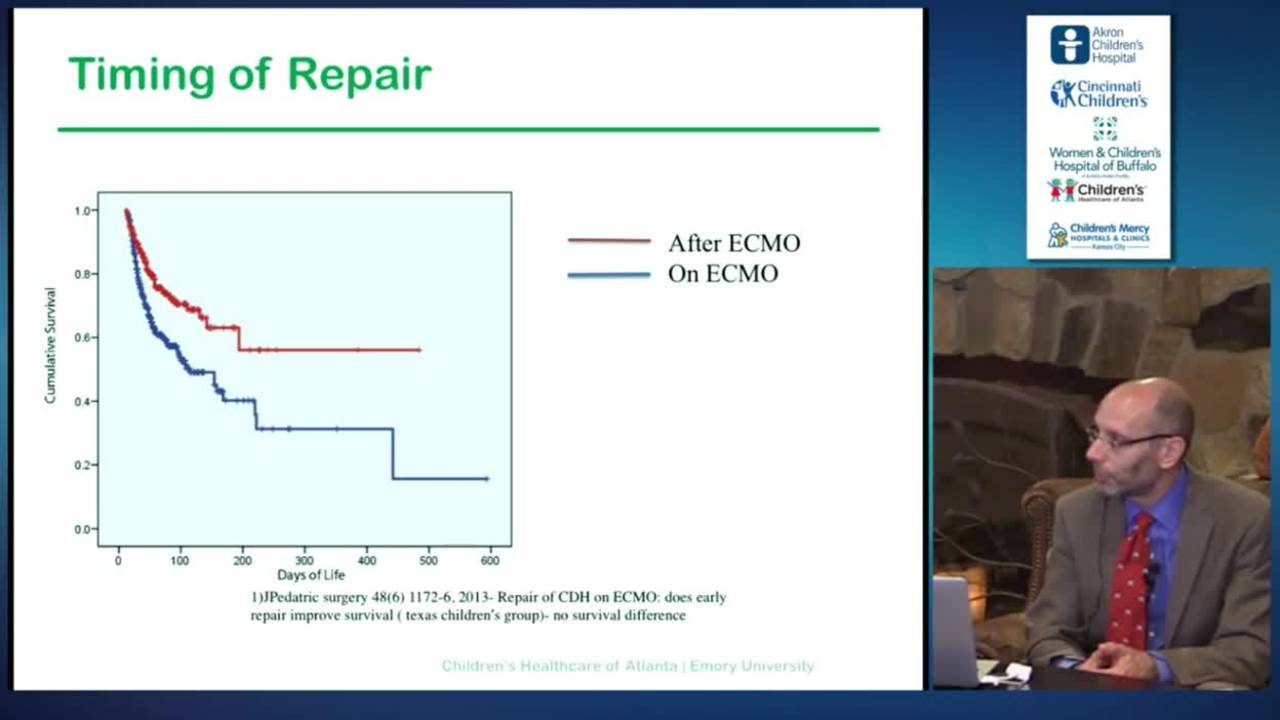
Anticoagulation choice determines when you can operate. For congenital diaphragmatic hernia on ECMO, bivalirudin allows surgical repair after 8 hours once levels are stable, versus traditional anticoagulation requiring longer equilibration 7:26. Early repair while on ECMO is safe with an optimal window between 8 to 24 hours 7:49. The Michigan SER Protocol showed survival was equivalent between ECMO and comfort care groups for severe unilateral CDH based on prenatal criteria 6:43, but the majority of centers still do VA ECMO primarily for these babies 6:34. The judgment is not whether to offer ECMO — it is when to operate once the child is on it.

Surgery-first for cholelithiasis avoids the ERCP pancreatitis tax

ERCP causes pancreatitis 10% of the time regardless of operator skill 12:02. Surgery-first pathway for pediatric cholelithiasis achieves 86% stone clearance reflected by negative intraoperative cholangiogram 12:14, rising to the 90s with simple flushing, catheter manipulation, or reaming the sphincter 12:25. The approach reduces resource utilization including MRCP 11:33. The lesson is that preoperative imaging and endoscopy are not neutral — they carry procedural risk and delay. If you can clear the duct at the index operation, the ERCP was avoidable.

Biliary atresia outcomes degrade with every delay

Every 10-day delay in biliary atresia treatment worsens outcomes by 20% 13:41. MMP-7 sensitivity is reasonable but cutoffs vary between teams because the assay is still evolving 13:58. Cincinnati Children's commitment is Kasai procedure within 7 days of patient presentation 14:21. The biomarker aids earlier diagnosis, but the real intervention is institutional commitment to move fast once the diagnosis is suspected. Waiting for perfect diagnostic certainty costs native liver survival.

Pilonidal disease: operate less by managing more

Hair removal protocol reduces surgical need. A US Army clinic with captive patient population implementing weekly shaving protocol observed dramatic improvement and significantly reduced surgical intervention 16:40. Clipping is the easiest and simplest approach when a parent or active caregiver is involved, recommended once weekly 17:17. Patients presenting with wounds as initial presentation tend to not always reach full healing with minimally invasive approach 16:23. The judgment is recognizing that some pilonidal disease is a hygiene problem masquerading as a surgical problem — and that operating on someone who will not maintain hair removal is setting them up for recurrence.

The discussants emphasized that these are not protocol deviations — they are the judgment calls that come from managing fifty cases instead of five.

Takeaways from this story

  • Cryoanalgesia blocks fail with single lumen tubes and anterior probe placement — technique assumptions matter more than technology.
  • Bivalirudin ECMO allows CDH repair after 8 hours versus traditional anticoagulation, opening an optimal surgical window at 8-24 hours.
  • Surgery-first for cholelithiasis achieves 86-90% stone clearance while avoiding ERCP's 10% pancreatitis rate regardless of skill.
  • Every 10-day delay in biliary atresia treatment worsens outcomes by 20% — institutional speed matters more than biomarker precision.
  • Weekly hair removal protocol in pilonidal disease dramatically reduces surgical need — some cases are hygiene problems, not surgical ones.

Keywords

Hashtags

Transcript

Comments

Loading comments…