14 views 0 likes

StayCurrentMD

GCMD Space · View profile →

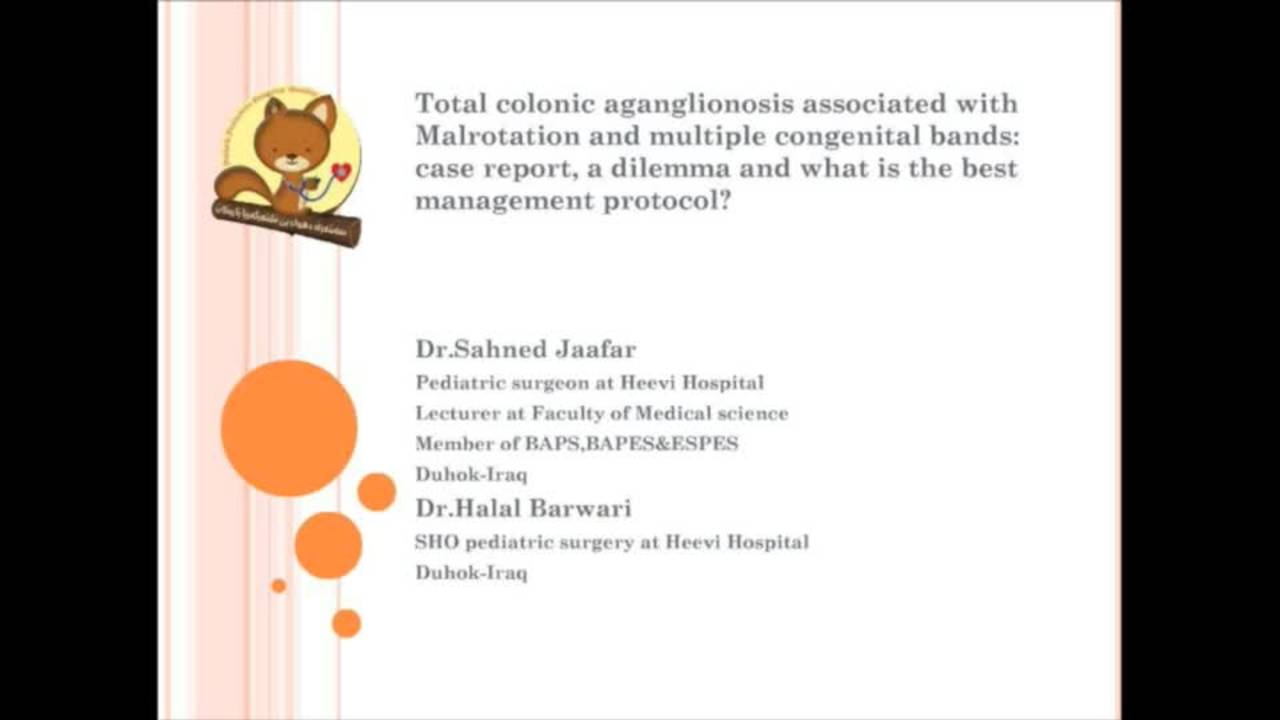
Total Colonic Hirschsprung Disease with Malrotation: Difficult Cases

Video Published 2019-01-11 Updated 2026-06-10

Timestops (4)

Topic Overview

A case presentation of a neonate with total colonic Hirschsprung disease, malrotation with multiple congenital bands, and a cone segment in the terminal ileum—a combination the presenter believes is the first reported. The infant underwent laparotomy with band lysis and ileostomy creation, but experienced poor weight gain and recurrent dehydration. Faculty discussion centers on surgical approach for total colonic Hirschsprung disease (Duhamel vs. Soave), timing of definitive repair based on ileostomy output consistency rather than age or weight, and the importance of sodium supplementation and monitoring in infants with ileostomies to support growth.

Key Takeaways

  • Delay definitive repair until ileostomy output firms up, not based on age/weight alone—liquid output predicts poor outcomes. (6:41)
  • Check ileostomy effluent sodium (>5-7 mEq/L causes poor weight gain); serum sodium stays normal for months despite losses. (9:18)
  • For total colonic Hirschsprung, Duhamel preferred for its simplicity and built-in reservoir; continence achieved in ~50% only. (6:26)
  • All infants with ileostomy likely need sodium supplementation; monitor urinary sodium to guide dosing and ensure growth. (10:04)
  • Malrotation with Hirschsprung usually presents as bilious vomiting; if bowel doesn't open post-Ladd, consider Hirschsprung. (5:20)

Inside this episode

Kai, the Library's AI content creator, listened to this episode and mapped who's speaking, the chapters, key claims, and cases. Every item links to the exact moment in the recording.

AI-enriched

Who's speaking

  • Dr. Jafar — guest
  • Todd — host
  • Speaker 3 — guest
  • Speaker 4 — guest
  • Sharif — guest
  • Speaker 6 — guest

Chapters

  • 0:02Case Presentation: Multiple GI Anomalies — Presenter describes a neonate with delayed meconium passage who developed signs of Hirschsprung disease at day 7. Laparotomy revealed malrotation with three congenital bands, collapsed colon, and a cone segment in the terminal ileum. Biopsies confirmed total colonic aganglionosis. Ileostomy was created; infant experienced poor weight gain and recurrent dehydration despite nutritional support.
  • 3:06Literature Review and Imaging — Presenter reviews literature on total colonic Hirschsprung disease with malrotation (few reported cases) and congenital bands (rare, possibly from antenatal perforation). Presents intraoperative images showing bands between bowel loops, abdominal wall, and liver; spread duodenum; and collapsed terminal ileum and colon.
  • 5:09Faculty Discussion: Surgical Approach and Timing — Faculty discuss surgical options for total colonic Hirschsprung disease. One faculty member advocates Duhamel for its reservoir function and bases timing on ileostomy output consistency (waiting until solid food firms output) rather than age or weight. Another emphasizes that good continence outcomes in long-segment disease are only about 50%, and that small bowel involvement beyond 50 cm from the ileocecal valve indicates more global dysmotility. A third faculty member argues no procedure is definitively superior and surgeons should use the technique they perform best.
  • 8:24Nutritional Management and Continence Considerations — Faculty address poor weight gain, emphasizing sodium loss through ileostomy (>5-7 mEq/L in effluent prevents growth even with normal serum sodium). Urinary sodium monitoring is recommended to guide supplementation. Iron deficiency is noted as a long-term issue. Discussion of continence outcomes with Soave vs. Duhamel, with one faculty reporting good Soave results in standard cases but complications with Duhamel performed elsewhere. Presenter questions whether a more proximal anastomosis (Rehbein) might improve continence.

Key claims

  • 0:18Infant presented with delayed passage of meconium of more than 48 hours — Dr. Jafar
  • 0:30At day 7 of age, infant presented with signs and symptoms of Hirschsprung disease including abdominal distension, tight rectum with passage of explosive stool after removing examining finger — Dr. Jafar
  • 0:44Full thickness rectal biopsy confirmed absence of ganglion cells — Dr. Jafar
  • 0:58On laparotomy, malrotation with multiple bands was found: one band between loops of bowel, one between bowel and liver, and one between bowel and abdominal wall — Dr. Jafar
  • 1:14Collapsed colon and anterior ileum with typical cone segment were observed — Dr. Jafar
  • 1:32Biopsy from appendix and terminal ileum proved total colonic disease — Dr. Jafar
  • 1:39Postoperatively, infant received IV fluids, antibiotics, total parenteral nutrition, and after bowel function returned, a high-calorie formula (Ensure) with vitamin B12 supplementation — Dr. Jafar
  • 2:04Infant developed multiple attacks of dehydration requiring hospital admission for IV replacement — Dr. Jafar
  • 2:13At 70 days of age, infant's weight was 3.5 kg — Dr. Jafar
  • 3:16Only a few cases have been reported of total colonic Hirschsprung disease associated with malrotation (Philone had 4 patients, one other author had 1 patient, Zbra reported 3 patients) — Dr. Jafar
  • 3:26No cases have been reported with all three anomalies (total colonic Hirschsprung, malrotation, and congenital bands) — Dr. Jafar
  • 3:46Congenital bands are rare and only a few cases have been reported; etiology is unknown but could be attributed to antenatal perforation of the bowel — Dr. Jafar
  • 5:20The usual scenario for malrotation with Hirschsprung disease is a child with bilious vomiting who gets a contrast study showing malrotation, undergoes Ladd procedure, but then doesn't open up, leading to discovery of total colonic Hirschsprung disease — Speaker 3
  • 5:42After a Ladd procedure, if the baby doesn't open up, you must think about other potential causes for bilious vomiting — Speaker 3
  • 5:54Hirschsprung disease associated with malrotation is usually short segment, not total colonic — Speaker 3
  • 6:26For total colonic Hirschsprung disease, preferred operation is Duhamel because it is simple, safe, and provides a reservoir at the bottom, which Soave does not — Speaker 3
  • 6:41Timing of definitive repair should be based on consistency of ileostomy output, not age or weight — Speaker 3
  • 6:50Infants don't do well if definitive repair is done too early when ileostomy output is still very liquid; better to wait until it firms up, which usually happens when they get onto solid food — Speaker 3
  • 7:13For long segment or total colonic Hirschsprung disease, a relatively short piece of colon should be left, creating a small reservoir rather than a long Martin modification element — Speaker 4
  • 7:32Good continence control in long segment Hirschsprung disease is achieved in only about 50% of patients — Speaker 4
  • 7:54When small bowel involvement extends more than 50 cm from the ileocecal valve, it represents a more progressive disease with a bigger dysmotility element — Speaker 4
  • 8:31There is no evidence in the literature that any particular procedure is definitively better for long segment Hirschsprung disease; surgeons should use the procedure they have the best results with — Sharif
  • 9:18Poor weight gain in an infant with ileostomy receiving adequate calories and normal blood tests is often due to sodium loss — Sharif
  • 9:49Serum sodium will remain normal for many months before decreasing, so sodium levels in the ileostomy effluent must be checked — Sharif
  • 9:57If ileostomy effluent contains more than 5 to 7 mEq per liter of sodium, the baby will not gain weight — Sharif
  • 10:04The baby must be gaining weight and growing before proceeding with definitive repair — Sharif
  • 10:10Measuring urinary sodium is the best way to guide sodium replacement dosing — Speaker 3
  • 10:10Every baby with an ileostomy should probably receive sodium supplementation — Speaker 3
  • 10:26Iron deficiency is a long-term issue in children with ileostomies and any repairs performed — Speaker 4
  • 10:46For total colonic Hirschsprung disease, if doing Soave or other procedure, must wait until baby grows and ileostomy is thicker, then can continue with bulking agents or antidiarrheal agents — Speaker 6
  • 11:20Some patients who had Duhamel performed abroad came back with enterocolitis, obstruction, and distension of the Duhamel pouch — Speaker 6
  • 11:42Monitoring ileostomy output before deciding on any procedure is critical — Speaker 6
  • 11:42Some patients who had ileal-anal anastomosis developed severe erosive perianal skin breakdown requiring protective ileostomy before further procedures — Speaker 6
  • 12:40In regular (non-total colonic) Hirschsprung disease patients treated with Soave, incontinence is not seen if the procedure is performed well without damaging sphincters — Speaker 6

Cases discussed

  • 0:02Neonate with total colonic Hirschsprung disease, malrotation with three congenital bands, and cone segment in terminal ileum

Points of disagreement

  • 6:26Preferred surgical procedure for total colonic Hirschsprung disease
    • Speaker 3: Prefers Duhamel because it is simple, safe, and provides a reservoir, unlike Soave
    • Sharif: No procedure is definitively superior; surgeons should use the technique they have best results with
    • Speaker 6: Prefers Soave with good results in standard cases; has seen complications with Duhamel performed elsewhere
  • 10:10Best method to guide sodium supplementation in infants with ileostomies
    • Sharif: Check sodium levels in ileostomy effluent (>5-7 mEq/L prevents growth)
    • Speaker 3: Measuring urinary sodium is the best way to guide sodium replacement dosing

Open questions

  • What is the best feeding regimen for this infant to improve weight gain?
  • What is the best definitive procedure: Martin, Rehbein, Duhamel, or ileostomy with ileal pouch creation?
  • What is the risk of incontinence with each procedure?
  • What is the best timing for definitive procedure: based on weight or age?
  • What is the optimal length of the Duhamel pouch to avoid future complications such as enterocolitis and obstruction?
This episode was analyzed and enriched by Kai, the Library's AI content creator. Every item links to the moment it comes from — click a timestamp to listen in context.
Written for:

Total Colonic Hirschsprung Disease with Malrotation and Congenital Bands: A Rare Triad

The patient case from this episode, retold from presentation to outcome with the decisions made along the way. Written by Kai from the episode transcript and reviewed before publishing.

For the care team · Case narrative · AI-written, human-reviewed

Presentation

A neonate presented with delayed passage of meconium beyond 48 hours 0:18. Meconium passed after rectal examination, but the infant was kept for observation. At day 7 of life, the clinical picture clarified: abdominal distension, a tight rectum, and explosive stool after digital examination 0:30. Full-thickness rectal biopsy confirmed aganglionosis 0:44.

The Decision Point

The team planned laparotomy for transverse colostomy creation — standard management for confirmed Hirschsprung disease. At exploration, they encountered findings that changed the operation entirely. Malrotation was present, with three distinct congenital bands: one between bowel loops, one tethering bowel to liver, and one fixing bowel to the abdominal wall 0:58. The colon was collapsed, and the terminal ileum showed a characteristic cone segment 1:14. Biopsies from the appendix and terminal ileum confirmed total colonic involvement 1:32.

The combination of total colonic Hirschsprung disease, malrotation, and multiple congenital bands has not been reported 3:26. Congenital bands themselves are rare; their etiology remains unknown, though antenatal bowel perforation has been proposed 3:46. The more common scenario in malrotation with Hirschsprung disease is a child with bilious vomiting who undergoes a Ladd procedure for presumed isolated malrotation, then fails to decompress, prompting the discovery of total colonic disease 5:20. After a Ladd procedure, persistent obstruction mandates reconsideration of the differential 5:42. When the two conditions coexist, Hirschsprung disease is usually short-segment, not total colonic 5:54.

Management

The team released all bands and created an ileostomy in the left upper quadrant rather than the planned colostomy. Postoperatively, the infant received IV fluids, antibiotics, and total parenteral nutrition, transitioning to a high-calorie formula (Ensure) with vitamin B12 supplementation once bowel function returned 1:39. Despite this regimen, the infant developed recurrent dehydration requiring multiple hospital admissions for IV replacement 2:04. At 70 days of age, weight was 3.5 kg — slow growth for a child now four months old 2:13.

The Weight Gain Problem

Poor weight gain in an infant with an ileostomy receiving adequate calories and normal serum studies is often sodium loss 9:18. Serum sodium remains normal for months before declining, masking the deficit 9:49. Sodium levels in the ileostomy effluent must be measured directly. If effluent contains more than 5 to 7 mEq per liter of sodium, the infant will not gain weight 9:57. Urinary sodium measurement is the most reliable guide for sodium replacement dosing 10:10, and some advocate routine sodium supplementation for every infant with an ileostomy 10:10. The infant must be gaining weight and growing before definitive repair is attempted 10:04. Iron deficiency is another long-term concern in children with ileostomies and should not be overlooked 10:26.

Timing and Choice of Definitive Repair

For total colonic Hirschsprung disease, timing of definitive repair should be guided by the consistency of ileostomy output, not age or weight 6:41. Infants do poorly if repair is performed while output remains liquid; waiting until it firms up — typically when solid food is introduced — yields better results 6:50.

Procedure choice remains debated. One approach favors the Duhamel procedure for its simplicity, safety, and creation of a small reservoir, which the Soave does not provide 6:26. When performing Duhamel for long-segment or total colonic disease, a relatively short piece of colon should be left to create a small reservoir rather than a long Martin modification 7:13. However, there is no evidence in the literature that any particular procedure is definitively superior for long-segment Hirschsprung disease; surgeons should use the procedure with which they have the best results 8:31.

Expectations must be realistic. Good continence control in long-segment Hirschsprung disease is achieved in only about 50% of patients 7:32. When small bowel involvement extends more than 50 cm from the ileocecal valve, the disease is more progressive, with a larger dysmotility component 7:54. Some patients who underwent Duhamel developed enterocolitis, obstruction, and distension of the Duhamel pouch 11:20. Others who had ileal-anal anastomosis developed severe erosive perianal skin breakdown requiring protective ileostomy before further procedures 11:42. Monitoring ileostomy output before proceeding with any definitive procedure is critical 11:42.

What the Case Changes

This case illustrates that persistent obstruction after addressing one anatomic abnormality demands systematic reconsideration of the differential. The triad of total colonic Hirschsprung disease, malrotation, and congenital bands is exceedingly rare, but the principle is universal: when a neonate does not decompress as expected, the diagnosis is incomplete. Before definitive repair of total colonic disease, sodium balance must be addressed — serum sodium is a lagging indicator, and effluent or urinary sodium guides replacement. Finally, in long-segment Hirschsprung disease, no single operation has proven superiority; the best procedure is the one the surgeon performs best, and families must understand that even optimal surgery yields good continence in only half of patients.

Takeaways from this story

  • After Ladd procedure, persistent obstruction mandates reconsideration — total colonic Hirschsprung may be the hidden diagnosis.
  • Poor weight gain with normal serum sodium often reflects ileostomy sodium loss; measure effluent or urinary sodium to guide replacement.
  • Time definitive repair by ileostomy output consistency, not age or weight — wait until output firms up with solid food introduction.
  • No procedure is proven superior for total colonic Hirschsprung; use the operation you perform best and counsel that good continence occurs in ~50%.

Keywords

Hashtags

Transcript

Comments

Loading comments…