


From
StayCurrentMD
Telementoring - Transforming Healthcare, Episode 5
hosted by Dr. Em Gootee & Dr. Todd Ponsky
Chapter 1 of 3 · Fundamentals
Introduction
Introduction to telementoring and episode overview
Expert statements on this page
No expert statements were drawn from this page.
Host summaries · secondary, not cited in answers
Educational content from recorded physician discussions — not medical advice. Talk to your (or your child's) care team about your situation.
Video
Intestinal Atresia Types Explained: Grossfeld Classification for Pediatric Surgery
1 min · Published Sep 2026
Video
Derivation and validation of the Pediatric Community-Acquired Pneumonia Severity (PedCAPS) score: A prospective cohort study
50 s · Published Sep 2026
Video
FETO for Late-Diagnosed Severe Congenital Diaphragmatic Hernia (CDH) at Cincinnati Children's with Dr. Beth Rymeski
4 min · Published Sep 2026
Video
Severe Congenital Diaphragmatic Hernia (CDH) Case: FETO Management & Unexpected Findings with Dr. Beth Rymeski
3 min · Published Sep 2026
Video
Fetoscopic Endoluminal Tracheal Occlusion (FETO) Procedure: Step-by-Step Guide with Dr. Beth Rymeski
4 min · Published Sep 2026
Video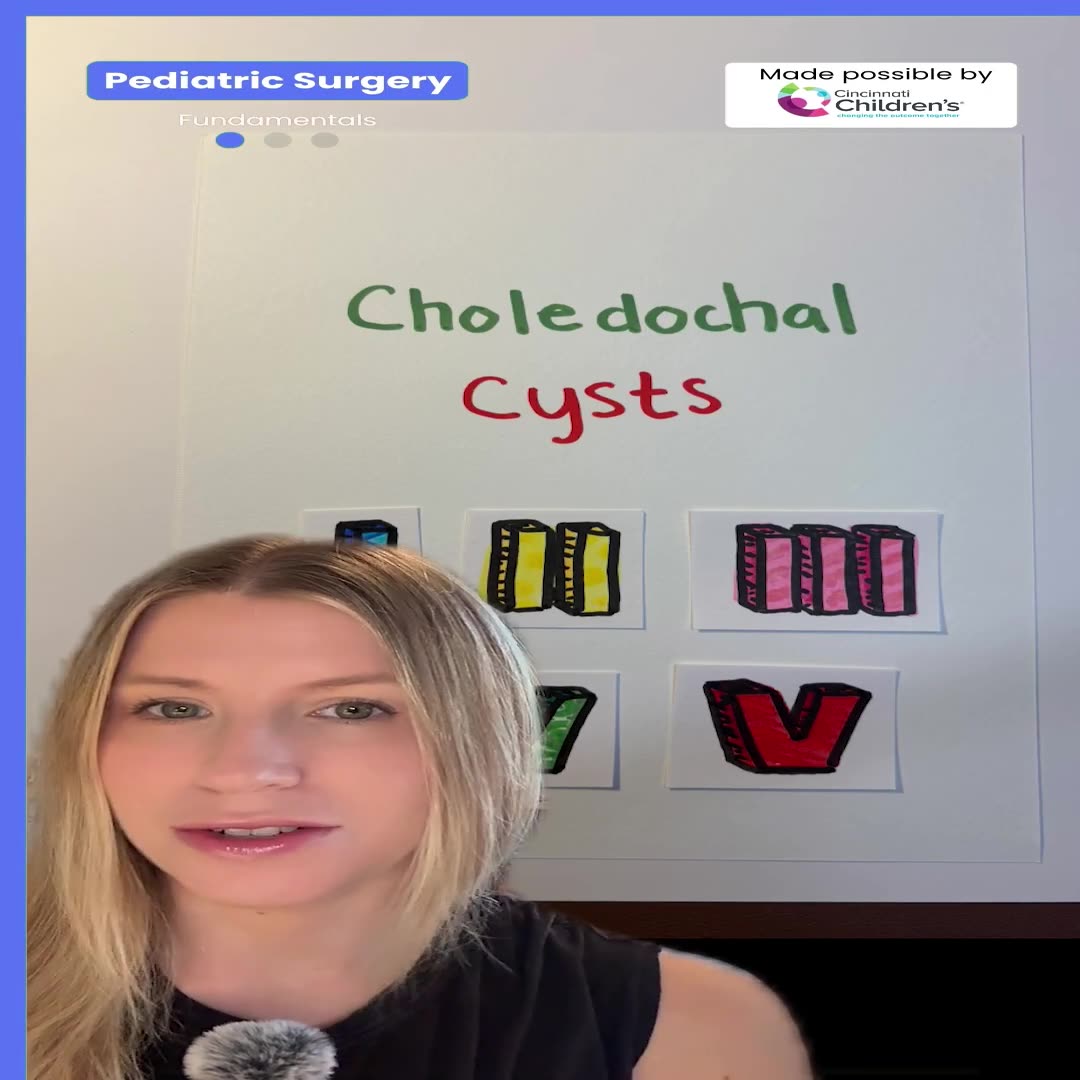
Choledochal Cyst Types Explained: Pediatric Surgery Fundamentals
1 min · Published Sep 2026
What the experts said
In traditional surgical training, a resident trainee spends time with an expert, first watching the expert, then the expert watches the trainee repeatedly, with the trainee gaining more autonomy over time.
After graduation, surgeons practice independently and face challenges learning new devices and technologies that are developed.
A model was created for how a practicing surgeon can learn a new technique, with step one being a course or didactic instruction.
Step two of the learning model is that the trainee watches the expert physically in the operating room.
A simulation model is instituted at step two in preparation for step three.
Step three is that the trainee actually performs the case and the expert watches them physically in the operating room.
It is difficult in practice to keep traveling to go watch the expert over and over again.
The concept of telementoring was instituted to address the difficulty of repeated travel for in-person expert observation.
Telementoring is defined as a relationship facilitated by telecommunication technology in which an expert provides guidance to a less experienced learner from a remote location.
Previous research has shown that telementoring can be used effectively and reliably as a surgical training aid.
Telementoring allows two surgeons to work together virtually, where the expert can watch the trainee and certify that they are able to do the case on their own.
Proximie is one of the leaders in telementoring technology.
Proximie is a telepresence software platform that allows clinicians to virtually scrub in to any operating room or cath lab from anywhere in the world.