


From
StayCurrentMD
Suspected Hirschsprung's-associated enterocolitis (HAEC) Treatment Guideline...
With Dr. Meera Kotagal · hosted by Dr. Todd Ponsky
Chapter 1 of 4 · Fundamentals
Introduction
Expert statements on this page
No expert statements were drawn from this page.
Host summaries · secondary, not cited in answers
Educational content from recorded physician discussions — not medical advice. Talk to your (or your child's) care team about your situation.
Video
Technique: Laparoscopic Assisted Pull-through for Hirschsprung's Disease
Dr. Steve Rothenberg · 10 min · Published Nov 2018
Podcast
The Colorectal Quiz Episode 20: Hirschsprung Disease Obstruction Part 2
21 min · Published Sep 2021
Video
Top Themes From The Stay Current App
Published Sep 2020
Podcast
The Colorectal Quiz Episode 10: Total Colonic Hirschsprung Disease Part 1
12 min · Published Apr 2021
Video
Quick Literature Updates Ep 23
4 min · Published Oct 2025
Video
Transitional Care in Anorectal Malformation and Hirschsprung's Disease
1 min · Published Jul 2024
Video
Validation of an anorectal malformation trainer - Can a high-fidelity model simulate real life?
1 min · Published Jun 2026
Video
Complications and Long-Term Outcomes of Patients With Cloacal Malformation After Bowel Neovagina...
1 min · Published Jun 2026
Video
Safety and utility of long-acting steroid injection for management of post-operative stricture...
1 min · Published Jun 2026
Video
Association Between Social Determinants of Health and Choice of Urinary Reconstruction in Children
1 min · Published Jun 2026
Video
The Perineal Body Preserving PSARP (PPP)
11 min · Published Jun 2026
Video
Update Course Rewind 2025: Hirschsprung + ARM: Rare but Real
1 min · Published May 2026
Video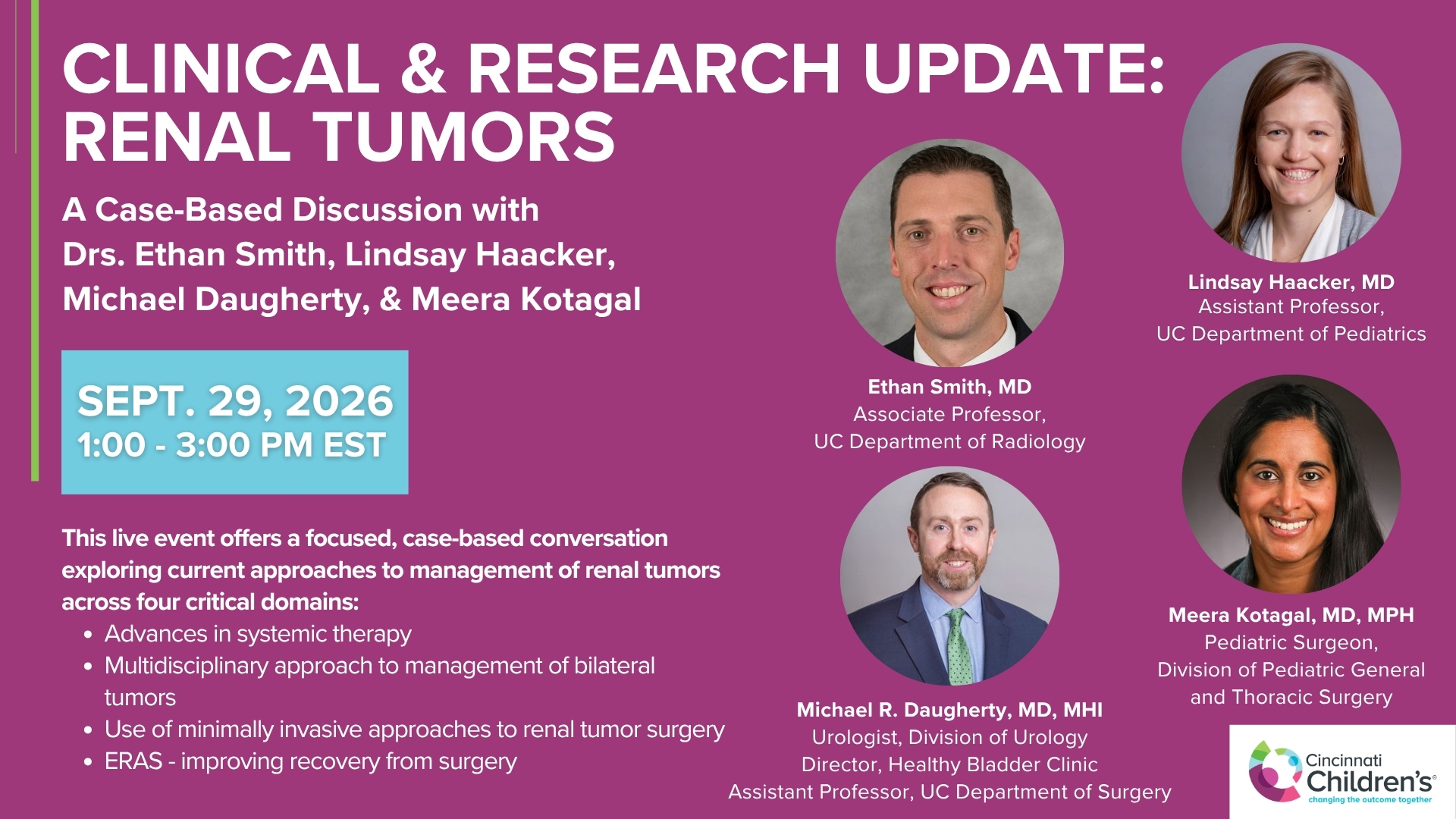
Clinical & Research Update: Renal Tumors with Drs. Ethan Smith, Lindsay Haacker, Michael Daugherty, and Meera Kotagal
71 min · Published Sep 2026
Video
Neuroblastoma with Dr. Meera Kotagal
14 min · Published Sep 2024
Video
Update Course Rewind: 2023 Top Ten Key Takeaways
16 min · Published Jun 2024
Podcast
Inguinal Hernias: Diagnosis and Management
16 min · Published Apr 2021
Video
7th Annual Pediatric Surgery Update Course 2019 - FULL SHOW
285 min · Published Jul 2020
Video
Intestinal Atresia Types Explained: Grossfeld Classification for Pediatric Surgery
1 min · Published Sep 2026
Video
Derivation and validation of the Pediatric Community-Acquired Pneumonia Severity (PedCAPS) score: A prospective cohort study
50 s · Published Sep 2026
Video
FETO for Late-Diagnosed Severe Congenital Diaphragmatic Hernia (CDH) at Cincinnati Children's with Dr. Beth Rymeski
4 min · Published Sep 2026
Video
Severe Congenital Diaphragmatic Hernia (CDH) Case: FETO Management & Unexpected Findings with Dr. Beth Rymeski
3 min · Published Sep 2026
Video
Fetoscopic Endoluminal Tracheal Occlusion (FETO) Procedure: Step-by-Step Guide with Dr. Beth Rymeski
4 min · Published Sep 2026
Video
Choledochal Cyst Types Explained: Pediatric Surgery Fundamentals
1 min · Published Sep 2026
What the experts said
Papers by Pastor et al and Gosain et al outline frameworks and clinical guidelines for management of enterocolitis
The guideline is most appropriate for patients with either known or suspected Hirschsprung's who present with GI symptoms and/or fever
GI symptoms in HAEC include abdominal distension, vomiting, no or minimal stool, foul smelling stool, or explosive diarrhea
Systemic signs of concern include fever, lethargy, age-adjusted tachycardia, tachypnea, hypotension, or oliguria
Patients should be seen and evaluated as soon as possible, ideally within one hour by someone with clinical expertise such as a surgical fellow or attending
The exam should include a rectal exam
If the patient is less than four weeks out from surgery, fellows should discuss the rectal exam with an attending surgeon prior to performing it
Irrigations should not be delayed for patients to get an x-ray
Irrigations should be repeated as frequently as every eight hours, but even every six or four hours as needed for sicker patients
Abdominal films should be obtained upon arrival and then repeated again after an irrigation to demonstrate adequate decompression
Abdominal films can be repeated throughout the course of the hospitalization as clinically necessary
Patients should be NPO and started on IV fluids to assist with resuscitation and hydration
Patients without systemic signs who are mostly clinically well can be maintained on either IV or oral flagyl during hospitalization
All patients who are vomiting should be on IV antibiotics
Patients with systemic signs who are sicker need broad spectrum antibiotics, specifically Zosyn and flagyl at Cincinnati Children's
All patients should get a CBC and a basic metabolic panel
A venous blood gas should be obtained for sicker patients to help evaluate resuscitation needs
Patients with systemic signs should be evaluated for potential admission to the ICU
After an admission for enterocolitis, patients are continued on metronidazole and irrigations for a few weeks and then slowly tapered
Underlying anatomic issues such as a stricture or a transition zone pull through must be addressed to prevent recurrent enterocolitis