


From
Dr. Nelson G. Rosen
Surgical management of chronic pancreatitis in children: when and how to intervene
With Dr. Juan Gurria · hosted by Lizzy Lee, PA-C
Chapter 1 of 4
Surgical indications
Introduction and indications for surgical intervention
Expert statements on this page
No expert statements were drawn from this page.
Host summaries · secondary, not cited in answers
Educational content from recorded physician discussions — not medical advice. Talk to your (or your child's) care team about your situation.
Video
Surgical Interventions for Pancreatitis in Children: Insights from Dr. Juan Gurria
4 min · Published Oct 2026
Video
Total pancreatectomy with islet autotransplantation (TPIAT) - Cincinnati Children's Pancreas Care Center
CCHMC Pediatric Surgery · 10 min · Published Dec 2024
Video
Update Course Rewind: Management of Chronic Pancreatitis 2023
8 min · Published Apr 2024
Video
Overview of the Surgical Management of Acute and Chronic Pancreatitis in Children with Dr. Juan Gurria
66 min · Published Apr 2026
Podcast
Total Pancreatectomy with Islet Autotransplantation (TPIAT)
Juan Pablo Gurria · 10 min · Published Dec 2024
Podcast
Managing pancreatic fluid collections and chronic pancreatitis complications in children
2 min · Published Nov 2026
Podcast
Pediatric pancreatitis: diagnosis, causes, and genetic insights with Dr. Juan Gurria
3 min · Published Nov 2026
Podcast
Preparing for successful ECPR: team coordination and early activation strategies
2 min · Published Nov 2026
Podcast
Surgical Decision-Making in Necrotizing Enterocolitis: Imaging, Timing, and Operative Strategies
11 min · Published Nov 2026
Video
Robotics in Pediatric Surgery: Which indications benefit the most? w/ Dr. Juan Gurria
18 min · Published Oct 2026
Video
How to Jumpstart a Robotic Practice in Pediatrics with Dr. Juan Gurria
99 min · Published Oct 2026
Video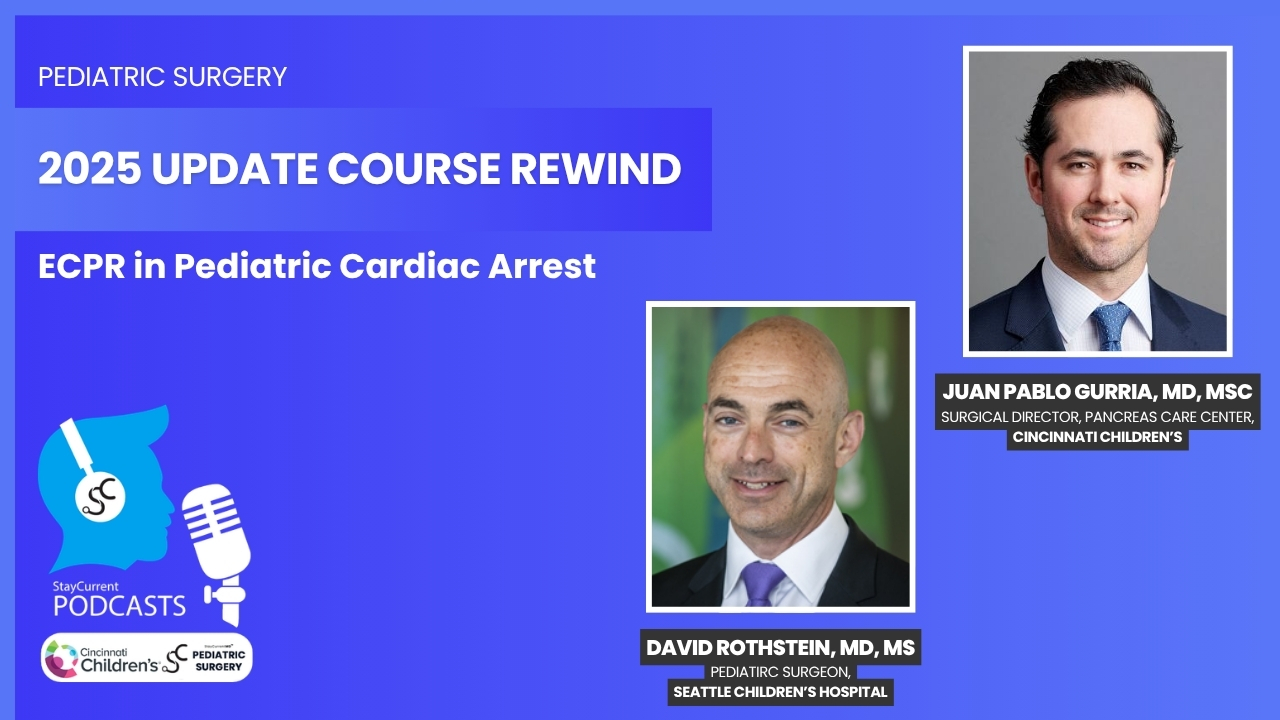
Update Course Rewind 2025: ECPR in Pediatric Cardiac Arrest with Drs. Juan Gurria & David Rothstein
2 min · Published Oct 2026
Podcast
Routine Anal Dilations After PSARP: Questioning a Decades-Old Practice
2 min · Published Nov 2026
Podcast
Pediatric Surgery Literature Updates: Lymphatic Malformations, G-Tube Complications, and Cryptorchidism Timing
4 min · Published Nov 2026
Podcast
Botox injection during Hirschsprung pull-through: evidence and technique considerations
1 min · Published Nov 2026
Podcast
Central line troubleshooting and vascular access preservation in pediatric patients
2 min · Published Nov 2026
Podcast
Colorectal Quiz Episode 50: Key Takeaways from the 16th European Pediatric Colorectal Conference
24 min · Published Nov 2026
Podcast
Nerve monitoring and risk stratification in pediatric thyroid surgery
6 min · Published Nov 2026
What the experts said
Cincinnati Children's Pancreas Care Center evaluates over 100 patients per year for chronic pancreatitis and operates on only 30 of them because medical management options remain for the others.
Some pediatric chronic pancreatitis patients are as young as 3 years old, have known only pain in their lives, fail to achieve developmental milestones, and are on opioids by age 5 or 6.
In patients with genetic mutations causing pancreatitis, partial pancreatic resection may temporarily relieve pain but the genetic mutations continue to affect the remaining pancreas, making partial resection a disservice to the patient.
Some referrals for pancreatic tumors in children turn out to be autoimmune pancreatitis upon evaluation.
Segmental resection should never be offered to a patient with a PRSS1 mutation.
After total pancreatectomy, patients become automatic diabetics; to address this, islets are extracted from pancreatic tissue and infused back into the patient's system.
Dr. Gurria performs post-pyloric duodenal resection during TPIAT reconstruction because all these patients have gastroparesis.
Dr. Gurria injects Botox into the pyloric muscle to keep the pyloric gate open during TPIAT reconstruction.
Cincinnati Children's has an in-house lab that performs islet isolation, which takes about 3.5 hours.
When islet cells are ready, they are injected through the splenic vein into the portal vein.
Portal vein thrombosis is a significant risk during TPIAT because islet infusion is like putting milkshake into a low-flow vein, which can easily clog.
Dr. Gurria performs TPIAT under anticoagulation to reduce the risk of portal vein thrombosis.
The most common reason for surgical intervention in pediatric chronic pancreatitis is severe pain refractory to non-surgical treatment.
Surgical options for pediatric chronic pancreatitis include drainage, partial resection, and combination drainage-resection, but these do not work for children with hereditary disease.
When an inflammatory head mass is seen in the pancreas of a child, autoimmune pancreatitis should be considered in the differential diagnosis.
Surgery may be an option for children with large duct disease, strictures, or trauma-related pancreatic anatomy issues, but genetic causes of pancreatitis need a different strategy.
Total pancreatectomy with islet autotransplantation (TPIAT) removes the pancreas in children with severe refractory disease to control chronic pain.
In TPIAT, islet cells that normally produce insulin are extracted from the pancreas and transplanted back into the patient through the portal vein, where they take up residence in the liver.
Dr. Gurria published a 2025 paper showing that Botox injection after pancreatectomy with islet autotransplantation improved gastroparesis in children.
After TPIAT for chronic pancreatitis, there is an 80% drop in opioid use one month postoperatively with a sustained effect for years.
Complications after TPIAT can include bleeding or portal vein thrombosis.
Surgical intervention for pediatric chronic pancreatitis is reserved for patients with severe pain that persists despite other treatment options.
Conventional pancreatic drainage or resection procedures may help children with ductal obstruction, strictures, or trauma-related disease, but are generally not appropriate for hereditary pancreatitis because the underlying genetic process continues to damage the remaining pancreas.
TPIAT is not a first-line therapy for pancreatitis and careful patient selection is essential.
In appropriately selected patients, TPIAT can provide substantial pain relief, improve quality of life, and achieve acceptable long-term glycemic control.