7 views 0 likes

StayCurrentMD

GCMD Space · View profile →

Problematic Anorectal Malformation Cases: Pediatric Colorectal Controversies...

Video Published 2019-01-11 Updated 2026-06-10

Timestops (6)

Topic Overview

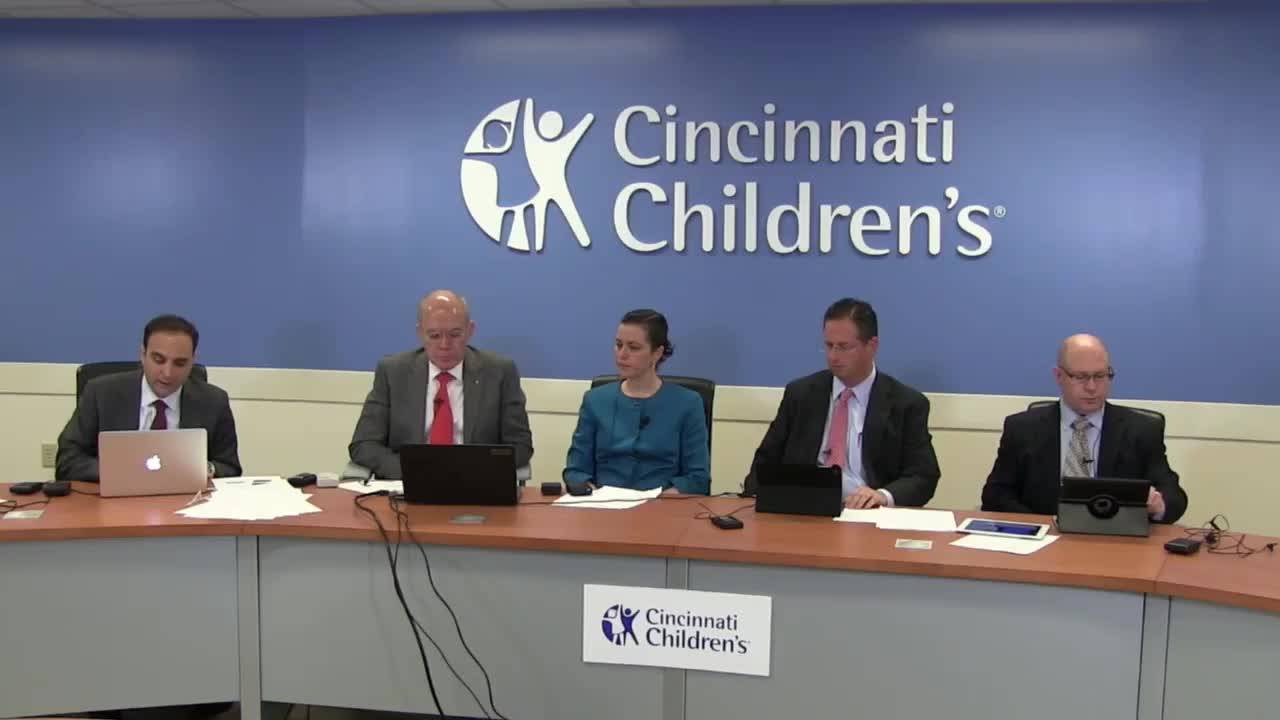
A panel discussion on postoperative management and complications following anorectal malformation (ARM) repair in females. The discussants debate dilatation protocols, with one panelist advocating weekly in-clinic calibration rather than daily parental dilatation at home, citing comparable stricture rates and reduced psychological burden. Common complications presented include retained vestibular fistulas, posterior mislocation of the neoanal opening, rectal prolapse managed with staged hemi-anoplasty, and posterior urethral diverticula after laparoscopic pull-through for bulbar fistulas—one case progressing to adenocarcinoma after 30 years.

Key Takeaways

  • Weekly in-clinic calibration for 6 weeks shows no difference in stricture/perforation rates vs daily home dilatation, sparing families burden. (2:16)
  • Retained vestibular fistula post-ARM repair is benign if neoanal opening adequate, but problematic if large and extends behind perineal body. (6:41)
  • Staged hemi-anoplasty for rectal prolapse eliminates need for dilatations; half-circumferential repair heals without stricture. (10:36)
  • Posterior urethral diverticulum after laparoscopic pull-through represents retained distal rectum from inadequate dissection. (12:00)
  • Colonic mucosa in posterior urethral diverticulum bathed in urine for 30 years progressed to adenocarcinoma in one reported case. (12:50)

Inside this episode

Kai, the Library's AI content creator, listened to this episode and mapped who's speaking, the chapters, key claims, and cases. Every item links to the exact moment in the recording.

AI-enriched

Who's speaking

  • Speaker 1 — host
  • Jeff — guest
  • Speaker 3 — guest
  • Speaker 4 — guest
  • Ivo — guest

Chapters

  • 0:00Standard follow-up and dilatation protocols — Panelists describe their postoperative follow-up schedules and dilatation practices for ARM repair, ranging from 2-week to 6-month intervals, with geographic challenges noted for remote patients.
  • 3:18Debate on parental dilatation necessity — One panelist presents a minority opinion that weekly in-clinic calibration without daily parental dilatation yields equivalent outcomes with less psychological burden, citing a comparative study.
  • 4:44European perspective and trial considerations — European representative discusses ongoing debate about reducing postoperative dilatation protocols, with consideration of a trial starting at 6 weeks.
  • 6:21Complications: retained fistulas and mislocation — Case presentations of retained vestibular fistulas, posterior mislocation of the neoanal opening, and missed urogenital sinus in cloacal repairs.
  • 9:23Rectal prolapse management — Discussion of staged hemi-anoplasty approach for rectal prolapse, performed as ambulatory procedures 3 months apart to avoid stricture and dilatation requirements.
  • 11:29Posterior urethral diverticulum complications — Presentation of posterior urethral diverticulum as a complication of laparoscopic pull-through for bulbar fistula, including one case of adenocarcinoma development after 30 years.

Key claims

  • 0:23Standard follow-up after ARM repair includes seeing patients at 2 weeks to start dilations, then at 1 month, 3 months, 6 months, and yearly thereafter for local patients — Speaker 1
  • 0:46For remote patients in Alaska or Montana, local follow-up is arranged with efforts to bring patients back at 3 and 6 months — Speaker 1
  • 1:06Dilatation protocol involves starting at 2 weeks, teaching parents to dilate at home with Hagar dilators up to size 12 or 13 depending on patient size — Jeff
  • 1:35First-year follow-up occurs every 3 months with strict protocol for constipation management, advising parents not to let child go more than 1.5-2 days without stool — Jeff
  • 2:16Weekly in-clinic calibration for 6 weeks without parental home dilatation shows no difference in stricture rate, perforation rate, or enterocolitis rate compared to daily parental dilatation — Speaker 3
  • 3:01Approximately 10% of patients managed with weekly calibration develop narrowing and require home dilatation — Speaker 3
  • 3:10Daily dilatation by parents is a psychological hardship and not necessary most of the time — Speaker 3
  • 3:38Patients should be kept around Toronto for at least 3-4 weeks postoperatively for weekly follow-up — Speaker 3
  • 3:56Children aged 3-4 years who missed early anoplasty window cannot be dilated by parents at home but do fine with clinic dilatation every 1-2 weeks — Speaker 3
  • 5:18European centers are considering a trial protocol starting with 6 weeks of dilatations to potentially reduce current protocols — Ivo
  • 6:41Retained vestibular fistula after ARM repair is of no consequence if the neoanal opening is adequate, but can be problematic if large and extending behind the perineal body — Speaker 4
  • 7:27Surgical repair goal for dehisced perineal body is to position healthy rectum down, healthy vagina up, and create muscular perineal body structure in between — Speaker 4
  • 7:49Postoperative management options include colostomy for diversion or keeping patient NPO — Speaker 4
  • 8:53Most common problem in cloacal repairs is addressing only the rectum without managing the urogenital sinus — Speaker 4
  • 9:33Misidentification of bladder neck as rectum during pull-through can occur if anatomy is not understood preoperatively — Speaker 4
  • 10:36Staged hemi-anoplasty for rectal prolapse, with second half done 3 months later as ambulatory procedure, eliminates need for dilatations — Speaker 4
  • 11:09Half-circumferential anoplasty heals quickly and does not stricture, unlike full circumferential dissection — Speaker 4
  • 12:00Posterior urethral diverticulum represents retained original distal rectum after inadequate distal dissection during pull-through — Speaker 4
  • 12:25If uncertain of anatomy during laparoscopic pull-through, the colon should be opened to identify the fistula from inside — Jeff
  • 12:50Posterior urethral diverticulum with colonic mucosa bathed in urine for 30 years developed into adenocarcinoma in one case — Speaker 4

Cases discussed

  • 6:24Patient with previous ARM pull-through with retained vestibular fistula
  • 7:04Adult with dehisced perineal body after episiotomy resembling mislocated anus
  • 8:18Patient with posterior mislocation of neoanal opening
  • 8:53Cloaca patient with only rectal component addressed
  • 9:30Misidentified anatomy during pull-through resulting in bladder neck pull-through
  • 11:45Posterior urethral diverticulum after laparoscopic pull-through for bulbar fistula
  • 12:4430-year-old with adenocarcinoma arising from posterior urethral diverticulum

Points of disagreement

  • 2:06Necessity of daily parental dilatation after ARM repair
    • Jeff: Teaches parents to dilate at home with Hagar dilators, following strict protocol with frequent follow-up
    • Speaker 3: Performs weekly in-clinic calibration for 6 weeks without parental home dilatation, citing equivalent outcomes and reduced psychological burden

Open questions

  • What is the optimal dilatation protocol after ARM repair—daily parental dilatation versus weekly in-clinic calibration?
  • Should a randomized trial be conducted comparing daily parental dilatation to weekly in-clinic calibration?
  • What is the minimum duration of postoperative dilatation that maintains acceptable stricture rates?
  • What is the true incidence and long-term malignancy risk of retained posterior urethral diverticula after ARM repair?
This episode was analyzed and enriched by Kai, the Library's AI content creator. Every item links to the moment it comes from — click a timestamp to listen in context.
Written for:

Postoperative Management and Complications in Anorectal Malformation Repair

The episode's main topic retold as a plain-language walkthrough — what it is, why it matters, and what the speakers concluded. Written by Kai from the episode transcript and reviewed before publishing.

For the care team · Explainer · AI-written, human-reviewed

Why This Subspecialty Exists

Anorectal malformations (ARMs) represent a spectrum of congenital defects where the rectum fails to develop normally, often connecting to the urinary or genital tract through a fistula. Surgical correction — typically a posterior sagittal anorectoplasty (PSARP) or laparoscopic pull-through — creates a neoanal opening and positions the rectum within the sphincter complex. The technical repair is only the beginning. These children require years of structured follow-up to manage strictures, constipation, and functional outcomes. The subspecialty exists because getting the anatomy right at surgery means little if the postoperative care fails.

The Core Clinical Problem

The neoanal opening heals by secondary intention and will stricture without mechanical dilation. Simultaneously, these patients face constipation from dysmotility and must avoid fecal impaction, which can destroy a well-positioned repair. The challenge is balancing stricture prevention against the psychological burden of daily parental anal dilation in an infant. Geographic barriers compound this — families living hundreds of miles from the surgical center cannot return weekly, yet inadequate follow-up leads to preventable complications.

How Postoperative Management Works

Standard protocols involve seeing patients at 2 weeks to initiate dilation, then at 1, 3, and 6 months, with yearly follow-up thereafter for local patients 0:23. For remote families — one center covers 25% of U.S. land mass including Alaska and Montana — local providers handle interim care, with efforts to bring patients back at 3 and 6 months 0:46.

The traditional dilation approach starts at 2 weeks, teaching parents to use Hagar dilators at home, advancing to size 12 or 13 depending on patient size 1:06. First-year visits occur every 3 months with strict constipation protocols, advising parents not to let the child go more than 1.5–2 days without stool 1:35.

One discussant presents a minority approach: weekly in-clinic calibration for 6 weeks without parental home dilation. In a comparative study, this showed no difference in stricture rate, perforation rate, or enterocolitis rate compared to daily parental dilation 2:44. Approximately 10% of patients managed this way develop narrowing and require home dilation 3:01. The rationale is straightforward: "Daily dilatation by the parents is a psychological hardship for them, and I don't think it's necessary most of the time" [q4]. This approach requires families to remain near the surgical center for 3–4 weeks postoperatively 3:38. Interestingly, older children (ages 3–4) who missed early repair cannot be dilated by parents at home but do well with clinic dilation every 1–2 weeks 3:56. European centers are considering trial protocols starting with 6 weeks of dilations to potentially reduce current regimens 5:18.

Where Practice Remains Contested

The dilation debate is unresolved. One discussant states he would not have equipoise to randomize patients to daily dilation [q6], while others maintain traditional protocols. The evidence base is thin — one comparative study from a single center, not a randomized trial. Geographic realities force pragmatic compromises that may or may not affect outcomes.

Recognizing and Managing Complications

Retained vestibular fistulas occur when the original fistula is not excised during repair. If the neoanal opening is adequate, this is often inconsequential, but large fistulas extending behind the perineal body leave no structural support and require removal, particularly during revision procedures 6:41. The surgical goal in revision is positioning healthy rectum down, healthy vagina up, and creating a muscular perineal body structure between them 7:27. Postoperative management options include colostomy for diversion or keeping the patient NPO 7:49.

In cloacal repairs, the most common error is addressing only the rectum without managing the urogenital sinus 8:53. Misidentification of anatomy can lead to pulling through the bladder neck instead of the rectum if preoperative imaging is not carefully reviewed 9:33.

Rectal prolapse, a frequent complication, can be managed with staged hemi-anoplasty: half the circumference initially, the other half 3 months later as an ambulatory procedure 10:36. Half-circumferential repairs heal quickly and do not stricture, unlike full circumferential dissection 11:09. This eliminates dilation requirements.

Posterior urethral diverticulum represents retained distal rectum after inadequate distal dissection during laparoscopic pull-through for bulbar fistulas 12:00. When uncertain of anatomy during laparoscopic approach, the colon should be opened to identify the fistula from inside 12:25. This complication carries long-term risk: one case of colonic mucosa bathed in urine for 30 years developed into adenocarcinoma 12:50.

When to Involve This Team

Refer any child with ARM for initial surgical planning. For established patients, refer back if stricture develops despite dilation, if rectal prolapse occurs, if there is concern for retained fistula or mislocated anus, or if functional outcomes (continence, constipation management) are suboptimal. These are not problems for general pediatric surgery — they require surgeons who manage these patients in volume and understand the long-term functional trajectory.

Takeaways from this story

  • Weekly in-clinic calibration may achieve equivalent outcomes to daily parental dilation while reducing family psychological burden.
  • Staged hemi-anoplasty for rectal prolapse eliminates stricture risk and dilation requirements compared to full circumferential repair.
  • Inadequate distal dissection during laparoscopic pull-through leaves retained rectum that can develop into adenocarcinoma decades later.
  • In cloacal repairs, the most common error is addressing only the rectum without managing the urogenital sinus.

Keywords

Hashtags

Transcript

Comments

Loading comments…