


From
StayCurrentMD
Pectus - Patient and Family Education
With CCHMC Pediatric Surgery
Part of
Pectus Excavatum 58 items
Chapter 1 of 4 · Patient & Family Education
Integrative care
Integrative Care and Complementary Therapies for Pectus Patients
Expert statements on this page
No expert statements were drawn from this page.
Host summaries · secondary, not cited in answers
Educational content from recorded physician discussions — not medical advice. Talk to your (or your child's) care team about your situation.
Video
Quick Literature Updates Ep 24
4 min · Published Nov 2025
Video
Update Course Rewind: Part 2 Non-Pectus Uses of Cryoanalgesia 2024
Lurie Children's Hospital · 4 min · Published Jun 2025
Video
Update Course Rewind: Part 1 Non-Pectus Uses of Cryoanalgesia 2024
4 min · Published Jun 2025
Video
Update Course Rewind: 2024 Top Ten Key Takeaways
Dr. Todd Ponsky · 18 min · Published Jun 2025
Podcast
Journal of Pediatric Surgery Article Review: 1st Quarter (Jan-Mar) 2025
16 min · Published May 2025
Video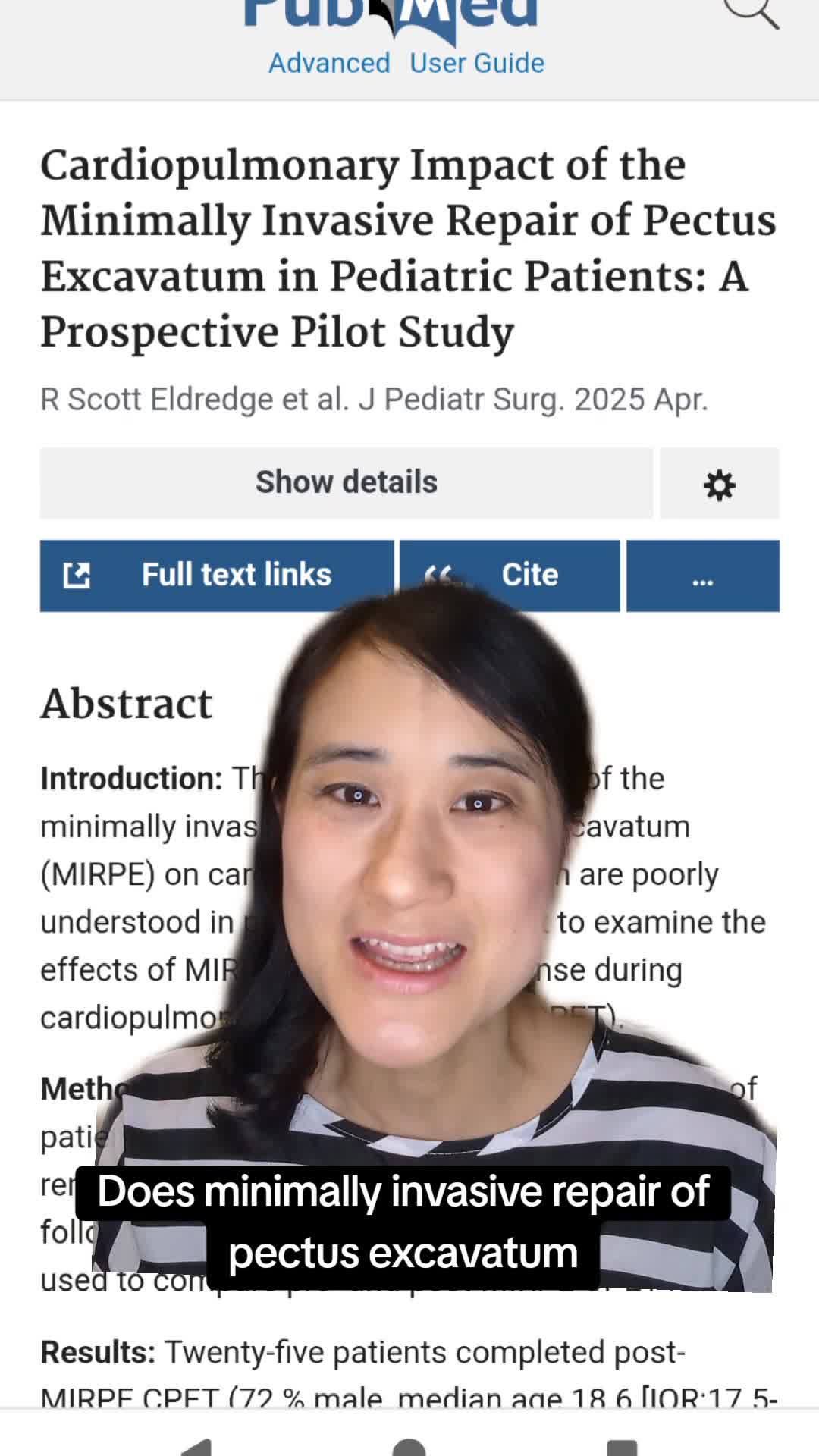
Cardiopulmonary Impact of the Minimally Invasive Repair of Pectus Excavatum in Pediatric Patients: A Prospective Pilot Study
55 s · Published Apr 2025
Video
Intestinal Atresia Types Explained: Grossfeld Classification for Pediatric Surgery
1 min · Published Sep 2026
Video
Derivation and validation of the Pediatric Community-Acquired Pneumonia Severity (PedCAPS) score: A prospective cohort study
50 s · Published Sep 2026
Video
FETO for Late-Diagnosed Severe Congenital Diaphragmatic Hernia (CDH) at Cincinnati Children's with Dr. Beth Rymeski
4 min · Published Sep 2026
Video
Severe Congenital Diaphragmatic Hernia (CDH) Case: FETO Management & Unexpected Findings with Dr. Beth Rymeski
3 min · Published Sep 2026
Video
Fetoscopic Endoluminal Tracheal Occlusion (FETO) Procedure: Step-by-Step Guide with Dr. Beth Rymeski
4 min · Published Sep 2026
Video
Choledochal Cyst Types Explained: Pediatric Surgery Fundamentals
1 min · Published Sep 2026
What the experts said
Cincinnati Children's is the only pediatric hospital with an inpatient integrative care team consisting of about 15 holistic health specialists.
Massage therapy can reduce pain and anxiety, decrease cortisol levels, and enhance relaxation in pectus repair patients.
Energy therapies (Reiki and healing touch) are biofield therapies that work to restore harmony and balance within the body and can be performed hands-on or hands-off.
A 2009 retrospective database review of 519 patients showed that massage therapy and healing touch reduced pain and anxiety scores by 50% in 50% of patients.
Physical therapy evaluates pectus patients on the first postoperative day and teaches them to get out of bed using a crunch-to-sit-up technique without using arms to push or pull.
Pectus repair patients have strict precautions against bending, twisting, and rolling postoperatively.
All pectus patients and families are required to attend a preoperative education class before scheduled surgery.
The preoperative class covers expectations for testing, hospital stay, recovery room experience, epidural placement, and postoperative devices including compression boots, Foley catheter, and incentive spirometer.
The SSI (surgical site infection) bundle for pectus patients includes screening all patients for metal allergy, MRSA, and staph, with treatment using Bactroban if positive.
The SSI bundle has been in place for almost 3 years and was developed through literature review and collaboration with infectious disease.
Most pain in Ehlers-Danlos patients is muscle-based or from muscle attachments rather than arthritis or bone pain.
70% of adult patients with Ehlers-Danlos syndrome experience blacking out sensation or dizziness with standing associated with racing heartbeat (POTS).
Ehlers-Danlos patients with POTS phenotype have overactivity of the sympathetic nervous system, leading to panic, anxiety, sleep dysfunction, and chronic fatigue.
Sympathetic nervous system overactivity in Ehlers-Danlos patients shuts down parasympathetic digestive functions, causing nausea or abdominal pain immediately after eating.
Ehlers-Danlos patients with POTS should use recumbent exercise (bike or rowing machine) or aquatic-based therapy rather than upright exercise like treadmills, which cause immediate dizziness and tachycardia.
Aquatic-based therapy supports blood flow to the brain in Ehlers-Danlos patients with dysautonomia.
Recumbent or aquatic exercise protocols in Ehlers-Danlos patients have shown improvements in chronic fatigue, sleep dysfunction, and pain sensitivity.
Early mobility after pectus repair helps reduce the rate of complications and decrease overall length of stay.
Ehlers-Danlos patients have impaired proprioception with more movement than they should, demonstrated in multiple studies and meta-analyses, due to connective tissue dysfunction in feedback structures.
The Dallas protocol for dysautonomia treatment requires 5 days per week, 30 minutes per day of exercise reaching 80% of maximum heart rate.