


From
StayCurrentMD
Laparoscopic Duodenojejunostomy for Superior Mesenteric Artery Syndrome (13...
Chapter 1 of 3 · Case-Based Learning
Presentation & workup
Patient Presentation and Initial Management
Expert statements on this page
No expert statements were drawn from this page.
Host summaries · secondary, not cited in answers
Educational content from recorded physician discussions — not medical advice. Talk to your (or your child's) care team about your situation.
Video
Intestinal Atresia Types Explained: Grossfeld Classification for Pediatric Surgery
1 min · Published Sep 2026
Video
Derivation and validation of the Pediatric Community-Acquired Pneumonia Severity (PedCAPS) score: A prospective cohort study
50 s · Published Sep 2026
Video
FETO for Late-Diagnosed Severe Congenital Diaphragmatic Hernia (CDH) at Cincinnati Children's with Dr. Beth Rymeski
4 min · Published Sep 2026
Video
Severe Congenital Diaphragmatic Hernia (CDH) Case: FETO Management & Unexpected Findings with Dr. Beth Rymeski
3 min · Published Sep 2026
Video
Fetoscopic Endoluminal Tracheal Occlusion (FETO) Procedure: Step-by-Step Guide with Dr. Beth Rymeski
4 min · Published Sep 2026
Video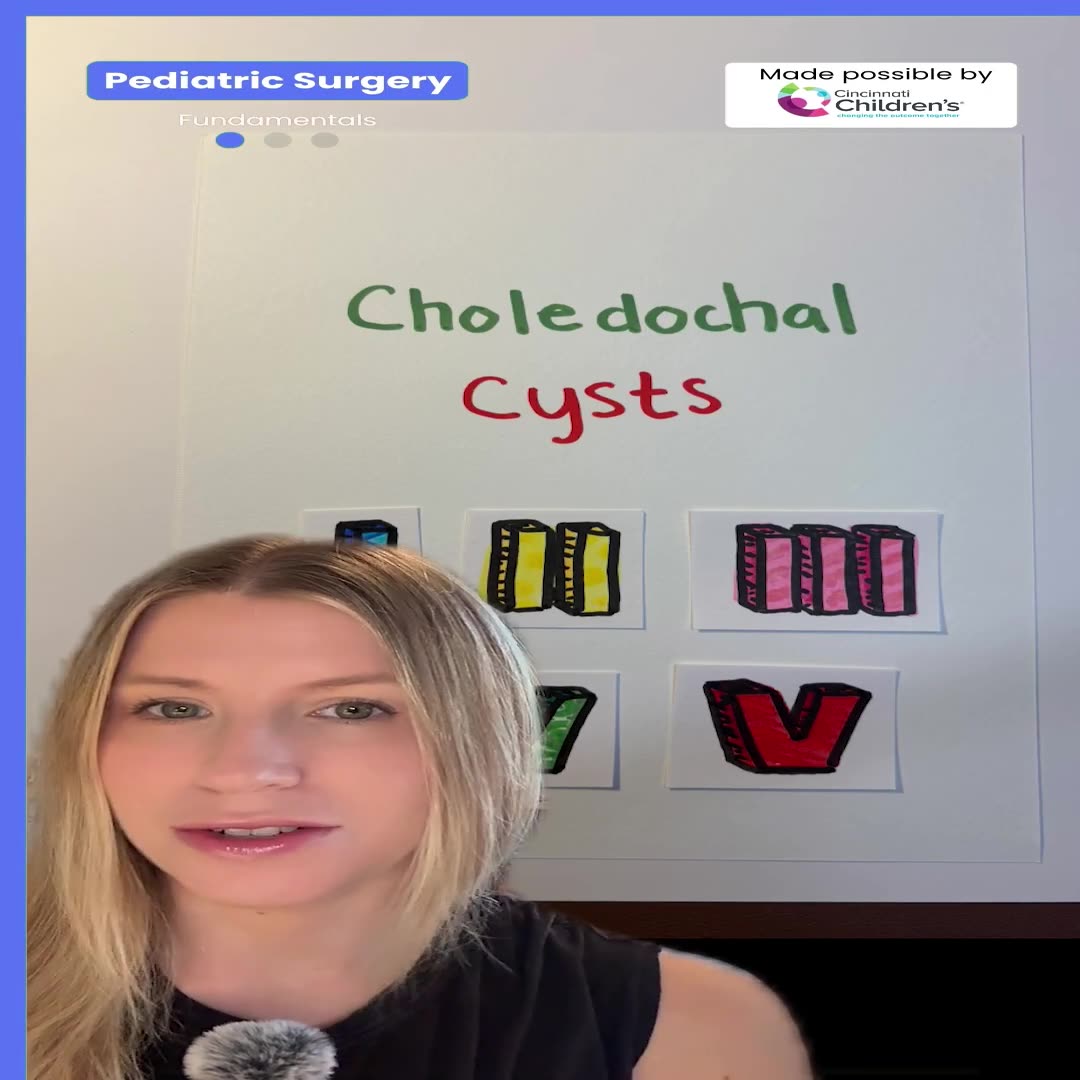
Choledochal Cyst Types Explained: Pediatric Surgery Fundamentals
1 min · Published Sep 2026
What the experts said
Patient was a 13-year-old male at the 50th percentile for weight given his age
CT scan demonstrated an obstruction at the third portion of the duodenum and a narrow aorta mesenteric angle
Patient failed to gain weight over a two-week period with ongoing high volume NG tube output despite conservative management with NG decompression and nasoduodenal feeds
Laparoscopic duodenojejunostomy was performed using an umbilical camera port, a right-sided retracting port, and two left-sided working ports
A transabdominal suture through the omentum was used to retract the transverse colon during the dissection
An anastomosis at the third portion of the duodenum has the benefits of leaving the transverse colon intact and avoids a duodenal diverticulum proximal to the mesenteric root
A jejunal loop approximately 30 centimeters distal to the ligament of Treitz was selected for the anastomosis
A 45 millimeter endoGIA stapler was used to create the anastomosis
The common enterotomy was closed with an absorbable suture in a single layer
Postoperatively, the patient underwent bowel rest for 5 days
A contrast study performed on postoperative day 5 demonstrated a patent anastomosis without leak
The patient was discharged 2 days after the contrast study following quick diet advancement