10 views 0 likes

StayCurrentMD

GCMD Space · View profile →

Intussusception - Soft Tissue Abscess - Pilonidal Cyst - Bleeding Meckel's...

Video Published 2018-11-10 Updated 2026-06-10

Timestops (4)

Topic Overview

A rapid-fire case-based discussion covering management of intussusception, soft tissue abscess, pilonidal cyst, and bleeding Meckel's diverticulum. Key practice points include same-day discharge after successful intussusception reduction (4-hour observation in ED), incision and drainage of abscesses without routine antibiotics or admission, delayed definitive pilonidal surgery after recurrence, and small bowel resection versus stapled diverticulectomy for bleeding Meckel's. Multiple speakers report recent practice changes toward less invasive management and shorter hospital stays.

Key Takeaways

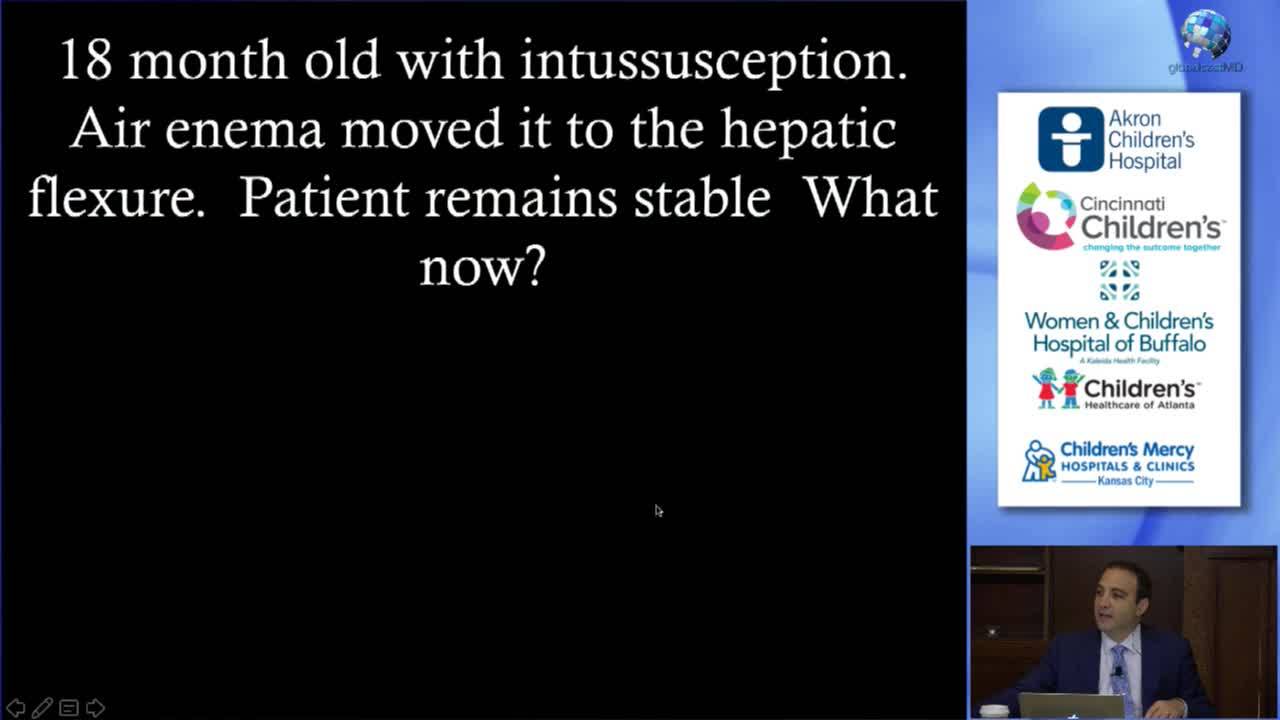
  • Intussusception patients can safely discharge from ED after 4h observation if stable, tolerating PO, afebrile (1/48 recurred) (0:57)
  • Soft tissue abscess I&D has 0.9% failure rate with same-day discharge; admit only if cellulitis + fever + leukocytosis together (8:08)
  • Bascom pit excision under local 10 days post-I&D prevents 70% of pilonidal recurrences; reserve formal excision for failures (10:57)
  • Bleeding Meckel's requires small bowel resection, not diverticulectomy—ulcer is in Meckel's itself, stapling leaves bleeding source (17:00)
  • Age >5-6 years raises suspicion for pathologic lead point (30-60% incidence); may still attempt reduction then work up electively (4:22)

Inside this episode

Kai, the Library's AI content creator, listened to this episode and mapped who's speaking, the chapters, key claims, and cases. Every item links to the exact moment in the recording.

AI-enriched

Who's speaking

  • Speaker 1 — host
  • Nick Bruns — guest
  • Speaker 3 — guest
  • Speaker 4 — guest
  • Ian Glenn — guest
  • Speaker 6

Chapters

  • 0:00Intussusception Management — Discussion of post-reduction observation protocols, repeat imaging criteria, incidental appendectomy, and age cutoffs for pathologic lead points.
  • 5:43Soft Tissue Abscess — Location of incision and drainage (ED vs OR), packing techniques, admission criteria, and antibiotic use. Includes institutional data on same-day discharge outcomes.
  • 9:49Pilonidal Cyst — Timing of definitive surgery, surgical techniques including Bascom pit excision and off-midline flap closures, and role of laser hair removal.
  • 15:08Bleeding Meckel's Diverticulum — Workup after negative Meckel's scan, role of PPI therapy, laparoscopic versus open resection techniques, and debate over diverticulectomy versus small bowel resection.

Key claims

  • 0:57Cincinnati changed practice 6-8 months ago to discharge intussusception patients home from ER after 4-hour observation period — Speaker 1
  • 2:0148 patients sent home from ED after intussusception reduction, only one recurred within 48 hours and did not require operation — Nick Bruns
  • 2:14Discharge criteria for intussusception: tolerating oral hydration, hemodynamically stable, afebrile — Nick Bruns
  • 2:36When contrast fills appendix but won't reflux into small bowel, bring patient back for repeat reduction in a few hours — Speaker 1
  • 2:44Inability of contrast to reflux into small bowel attributed to ileocecal edema — Nick Bruns
  • 3:04Repeat enema study after failed reflux proves reduction occurred because edema has decreased, does not actually reduce the intussusception — Speaker 4
  • 3:19Ultrasound after intussusception reduction is difficult to interpret due to inflammation — Speaker 1
  • 3:58Current practice is to leave appendix in place during intussusception reduction to avoid risk of appendiceal stump dehiscence if reoperation needed — Speaker 1
  • 4:22Age 5-6 years is cutoff for high suspicion of pathologic lead point in intussusception — Speaker 1
  • 4:55For suspected pathologic lead point, may attempt reduction then work up electively and perform resection in better circumstances — Speaker 1
  • 5:28Over age 5, 30-60% of intussusception cases have pathologic lead point depending on series — Nick Bruns
  • 6:52Many soft tissue abscesses drained in ED by emergency physicians with sedation — Speaker 1
  • 8:08Admission criteria for abscess: cellulitis, fever, and leukocytosis in combination — Speaker 1
  • 8:31Antibiotics prescribed for abscess only if cellulitis present — Speaker 3
  • 8:57Treatment failure rate (readmission or repeat I&D within 2 weeks) was 0.9% for same-day discharge after abscess drainage — Nick Bruns
  • 9:11Only 2 of 138 patients with leukocytosis had treatment failure after same-day discharge — Nick Bruns
  • 9:26Patients with white counts of 35 sent home after abscess drainage did fine — Nick Bruns
  • 10:27Definitive pilonidal surgery typically performed after second recurrence — Speaker 1
  • 10:57Bascom technique: excise pits at skin level with 11 blade under local, 70% never recur — Speaker 3
  • 11:26Pit excision performed 10 days after I&D once acute infection subsided — Speaker 3
  • 11:37For recurrence after pit excision or large draining sinuses, perform formal excision with off-midline layered closure and drain — Speaker 3
  • 12:24Physical exam findings (deep gluteal fold, excessive hair) affect pilonidal management decisions — Speaker 1
  • 12:50For severe pilonidal disease, may leave wound open with wet-to-dry dressing changes or wound vac — Speaker 1
  • 13:18Karydakis flap superior to excision only and comparable to modified Limberg flap for pilonidal disease — Ian Glenn
  • 13:43Post-operative management is key to pilonidal success: keep patient prone on bed until wound heals — Speaker 1
  • 14:26One patient reported laser hair removal was most painful thing ever experienced, discontinued after half session — Speaker 1
  • 15:34After negative Meckel's scan for hematochezia, perform colonoscopy with intent to do laparoscopy at same anesthetic if colonoscopy negative — Speaker 3
  • 16:14PPI will stop bleeding from Meckel's diverticulum, should never be emergency operation — Speaker 4
  • 17:00For bleeding Meckel's with ulcer at base, perform small bowel resection rather than simple diverticulectomy — Speaker 1
  • 17:29Ulcers in bleeding Meckel's are in the Meckel's itself, not in adjacent small bowel — Speaker 1
  • 17:39Stapling off Meckel's removes acid source but bleeding ulcer remains for next day — Speaker 1
  • 18:09Ectopic gastric mucosa almost always at tip of Meckel's diverticulum — Speaker 1
  • 18:48When resecting Meckel's through umbilicus, let it relax and mark edges with marker before stapling to avoid distortion and narrowing — Speaker 1

Points of disagreement

  • 3:43Appendectomy during intussusception reduction
    • Speaker 1: Used to remove appendix, now leaves it in to avoid stump dehiscence risk
    • Speaker 6: Takes appendix out
    • Speaker 1: Leaves appendix for colorectal surgeons
  • 2:36Management after failed contrast reflux in intussusception
    • Speaker 1: Bring back for repeat reduction in a few hours
    • Nick Bruns: Observe without repeat study, edema will resolve
  • 17:00Bleeding Meckel's: diverticulectomy versus bowel resection
    • Speaker 1: Small bowel resection for bleeding Meckel's with ulcer
    • Speaker 4: Staple across base, PPI stops bleeding, no need for bowel resection
    • Speaker 1: Stapling leaves bleeding ulcer behind for next day
  • 18:22Meckel's resection technique
    • Speaker 1: Pull through umbilicus, mark edges without tension before stapling
    • Speaker 4: Laparoscopic stapling adequate, linear staple line not concerning

Open questions

  • What is the optimal timing for repeat enema after failed contrast reflux in intussusception?
  • Should white blood cell count influence decision to admit after abscess drainage?
  • What is the role of ultrasound-guided enema reduction for intussusception?
  • Does laser hair removal prevent pilonidal recurrence and is it cost-effective?
  • For bleeding Meckel's, is diverticulectomy with PPI therapy equivalent to small bowel resection?
  • What is the optimal extent of laser hair removal field for pilonidal disease prevention?
This episode was analyzed and enriched by Kai, the Library's AI content creator. Every item links to the moment it comes from — click a timestamp to listen in context.
Written for:

Managing Four Common Pediatric Surgical Problems: Intussusception, Abscess, Pilonidal Disease, and Meckel's Diverticulum

The episode's main topic retold as a plain-language walkthrough — what it is, why it matters, and what the speakers concluded. Written by Kai from the episode transcript and reviewed before publishing.

For the care team · Explainer · AI-written, human-reviewed

Intussusception: The Shift to Same-Day Discharge

Intussusception reduction has traditionally meant overnight admission, but practice is changing. After successful radiologic reduction, many centers now discharge patients directly from the emergency department following a four-hour observation period 0:57. The discharge criteria are straightforward: tolerating oral hydration, hemodynamically stable, and afebrile 2:14. Data from 48 patients sent home this way showed only one recurrence within 48 hours, and that child required only repeat reduction, not surgery 2:01.

The technical challenge comes when contrast fills the appendix but won't reflux into the small bowel. This reflects ileocecal valve edema, not reduction failure 2:44. The standard approach is to bring the patient back for repeat enema in a few hours — not to reduce the intussusception again, but to prove reduction occurred once the edema resolves 3:04. Ultrasound after reduction is difficult to interpret due to inflammation and is generally not helpful 3:19.

Age matters significantly in intussusception. The inflection point is around five to six years old 4:22. Above this age, 30-60% of cases have a pathologic lead point 5:28. For older children, some surgeons attempt reduction first, then work up the lead point electively and perform resection under better circumstances rather than proceeding directly to emergency laparotomy 4:55. Non-ileocolic location also raises suspicion for a lead point regardless of age.

Incidental appendectomy during intussusception reduction has fallen out of favor. The concern is appendiceal stump dehiscence if the patient requires reoperation 3:58.

Soft Tissue Abscess: Rethinking Admission Criteria

Many pediatric abscesses are now drained in the emergency department by emergency physicians using procedural sedation 6:52. The question is which patients need admission for intravenous antibiotics afterward.

Traditional teaching emphasized admitting patients with fever, leukocytosis, or surrounding cellulitis. Current practice is more selective: antibiotics are prescribed only when cellulitis is present 8:31, and admission requires some combination of cellulitis, fever, and leukocytosis together rather than any single factor 8:08.

Data supporting same-day discharge after operative drainage in the OR shows a treatment failure rate (readmission or repeat incision and drainage within two weeks) of only 0.9% 8:57. Notably, only 2 of 138 patients with leukocytosis had treatment failure 9:11, and patients with markedly elevated white blood cell counts were safely discharged home 9:26. These findings suggest that leukocytosis alone should not drive admission decisions.

Pilonidal Disease: The Bascom Technique and Staged Management

Pilonidal disease typically requires a second recurrence before definitive surgery 10:27. The Bascom pit excision technique offers a minimally invasive first-line approach: under local anesthesia, excise the 1-millimeter pits at skin level with an 11 blade and allow healing by secondary intention 10:57. This is performed about 10 days after incision and drainage once acute infection has subsided 11:26. By the data supporting this technique, 70% of patients never recur after pit excision alone.

For recurrence after pit excision or for patients with large draining sinuses, formal excision with off-midline layered closure and drain placement is indicated 11:37. Physical exam findings — particularly a deep gluteal fold and excessive hair — influence management decisions and may prompt earlier definitive surgery 12:24. For severe disease, some surgeons leave the wound open with wet-to-dry dressing changes or negative pressure wound therapy 12:50.

Flap techniques including the Karydakis flap show superior outcomes to excision alone and comparable results to the modified Limberg flap 13:18. However, surgical technique may matter less than post-operative management: keeping the patient prone until the wound heals appears critical to success 13:43. Laser hair removal is sometimes recommended, though patient tolerance varies significantly 14:26.

Bleeding Meckel's Diverticulum: PPI Therapy and Resection Technique

After a negative Meckel's scan in a child with hematochezia, one approach is colonoscopy with intent to proceed to laparoscopy at the same anesthetic if colonoscopy is negative 15:34. An alternative strategy is starting a proton pump inhibitor, which will stop bleeding from a Meckel's diverticulum by suppressing acid production from ectopic gastric mucosa 16:14. This converts an emergency operation to an elective one.

The critical anatomic point: ulcers in bleeding Meckel's diverticulum are located in the diverticulum itself, not in the adjacent small bowel 17:29. The ectopic gastric mucosa is almost always at the tip of the Meckel's 18:09. This anatomy informs the choice between simple diverticulectomy and small bowel resection. If you staple off the Meckel's without resecting the ulcerated tissue, the acid source is removed but the bleeding ulcer remains 17:39. For a bleeding Meckel's with an ulcer at the base, small bowel resection rather than simple diverticulectomy is indicated 17:00.

Technique matters when resecting laparoscopically. Pulling the Meckel's up to staple it creates tension that distorts anatomy and risks narrowing the bowel lumen 18:48. One approach is to exteriorize the diverticulum through the umbilicus, let it relax completely, and mark the edges with a marker before applying the stapler to avoid inadvertent stricture.

Takeaways from this story

  • After successful intussusception reduction, patients can be safely discharged from ED after 4 hours if stable and tolerating fluids.
  • Leukocytosis alone should not drive admission after abscess drainage; treatment failure rate is <1% even with markedly elevated WBC.
  • Bascom pit excision under local anesthesia prevents recurrence in 70% of pilonidal cases without formal excision.
  • PPI therapy stops bleeding from Meckel's diverticulum, converting emergency to elective surgery.
  • Ulcers in bleeding Meckel's are in the diverticulum itself, not adjacent bowel—stapling without resecting leaves the ulcer behind.

Keywords

Hashtags

Transcript

Comments

Loading comments…