18 views 0 likes

StayCurrentMD

GCMD Space · View profile →

Interesting Cases & Surgical Approaches: Pectus Innovations

Video Published 2019-01-11 Updated 2022-08-22

Timestops (9)

0:00
Introduction and Nuss Revision Overview
Brief case presentation of a 5-year-old with Marfan syndrome treated with Nuss procedure. Transition to discussion of re…
2:37
Nuss Failure Modes and Forced Sternal Elevation
Technical causes of Nuss failure including bar rotation, lateral stripping, and early removal. Introduction of forced st…
6:53
Revision Case Series: Bar Rotation and Stripping
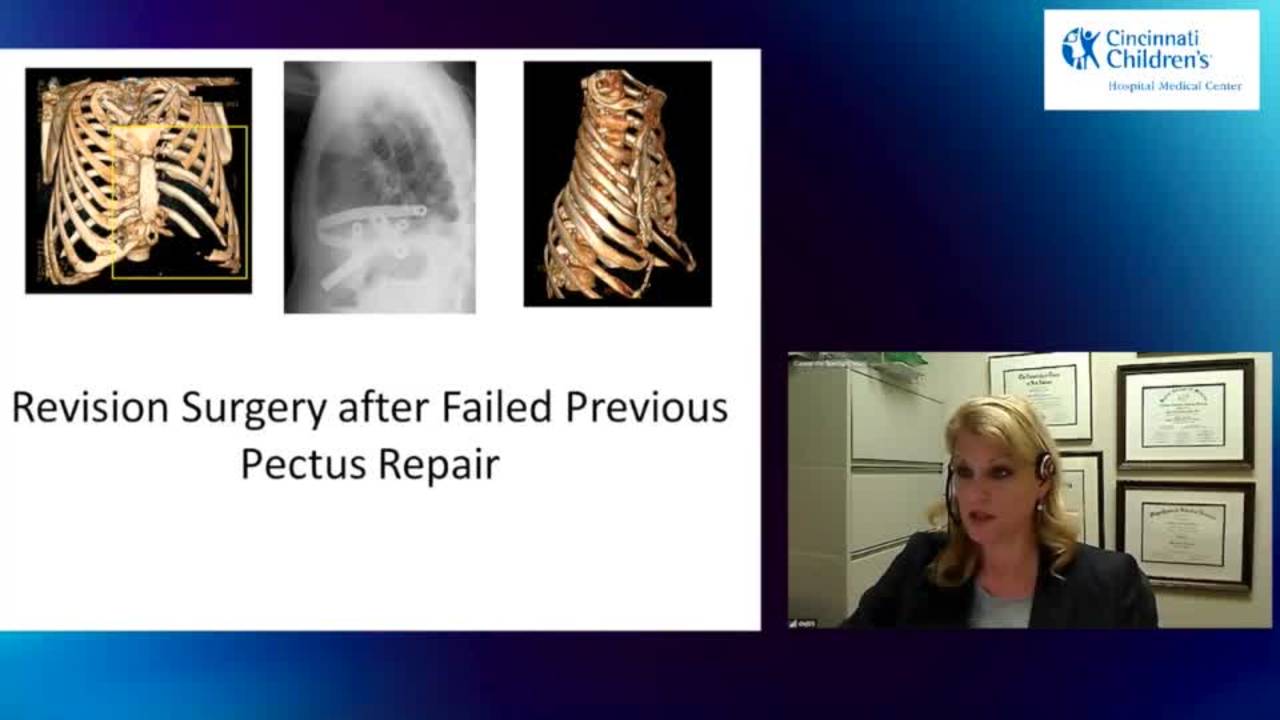
Three revision cases demonstrating management of rotated bars, laterally stripped bars, and residual deformity. Technica…
14:07
Bar Length and Technical Discussion
Discussion of optimal bar length (2-3 cm beyond lateral chest wall curve), avoiding both excessive length (instability) …
18:10
Osteotomies and Hybrid Repairs
Indications for releasing osteotomies when forced elevation fails, particularly in patients over 30. Technique involves …
23:40
Unstable Chest Wall and Cartilage Management
Discussion of post-Ravitch chest wall instability. Debate about thoracoscopic versus open cartilage resection, with cons…
29:12
Malunion and Floating Sternum
Management of severe complications including malunion, pseudoarthrosis, and floating sternum after failed open repairs. …
35:46
Chest Wall Hernias and Complex Reconstruction
Three cases of large anterior chest wall defects requiring methylmethacrylate reconstruction, titanium plating, and in o…
41:17
Revision Limits and Pain Management
Discussion of when multiple revisions become futile, particularly in connective tissue disorders. Emphasis that the best…

Topic Overview

A surgical discussion focused on revision pectus excavatum surgery and technical approaches to complex chest wall reconstruction. The speakers review failure modes of the Nuss procedure (bar rotation, lateral stripping, early removal) and open Ravitch repairs (malunion, chest wall hernias, non-healing). Technical innovations presented include forced sternal elevation with a Rultract retractor, intercostal space reinforcement with fiber wire, multiple-bar strategies to distribute pressure, and hybrid approaches combining minimally invasive bar placement with limited osteotomies. Several revision cases demonstrate management of recurrent deformity, floating sternum, and large anterior chest wall defects requiring methylmethacrylate reconstruction and plating.

Key Takeaways

  • 30% of adult pectus patients now receive 3 bars to distribute pressure and reduce pain in stiff chests. (7:22)
  • Forced sternal elevation with Rultract predicts bar success: if chest won't lift, bars alone won't correct it over time. (5:53)
  • Malunion presents with paradoxical movement and pain despite near-normal Haller index; CT shows rib-sternum detachment. (32:54)
  • Complex revisions require anterior plating plus bars; bars alone led to recurrence when removed. (31:43)
  • Expiratory-phase CT reveals dynamic chest wall hernias with Haller changing from 2.2 to 5.0 between inspiration and expiration. (40:01)

Inside this episode

Kai, the Library's AI content creator, listened to this episode and mapped who's speaking, the chapters, key claims, and cases. Every item links to the exact moment in the recording.

AI-enriched

Who's speaking

  • Speaker 1 — host
  • Don — guest
  • Doctor Garcia — guest
  • Speaker 4

Chapters

  • 0:00Introduction and Nuss Revision Overview — Brief case presentation of a 5-year-old with Marfan syndrome treated with Nuss procedure. Transition to discussion of revision surgery, with approximately 30% of the speaker's practice being revisions from multiple surgeons.
  • 2:37Nuss Failure Modes and Forced Sternal Elevation — Technical causes of Nuss failure including bar rotation, lateral stripping, and early removal. Introduction of forced sternal elevation using the Rultract retractor to facilitate dissection and bar placement in stiff adult chests.
  • 6:53Revision Case Series: Bar Rotation and Stripping — Three revision cases demonstrating management of rotated bars, laterally stripped bars, and residual deformity. Technical solutions include multiple bars, intercostal reinforcement with fiber wire, and medial bar fixation.
  • 14:07Bar Length and Technical Discussion — Discussion of optimal bar length (2-3 cm beyond lateral chest wall curve), avoiding both excessive length (instability) and insufficient length (risk of falling into intercostal space). Debate about suture fixation techniques.
  • 18:10Osteotomies and Hybrid Repairs — Indications for releasing osteotomies when forced elevation fails, particularly in patients over 30. Technique involves limited cartilage release from sternum, segment resection if needed, and anterior plating for stability. Hybrid approach combines bars posteriorly with anterior stabilization.
  • 23:40Unstable Chest Wall and Cartilage Management — Discussion of post-Ravitch chest wall instability. Debate about thoracoscopic versus open cartilage resection, with consensus that open approach allows better stabilization with plates or sutures.
  • 29:12Malunion and Floating Sternum — Management of severe complications including malunion, pseudoarthrosis, and floating sternum after failed open repairs. Reconstruction requires debridement to viable tissue, posterior bar support, anterior plating, and sometimes biologic mesh coverage.
  • 35:46Chest Wall Hernias and Complex Reconstruction — Three cases of large anterior chest wall defects requiring methylmethacrylate reconstruction, titanium plating, and in one case omental flap coverage. Includes discussion of dynamic collapse visible only on expiratory CT imaging.
  • 41:17Revision Limits and Pain Management — Discussion of when multiple revisions become futile, particularly in connective tissue disorders. Emphasis that the best operation is the first operation, with recognition of significant learning curve and chronic pain as a major complication.

Key claims

  • 0:50Approximately 30% of the speaker's practice consists of revision pectus cases, not all originally performed by the speaker — Don
  • 1:22True incidence of pectus recurrence is unknown because many patients do not report back to centers — Don
  • 1:39In an adult open repair series originally reporting 5% recurrence, at least 20 patients contacted for revision over the subsequent 10 years — Don
  • 2:12Nuss procedure failures are typically related to technical issues: bar positioning, bar rotation, and premature removal — Don
  • 2:22Open repair failures involve different mechanisms: healing issues, malunion, and regression — Don
  • 3:14Once bars rotate, their ability to elevate the chest wall is lost and they usually cause pain — Don
  • 3:41Lateral stripping occurs when the bar is not supported by the intercostal space and migrates posteriorly, losing forward elevation capability — Don
  • 4:41In adult patients, the chest is often so stiff and rigid that intercostal spaces cannot support bar pressure, leading to ripping and bar migration — Don
  • 5:11The speaker uses forced sternal elevation, reinforces intercostal spaces in heavier adults, fixes bars medially, uses multiple bars, and performs releasing osteotomies when needed — Don
  • 5:53The Rultract retractor lifts and elevates the sternum during dissection, reducing force required and creating open space for thoracoscopic visualization — Don
  • 6:53Fiber wire (woven PTFE suture) is used in figure-of-eight configuration around ribs and bar to prevent rib separation and bar migration — Don
  • 7:22Single bar placement creates tremendous pressure and pain in heavier, stiffer chests; balancing the defect with multiple bars reduces these problems — Don
  • 7:47Approximately 30% of the speaker's patients now receive 3 bars — Don
  • 7:51For very low bar placement, the speaker drills through the sternum and passes suture to loop around sternum and bar centrally to prevent rotation — Don
  • 15:59Optimal bar length is 2-3 centimeters beyond the lateral chest wall curve, catching side ribs but not wrapping to the back — Don
  • 18:34In a series of over 300 adult pectus repairs (over 200 age 30+), the speaker could achieve elevation with Rultract in almost all patients under 30, but 11-12% of patients over 30 would not lift — Don
  • 20:22If the chest does not lift with forced elevation, bars alone will not make it lift over time — Don
  • 20:41Limited osteotomy technique involves freeing cartilages from sternum at the non-lifting site, then shortening cartilages to allow reapproximation, similar to cartilage-sparing Ravitch — Don
  • 24:43In older patients with calcified cartilage, the classic cartilage-sparing perichondrial preservation technique is often not feasible due to adhesions — Don
  • 25:50Osteotomies require open approach; thoracoscopic cartilage resection is possible but difficult and still requires stabilization with sutures or plates — Don
  • 30:00Redo open repairs that did not achieve support can often be successfully revised with Nuss bars as they lift easily — Don
  • 30:31Patients with evidence of hernia, malunion, or thoracic dystrophy automatically require open revision — Don
  • 31:29All complex revision cases are prepped with groins exposed to allow emergent femoral bypass access in case of life-threatening bleeding — Don
  • 31:43Anterior plating is used on all complex revision cases because bars alone led to recurrence when removed — Don
  • 32:54Malunion or pseudoarthrosis is best assessed by physical exam; CT scans show ribs not attached to sternum as the key finding — Don
  • 33:42Patients with malunion have pain, inability to Valsalva, and paradoxical chest wall movement, but Haller index can be nearly normal, leading to misdiagnosis — Don
  • 34:01Malunion reconstruction requires stabilization with plating, often bone graft or methylmethacrylate to fill spaces, and sometimes mesh coverage — Don
  • 35:20On thin patients, complete soft tissue coverage of plates is critical; biologic mesh can be used when pectoralis muscles have atrophied and cannot be mobilized to cover hardware — Don
  • 40:01Chest wall hernias can show dynamic collapse visible only on expiratory phase CT imaging, with Haller index changing from 2.2 on inspiration to 5.0 on expiration — Don
  • 40:44Methylmethacrylate, titanium mesh, titanium plates, or prefabricated titanium parts can be used for chest wall reconstruction — Don
  • 41:17Complex revision patients are never completely normal again; the goal is to make them better, not perfect — Don
  • 42:10Multiple revisions become futile in connective tissue disorders or chests that will not heal, leading to cycles of infection and osteonecrosis — Don
  • 43:21The best operation is the first operation; there is a significant learning curve for pectus repair that is not adequately recognized — Doctor Garcia
  • 43:09Chronic pain requiring narcotics is a major complication in revision cases — Doctor Garcia

Cases discussed

  • 0:005-year-old male with Marfan syndrome, symptomatic pectus excavatum
  • 8:2328-year-old male, failed primary Nuss two years prior
  • 9:4320-year-old male, failed primary Nuss with second bar added at 6 months
  • 11:2249-year-old woman, two prior Nuss attempts with three OR visits including reoperation for bleeding
  • 32:0145-year-old male, failed Ravitch two years prior
  • 34:1928-year-old male, failed Ravitch at age 15
  • 36:0562-year-old male, prior Ravitch with excision, two pectus bars in situ
  • 37:3547-year-old woman, failed Ravitch with Bioridge plating one year prior
  • 39:3150-year-old male band member (trumpet player), failed Ravitch with revision three years prior

Open questions

  • What is the true incidence of pectus recurrence after repair?
  • How long should bars remain in patients with connective tissue disorders?
  • At what point do multiple revisions become futile?
  • What is the optimal approach for thoracoscopic cartilage resection?
  • How can chronic pain be minimized in complex revision cases?
This episode was analyzed and enriched by Kai, the Library's AI content creator. Every item links to the moment it comes from — click a timestamp to listen in context.
Written for:

Pectus Revision Surgery: Technical Failures, Malunion, and the Limits of Reconstruction

The essential version of this episode — what it covers, the points that matter most, and what it changes for you. Written by Kai from the episode transcript and reviewed before publishing.

For the care team · Core brief · AI-written, human-reviewed

The Revision Problem

Revision pectus cases constitute approximately 30% of one high-volume surgeon's practice 0:50. The true recurrence rate after pectus repair remains unknown because many patients never return to their original centers 1:22. In one adult open repair series initially reporting 5% recurrence, at least 20 patients contacted the surgeon for revision over the subsequent decade 1:39.

Why Repairs Fail

Nuss procedure failures stem primarily from technical issues: bar malposition, bar rotation, and premature removal 2:12. Once bars rotate, they lose their ability to elevate the chest wall and typically cause pain 3:14. Lateral stripping — where the bar migrates posteriorly after losing intercostal support — eliminates forward elevation capability 3:41. In adults, rigid chests often cannot support bar pressure; intercostal spaces tear, allowing bar migration 4:41.

Open repair failures involve different mechanisms: healing problems, malunion, and regression 2:22. Malunion presents with pain, inability to Valsalva, and paradoxical chest movement, yet Haller index may appear nearly normal, leading to frequent misdiagnosis 33:42. Physical exam proves more sensitive than CT for detecting malunion; the key imaging finding is ribs not attached to sternum 32:54.

Technical Adaptations

To prevent primary failures in challenging cases, the surgeon employs forced sternal elevation with a Rultract retractor, which lifts the chest during dissection and creates open thoracoscopic space 5:53. Fiber wire sutures in figure-of-eight configuration around ribs and bar prevent migration in stiff chests 6:53. Multiple bars — used in approximately 30% of cases — distribute pressure and reduce pain compared to single-bar placement 7:22.

When forced elevation fails to lift the chest, bars alone will not achieve elevation over time 20:22. Limited osteotomy through small incisions releases non-lifting segments, allowing bar placement posteriorly with anterior plating for stabilization 20:41.

Revision Complexity

Complex revisions require anterior plating because bars alone led to recurrence after removal 31:43. Malunion reconstruction demands stabilization with plates, often bone graft or methylmethacrylate to fill spaces, and sometimes mesh coverage 34:01. On thin patients, complete soft tissue coverage of hardware is critical; biologic mesh may be needed when pectoralis muscles have atrophied 35:20.

Chest wall hernias can show dynamic collapse visible only on expiratory CT, with Haller index changing from 2.2 on inspiration to 5.0 on expiration 40:01. Reconstruction options include methylmethacrylate, titanium mesh, titanium plates, or prefabricated titanium components 40:44.

Realistic Expectations

Complex revision patients never return to normal; the goal is improvement, not perfection 41:17. Multiple revisions become futile in connective tissue disorders or chests that will not heal, creating cycles of infection and osteonecrosis 42:10. Chronic pain requiring narcotics remains a major complication 43:09. The best operation is the first operation; pectus repair carries a significant learning curve that is not adequately recognized 43:21.

Takeaways from this story

  • Bar rotation and lateral stripping eliminate chest wall elevation and typically cause pain, requiring revision.
  • Malunion can present with near-normal Haller index but severe symptoms; physical exam is more sensitive than CT.
  • Multiple bars (used in approximately 30% of cases) distribute pressure and reduce pain compared to single-bar placement.
  • Complex revision patients never return to normal; the goal is improvement, and chronic pain remains a major complication.
  • The best operation is the first operation; pectus repair has a significant learning curve not adequately recognized.

Keywords

Hashtags

Transcript

Comments

Loading comments…