
Interesting Case Presentations Part II: EA/TEF
hosted by Dr. Todd Ponsky & Dr. Em Gootee · StayCurrentMD
Educational content from recorded physician discussions — not medical advice. Talk to your (or your child's) care team about your situation.
Podcast
Tracheoesophageal Fistula with Dr. Daniel von Allmen
45 min · Published Dec 2016
Video
TEF Presentations (Extended): Aerodigestive & Esophageal Surgery
108 min · Published Dec 2014
Video
Introduction and Panel Discussion: EA & TEF
Dr. Todd Ponsky · 36 min · Published Dec 2012
Video
Complications and Beyond
66 min · Published Sep 2020
Video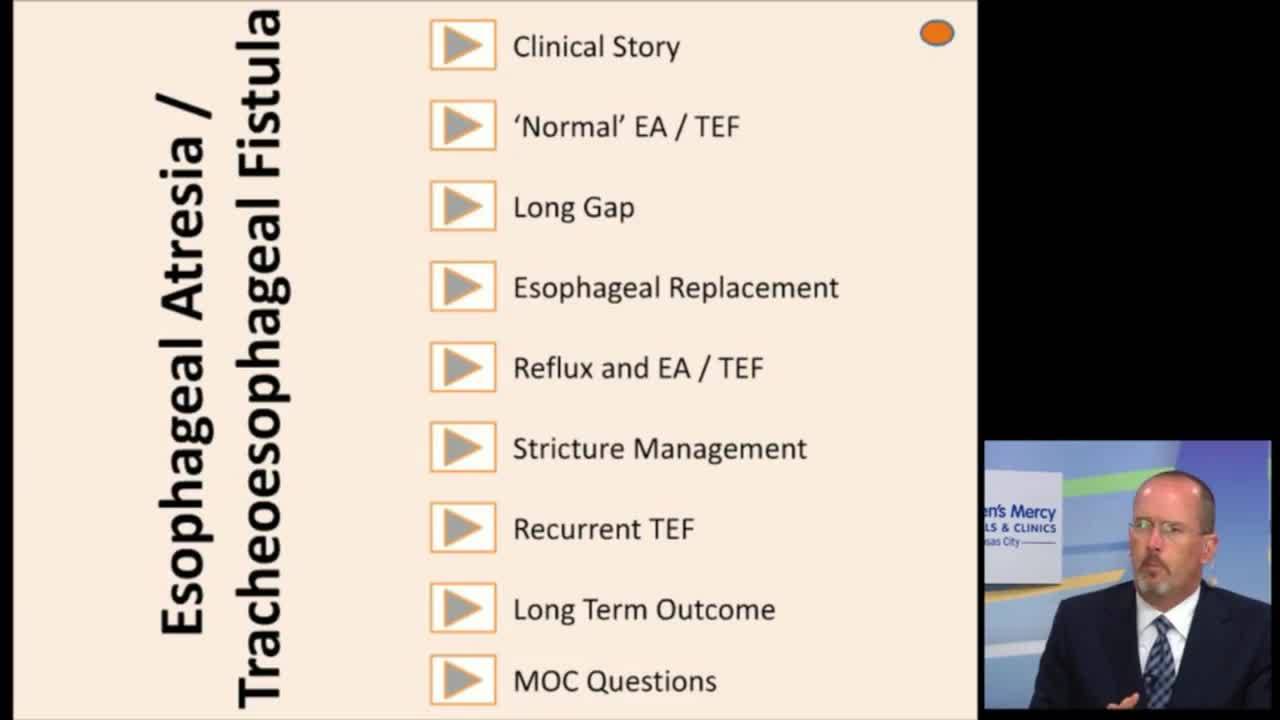
Update Course 2013: EA & TEF
38 min · Published Sep 2013
Video
Tracheoesophageal Fistula with Dr. Daniel von Allmen
Dr. Todd Ponsky · 45 min · Published Dec 2016
Video
Pediatric Surgical Oncology Research Collaborative (PSORC): Studying Rare Pediatric Tumors
56 s · Published May 2026
Video
Update Course Rewind 2025: Hirschsprung + ARM: Rare but Real
1 min · Published May 2026
Video
Update Course Rewind 2025: Hirschsprung + ARM: Rare but Real
1 min · Published May 2026
Video
Pooling Patients to Study Rare Pediatric Tumors: An Introduction to PSORC
56 s · Published May 2026
Video
The fetal frontier: A review of current and emerging fetal therapies for genetic diseases
44 s · Published May 2026
Video
Indocyanine green assists with sentinel lymph node mapping in pediatric and adolescent patients
1 min · Published May 2026
What the experts said
Hybrid thoracoscopic-endoscopic approach with transillumination is essential for localizing distal esophageal strictures that are not visible thoracoscopically
Distal esophageal cartilaginous rings should be resected rather than dilated, as dilation is ineffective
Upper pouch fistulas or H-type fistulas are very difficult to see and can be missed even by experienced endoscopists, requiring repeated investigations
Contrast studies should be used in addition to bronchoscopy when evaluating for fistulas, as what may be missed with bronchoscope could be picked up with contrast
Thoracoscopic approach is feasible even after previous open thoracotomy on the same side, with adhesions being manageable
Esophageal flap repair can convert a grade 3 laryngotracheoesophageal cleft to a grade 2 cleft, allowing for safer subsequent endoscopic repair
Rapid spillover of contrast into the trachea with less than 1 millimeter of contrast should raise suspicion for laryngotracheoesophageal cleft
During bronchoscopy, one should attempt to separate the posterior commissure of the vocal cords to identify a laryngotracheoesophageal cleft
For right-sided aortic arch with EA/TEF, left chest approach is easier because the aorta is out of the way
Right chest approach with right-sided arch is feasible but can cause bradycardia when retracting the lung
For patients with CHARGE syndrome and swallowing problems, if esophageal replacement is required, colon interposition is preferable to gastric transposition because the stomach can remain in the abdomen for gastrostomy feeding
Thoracoscopic approach allows better protection of the recurrent laryngeal nerve during H-type fistula repair because all manipulation is under direct vision
Flexible bronchoscopy through an endotracheal tube will miss proximal fistulas because the tube is positioned too far distally
Rigid bronchoscopy provides better examination than flexible bronchoscopy for identifying fistulas
Post-pneumonectomy syndrome is a risk in young patients with esophageal lung, potentially requiring placement of tissue expander to stabilize the mediastinum
The younger the patient undergoing pneumonectomy, the greater the risk of post-pneumonectomy syndrome
The incidence of proximal fistula in patients with pure esophageal atresia is extremely high, much higher than previously thought, according to Klaus Bach's group at Utrecht
Paralytics and sedation may be beneficial postoperatively for long-gap EA repairs with significant tension
Esophageal lung is an extremely rare clinical entity where the main stem bronchus connects directly to the lower esophagus, with only 20 cases reported in world literature
Management of esophageal lung involves pneumonectomy