11 views 0 likes

StayCurrentMD

GCMD Space · View profile →

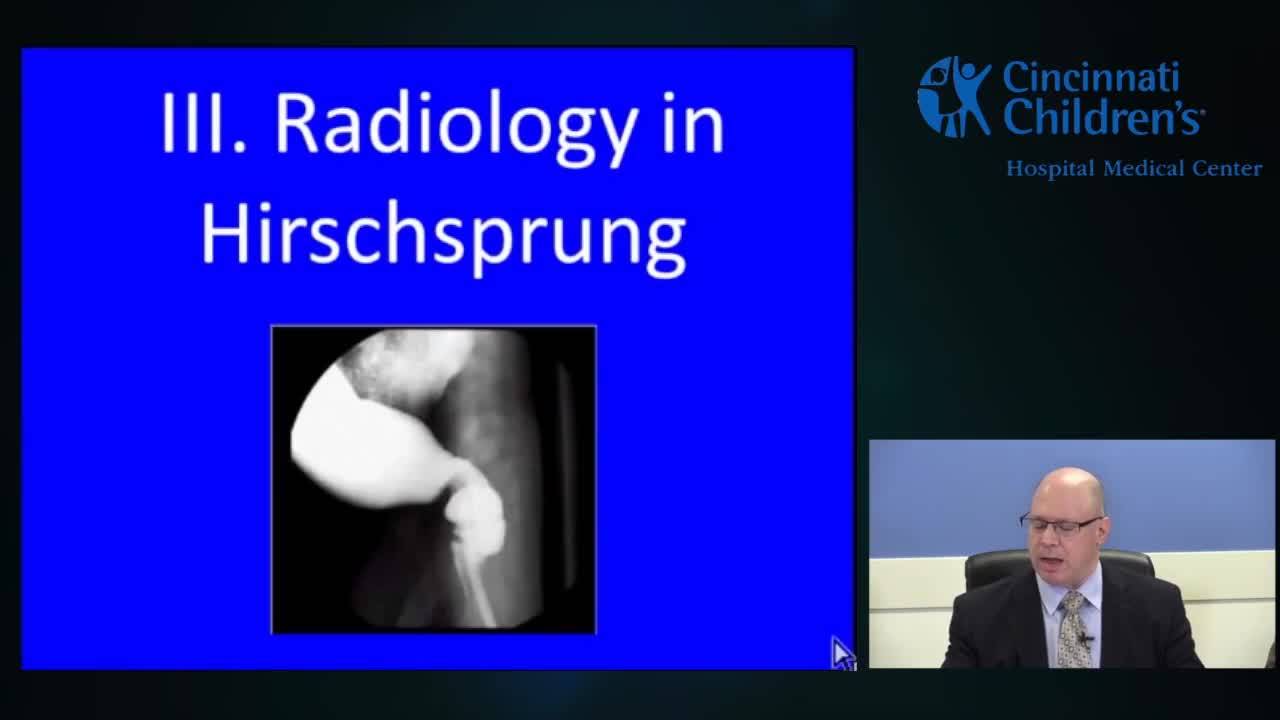
Hirschsprung Disease: Update Course 2013

Video Published 2019-01-11 Updated 2026-06-10

Timestops (6)

Topic Overview

A surgical case conference on Hirschsprung disease management covering diagnostic workup, operative approaches, and complications. Faculty discuss contrast enema versus upper GI for neonatal obstruction, timing and technique of pull-through procedures for varying transition zone levels, management of cecal perforation, and treatment of Hirschsprung-associated enterocolitis. Key clinical points include the importance of tissue diagnosis before surgery, the challenge of ultra-short segment disease, approaches to long-segment cases with massive colonic dilation, and the role of chronic metronidazole and Botox in recurrent enterocolitis.

Key Takeaways

  • Manometry false negatives require biopsy; absent reflex alone doesn't confirm Hirschsprung's. (14:37)
  • Long-segment cases need 6-12mo stoma before pull-through to prevent severe perianal excoriation. (22:40)
  • Cecal/ascending transition zones should be treated as total colonic disease with ileal Duhamel. (23:48)
  • Chronic metronidazole and Botox reduce enterocolitis hospitalizations post-pull-through. (37:33)
  • Older children with dilated colon need laparoscopic dissection to minimize sphincter stretch and preserve continence. (31:50)

Inside this episode

Kai, the Library's AI content creator, listened to this episode and mapped who's speaking, the chapters, key claims, and cases. Every item links to the exact moment in the recording.

AI-enriched

Who's speaking

  • Speaker 1 — host
  • Speaker 2 — host
  • Dr. Langer — guest
  • Speaker 4 — guest
  • Dr. Garrison — guest
  • Dr. Thayer — guest

Chapters

  • 0:00Initial workup for neonatal bowel obstruction — Discussion of diagnostic approach for a 72-hour-old term infant with distention and non-bilious emesis. Faculty debate contrast enema versus upper GI as first study, with consensus favoring contrast enema plus suction rectal biopsy. Emphasis on tissue diagnosis before surgery.
  • 6:10Operative approach for sigmoid transition zone — Case of sigmoid Hirschsprung on contrast enema. Faculty discuss transanal versus laparoscopic-assisted pull-through, with debate over positioning (prone versus lithotomy) and risk of underestimating transition zone level, particularly in female patients.
  • 11:00Ultra-short segment Hirschsprung controversy — Live caller presents 16-year-old with Down syndrome, chronic constipation, and biopsy showing aganglionosis at 3 cm but normal ganglion cells at 5 cm. Faculty debate definitions of ultra-short segment disease, role of myectomy versus pull-through, and technical challenges in adolescent patients with thickened rectum.
  • 19:23Management of cecal perforation and long-segment disease — Case of term infant with cecal perforation and ascending colon transition zone. Discussion of closure with loop ileostomy versus leveling ostomy, timing of definitive repair (waiting 6-12 months for stoma output to thicken), and choice between preserving short colonic segment versus ileal Duhamel.
  • 28:10Older child with chronic constipation — Three-year-old with massive colonic dilation. Faculty discuss age cutoff for suction rectal biopsy (most favor general anesthesia after age 2), role of diverting colostomy to allow bowel decompression, and debate over whether dilated colon will shrink with diversion or requires resection.
  • 34:10Hirschsprung-associated enterocolitis — Six-month-old post-pull-through with fever, distention, and diarrhea. Discussion of medical management with IV antibiotics and rectal irrigations, workup for recurrent enterocolitis including exam under anesthesia with biopsies to rule out transition zone pull-through, and role of chronic oral metronidazole and Botox injections.

Key claims

  • 36:05The incidence of enterocolitis is significantly higher in children with trisomy 21, as much as double the incidence in genetically normal kids — Speaker 1
  • 4:58False positive contrast enemas occur in newborns showing a transition zone that looks like Hirschsprung's but is not — Dr. Langer
  • 14:19In older kids, if they have a normal recto-anal inhibitory reflex on manometry, they don't have Hirschsprung's and don't need biopsy — Dr. Langer
  • 14:37Manometry can have false absence of the reflex, so if reflex is absent you still have to biopsy — Dr. Langer
  • 15:15There are two definitions for ultra-short segment Hirschsprung's: absence of recto-anal inhibitory reflex with normal ganglion cells (internal sphincter achalasia), versus very short segment of true aganglionosis — Dr. Langer
  • 15:54Internal sphincter achalasia is not Hirschsprung's disease, it's a different entity — Dr. Langer
  • 8:49The incidence of long segment Hirschsprung's in girls is fifty-fifty, so odds are much higher than in boys — Speaker 4
  • 8:02In Mana Proctor's paper, 8% of cases that looked like short transition zone had pathological transition zone significantly higher (long transition zone) — Dr. Langer
  • 20:55Most cecal perforations from Hirschsprung's disease are not total colonic disease, they are shorter segment disease where the cecum gets distended and perforates like with a rectal cancer — Dr. Langer
  • 22:40In long segment disease, wait longer before pull-through (6 to 12 months) because patients have terrible perianal excoriation if pulled through too early, need to wait till stoma output thickens — Dr. Langer
  • 23:37Experience with very short pull-through using just the cecum has not been good, patients end up with stasis and enterocolitis from the big pouch reservoir — Dr. Langer
  • 23:48For ascending colon or cecal transition zones, treat like total colon disease and do ileal Duhamel rather than preserving the short colonic segment — Dr. Langer
  • 24:23If transition zone is at hepatic flexure, preserve the colon and bring it down, but if just cecum, sacrifice it — Dr. Langer
  • 32:26In older children with massive dilation, distal bowel can shrink in size with a stoma for 6 or 8 months at age 3, making pull-through easier — Dr. Langer
  • 32:42The older the kid, the less likely the dilated bowel will shrink down in size with diversion — Dr. Langer
  • 17:13The anal canal in an adult is 3 to 4 centimeters long, versus 1 centimeter in an infant, so biopsies at 3 cm in an adolescent may actually be from the anal canal where there are normally no ganglion cells — Speaker 4
  • 17:25In the anal canal there are no ganglion cells normally, but you should not see hypertrophic nerves — Speaker 1
  • 17:39Biopsies from anal canal should show transitional epithelium, not normal rectum mucosa — Dr. Langer
  • 37:48Botox injection decreased the number of hospitalizations for enterocolitis in children post-pull-through — Dr. Langer
  • 37:58Botox doesn't always work for enterocolitis, sometimes it works and sometimes it doesn't — Dr. Langer
  • 37:33Many kids need chronic metronidazole for enterocolitis, can be on it for three months, and when you try taking them off they start getting symptoms again, some need it for a long time — Dr. Langer
  • 5:16There is an occasional patient really sick from enterocolitis where you may not want to wait for tissue diagnosis and might have to operate and divert because it's long segment, can't decompress with irrigation, and pathology won't be back for days — Speaker 4
  • 31:50In older children trying to resect dilated colon transanally, the stretch put on the sphincter is enormous and continence postoperatively definitely suffers — Dr. Garrison
  • 32:04For older children with dilated colon, go all the way down with laparoscopic dissection and do very little resection transanally to minimize sphincter stretch — Dr. Garrison
  • 33:33Biopsies done by colonoscopy in older children can miss Hirschsprung's disease, rectal biopsy is more reliable — Dr. Garrison

Cases discussed

  • 1:0272-hour-old full-term infant with abdominal distention, non-bilious emesis, and distended small bowel on X-ray
  • 19:5637-week term infant with cecal perforation and ascending colon transition zone
  • 11:0516-year-old with Down syndrome, chronic constipation, and ultra-short segment findings
  • 28:123-year-old with chronic constipation and massive colonic dilation
  • 34:106-month-old post-pull-through with Hirschsprung-associated enterocolitis

Points of disagreement

  • 2:35Need for upper GI in neonatal bowel obstruction with bilious emesis
    • Speaker 2: Would not routinely get upper GI in newborn obstruction with distal air, would start with contrast enema
    • Speaker 2: Notes that significant portion of fellows at another course said they would absolutely get upper GI first because it could be volvulus
  • 4:17Tissue diagnosis required before surgery for Hirschsprung's
    • Speaker 2: Among faculty, absolutely have to have tissue diagnosis before surgery
    • Speaker 2: Notes substantial number of people from different countries go straight to surgery based on contrast enema alone
  • 15:15Existence of ultra-short segment Hirschsprung's disease
    • Dr. Langer: Ultra-short segment exists as very short segment of true aganglionosis, distinct from internal sphincter achalasia
    • Dr. Garrison: Reports that Dr. Pena and Dr. Levitt do not believe in ultra-short segment Hirschsprung's, none of their patients have received myectomies
  • 23:37Management of ascending colon transition zone
    • Dr. Langer: Sacrifice the short colonic segment and do ileal Duhamel because experience with pulling cecum down has not been good
    • Speaker 1: Try to preserve bit of colon as long as it's enough to do reasonable anastomosis, not just pulling cecum down
  • 30:43Whether massively dilated colon will shrink with diversion in 3-year-old
    • Dr. Langer: Has had success getting distal bowel to shrink with stoma for 6-8 months at this age, makes pull-through easier
    • Speaker 2: Bowel shown is so mammothly dilated it won't come down no matter how long you wait, should resect at time of diversion

Open questions

  • At what age should surgeons stop doing suction rectal biopsies and switch to open biopsies under general anesthesia?
  • Does Botox injection work as a trial to predict success of myectomy in ultra-short segment disease?
  • In older children with massive colonic dilation, will the bowel shrink adequately with diversion alone or does it require resection?
  • What is the optimal duration of chronic metronidazole prophylaxis for recurrent enterocolitis?
  • Is there a male versus female difference in likelihood of underestimating transition zone level on contrast enema?
This episode was analyzed and enriched by Kai, the Library's AI content creator. Every item links to the moment it comes from — click a timestamp to listen in context.
Written for:

Cecal Perforation in a Newborn: When the Transition Zone Surprises You

The patient case from this episode, retold from presentation to outcome with the decisions made along the way. Written by Kai from the episode transcript and reviewed before publishing.

For the care team · Case narrative · AI-written, human-reviewed

Presentation

A 37-week term infant arrived on day 3 of life with abdominal distention 0:00. The child had passed a small amount of meconium, but plain films revealed free air 0:00. At exploration, the surgical team found a cecal perforation with minimal small bowel dilation and no obvious transition zone visible at laparotomy 0:00.

The Decision Point

The perforation itself was straightforward — close it and divert 0:00. The question was what to do with the colon 23:48. A postoperative contrast study showed normal-caliber colon throughout, no transition zone apparent 0:00. But the biopsy told a different story: the transition zone sat in the ascending colon, just above the perforation site 0:00.

This is the anatomy that makes you pause 0:00. The child has long-segment disease, but most of the colon looks normal 0:00 0:00. Do you preserve that ascending colon and cecum, accepting the technical challenge of pulling through a bulky reservoir 23:37? Or do you treat this like total colonic aganglionosis and sacrifice the short ganglionic segment for an ileal Duhamel 23:48?

One discussant noted that cecal perforations in Hirschsprung disease usually occur in shorter-segment cases, not total colonic disease 20:55. The cecum distends and ruptures under pressure 20:55. The pathology here confirmed that pattern — long-segment, but not total colonic 0:00.

What They Did

The team closed the perforation and created a loop ileostomy 0:00. If the infant had been stable enough, they would have performed serial biopsies along the colon at the initial operation to map the transition zone precisely for the definitive repair 23:48.

For the pull-through itself, the consensus leaned toward treating this as long-segment disease and performing an ileal Duhamel rather than attempting to preserve the short colonic segment 23:48. The reasoning: experience with very short pull-throughs using just the cecum has been poor, with patients developing stasis and enterocolitis from the large pouch reservoir 23:37. When the transition zone is at the hepatic flexure, preserve the colon and bring it down 24:23. When it's just the cecum or ascending colon, sacrifice it 24:23.

Timing mattered 22:40. In long-segment disease, waiting before pull-through allows the stoma output to thicken, reducing the severe perianal excoriation that occurs when these children are pulled through too early 22:40. Dilated distal bowel can shrink over time with diversion, making the pull-through technically easier 32:26. The older the child, the less likely the bowel will collapse with diversion 32:42, but at this age, decompression should work 32:26 32:42.

One surgeon planned a laparoscopic Duhamel, mobilizing the bowel laparoscopically and performing minimal transanal dissection to avoid excessive sphincter stretch 0:00. Another would wash out the defunctioned distal segment at the time of stoma creation but not maintain regular irrigations afterward, since the diverted colon doesn't accumulate much content 0:00.

Outcome

The discussants did not report the child's outcome.

What the Case Changes

When Hirschsprung disease presents with perforation, the transition zone location may not be obvious at laparotomy 0:00. Contrast studies can miss it entirely 0:00. Serial biopsies at the initial operation, if the child is stable, prevent a second look later to find the level 23:48.

For transition zones in the cecum or ascending colon, the technical appeal of preserving a short colonic segment conflicts with the functional reality: a cecal pull-through creates a large, poorly emptying pouch prone to enterocolitis 23:37. The judgment here is to treat the anatomy like total colonic disease and perform an ileal Duhamel, accepting the loss of a small amount of ganglionic colon in exchange for better function 23:48 24:23. If the transition zone reaches the hepatic flexure, the balance shifts — enough colon to justify preservation 24:23.

In long-segment disease, early pull-through in infancy risks severe perianal skin breakdown from liquid stool 22:40. Waiting for stoma output to thicken is not just convenient — it prevents a miserable postoperative course 22:40. The dilated distal bowel may shrink during that interval, simplifying the dissection 32:26. The trade-off is managing an ostomy, but the functional outcome justifies the delay 22:40.

Takeaways from this story

  • Cecal perforation in Hirschsprung disease usually indicates shorter-segment disease where the cecum distends and ruptures, not total colonic aganglionosis.
  • For transition zones in the cecum or ascending colon, treat like total colonic disease with ileal Duhamel rather than preserving the short segment.
  • In long-segment disease, wait before pull-through to allow stoma output to thicken and prevent severe perianal excoriation.
  • Dilated distal bowel in infants can shrink over time with diversion, making pull-through easier; this effect diminishes with age.

Keywords

Hashtags

Transcript

Comments

Loading comments…