


From
StayCurrentMD
Hirschsprung Disease: Surgical Procedures
With Dr. Alberto Peña & Dr. Luis de la Torre & Dr. Richard Krauss · hosted by Dr. Todd Ponsky & Dr. Andrea Bischoff
Chapter 1 of 12 · Surgical Management
Approach decision
Initial Surgical Approach Decision: Transanal vs. Laparoscopic
Expert statements on this page
No expert statements were drawn from this page.
Host summaries · secondary, not cited in answers
Educational content from recorded physician discussions — not medical advice. Talk to your (or your child's) care team about your situation.
Video
Hirschsprung Disease: Cases and Complications
103 min · Published Feb 2015
Video
Panel Discussion and Case Presentation Part II: Pediatric Bowel Management 2013
Dr. Todd Ponsky · 33 min · Published May 2013
Video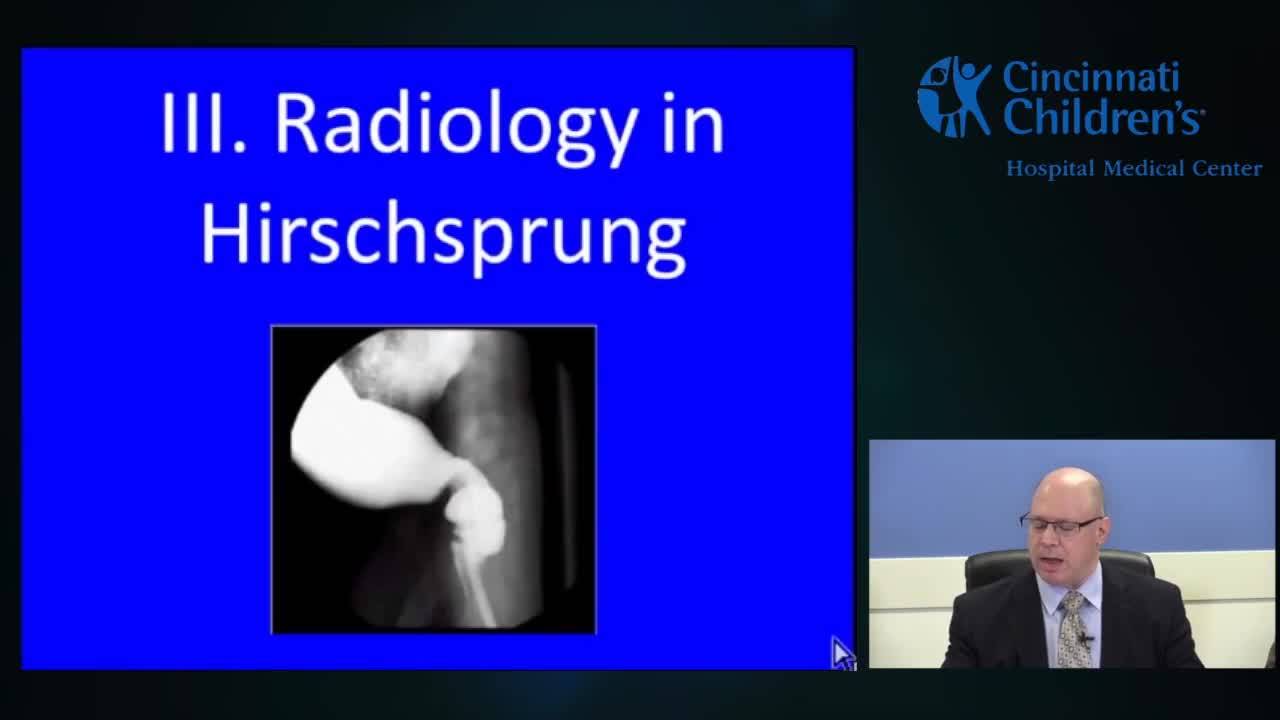
Evaluation & Management Of Hirschsprung's Disease
44 min · Published Nov 2018
Podcast
Colorectal Quiz: Episode 46
Marc Levitt · 29 min · Published Apr 2025
Video
Colorectal Quiz: Episode 46 - Hirschsprung's Disease
Marc Levitt · 29 min · Published Apr 2025
Video
The Colorectal Quiz Episode 21: The History of Hirschsprung Disease
Marc Levitt · 15 min · Published Sep 2025
Video
Validation of an anorectal malformation trainer - Can a high-fidelity model simulate real life?
1 min · Published Jun 2026
Video
Complications and Long-Term Outcomes of Patients With Cloacal Malformation After Bowel Neovagina...
1 min · Published Jun 2026
Video
Safety and utility of long-acting steroid injection for management of post-operative stricture...
1 min · Published Jun 2026
Video
Association Between Social Determinants of Health and Choice of Urinary Reconstruction in Children
1 min · Published Jun 2026
Video
The Perineal Body Preserving PSARP (PPP)
11 min · Published Jun 2026
Video
Update Course Rewind 2025: Hirschsprung + ARM: Rare but Real
1 min · Published May 2026
Video
Radiology and Image Diagnosis of Hirschsprung Disease
44 min · Published Nov 2018
Video
Outcomes and Complications in Hirschsprung Disease
105 min · Published Nov 2018
Video
Surgical Procedures for Hirschsprung Disease
128 min · Published Nov 2018
Video
Cloaca - Prental Imaging & Diagnosis - Counseling
Dr. Todd Ponsky · 36 min · Published Nov 2018
Podcast
Cloacal Exstrophy with Dr. Alberto Peña
53 min · Published Apr 2017
Video
Laxative for Bowel Management: Pediatric Bowel Management 2013
Dr. Todd Ponsky · 26 min · Published May 2013
Video
Intestinal Atresia Types Explained: Grossfeld Classification for Pediatric Surgery
1 min · Published Sep 2026
Video
Derivation and validation of the Pediatric Community-Acquired Pneumonia Severity (PedCAPS) score: A prospective cohort study
50 s · Published Sep 2026
Video
FETO for Late-Diagnosed Severe Congenital Diaphragmatic Hernia (CDH) at Cincinnati Children's with Dr. Beth Rymeski
4 min · Published Sep 2026
Video
Severe Congenital Diaphragmatic Hernia (CDH) Case: FETO Management & Unexpected Findings with Dr. Beth Rymeski
3 min · Published Sep 2026
Video
Fetoscopic Endoluminal Tracheal Occlusion (FETO) Procedure: Step-by-Step Guide with Dr. Beth Rymeski
4 min · Published Sep 2026
Video
Choledochal Cyst Types Explained: Pediatric Surgery Fundamentals
1 min · Published Sep 2026
What the experts said
Between 75 and 80% of the time, transanal dissection with sequential biopsies reaches normal ganglionic bowel; in the other 20%, conversion to abdominal approach is needed.
If you start transanally and cannot mobilize more bowel, you simply go into the abdomen and continue the resection—this is not considered a complication.
When starting laparoscopically, if you break the peritoneum transanally first, it becomes hard to maintain pneumoperitoneum.
Transanal approach results in absolutely no scar and minimal postoperative pain.
The main problems in Hirschsprung disease are not related to the surgical approach (laparoscopic vs. transanal) but to inexperience and technical incapacity of the surgeon that damages the patient permanently.
Patients complain about fecal incontinence, not about the size of the scar—that is the real problem.
The Lone Star retractor hooks should be placed at the pectinate line itself, not in the anal canal, to protect the anal canal by definition.
Surgeons should be careful not to stretch too much during transanal dissection because excessive stretching damages the sphincter mechanism by definition, potentially causing fecal incontinence.
The keys to avoiding strictures and retractions are: respecting the pectinate line and anal canal, not stretching the anus too much, mobilizing the rectum to ensure normal ganglionic bowel with good blood supply, and performing anastomosis with no tension.
Prone position is preferred over lithotomy position for transanal procedures because in lithotomy the surgeon is the only one who can see, the field is vertical causing instrument loss, and the scrub nurse has difficulty seeing.
Leaving 1-2 centimeters of aganglionosis does not explain why patients don't behave well—some patients operated with exactly the same technique do beautifully while others have enterocolitis symptoms, and we don't know why.
The majority of patients who come with symptoms of retention (enterocolitis or constipation) after pull-through do not have a portion of ganglionic bowel left—they simply behave like that and we do not know why.
When we remove the rectum of a human being, we are already seriously affecting the mechanisms of bowel control because we are removing the natural reservoir of the patient.
Even adult ulcerative colitis patients with perfect operations have problems with bowel control—they have accidents at night—because we are connecting a piece of colon that is constantly moving to where the rectum normally rests.
Even in patients with a very well preserved anal canal, some children have different degrees of fecal incontinence after Hirschsprung surgery.
Fecal incontinence in Hirschsprung disease is much more common than we believe, and we have not been discussing it enough in pediatric surgical meetings.
If you preserve the pectinate line, by definition you are preserving this crucial part of the bowel.
Patients are born with bowel control—we provoke the fecal incontinence through surgical technique.
The anterior dissection of the rectal wall must be conducted in a very meticulous way because the rectum has a common wall with the vagina and the prostatic urethra—fistulas to the vagina or urinary tract are unacceptable complications.
If you see fat around the rectum during full-thickness dissection, you can get closer to the rectum because that means you are not in the real rectal wall.
If you stay right on the bowel wall during dissection, you will not provoke denervation of the urinary tract.
To do a very good endorectal pull-through, you need to identify a very good plane of dissection and observe the circular fibers of the rectum that will become the rectal cuff.
If you are in the right plane of dissection during endorectal pull-through, the operation is almost bloodless.
When you leave a large muscular cuff, the patient will most probably have chronic obstruction, and this chronic obstruction will produce chronic colitis.
A posterior myectomy should be performed, resecting 1-2 centimeters in length of the muscular cuff to create a short muscular cuff from below.
Full-thickness biopsies should be sent for frozen section, not small seromuscular biopsies, because pathologists suffer when you send very small biopsies for frozen section.
One of the most common problems in endorectal pull-through is leaving a large cuff, which causes obstruction.
The anastomosis should be performed with the most perfect technique possible using fine sutures, 5-0 or 6-0 Vicryl.
Patients who improve with rectal irrigation most probably suffer from Hirschsprung disease.
Long-segment Hirschsprung disease patients do not improve with irrigation—they are totally different and represent another big problem.
More than 80% of Hirschsprung disease patients have rectosigmoid aganglionosis.
Patients with long-segment disease and massive megacolon are not good candidates for primary transanal pull-through because we need to remove these huge segments of chronic dilation which have poor motility.
The anal canal is composed of three clear zones: the anoderm with squamous epithelium, the area where the pectinate line lives, and the columnar zone.
The columnar zone should be preserved for fecal control.
Patients who have had the anal canal removed through different techniques are fecally incontinent, and interestingly, these patients also don't have enterocolitis.
If you do the anastomosis below the columnar zone, the patient will be fecally incontinent—using 100% of that area results in full fecal incontinence, using 50% results in partial fecal incontinence.
Most common complications in total colonic aganglionosis include ileostomy prolapse, obstructive symptoms following pouch pull-through, wrong pathological diagnosis, anastomotic stricture or acquired atresia, severe diaper rash, and enterocolitis.
To avoid ileostomy prolapse, tack the bowel proximal to the stoma to the abdominal wall—whenever you open a stoma in a mobile portion of colon or intestine, you are at risk of prolapse.
For total colonic aganglionosis in a healthy newborn, perform colectomy with straight ileoanal anastomosis and ileostomy at presentation, then close the ileostomy only when the child is toilet trained for urine and willing to accept rectal irrigation.
Patients with total colonic aganglionosis have higher risk for enterocolitis, and the best treatment for enterocolitis is rectal irrigation.
If urinary sodium is less than 20 millimoles per liter in a patient with ileostomy, start oral sodium replacement.
You should not do an ileoanal anastomosis until the patient is toilet trained for urine because the patient needs to know how to go to the bathroom and evacuate in the toilet, otherwise you will have the worst unmanageable diaper rash.
Waiting until the patient is toilet trained for urine (usually around 3 years of age) before closing the ileostomy results in the baby becoming totally trained for stool soon after closure, provided you did a correct operation and preserved the anal canal.
If you take a child that has been traumatized with rectal maneuvers and try to do rectal irrigations, there will be problems, whereas if a patient has an ileostomy and the mother does rectal irrigations once in a while with a soft catheter, the baby will accept that.
Patients with total colonic aganglionosis have a high incidence of enterocolitis and will most likely need rectal irrigation, which is difficult to do in a 3-year-old with severe diaper rash who doesn't want anything near the anus.
Laparoscopy decreases the stretch of anal sphincters compared to pure transanal approach when going high, which could affect fecal continence.
With laparoscopy, you can dissect way down to the pelvic floor, so the actual transanal dissection is very short with very limited stretch on the sphincters.
There are two big types of Hirschsprung disease: a benign type where patients never have enterocolitis and can go for years with huge megacolon, and a bad group with manifestations during the newborn period who have great tendency to suffer enterocolitis even with a good operation.
Patients with congenital central hypoventilation syndrome (Ondine's curse) need tracheostomy and assisted ventilation during sleep because they stop breathing when they fall asleep.
The association of Hirschsprung disease and anorectal malformation is very bad because every patient will be fecally incontinent—the patient has no anal canal by definition, and resection of the rectosigmoid removes the natural reservoir.
For post-evacuation films in Hirschsprung patients, delayed evacuation is seen in those who do have Hirschsprung's, but this is not relied upon for diagnosis. In patients with equivocal findings, the Hirschsprung segment may be spastic and expel contrast, sometimes with huge expulsion.
In chronic constipation patients (not Hirschsprung), about half of the contrast coming out on post-evacuation films is usually considered normal, though this is a gestalt assessment, not a precise measurement.
The concordance between pathology and radiology is 75% in rectosigmoid Hirschsprung disease patients, meaning 25% are discordant.
The concordance is only 25% for long-segment Hirschsprung disease between radiology and pathology.
The PHOX2B gene provides instructions for making a protein that acts early in development to help promote nerve cell formation and regulate neuron maturation, and is active in the neural crest cells that form parts of the autonomic nervous system controlling breathing, blood pressure, heart rate, and digestion.
PHOX2B mutation is associated with congenital central hypoventilation syndrome, neuroblastoma, and Hirschsprung disease.