15 views 0 likes

StayCurrentMD

GCMD Space · View profile →

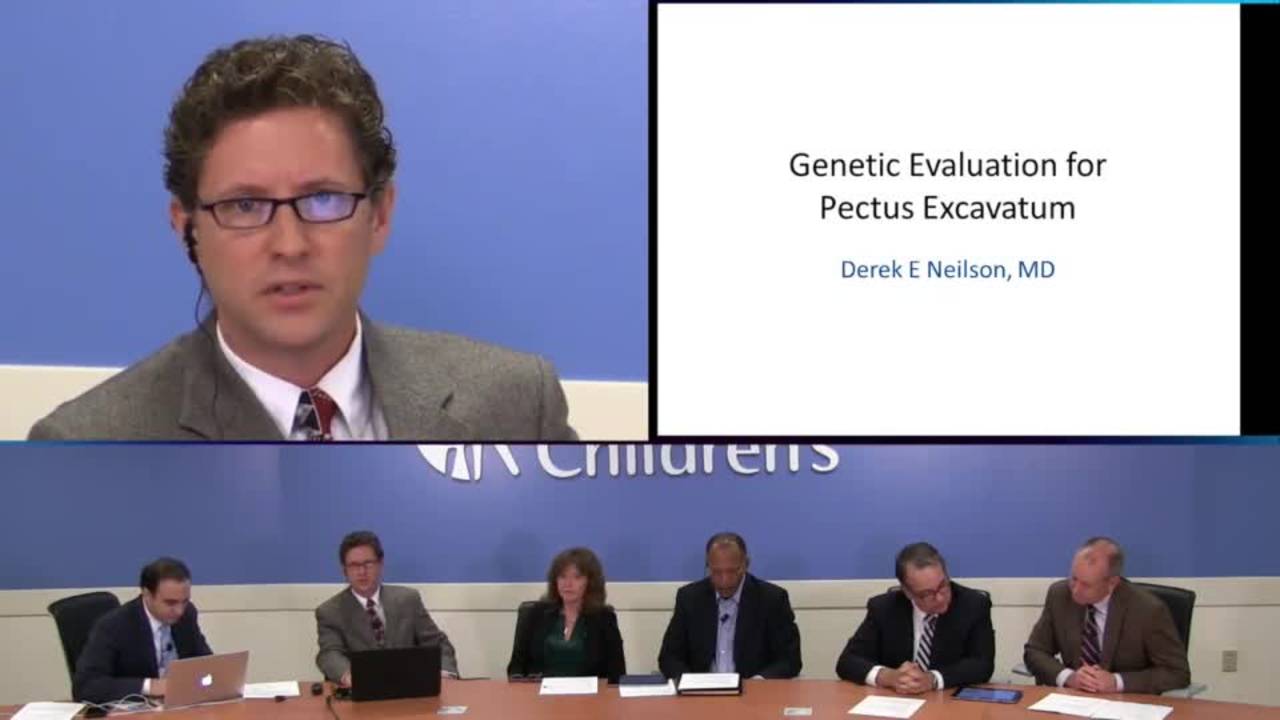
Genetics: Pectus Innovations

Video Published 2019-01-11 Updated 2022-08-22

Timestops (24)

0:00
Let's say thank you and Now for something completely differe…
Let's say thank you and Now for something completely different, we're going to talk about genetic evaluation for pectus …
0:21
And what we do in our clinic is really the skeletal evaluati…
And what we do in our clinic is really the skeletal evaluation, which is an examination of the um various physical findi…
0:49
This is one of the main skeletal findings that we see
This is one of the main skeletal findings that we see, so this is what contributes to our patients being tall and having…
1:19
The reason that we are looking for these is really related t…
The reason that we are looking for these is really related to the cardiac risk associated with Marfan syndrome and the o…
1:38
The diagnosis of this condition rests on the findings that a…
The diagnosis of this condition rests on the findings that are largely centered now on the cardiac findings, so an echoc…
2:05
There are some patients that have some Marfan-like character…
There are some patients that have some Marfan-like characteristics where we may actually extend that evaluation to other…
2:34
For many of us
For many of us, Ehlers-Danlos syndrome is a condition that we heard about once, maybe in medical school, and I can actua…
3:00
The classic type is due to defects in collagen 5 and is char…
The classic type is due to defects in collagen 5 and is characterized by joint hypermobility as well as abnormal skin. T…
3:26
This is the one that freaks most surgeons out because when t…
This is the one that freaks most surgeons out because when they hear about Ehlers-Danlos syndrome, they think, oh, I sho…
3:52
So with that condition
So with that condition, what we're looking for is a family history or personal history of ruptures, bowel rupture, aorti…
4:07
Um
Um, every so often that, uh, um, condition comes up as a consideration, and what's very nice about that is that it has g…
4:33
Uh
Uh, and so here's a little girl who can do activities with, uh, seem to test the limits of flexibility. And we test this…
4:59
We are looking for a hyperextension of the pinky past 90 deg…
We are looking for a hyperextension of the pinky past 90 degrees, apposition of the thumb to the forearm. And hyperexten…
5:27
It's considered that if a person has 5 or more joints that a…
It's considered that if a person has 5 or more joints that are hypermobile, they meet the criteria for generalized hyper…
5:46
There may be some scarring abnormalities
There may be some scarring abnormalities, and stria, but usually on the fairly mild side. We also look for the family hi…
6:01
I often get the question is what's the difference between be…
I often get the question is what's the difference between being flexible and having Ehlers-Danlos, and that is a really …
6:32
But what we also have noticed is that our patients exhibit a…
But what we also have noticed is that our patients exhibit a constellation of findings that include chronic pain. Associ…
7:02
So basically if you take everything that doctors don't like …
So basically if you take everything that doctors don't like to treat very well because they don't respond and throw them…
7:33
And that becomes problematic because that chronic pain aspec…
And that becomes problematic because that chronic pain aspect can play into whether they are at risk for more pain from …
7:56
One of the ideas behind fibromyalgia is that there is a cent…
One of the ideas behind fibromyalgia is that there is a central sensitivity to pain, meaning that these patients are una…
8:28
Um
Um, and this is one of the reasons why, uh, Derek and his team are a central component in our evaluation of, of our prac…
8:55
Do you have arachnodactyly?
Do you have arachnodactyly? Do they have stria? And if they have some of those findings, like I had one little girl, she…
9:08
And then if
And then if, if I find some of those findings, then I'll send them to genetics to be evaluated. I'm gonna make a plea wh…
9:34
Uh
Uh, I, I would love to know who I should be sending to genetics as someone who doesn't see it that often. You see them s…

Topic Overview

A single-speaker presentation on genetic evaluation for pectus excavatum, focusing on screening for Marfan syndrome and Ehlers-Danlos syndrome (EDS). The speaker describes the skeletal examination for Marfan (wrist/thumb signs, arm span ratios) and the cardiac risks (aortic dissection, mitral valve prolapse) that drive the evaluation. For EDS, the hypermobile type is most common in this population; the speaker explains the Beighton score for joint hypermobility and a constellation of associated problems—chronic pain, migraines, orthostatic hypotension, irritable bowel syndrome, anxiety—that may complicate pectus surgery, particularly the risk of fibromyalgia and central pain sensitization. Brief discussion follows on which patients warrant genetics referral.

Key Takeaways

  • Screen pectus patients for Marfan (aortic dissection risk) and hypermobile EDS (chronic pain/fibromyalgia risk pre-op). (0:00)
  • Beighton score ≥5 defines generalized hypermobility; look for family history and associated problems to diagnose EDS. (4:41)
  • Hypermobile EDS patients often have chronic pain, migraines, orthostatic hypotension, IBS, and anxiety—complicating surgery. (6:32)
  • 50% of teens with fibromyalgia have hypermobility; central pain sensitization increases post-op pain risk in pectus repair. (7:42)

Inside this episode

Kai, the Library's AI content creator, listened to this episode and mapped who's speaking, the chapters, key claims, and cases. Every item links to the exact moment in the recording.

AI-enriched

Who's speaking

  • Derek — guest
  • Speaker 2
  • Speaker 3
  • Speaker 4

Chapters

  • 0:00Marfan Syndrome Evaluation — Skeletal examination for Marfan (wrist/thumb signs, arm span and segment ratios, pectus, scoliosis, foot deformities) and the cardiac risks (aortic dissection, mitral valve prolapse) and ocular risks (lens dislocation) that motivate screening. Diagnosis centers on cardiac imaging (echo, MRI for aortic root dilation) and fibrillin gene testing when findings are suggestive.
  • 2:27Ehlers-Danlos Syndrome Overview — EDS as a group of connective tissue disorders. Classic type (collagen 5 defects) features joint hypermobility and fragile, thin skin with papery scars. Vascular type (collagen 3 mutations) involves internal organ fragility (bowel, aortic, uterine rupture) but is rare in this clinic; genetic testing is 99% sensitive. Most pectus patients have the hypermobile type.
  • 4:23Hypermobile EDS and Associated Problems — Hypermobile EDS is assessed by the Beighton score (9 joints; ≥5 hypermobile joints = generalized hypermobility) plus mild skin changes, family history, and presence of problems. Associated constellation includes chronic pain, migraines, TMJ dysfunction, easy bruising/bleeding, orthostatic hypotension, racing heartbeat, chronic constipation/IBS, panic/anxiety, and sleep problems. Hypermobility is a risk factor for fibromyalgia (50% of adolescent fibromyalgia patients are hypermobile), which involves central pain sensitization and may complicate pectus surgery outcomes.
  • 8:28Clinical Integration and Referral Criteria — Brief discussion on which pectus patients warrant genetics referral. One surgeon describes screening for double-jointedness, Marfanoid features (arachnodactyly, striae), and extreme flexibility (e.g., leg above head) and refers those with positive findings. Another requests a standardized workup protocol for pectus patients to guide referral decisions.

Key claims

  • 0:00Genetic evaluation for pectus excavatum primarily screens for Marfan syndrome and Ehlers-Danlos syndrome. — Derek
  • 0:21In Marfan syndrome, the wrist sign (thumb and pinky finger overlap when wrapped around the wrist) and thumb protrusion past the ulnar border indicate overgrowth of long bones relative to the trunk. — Derek
  • 1:00Marfan skeletal findings include pectus excavatum and carinatum, scoliosis, and hindfoot deformities. — Derek
  • 1:19Cardiac risks in Marfan syndrome include aortic dissection and mitral valve prolapse; other complications include retinal detachments. — Derek
  • 1:38Marfan diagnosis centers on cardiac findings; echocardiogram or MRI are the main tools to evaluate for dilated aortic root. — Derek
  • 1:55Lens dislocations are evaluated in Marfan syndrome, and fibrillin gene testing is performed in cases with suggestive findings. — Derek
  • 2:05In patients with Marfan-like characteristics, evaluation may extend to other genetic syndromes involving TGF-beta signaling, which may contribute to aortic remodeling and long bone overgrowth. — Derek
  • 2:27Ehlers-Danlos syndrome is by far the more common condition evaluated in pectus patients compared to Marfan syndrome. — Derek
  • 2:45Ehlers-Danlos syndrome represents a grouping of related connective tissue conditions, not a single disorder. — Derek
  • 3:00Classic Ehlers-Danlos is due to defects in collagen 5 and is characterized by joint hypermobility and abnormal skin that is fragile, thin, with weak and papery thin scars. — Derek
  • 3:17Vascular Ehlers-Danlos is caused by mutations in collagen 3 and involves internal organ fragility (bowel, aortic, or uterine rupture) rather than hypermobile joints. — Derek
  • 3:39Vascular Ehlers-Danlos is one of the least common conditions seen in the pectus clinic. — Derek
  • 4:07Genetic testing for vascular Ehlers-Danlos is 99% sensitive. — Derek
  • 4:23The hypermobile type of Ehlers-Danlos is what is typically evaluated in the pectus clinic. — Derek
  • 4:41The Beighton score tests 9 different joints and is scored 1 for each side except the hips, with a maximum of 9 points. — Derek
  • 4:52Beighton score criteria include hyperextension of the arms past 10 degrees, hyperextension of the pinky past 90 degrees, apposition of the thumb to the forearm, hyperextension of the knee past 10 degrees, and placing hands flat on the floor without bending the knees. — Derek
  • 5:27A person with 5 or more hypermobile joints on the Beighton score meets criteria for generalized hypermobility. — Derek
  • 5:40In hypermobile Ehlers-Danlos, skin changes are mild (mildly hyperextensible, easy bruising, mild scarring abnormalities, striae). — Derek
  • 6:01The dividing line between being flexible and having Ehlers-Danlos may be very fuzzy; diagnosis looks for similar findings in family members and the presence of problems. — Derek
  • 6:25Problems associated with hypermobile Ehlers-Danlos include joints that are loose and dislocate. — Derek
  • 6:32Patients with hypermobile Ehlers-Danlos exhibit a constellation of findings: chronic pain, chronic headaches and migraines, temporomandibular joint dysfunction, easy bruising and bleeding, orthostatic hypotension or dizziness or blacking out with standing, episodes of racing heartbeat, chronic constipation with irritable bowel syndrome, panic and anxiety disorders, and sleeping problems. — Derek
  • 7:12Most adult patients with hypermobile Ehlers-Danlos have almost all of the associated problems when they present. — Derek
  • 7:17In children with hypermobile Ehlers-Danlos, problems may be very mild or not evident, but may begin to emerge during puberty, which may coincide with consideration of pectus surgery. — Derek
  • 7:33The chronic pain aspect of hypermobile Ehlers-Danlos can play into whether patients are at risk for more pain from pectus surgery. — Derek
  • 7:42Hypermobility is a risk factor for fibromyalgia; 50% of teenagers diagnosed with fibromyalgia have hypermobility. — Derek
  • 7:56Fibromyalgia involves central sensitivity to pain, meaning patients are unable to filter out unwanted pain signals in the same way as other persons. — Derek
  • 8:08A hypermobile patient may be at risk for more problems with chronic pain. — Derek
  • 8:28Derek and his genetics team are a central component in the evaluation of pectus patients in this practice. — Speaker 2
  • 8:41One surgeon screens pectus patients for double-jointedness, Marfanoid appearance (arachnodactyly), striae, and extreme flexibility (e.g., leg above head) and refers those with positive findings to genetics. — Speaker 4

Open questions

  • What is a standardized workup protocol for pectus patients to guide genetics referral decisions?
This episode was analyzed and enriched by Kai, the Library's AI content creator. Every item links to the moment it comes from — click a timestamp to listen in context.
Written for:

Genetic Screening in Pectus Excavatum: Marfan and Ehlers-Danlos Evaluation

The essential version of this episode — what it covers, the points that matter most, and what it changes for you. Written by Kai from the episode transcript and reviewed before publishing.

For the care team · Core brief · AI-written, human-reviewed

What This Episode Covers

Genetic evaluation for pectus excavatum primarily screens for Marfan syndrome and Ehlers-Danlos syndrome 0:00. The assessment is not academic — it identifies cardiac risk in Marfan patients and chronic pain vulnerability in hypermobile Ehlers-Danlos patients, both of which directly affect surgical decision-making.

Marfan Syndrome

The skeletal exam looks for long bone overgrowth relative to trunk length: the wrist sign (thumb and pinky overlap when wrapped around the wrist) and thumb protrusion past the ulnar border 0:21. Other findings include pectus deformities, scoliosis, and hindfoot abnormalities 9:27. The real concern is cardiac: aortic dissection and mitral valve prolapse 1:19. Diagnosis centers on echocardiogram or MRI to evaluate for dilated aortic root 1:38, with lens dislocation screening and fibrillin gene testing in suggestive cases 1:55. Some Marfan-like presentations warrant evaluation for other TGF-beta signaling pathway disorders 2:05.

Ehlers-Danlos Syndrome

Ehlers-Danlos is by far the more common condition in pectus patients 2:27. It represents a grouping of connective tissue disorders, not a single entity 2:45. Classic Ehlers-Danlos (collagen 5 defects) presents with joint hypermobility and fragile, thin skin with papery scars 3:00. Vascular Ehlers-Danlos (collagen 3 mutations) involves internal organ fragility — bowel, aortic, or uterine rupture — rather than hypermobile joints 3:17, but is one of the least common conditions seen in the pectus clinic 3:39. Genetic testing for vascular Ehlers-Danlos is 99% sensitive 4:07.

The hypermobile type is what typically requires evaluation 4:23. The Beighton score tests 9 joints: hyperextension of elbows and knees past 10 degrees, pinky hyperextension past 90 degrees, thumb apposition to forearm, and hands flat on floor without bending knees 4:41 4:52. A score of 5 or more indicates generalized hypermobility 5:27. Skin changes are mild — mild hyperextensibility, easy bruising, mild scarring abnormalities, striae 5:40.

The dividing line between flexibility and Ehlers-Danlos is fuzzy; diagnosis looks for similar findings in family members and the presence of problems 6:01. Problems include joints that dislocate 6:25 and a constellation of findings: chronic pain, chronic headaches and migraines, temporomandibular joint dysfunction, easy bruising and bleeding, orthostatic hypotension, episodes of racing heartbeat, chronic constipation with irritable bowel syndrome, panic and anxiety disorders, and sleeping problems 6:32. Most adult patients with hypermobile Ehlers-Danlos have almost all of these problems 7:12.

Why This Matters for Pectus Surgery

In children, hypermobile Ehlers-Danlos problems may be mild or not evident but may emerge during puberty, which often coincides with consideration of pectus surgery 7:17. The chronic pain aspect can predict risk for more pain from pectus surgery 7:33. Hypermobility is a risk factor for fibromyalgia; 50% of teenagers diagnosed with fibromyalgia have hypermobility 7:42. Fibromyalgia involves central sensitivity to pain — an inability to filter out unwanted pain signals 7:56. A hypermobile patient may be at risk for more problems with chronic pain 8:08.

One surgeon screens for double-jointedness, Marfanoid appearance (arachnodactyly), striae, and extreme flexibility and refers positive findings to genetics 8:41. One of the discussants expressed the need for standardized guidance on appropriate workup for pectus patients 9:27.

Takeaways from this story

  • Marfan screening focuses on cardiac risk (aortic dissection, mitral valve prolapse) via echo/MRI for dilated aortic root.
  • Hypermobile Ehlers-Danlos is far more common than Marfan in pectus patients and predicts chronic pain risk post-surgery.
  • Beighton score ≥5 indicates generalized hypermobility; look for constellation of chronic pain, migraines, dysautonomia, IBS.
  • 50% of teenagers with fibromyalgia have hypermobility; central pain sensitization may complicate surgical recovery.

Keywords

Hashtags

Transcript

Comments

Loading comments…