


From
StayCurrentMD
ECMO timing and technique for severe congenital diaphragmatic hernia in neonates
With Dr. Rebecca Stark & Dr. Steven Lee · hosted by Dr. Em Gootee
Chapter 3 of 4
SEER protocol
SEER protocol and comfort care decision-making
Cued at 3:04 · press play
Expert statements on this page
No expert statements were drawn from this page.
Host summaries · secondary, not cited in answers
Educational content from recorded physician discussions — not medical advice. Talk to your (or your child's) care team about your situation.
Podcast
Timing and anticoagulation strategies for CDH repair on ECMO
4 min · Published Nov 2026
Video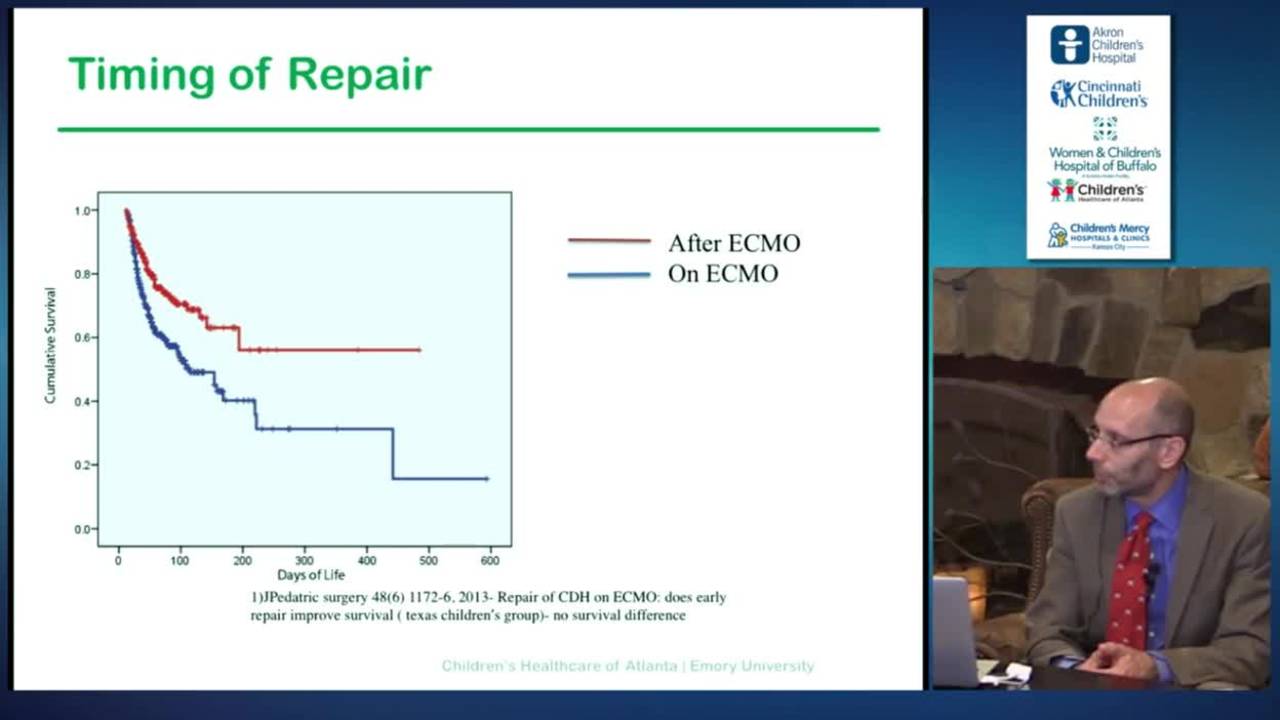
CDH-ECMO - VV vs. VA - Repair on ECMO: Update Course 2015
10 min · Published Nov 2015
Video
BOB Ped Surg 2023 - Shelby Sferra, AAP - Presentation
5 min · Published Feb 2023
Video
BOB in Ped Surg 2023 - AAP Winner - Shelby Sferra, MD
11 min · Published Feb 2023
Podcast
Protocol changes improve CDH survival rates at Cincinnati Children's Hospital
5 min · Published Nov 2026
Video
Update Course Rewind: 2024 Top Ten Key Takeaways
Dr. Todd Ponsky · 18 min · Published Jun 2025
Podcast
Routine Anal Dilations After PSARP: Questioning a Decades-Old Practice
2 min · Published Nov 2026
Podcast
Pediatric Surgery Literature Updates: Lymphatic Malformations, G-Tube Complications, and Cryptorchidism Timing
4 min · Published Nov 2026
Podcast
Botox injection during Hirschsprung pull-through: evidence and technique considerations
1 min · Published Nov 2026
Podcast
Central line troubleshooting and vascular access preservation in pediatric patients
2 min · Published Nov 2026
Podcast
Colorectal Quiz Episode 50: Key Takeaways from the 16th European Pediatric Colorectal Conference
24 min · Published Nov 2026
Podcast
Nerve monitoring and risk stratification in pediatric thyroid surgery
6 min · Published Nov 2026
What the experts said
The clinical scenario involves a full-term neonate with known left-sided very severe CDH, no cardiac or genetic anomalies, delivered about an hour ago and intubated per institutional protocols.
Initial vitals show preductal saturations in the 70s, heart rate 150, blood pressure 35/25 on 100% FIO2, with first gas showing pH 6.8, PaCO2 130, and PaO2 28.
There are lots of benefits to VV ECMO and lots of benefits to VA ECMO.
The majority of centers still do VA ECMO primarily for CDH babies.
Both VA and VV ECMO are totally reasonable answers for this clinical scenario.
Based on prenatal imaging showing high risk for needing ECMO, the time to intervene is probably earlier rather than later.
VV cannula availability and concerns with certain VV cannulas have played a role in ECMO modality selection.
If an institution does VV ECMO but cannot cannulate because the 13 French cannula is too big, they would probably do VA instead.
Better VV cannulas are coming out, which may change the numbers of centers using VV ECMO.
Michigan's SEER protocol prenatally selected severe CDH cases and educated parents they would go on this pathway.
In the SEER protocol, ECMO was on standby in the delivery room, and babies were intubated and resuscitated within 2 hours.
In the SEER protocol, if pH did not reach 7, PCO2 was not less than 100, and preductal sats were not above 80 within 2 hours, comfort measures only were offered.
The two groups in the SEER protocol (ECMO versus comfort care) had equivalent survival.
Half of the patients offered comfort measures in the SEER protocol could have been survivors.
If you make the decision to choose ECMO versus comfort care beforehand using protocols like SEER, you will be wrong 50% of the time.
With good prenatal counseling and parents who are all in, ECMO should be pursued for every unilateral isolated CDH.
Cases involving genetic or cardiac syndromes are an entirely different scenario from isolated CDH and are not included in the recommendation for universal ECMO.
In the SEER protocol, if babies could achieve the resuscitation targets, they were offered ECMO.
Half of the patients offered ECMO in the SEER protocol did not survive.