Read the article here: https://www.jpedsurg.org/article/S0022-3468(20)30423-1/pdf
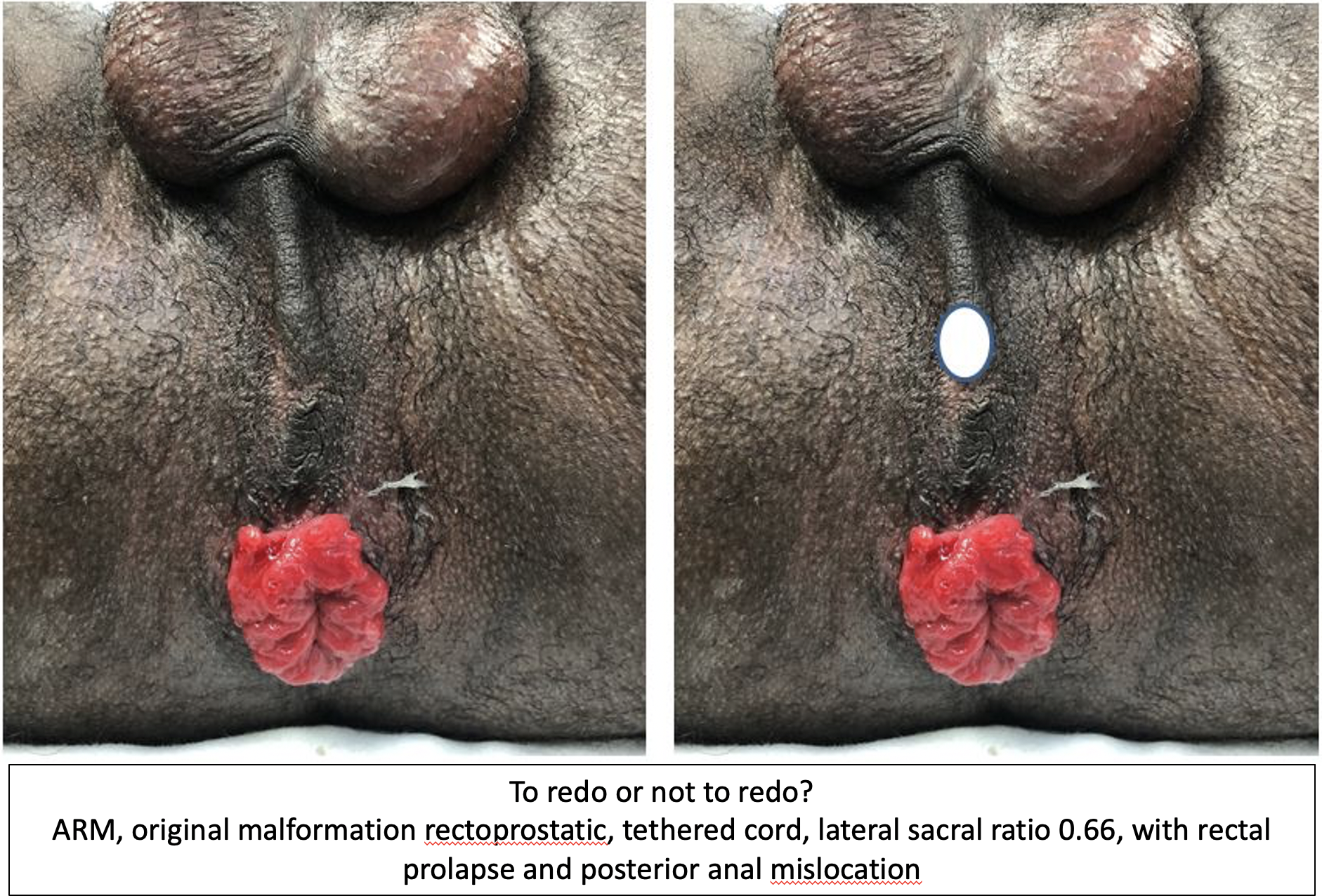
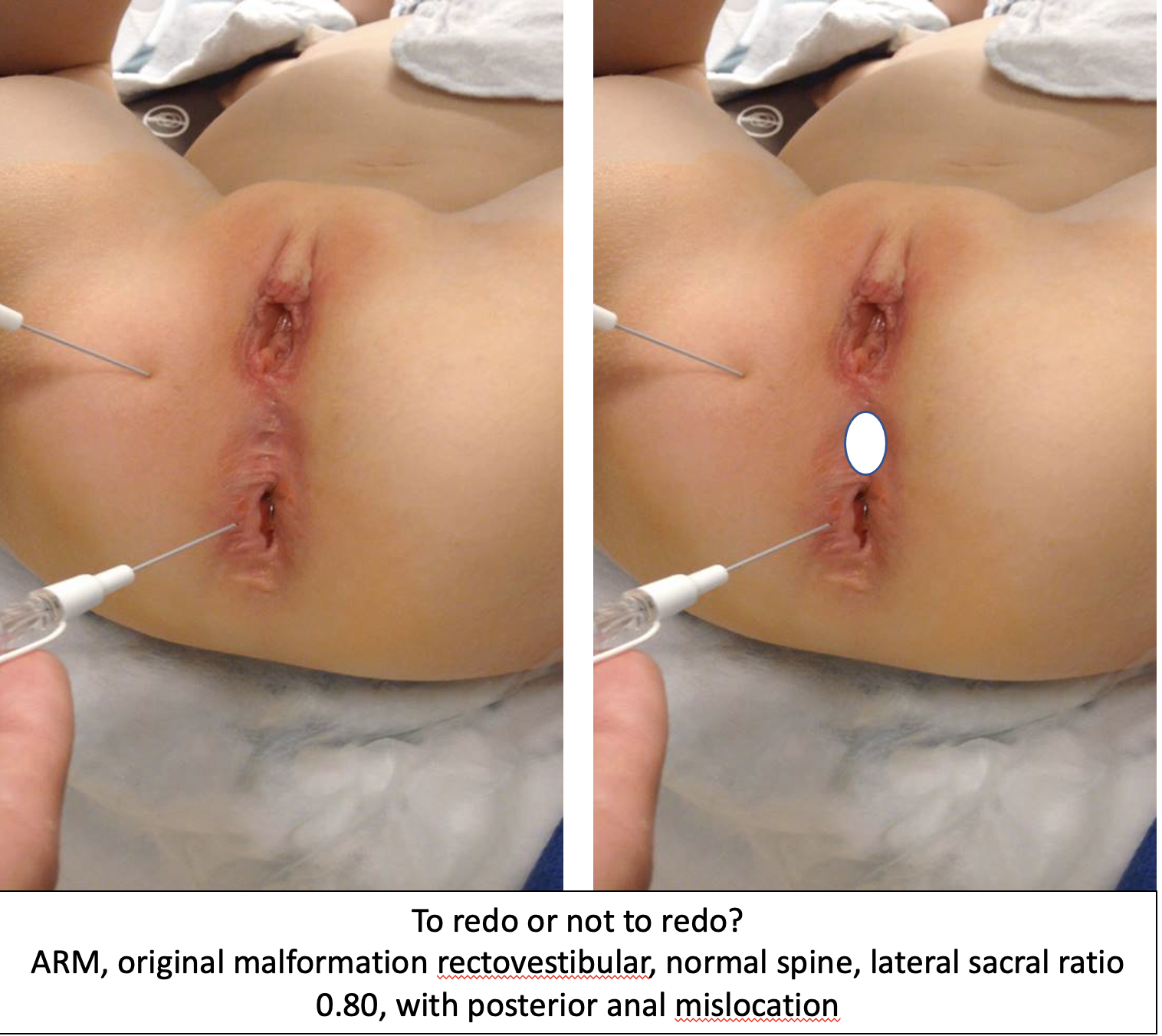
Type: podcast · 18 min · posted 2021-01-25 Canonical: https://library.globalcastmd.com/watch/colorectal-quiz-episode-2-when-to-redo-a-psarp-3580 ## Chapters - [0:00](https://library.globalcastmd.com/watch/colorectal-quiz-episode-2-when-to-redo-a-psarp-3580?t=0) Introduction and Clinical Challenge - [3:19](https://library.globalcastmd.com/watch/colorectal-quiz-episode-2-when-to-redo-a-psarp-3580?t=199) Case 1: Seven-Year-Old Male - [8:15](https://library.globalcastmd.com/watch/colorectal-quiz-episode-2-when-to-redo-a-psarp-3580?t=495) Case 2: Four-Year-Old Female and Technical Pearls - [11:00](https://library.globalcastmd.com/watch/colorectal-quiz-episode-2-when-to-redo-a-psarp-3580?t=660) JPS Study Review and Redo Outcomes - [16:02](https://library.globalcastmd.com/watch/colorectal-quiz-episode-2-when-to-redo-a-psarp-3580?t=962) Summary and Conclusion ## Statements - "If you don't get anorectoplasty perfect, you might not have the best outcomes, which separates it from other surgical procedures" — Rod Gerardo (opinion) [0:00](https://library.globalcastmd.com/watch/colorectal-quiz-episode-2-when-to-redo-a-psarp-3580?t=0) - "A lot of surgeons agree that oftentimes your first shot might be your only shot to give this patient a good outcome and the right anatomy" — Rod Gerardo (opinion) [0:50](https://library.globalcastmd.com/watch/colorectal-quiz-episode-2-when-to-redo-a-psarp-3580?t=50) - "The original malformation was a prostatic fistula and the patient has a tethered cord and a sacral ratio of 0.66" — Marc Levitt (clinical) [4:30](https://library.globalcastmd.com/watch/colorectal-quiz-episode-2-when-to-redo-a-psarp-3580?t=270) - "The family doesn't really care how technically elegant is your anaplasty. What they care about is whether that anaplasty that you make is going to work" — Rod Gerardo (opinion) [5:50](https://library.globalcastmd.com/watch/colorectal-quiz-episode-2-when-to-redo-a-psarp-3580?t=350) - "The higher the malformation is, the worse the prognosis" — Rod Gerardo (clinical) [6:15](https://library.globalcastmd.com/watch/colorectal-quiz-episode-2-when-to-redo-a-psarp-3580?t=375) - "Sacrum ratio 0.7 or greater usually means normal or close to normal sphincters and good muscle tone and spine innervation" — Rod Gerardo (clinical) [6:30](https://library.globalcastmd.com/watch/colorectal-quiz-episode-2-when-to-redo-a-psarp-3580?t=390) - "The most common associated spinal anomaly is tethered cord, but the worst is myelomeningocele" — Rod Gerardo (clinical) [6:55](https://library.globalcastmd.com/watch/colorectal-quiz-episode-2-when-to-redo-a-psarp-3580?t=415) - "Patients with myelomeningocele have much more trouble with continence" — Rod Gerardo (clinical) [6:55](https://library.globalcastmd.com/watch/colorectal-quiz-episode-2-when-to-redo-a-psarp-3580?t=415) - "It's amazingly common to have a mislocated anus" — Rod Gerardo (clinical) [7:44](https://library.globalcastmd.com/watch/colorectal-quiz-episode-2-when-to-redo-a-psarp-3580?t=464) - "A key pitfall is opening the PSARP incision first; you should mark the sphincters first, then open the PSARP so you don't get confused when placing the anoplasty" — Rod Gerardo (clinical) [7:55](https://library.globalcastmd.com/watch/colorectal-quiz-episode-2-when-to-redo-a-psarp-3580?t=475) - "The patient was born with a vestibular fistula, the spine is normal and has an excellent sacrum, so this is a much better prognosis bowel control patient" — Marc Levitt (clinical) [8:40](https://library.globalcastmd.com/watch/colorectal-quiz-episode-2-when-to-redo-a-psarp-3580?t=520) - "The stimulator is the same electrical stimulator that anesthesia uses for their train of four" — Marc Levitt (clinical) [9:50](https://library.globalcastmd.com/watch/colorectal-quiz-episode-2-when-to-redo-a-psarp-3580?t=590) - "You have to tell your anesthesiologist not to give skeletal muscle relaxant because the stimulator is a little bit weaker than the traditional stimulator" — Marc Levitt (clinical) [10:05](https://library.globalcastmd.com/watch/colorectal-quiz-episode-2-when-to-redo-a-psarp-3580?t=605) - "In higher malformations like bladder neck fistula in a boy, the sphincter complex isn't always where you think it's going to be; sometimes those sphincter complexes are more anterior than anticipated" — Rod Gerardo (clinical) [10:40](https://library.globalcastmd.com/watch/colorectal-quiz-episode-2-when-to-redo-a-psarp-3580?t=640) - "The vast majority of redo operations were for mislocation, then came stricture, and less common reasons included remnant of original fistula (roof), rectal prolapse, and others" — Marc Levitt (clinical) [12:00](https://library.globalcastmd.com/watch/colorectal-quiz-episode-2-when-to-redo-a-psarp-3580?t=720) - "Quality of life improved with a redo operation" — Marc Levitt (clinical) [12:30](https://library.globalcastmd.com/watch/colorectal-quiz-episode-2-when-to-redo-a-psarp-3580?t=750) - "Patients had an improved ability to achieve continence after redo" — Marc Levitt (clinical) [12:40](https://library.globalcastmd.com/watch/colorectal-quiz-episode-2-when-to-redo-a-psarp-3580?t=760) - "20% of patients with a poor sacrum or poor spine actually developed bowel control after their redo" — Marc Levitt (clinical) [12:50](https://library.globalcastmd.com/watch/colorectal-quiz-episode-2-when-to-redo-a-psarp-3580?t=770) - "Patients with good potential—a good sacrum and good spine—did extremely well after redo" — Marc Levitt (clinical) [13:05](https://library.globalcastmd.com/watch/colorectal-quiz-episode-2-when-to-redo-a-psarp-3580?t=785) - "Patients who did not develop voluntary bowel movements were still able to be clean with a bowel management program with enemas or antegrade using a Malone" — Marc Levitt (clinical) [13:15](https://library.globalcastmd.com/watch/colorectal-quiz-episode-2-when-to-redo-a-psarp-3580?t=795) - "The average age of patients in the study is about three and a half years" — Marc Levitt (epidemiological) [13:21](https://library.globalcastmd.com/watch/colorectal-quiz-episode-2-when-to-redo-a-psarp-3580?t=801) - "If you know the anatomy is off, you should do the redo" — Marc Levitt (opinion) [13:28](https://library.globalcastmd.com/watch/colorectal-quiz-episode-2-when-to-redo-a-psarp-3580?t=808) - "There's an advantage to getting the anatomy right the younger the child is" — Marc Levitt (opinion) [13:40](https://library.globalcastmd.com/watch/colorectal-quiz-episode-2-when-to-redo-a-psarp-3580?t=820) - "Many patients present after the age of potty training because they're incontinent, and evaluation reveals the reason is they don't have the best operation" — Marc Levitt (clinical) [14:10](https://library.globalcastmd.com/watch/colorectal-quiz-episode-2-when-to-redo-a-psarp-3580?t=850) - "When doing redo at older age, usually add a Malone at the same time so patients can learn how to get control with their new anatomy before trying voluntary bowel movements" — Marc Levitt (clinical) [14:30](https://library.globalcastmd.com/watch/colorectal-quiz-episode-2-when-to-redo-a-psarp-3580?t=870) - "The process of learning control with new anatomy after redo may take 6 to 12 months" — Marc Levitt (clinical) [14:43](https://library.globalcastmd.com/watch/colorectal-quiz-episode-2-when-to-redo-a-psarp-3580?t=883) ## Transcript Anal rectoplasty. It's an incredibly particular procedure and as many of you know, if you don't get it perfect, you might not have the best outcomes. And that kind of separates it from other surgical procedures. And on top of that pressure, a lot of surgeons agree that oftentimes your first shot might be your only shot to give this patient a good outcome and the right anatomy. So what happens when, despite our best efforts, the patient still has issues? Well, then we can talk about reoperating, but it's a difficult subject because how do you know when to reoperate? When's it better to just treat medically as opposed to reoperate? If this brief discussion sparked your memory and now you're thinking about a patient who didn't have a great outcome after their anal rectoplasty and you were kind of in this tough decision zone, don't feel bad because even some of the best pediatric colorectal surgeons can sometimes struggle with this. How many patients, Jason, have you seen on laxatives that comes with an anus in the wrong place? How many patients have you seen having had a cecostomy with perfect anatomy? That's the real frustrating one. Right? A lot. That's Dr. Mark Levitt at Children's National Hospital out in DC. And he's talking to his friend, Dr. Jason Frischer at Cincinnati Children's Hospital. They're talking about something that frustrates a lot of pediatric colorectal surgeons and just surgeons in general. After you've done an anorectoplasty, when do you pull the trigger and say it's time for a... Redo, redo, redo. And that's what we're going to talk about today. Anorectal malformations post-repair that might need a redo. I'm Rod Girardo from Cincinnati Children's. And this is the colorectal quiz, episode two. Well, welcome back, everyone. We're really glad you're joining us for our colorectal quizzes. This is going to be in conjunction with a review of a Journal of Pediatric Surgery article, which I'm excited to talk about as well. And really, we're here to talk about today is anal rectal malformations and post-repair. Patients who are having problems that come to your office at a few years of age and there's issues. And not only are there functional issues, but maybe anatomic issues. And so what we're putting out there proposing is to redo or not to redo. And now, Happy New Year to everyone. We missed you. Yes. Happy New Year, Jason. So yeah, you set this up really well. These are patients, we're going to present two patients, similar but different, that have had anal rectal malformation repairs in the distant past. They're now more like the age of potty training. The first one is seven years old. The second one we'll show you is four years old. And the question is, do they need something done to improve their anatomy, both from a practical point of view and from a functional point of view? Namely, improving their anatomy, will they develop bowel control? So the first case is this boy. At this point, Dr. Levitt pulls up an image of a seven-year-old male child who is status post a anal rectal plasty. If you're listening to this podcast in the Stay Current app, go ahead and open the drop box and click on the link for the first image and you can see what we're looking at. And there's some pretty obvious things that one can see. Obviously, there's a rectal prolapse. And I think anyone can just look at this image and see that the analplasty was placed too posteriorly. When we did an electrical stimulation on this patient, the center of the sphincter is in the second photo where the white dot is. Now, of importance, the original malformation was a prostatic fistula and the patient has a tethered cord and has sort of a middle-of-the-road sacral ratio of 0.66. So what would you do? Well, Mark, maybe we should discuss some of the findings. Yes, there's obvious findings of a prolapsed analplasty and a posterior position of the analplasty. But it also does maybe some other more subtle findings. Like, to me, the bottom looks quite flat. And I know you mentioned in the history that it's a rectal prostatic fistula. A patient has a tethered cord and a sacral ratio. So how do we put all that information together when discussing with the family trying to prognosticate the potential for bowel control? Yeah, I mean, I think, Jason, that's a key question. And I think all of us that are taking care of patients with anorectal malformations, and I mean, every pediatric surgeon out there needs to commit that they know what type of malformation it is anatomically. They know the quality of the sacrum and the quality of the spine, even in the newborn period. Because I can tell you, the family doesn't really care how technically elegant is your analplasty. What they care about is whether that analplasty that you make is going to work. And is the child going to be clean and in normal underwear and just like all the other kids? So prognosis is key. And I think we can tell them a lot. So what type of malformation is it? Because the higher it is, the worse the prognosis. And then the sacrum ratio, 0.7 or greater usually means... Normal connotes normal sphincters most likely or close to normal sphincters. And obviously good muscle tone and the spine innervation of that area is probably good. All of that was represented by a good sacrum. And then the nerve innervation. So keeping in mind that patients can also come with... An associated spinal anomaly, most commonly tethered cord, but the worst of course is a myelomeningocele. And those patients have much more trouble with continence. Todd Ponsky was also on the call and he caught something that both of them said really quickly and kind of brushed off. You all both looked at this image and said, you can tell obviously that this is too low, too posterior. Without a stimulator in the office, what do you look for to immediately tell that the anoplasty was done too low? But basically I'm looking for the anal dimple and there's like a midline where I say, and there seems to be a little raised area, which is where the sphincters are and where the analplasty ought to be. You know, it's amazingly common to have a mislocated anus. Is it the surgeon either misses where the center is, if they're doing a laparoscopic pull through, or if doing a PSARP, they open the PSARP incision first. And I think a key pitfall is not do that. Mark the sphincters first, then open the PSARP because then you don't get confused at the end when you're trying to place the anoplasty in the correct location. The next image comes up, this time a female, again with what appears to be a posterior anorectoplasty. If you're in the app, go ahead and click the next image. It looks, this is obviously a female, it looks posteriorly located. And what my eye is drawn to is the ellipse, the pinkish ellipse, a little bit, the white dot shows where it ought to be. The urethra and vagina are normal. So this patient was born with a vestibular fistula. The spine is normal and has an excellent sacrum. So this is a much better prognosis bowel control patient, but with a similar anatomic problem. And we have to decide whether the patient needs a redo or not. What I'm hearing you say is that visual inspection can usually tell you where this should be. Yeah, that the stimulator can confirm maybe, but you usually can tell visually about where this should be. And although you said, so that's one point. And although you said that you should mark this off first before cutting, why are people making these more posterior? How do I prevent that as someone who doesn't have the same experience you do? Yeah, so I think the answer is that you look for the visual cues, as Jason said, the ellipse, the color change, where it's a little bit indented or a little bit of a raised area, how long the perineal body makes sense. And of course, use the stimulator. And before you make any incision of any kind, then the stimulator will show you the center and then you mark that. By the way, I get asked all the time about the stimulator. It's the same electrical stimulator that anesthesia uses for their train of four. And then there's a connection that you can make that has little pins. Really, really inexpensive. And you just have to tell your anesthesiologist not to give skeletal muscle relaxant because it's a little bit weaker than the traditional stimulator, which was super expensive. The other thing, Mark, I want to mention is that when you're doing reconstructing your malformations, there are patients, the high, quote unquote, higher the malformations, let's say a bladder neck fistula in a boy, their sphincter complex isn't always where you think it's going to be. Patients like patients who have a higher malformation, such as a bladder neck, sometimes those sphincter complexes are sort of more anterior than you think that you're anticipating it might be. So really use the visual cues and the functional findings when using an electrical stimulator to put it where it should be. They pull up a recent JPS article. It's titled Assessing the Benefit of Reoperations in Patients Who Suffer from Fecal Incontinence After Repair of Their Anorectal Malformation. If you're in the app, you could just click on the link and you could read the whole article. You know, what are the benefits of doing this? Because I struggle sometimes before I really delved into pediatric colorectal surgery. I always thought that the original reconstruction was it. And of course, we want it to be right the first time, but sometimes a redo is the right thing to do. So let's discuss that. Yeah, so I just want to really give a good shout out to Richard Wood and my other partners in Columbus, because he really helped document the data on patients, on how they were when they showed up, and what happened if you redid them. So really for the first time in the Journal of Pediatric Surgery article that we're talking about here is essentially long-term outcomes in patients who have had reoperations. So let's jump in. First of all, why do patients get redos? The vast majority were mislocation. Then came stricture. And then came some less common reasons. Most relevant was a remnant of the original fistula, also known as a roof, rectal prolapse, and some others. So how did their quality of life change? Then their quality of life improved with a redo. They also had an improved ability to achieve continence. Those patients were bought to be given the best opportunity to have nearly normal anatomy if possible. So in this study, they found that 20% of the patients with a poor sacrum or a poor spine actually developed bowel control after their redo. Now those with good potential, a good sacrum and a good spine, they did extremely well. Now the remainder who did not develop voluntary bowel movements, they were still able to be clean with a bowel management program with enemas or anti-grade using a malone. Now the average age of the patients in this study is about three and a half years, give or take. Kind of raises a question. Mark, I'm going to play a little devil's advocate here. What is the right age to make these decisions? So I think if you know the anatomy is off, you should do the redo. And actually, I think there's an advantage to getting the anatomy right the younger the child is. So if there's a two-year-old and the anus is mislocated or there's a bad prolapse, then I would offer them a redo and then let them live their life in diapers for a year or two with better anatomy and then see if they can successfully potty train, knowing that if they don't, then they go to bowel management with enemas and may or may not need them alone. The one nuance is, unfortunately, many of these patients present after the age of potty training because they're incontinent. And when they're incontinent, you or I evaluate them for that incontinence and find that the reason why they're incontinent is because they don't have the best operation. Their anus isn't in the right place. They may have great sphincters, but they can't close the anal hole when they squeeze them. So we do the redo at that time. I usually add a Malone at the same time just so that they can then learn how to get control with their new anatomy before they really, really take their anatomy out for a ride and stop the Malone flushes and try to have voluntary bowel movements. That process may take 6 to 12 months. Now, the patients that we talked about had obviously misplaced anuses or ani, but what if it's kind of in between? If you see a patient who has a mislocated anus and it's 50% within the sphincter complex, so half in, half out, three and a half years old, beacly incontinent. Yeah, I think that's a good question. That's more of a philosophical question. If I was presented with that exact scenario, I would probably redo them and do a Malone and then get them perfectly clean mechanically and then see if they can develop bowel control. So I think a lot of it depends on the family's needs and the age of the patient. I might be maybe a little bit more conservative and let the child take their car out for a ride first, see how it works. If it drives well, stay with that car. If it's not driving well, then consider the redo. I mean, obviously, it's a case-by-case basis, but... I'm sort of assuming that these patients are coming to us fecally incontinent. Right. So I think the point you're making, which I think is an excellent one, is that if they haven't declared their continence yet because they're not old enough to do so from a behavioral point of view, give them a chance. They may succeed. So to summarize, Dr. Levitt and Dr. Frischer, in conjunction with this JPS article, make a really good argument that those patients who are status post their PSARP but are still having some issues with continence functionally, regardless of their original prognosis group, they might benefit from a redo. They might be able to get continence. And finally, I think this paper, which us as surgeons sometimes maybe skip this point, but I think it's the most important point, is that you improved their quality of life. Yes, it's been awesome, as always. You have anything for me? Yeah. So now I'm trying to remember what... I just learned a joke from a kid. Well, there was a child that was asking his dad an important question. He said, Dad, where does poo come from? And the father did a Google search and got some education and said, well, it's complicated. You eat and then food goes into the stomach. It's digested. Nutrition comes out in the small intestine. Water is absorbed in the colon. And then there's poo. And the child thought about that for a minute and said, okay, well, then where does Tigger come from? Oh, boy. Why don't you record a different joke if that one's no good? No, we're keeping it. Until the next time. So there you have it. The second episode in our colorectal series with Dr. Levitt and Dr. Frischer. I think they put a really good argument for a redo. Sometimes incontinence might just come down to anatomy. I'm Rod Girardo. Thanks for listening. And until next time, remember, knowledge should be free. --- Not medical advice · citation policy: https://library.globalcastmd.com/ai