


From
StayCurrentMD
#APSA50: The Past and The Future
With Dr. Jim O'Neill & Dr. Joe Shapiro · hosted by Dr. Ray Hankey
Chapter 1 of 5 · Fundamentals
Introduction
Introduction to APSA 50th Anniversary Coverage
Expert statements on this page
No expert statements were drawn from this page.
Host summaries · secondary, not cited in answers
Educational content from recorded physician discussions — not medical advice. Talk to your (or your child's) care team about your situation.
Video
Intestinal Atresia Types Explained: Grossfeld Classification for Pediatric Surgery
1 min · Published Sep 2026
Video
Derivation and validation of the Pediatric Community-Acquired Pneumonia Severity (PedCAPS) score: A prospective cohort study
50 s · Published Sep 2026
Video
FETO for Late-Diagnosed Severe Congenital Diaphragmatic Hernia (CDH) at Cincinnati Children's with Dr. Beth Rymeski
4 min · Published Sep 2026
Video
Severe Congenital Diaphragmatic Hernia (CDH) Case: FETO Management & Unexpected Findings with Dr. Beth Rymeski
3 min · Published Sep 2026
Video
Fetoscopic Endoluminal Tracheal Occlusion (FETO) Procedure: Step-by-Step Guide with Dr. Beth Rymeski
4 min · Published Sep 2026
Video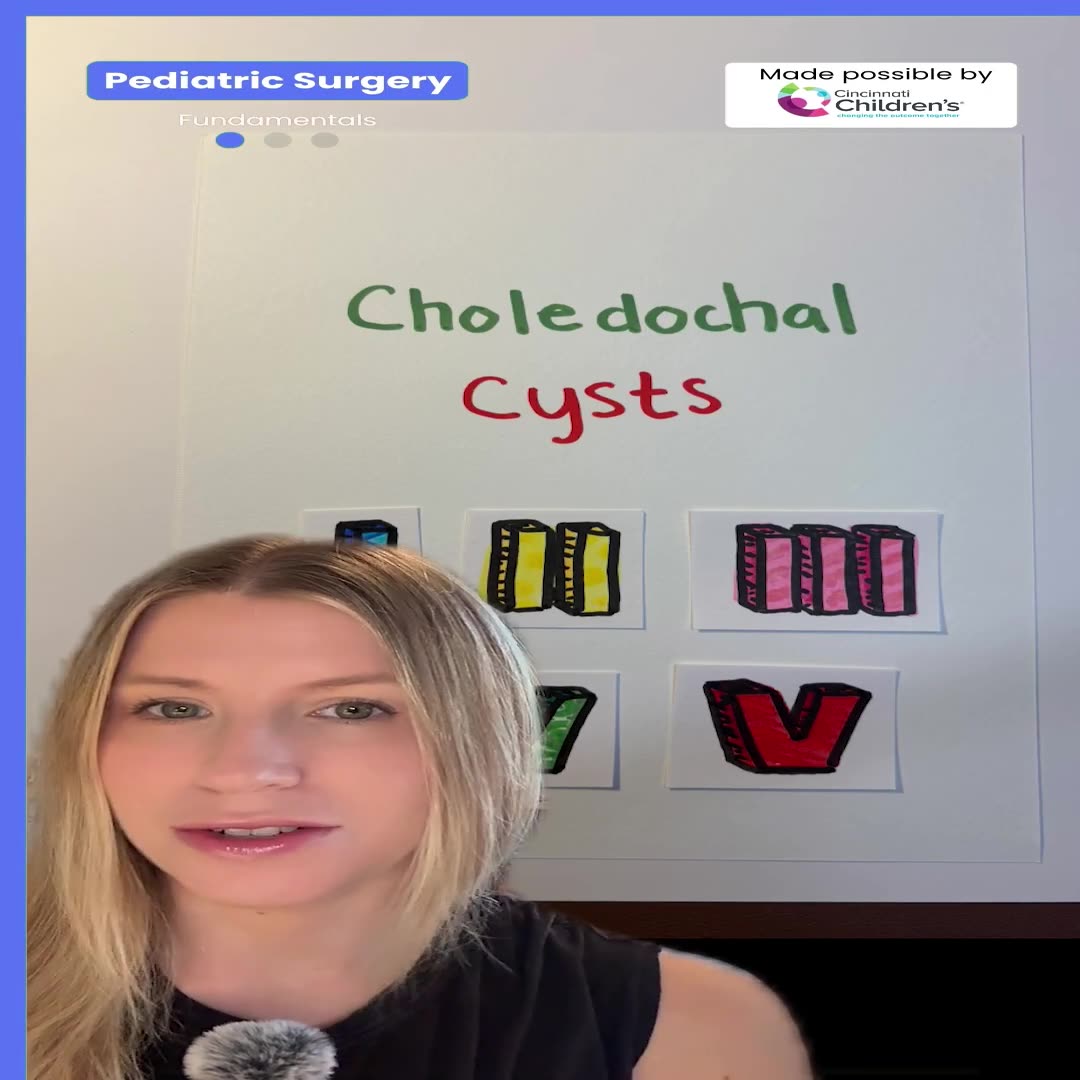
Choledochal Cyst Types Explained: Pediatric Surgery Fundamentals
1 min · Published Sep 2026
What the experts said
At the beginning of pediatric surgery, only three people devoted their energies exclusively to children's surgery: William Ladd, Herbert Koh, and Oswald Wyatt.
William Ladd worked for close to 28 years before he was able to specialize and was the first professor of pediatric surgery at Harvard and Boston Children's Hospital.
Pediatric surgery was much broader in scope in early days because there were no other specialists.
H. William Clatworthy had insight into how pediatric surgery could develop itself in a credible fashion so the specialty would be validated alongside general surgery.
The American Board of Surgery had four major objections to pediatric surgery board certification: no unique body of knowledge above general surgery, no organization with surgical roots, no approved educational curriculum with standards and metrics, and no structure of governance relating to major accrediting organizations.
Dr. Clatworthy developed a curriculum and metrics for certification that were designed to meet the requirements of the accrediting organization, the American College of Surgeons, and the American Surgical Association.
APSA and the Journal of Pediatric Surgery were established as linchpins to meet the four deficiencies identified by the American Board of Surgery.
By 1970-1971, pediatric surgery had completed all required infrastructure, and in 1971 the fifth application for boards was finally approved, with implementation by 1973.
Pediatric surgery is very good at collaborating in research, pretty good at collaborating in care particularly in institutions, but lousy about collaborating in education.
In global educational mission hospitals, there is total collaboration with people scrubbing together and sharing knowledge.
The challenges of practicing surgery have changed from when Dr. Shapiro trained to current practice.
Not doing anything after adverse events and just leaving clinicians to get over it and get back to the next case does not work—it can work for certain people in certain circumstances, but the literature shows it is a driver of burnout, depression, and suicide.
Surgeon emotional and physical well-being impacts the care given to patients and families, making it a safety and quality issue.
Most surgeons were trained to ignore their emotional responses to adverse events, but learned early on that bringing humanity to work with patients and families is essential to being a good surgeon.
APSA revealed a new strategic goal of equity and social justice built on the foundation of inclusion, representation, and participation for all.