


From
StayCurrentMD
#APSA50: Benjy Brooks Panel - The Women of APSA
With Dr. Catherine Anderson & Dr. Diana Farmer & Dr. Marion Henry · hosted by Dr. Alex Cassar
Chapter 1 of 6 · Fundamentals
Introductions
Introduction and guest biographies
Expert statements on this page
No expert statements were drawn from this page.
Host summaries · secondary, not cited in answers
Educational content from recorded physician discussions — not medical advice. Talk to your (or your child's) care team about your situation.
Video
Intestinal Atresia Types Explained: Grossfeld Classification for Pediatric Surgery
1 min · Published Sep 2026
Video
Derivation and validation of the Pediatric Community-Acquired Pneumonia Severity (PedCAPS) score: A prospective cohort study
50 s · Published Sep 2026
Video
FETO for Late-Diagnosed Severe Congenital Diaphragmatic Hernia (CDH) at Cincinnati Children's with Dr. Beth Rymeski
4 min · Published Sep 2026
Video
Severe Congenital Diaphragmatic Hernia (CDH) Case: FETO Management & Unexpected Findings with Dr. Beth Rymeski
3 min · Published Sep 2026
Video
Fetoscopic Endoluminal Tracheal Occlusion (FETO) Procedure: Step-by-Step Guide with Dr. Beth Rymeski
4 min · Published Sep 2026
Video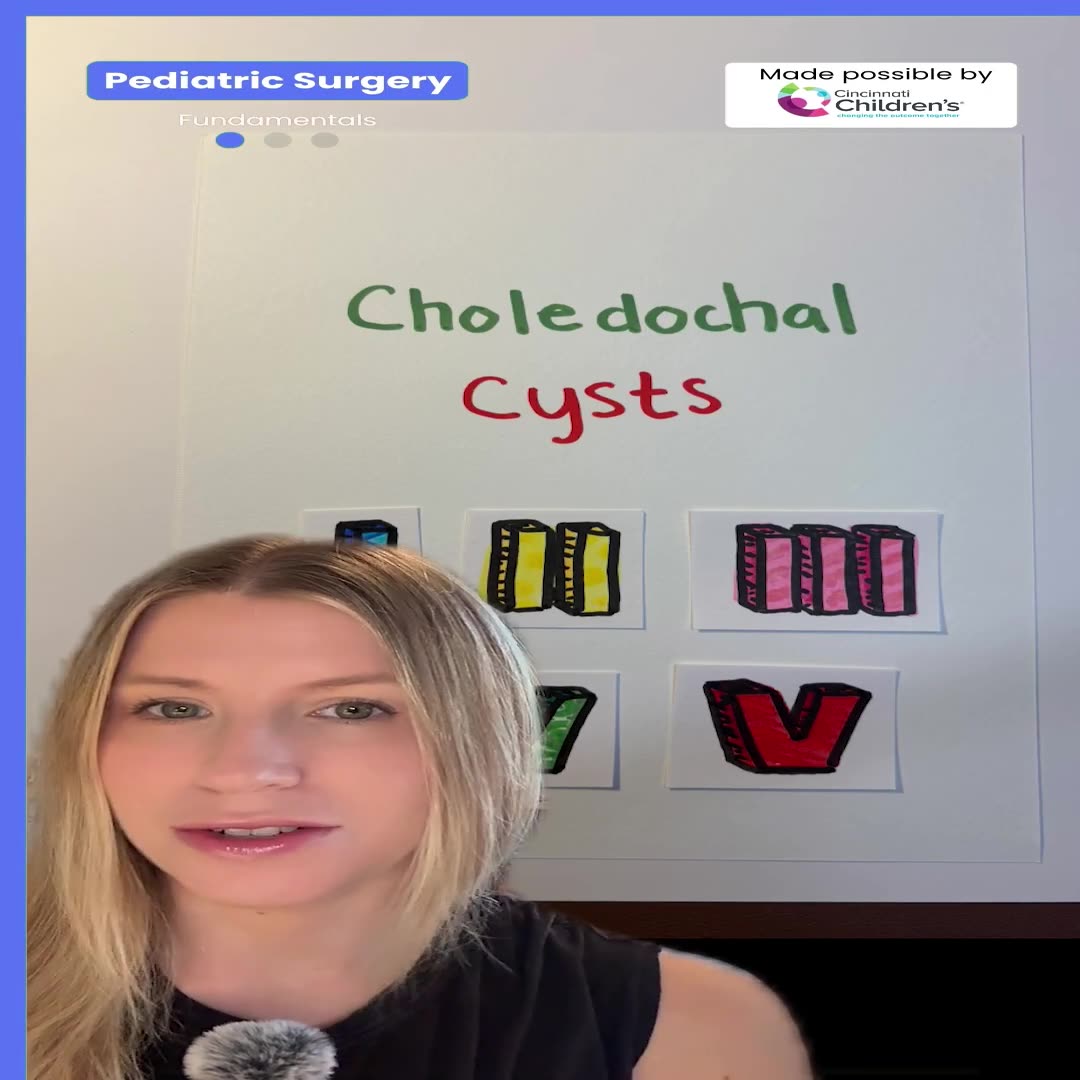
Choledochal Cyst Types Explained: Pediatric Surgery Fundamentals
1 min · Published Sep 2026
What the experts said
Benji Brooks was one of the first female members of APSA and one of the first female pediatric surgeons.
Dr. Robert Gross had never trained a woman and by reputation had prejudice against doing so.
Dr. Charles Janeway asked Dr. Gross to train Benji Brooks without revealing she was a woman; Gross assumed Brooks was male and agreed without an interview.
Dr. Gross discovered Benji Brooks was a woman on her first day but trained her anyway.
In early pediatric surgery, it was routine to remove the spleen in children with splenic trauma.
In early APSA meetings, the two alternatives for free afternoons were always golf or tennis.
A few women surgeons met informally and wanted alternative activities to golf and tennis.
When women requested a room for meetings, they were told APSA didn't want more 'splinter groups' to form.
The women's group started meeting informally without requesting official space, organizing lunches and activities like kayaking.
APSA eventually gave the women's group a room and program time, though they still had to buy their own lunch.
After 2-3 years of informal meetings, the group decided to name themselves the Benji Brooks Society after research confirmed she was the first pediatric surgeon.
Dr. Catherine Anderson was president of the American College of Surgeons when Marion Henry was a 4th-year medical student.
At a recent Benji Brooks gathering, the question was posed whether the group was still necessary given the number of women in pediatric surgery.
There was unanimous agreement that the women's group was still necessary because issues remain and work needs to be done.
The group decided to petition APSA to become an official committee rather than remain independent, believing women needed to be 'at the table' and 'in the room where it happens.'
The APSA board of governors approved the petition, making the Benji Brooks Women in Surgery Committee an official APSA committee.
Dr. Anderson experienced the 'old boy network' where her suggestions were ignored but the same ideas were praised when repeated by male colleagues.
Dr. Anderson felt comfortable with men because she was often the only woman in the room, but also gravitated toward surgeons' wives.
Dr. Francis Moore told Dr. Anderson he would rather give her a job in anesthesia than a surgical residency.
Dr. Brian Blade refused to give Dr. Anderson a surgical position, saying she would have to start again as an intern despite being mid-pediatric internship.
Georgetown gave Dr. Anderson a surgical residency position.
Dr. Anderson encountered male surgeons who were physically inappropriate but never experienced prejudice from male patients.
Male patients were grateful and appreciated that women surgeons talk more to patients and families.
Dr. Anderson was often mistaken for a nurse but did not let it offend her.
Dr. Anderson knew that to achieve the same distance as a man, she had to be better.
Dr. Anderson did not experience prejudice as she rose through the ranks of AAP, APSA, and ACS.
Dr. Farmer is the first woman fetal surgeon but only aspired to being a fetal surgeon, not to being 'first.'
Being first breaks the mold and makes people realize it's acceptable for others to follow.
There is extra pressure for pioneers to be even more excellent than average because nonbelievers are watching to see if the person got the job because they were deserving or because of their gender or minority status.
Early pioneers face extra pressure to demonstrate they deserve their positions and are worthy in them.
Women have been beaten down in society for so long that many question themselves and their abilities.
A pediatric surgeon from Bahrain asked Dr. Anderson why she was doing surgery and whether she could really be everything she wanted to be, exemplifying women's self-doubt in societies where they are beaten down.
Women have an inferiority complex that other women can help them overcome.
Dr. Henry's global surgery work has shown that women in the US are privileged to have freedoms not available in many societies where women are expected only to service men and raise children.
Women should not take for granted the opportunities available in the US and have an extra responsibility because of these privileges.
The Benji Brooks committee aims to both celebrate pioneers and help others overcome challenges.
There are still inequalities in leadership positions in surgery, particularly for women.
The committee plans to examine the status of women in pediatric surgery leadership as a 50th anniversary project.
Dr. Farmer received advice as an undergraduate that you can do it all—social life, career, and family—but probably not all at the same time.
At the recent Benji Brooks meeting, there was so much lively interaction that going around the room for introductions would have taken 3 hours due to the number of women present.
There is a tendency among women who are the only ones in a male-dominated field to not help other women, feeling special because they are cherished by their male colleagues and not wanting to let others in.
Dr. Anderson has been subjected to this behavior from other women and finds it extremely disappointing.
There is less of this 'queen bee' behavior now than in the past.
Dr. Anderson advised Dr. Farmer to start contributing financially to APSA, the APSA Foundation, and the College, which no one had suggested before.
The Benji Brooks Women in Surgery Committee aims to help lift all women and combat the problem of women not supporting other women.
The committee discussed tokenism at the recent lunch meeting.
The committee aims to create lists of women speakers so organizers don't have to rely on the one woman they know or one department, providing resources from throughout the country in academic and community programs of all sizes.
Dr. Anderson joined APSA in 1973 and became president in 1999.
The original APSA logo featured a male profile, which Dr. Anderson found irritating.
Heidi Hendron found it offensive for a woman president to wear a man's profile on her lapel and arranged for a custom pin to be made showing Dr. Anderson holding a baby.
Every female APSA president since Dr. Anderson has received this custom pin.
Dr. Anderson acknowledged that the female-specific pin was as sexist as the original male logo.
Dr. Anderson proposed changing the APSA logo at business meetings approximately 7-8 years before the change was implemented.
For the first 3 years Dr. Anderson proposed the logo change, she was not quite booed but the reception was impolite.
Dr. Ashcroft once came to the microphone and said something close to 'over my dead body' in response to the logo change proposal.
The new logo has been well received with no wholesale complaints or walkouts.
The 50th anniversary committee tied the logo change to the anniversary, making it an appropriate time for change, which helped socialize the idea.
Dr. Anderson had become so inured to criticism that she let the negative reception to her logo proposals go over her head and doesn't remember the resistance.
At early meetings when Dr. Anderson proposed the logo change, there was vocal feeling that APSA did not need to change and should stick with traditions.
Becoming somewhat numb to criticism is a common quality among women pioneers.