


From
StayCurrentMD
Aerodigestive & Esophageal Surgery - The Unsalvageable Esophagus & Cases
With CCHMC Pediatric Surgery · hosted by Dr. Em Gootee & Dr. Todd Ponsky
Chapter 1 of 12 · Case-Based Learning
Long-gap TEF
Introduction and first long-gap case: 4-month-old with type C TEF
Expert statements on this page
No expert statements were drawn from this page.
Host summaries · secondary, not cited in answers
Educational content from recorded physician discussions — not medical advice. Talk to your (or your child's) care team about your situation.
Video
Esophageal Atresia - Arnold Coran: Update Course 2014
Published Nov 2018
Podcast
Update Course Rewind: Management of Esophageal Leaks 2022
Miguel Guelfand · 8 min · Published Jul 2026
Video
QUAD #10 Pt.3: Advantages of Thoracoscopic Repair of Esophageal Atresia with Dr. Steve Rothenberg
Dr. Steve Rothenberg · Published Jun 2024
Video
Update Course 2021: MAGNET THERAPY FOR ESOPHAGEAL ATRESIA
Dr. Steve Rothenberg · Published May 2022
Podcast
Treatment for Long Gap Esophageal Atresia: Esophageal Elongation and Replacement
10 min · Published Jan 2022
Video
Dariusz Patkowski, MD, PhD - Best of the Best in Pediatric Surgery 2024
Dr. Todd Ponsky · 10 min · Published Feb 2024
Video
Surgeon annual volume impacts recurrence rates of pediatric inguinal hernia repairs: A multi-institutional study
54 s · Published Feb 2026
Podcast
Journal of Pediatric Surgery Article Review: 2nd Quarter (Apr-Jun) 2025
16 min · Published Aug 2025
Video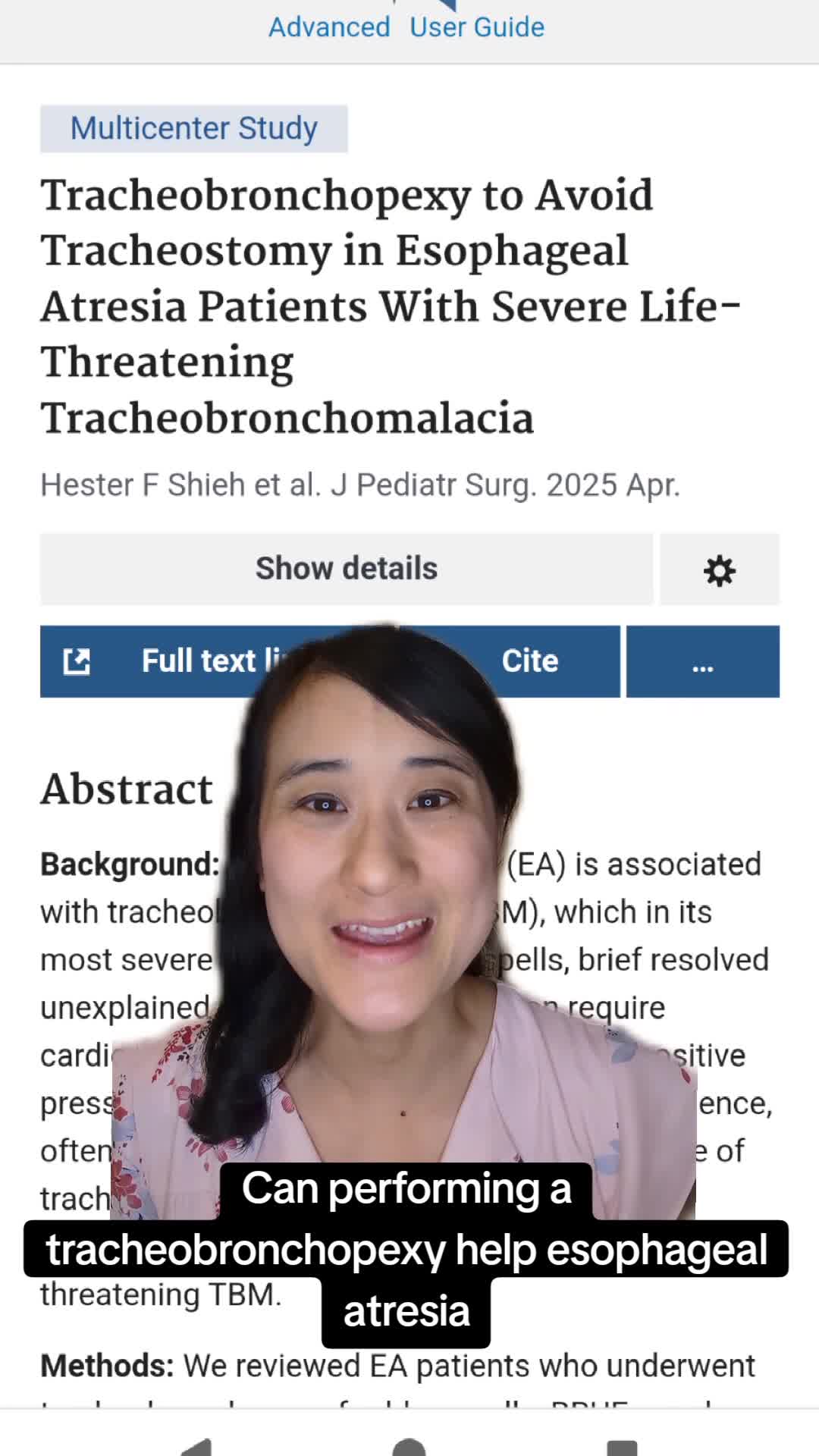
Tracheobronchopexy to Avoid Tracheostomy in Esophageal Atresia Patients With Severe Life-Threatening Tracheobronchomalacia
50 s · Published Apr 2025
Video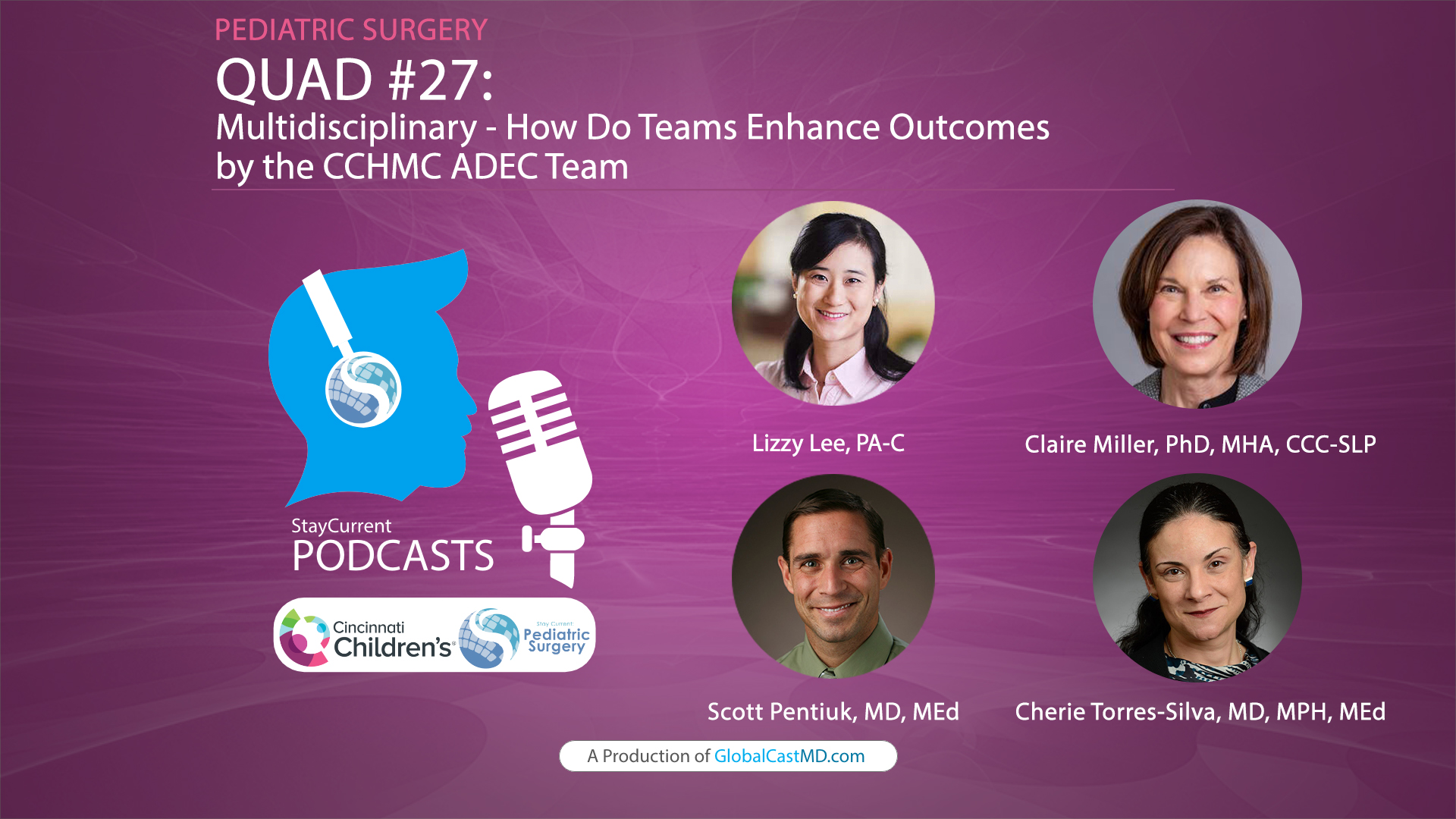
QUAD #27 - Multidisciplinary - How Do Teams Enhance Outcomes by the CCHMC ADEC Team
CCHMC Pediatric Surgery · 10 min · Published Apr 2025
Video
QUAD #25: Medical Management of Minor Laryngeal Clefts with Dr. Greg Burg
CCHMC Pediatric Surgery · 7 min · Published Feb 2025
Video
QUAD #22: What is CHARGE syndrome? with Dr. Catherine Hart
CCHMC Pediatric Surgery · 59 s · Published Dec 2024
Video
Intestinal Atresia Types Explained: Grossfeld Classification for Pediatric Surgery
1 min · Published Sep 2026
Video
Derivation and validation of the Pediatric Community-Acquired Pneumonia Severity (PedCAPS) score: A prospective cohort study
50 s · Published Sep 2026
Video
FETO for Late-Diagnosed Severe Congenital Diaphragmatic Hernia (CDH) at Cincinnati Children's with Dr. Beth Rymeski
4 min · Published Sep 2026
Video
Severe Congenital Diaphragmatic Hernia (CDH) Case: FETO Management & Unexpected Findings with Dr. Beth Rymeski
3 min · Published Sep 2026
Video
Fetoscopic Endoluminal Tracheal Occlusion (FETO) Procedure: Step-by-Step Guide with Dr. Beth Rymeski
4 min · Published Sep 2026
Video
Choledochal Cyst Types Explained: Pediatric Surgery Fundamentals
1 min · Published Sep 2026
What the experts said
In long-gap atresia, some surgeons use a Hagar dilator to measure the gap, but this may not reach the true end of the distal pouch. A flexible scope is more reliable for accurate gap measurement.
Interventional radiology can perform gap studies using a catheter with contrast injection to confirm the catheter is at the top of the pouch, then apply stretch to measure the gap under tension.
In long-gap atresia, if the distal pouch has been tacked to the prevertebral fascia at the initial operation, it will not mobilize adequately for primary repair unless the tack is surgically released.
Esophageal replacement options for long-gap atresia include reverse gastric tube, gastric pull-up, colon interposition, and small bowel interposition.
For long-gap esophageal atresia, a gap of 2 vertebral bodies or approximately 2 centimeters is considered close enough to attempt primary anastomosis.
If primary anastomosis cannot be achieved at initial operation, placing the ends on tension for one week and then re-operating often allows successful closure due to stretch.
In experimental porcine models of endoscopic Foker (using olive beads and wire traction), pressure necrosis at the anastomotic site is the suspected cause of death.
Intraluminal magnetic anastomosis is being developed as a minimally invasive approach to long-gap atresia, with the goal of reducing pressure necrosis compared to bead-based traction.
Segmental colonic interposition (preserving distal native esophagus) reduces the risk of long-term redundancy and tortuosity compared to full-length colon interposition from cervical esophagus to stomach.
Long-term complications of full-length colonic interposition include progressive tortuosity and poor drainage, which can be mitigated by using shorter segmental interpositions.
Segmental interposition preserves the native gastroesophageal junction, allowing potential future anti-reflux surgery at the normal GE junction rather than at a colonic-gastric anastomosis.
Segmental colonic interposition requires two anastomoses (one in chest, one in neck) and a thoracotomy, making it a morbid operation, but it is theoretically 'one and done.'
Substernal colonic interposition avoids thoracotomy and is useful when the chest is heavily scarred from prior operations. However, it requires sacrificing the entire native esophagus.
Sometimes surgeons try too hard to salvage the native esophagus, and children may do better with esophageal replacement, especially when chronic aspiration from recurrent TEFs or strictures causes severe pulmonary disease.
When mobilizing a distal esophageal pouch off tension (e.g., from prevertebral fascia), the pouch retracts and becomes much shorter than it appeared pre-operatively.
Cervical esophageal strictures at the thoracic inlet are difficult to resect via neck approach because the esophagus is fixed substernally and cannot be mobilized adequately for tension-free anastomosis.
Contrast esophagrams can underestimate the true diameter of a stricture if the proximal esophagus is dysmotile and does not generate enough pressure to distend the lumen. Balloon dilation under endoscopy provides a more accurate assessment.
Placing endoscopes from above and below during thoracoscopic stricture resection allows identification of the stricture by transillumination ('go to the light').
In patients with multiple prior thoracotomies and fused ribs, exposure can still be achieved by 'chipping away' at the fused ribs, though the field is narrow and the lung is at risk of injury from scarring.
Magnetic compression anastomosis (magnamosis) has been used successfully for gastrojejunostomy but is unproven in the esophagus. The main limitations are the distance magnets can attract across and the lack of mucosal lining in the resulting anastomosis.
Needle knife incision of esophageal strictures is effective for short, well-defined, non-circumferential scar bands. It should be avoided on the anterior wall in patients with prior TEF due to proximity to the trachea.
Covered esophageal stents (8 mm diameter) are now available for pediatric use and may be effective for temporizing strictures or leaks. They are partially covered to reduce migration and perforation risk.
Serial bougie dilation (e.g., Maloney or Savary dilators) is less effective than balloon dilation for esophageal strictures. Balloon dilation applies radial force and can crack scar tissue without requiring needle knife incision.
In patients with recalcitrant anastomotic strictures and documented reflux, treating reflux with fundoplication may allow the stricture to heal. However, this approach risks making subsequent esophageal mobilization more difficult if replacement is ultimately needed.
Medical acid suppression (PPI) reduces gastric acid but does not stop reflux itself. A mechanical barrier (fundoplication) is required to prevent reflux of bile and other irritants.
Patients born with tracheoesophageal fistula, especially those with esophageal atresia, are at significantly higher risk for eosinophilic esophagitis, a non-acid inflammatory condition that causes strictures if untreated.
Routine esophageal biopsies should be performed during endoscopy in TEF patients to screen for eosinophilic esophagitis, even in the absence of overt symptoms.
Eosinophilic esophagitis in infants is effectively managed with elemental formula, which works in approximately 95% of cases.
On CT scan, if the dilated esophagus lies immediately posterior to the malacic trachea, any esophageal distention (food bolus, stent) will compress the trachea. If the esophagus deviates to the left, tracheal compression is less likely.
Mobilizing the gastroesophageal junction to achieve length for primary esophageal anastomosis effectively creates a hiatal hernia and predisposes to reflux.
In a patient with a high cervical stricture and intact distal esophagus, primary resection and reanastomosis is theoretically possible but may be under significant tension and at risk of leak or re-stricture.
A combined neck and abdominal approach (two surgeons working simultaneously) significantly reduces operative time for complex esophageal reconstructions, which is important given the prolonged anesthesia these cases require.
When performing segmental colonic interposition, the choice of right vs. left colon is based on intraoperative assessment of the marginal artery; the side with better vascularity is selected.
When performing colonic interposition to the cervical esophagus, the colon can be brought substernally if the chest is too scarred for thoracotomy, even if a segmental interposition is planned.
Proximal esophageal anastomoses in the neck are at higher risk of leak when the native esophagus is scarred, short, and of poor quality. Leaks typically heal with conservative management (drainage, stenting).
Colonic interposition that appears appropriately short in the operating room may become redundant postoperatively due to the natural elasticity and lengthening of the colon over time.
Redundant colonic interposition can be revised by shortening the conduit at the distal anastomosis, dividing small branches along the colonic wall while preserving the vascular arcade.
For a spit fistula to avoid recurrent TEF, the distal esophageal stump must be fully mobilized down to the diaphragm and separated from the trachea, not just divided and dropped.
When the proximal esophagus is essentially absent (less than 1 cm), anastomosis can be performed to the hypopharynx by having the surgeon place fingers in the patient's mouth, push down to the base of the hypopharynx, and sew the conduit to the surgeon's fingers from below.
In complex esophageal cases, a combined operating room evaluation with rigid bronchoscopy, flexible bronchoscopy, and EGD (often with two scopes simultaneously) provides comprehensive anatomic assessment and is safer than sequential procedures.
Contrast studies through the endoscope under fluoroscopy are routinely performed before attempting wire passage or dilation to confirm anatomy and avoid perforation.
Esophageal bypass (leaving native esophagus in situ) is a viable option when resection would create an unreconstructible tracheal defect. A fundoplication is performed to prevent reflux into the residual esophageal pouch.
In patients with multiple tracheoesophageal fistulas and a non-continuous esophagus, attempting resection may create an unreconstructible posterior tracheal defect. Esophageal bypass is a safer alternative.
Residual esophageal secretions in a bypassed esophageal pouch are minimal and typically drain via a persistent TEF, preventing mucocele formation without requiring esophagectomy.
When performing esophageal bypass, leaving a tracheoesophageal fistula open allows native esophageal secretions to drain into the airway, preventing mucocele formation in the residual pouch.
Children who have been unable to swallow for years may continue to spit reflexively even after successful esophageal reconstruction. It can take weeks to months for them to relearn swallowing.
Patients with bypassed esophagus and colonic interposition can achieve full oral intake and normal quality of life, including eating solid foods like pizza.
David Vanderzee described a thoracoscopic technique for long-gap atresia: place traction sutures on both ends, externalize them on buttons without tightening, wait 3–4 days, return to OR to break adhesions and re-tension, then perform delayed anastomosis.
Manubrial resection for high esophageal strictures provides less exposure than expected because the clavicles limit the width of the resection corridor.
Kenalog (steroid) injection after stricture dilation is preferred over mitomycin. Mitomycin at high concentrations (up to 5 mg/mL) causes tissue necrosis and has not shown superior outcomes compared to steroids.
For recalcitrant esophageal strictures, weekly dilations (3–4 cycles) prevent fibroblasts from bridging and allow the stricture to scar open rather than closed.
Feeding via gastrojejunal tube with gastric drainage (GJ/G) is a temporizing measure to reduce reflux into the esophagus while managing a refractory stricture.
Esophageal stents can compress the adjacent trachea, especially in children with tracheomalacia or when the esophagus lies directly posterior to the trachea. Always perform bronchoscopy after stent placement.
Chronic esophageal foreign bodies (e.g., coins lodged for weeks) can cause posterior tracheal bulge and present as refractory asthma or bronchiolitis, often diagnosed late because chest X-rays are not routinely obtained in asthma protocols.
Covered esophageal stents can temporize anastomotic leaks and allow healing while maintaining luminal patency. Stent removal is typically planned after several weeks.
Tracheal homografts (dead trachea implants) have been performed but are associated with difficult postoperative courses lasting several months.
Tissue-engineered tracheal homografts with pre-epithelialization are under development in multiple centers (London leading) but are not yet ready for routine clinical use.
Long-term surveillance of bypassed esophagus includes periodic CT scans to rule out mucocele and endoscopic evaluation via the persistent TEF if needed.
Posterior tracheopexy (pexing the trachea to the anterior spine) combined with bovine pericardial patch for tracheal defects is an alternative to esophageal bypass, but pericardial patches can fail and create large tracheal defects.
Complications are nearly inevitable in complex esophageal reconstruction. The goal is not to eliminate complications but to anticipate and manage them effectively through a multidisciplinary team approach.