
8th Annual Pediatric Surgery Update Course
With Dr. Dr. Todd Ponsky · hosted by Dr. Todd Ponsky · StayCurrentMD
Educational content from recorded physician discussions — not medical advice. Talk to your (or your child's) care team about your situation.
Video
8th Annual Pediatric Surgery Update Course
Dr. Todd Ponsky · 215 min · Published Jul 2020
Video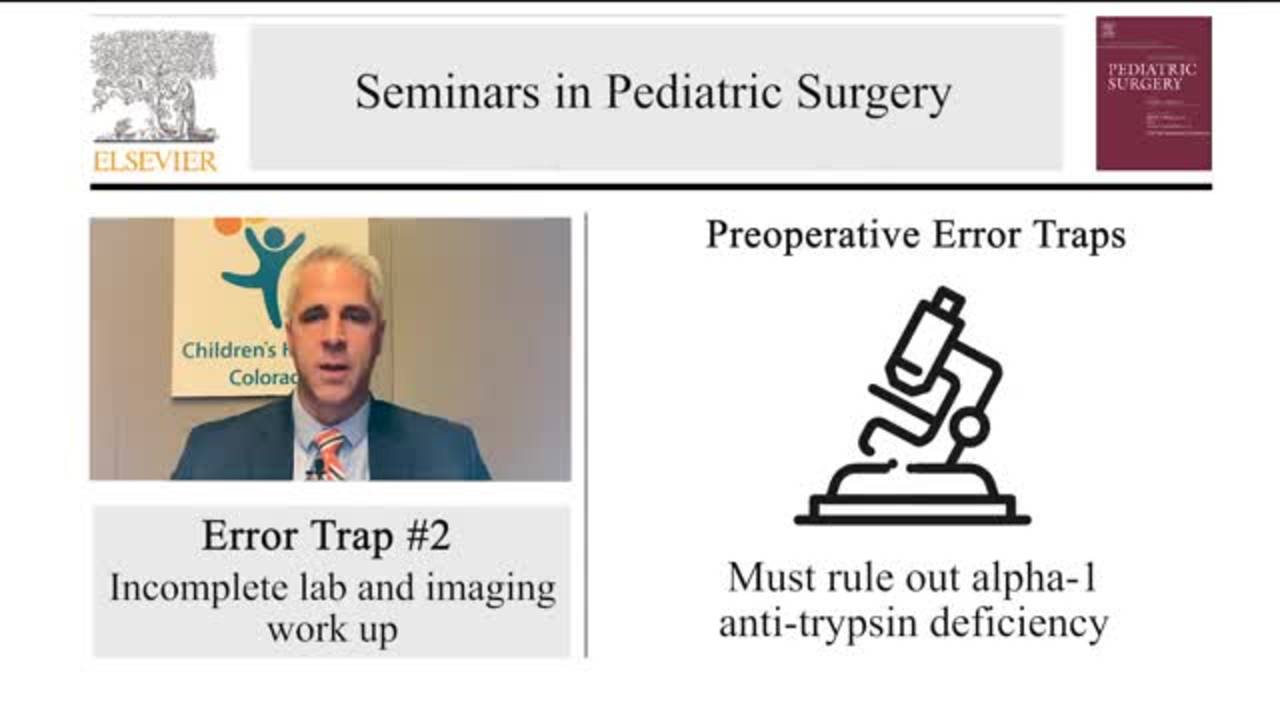
Error Traps and Culture of Safety in Biliary Atresia
CCHMC Pediatric Surgery · 4 min · Published Nov 2019
Video
Update Course Rewind: MMP-7 & Biliary Atresia Diagnosis 2024
CCHMC Pediatric Surgery · 6 min · Published Mar 2025
Video
Update Course Rewind: 2024 Top Ten Key Takeaways
Dr. Todd Ponsky · 18 min · Published Jun 2025
Video
Prof. Shilpa Sharma - Best of the Best in Pediatric Surgery 2024
Dr. Todd Ponsky · 5 min · Published Feb 2024
Podcast
Update Course Rewind: 2024 Top Ten Key Takeaways
Ramy Shaaban · 18 min · Published Jun 2025
Only a few other public items share this expert — go deeper there →
Video
Pediatric Surgical Oncology Research Collaborative (PSORC): Studying Rare Pediatric Tumors
56 s · Published May 2026
Video
Update Course Rewind 2025: Hirschsprung + ARM: Rare but Real
1 min · Published May 2026
Video
Update Course Rewind 2025: Hirschsprung + ARM: Rare but Real
1 min · Published May 2026
Video
Pooling Patients to Study Rare Pediatric Tumors: An Introduction to PSORC
56 s · Published May 2026
Video
The fetal frontier: A review of current and emerging fetal therapies for genetic diseases
44 s · Published May 2026
Video
Indocyanine green assists with sentinel lymph node mapping in pediatric and adolescent patients
1 min · Published May 2026
What the experts said
Ultrasound can identify 30-40% more lung nodules through palpation and visualization than CT scan alone
Cone beam CT can be performed on a C-arm fluoroscopy unit in an OR, hybrid OR, or interventional suite by rotating around the patient to create stacked CT images
Ultrasound guidance for foreign body removal becomes difficult after tissue dissection introduces air around the foreign body, making visualization nearly impossible
The majority of splenectomies nationwide happen before patients receive blood transfusion
New cryoprobe technology reduces freeze cycle from 2 minutes to 90 seconds, with improved shaft insulation allowing contact with lung tissue without freezing
Cryoablation for thoracotomy pain control results in 2-3 fold reduction in narcotic use during hospitalization compared to epidural or IV pain management alone
MMP-7 (matrix metalloproteinase-7) is a validated diagnostic biomarker for biliary atresia with sensitivity demonstrated across multiple international studies
Lipiodol marking for pulmonary nodules achieves 100% sensitivity and remains visible for up to 3 months, allowing delayed surgery without wire dislodgement risk
ChatGPT can perform title/abstract screening for systematic reviews with excellent inter-rater reliability compared to human reviewers when using custom GPT with serial prompts
Ligation of testicular vessels during orchiopexy leads to significant reduction of spermatogonia despite preserved testicular volume, meaning you bring down a good-sized testis of poor quality
The Shehata technique for intraabdominal testes achieves 88% success rate with 7% slip traction requiring redo, 12% atrophy rate, and no reported cases of internal hernia in over 430 cases over 15 years
In national survey of thoracic aortic injury management, 67% were managed non-operatively, 27% endovascularly, and 6% with open repair
Thoracic aortic injury in children managed with endovascular repair shows better outcomes than non-operative management, with decreased mortality and reduced spinal cord injury risk compared to open repair
DVT prophylaxis started within 24 hours of injury in trauma patients significantly reduces DVT incidence compared to delayed initiation, based on Midwest Consortium data
Adult randomized controlled trial of 6000 patients showed aspirin was non-inferior to Lovenox for DVT prophylaxis in orthopedic trauma patients
18% of lateral cutaneous nerve branches are posterior to the mid-axillary line, requiring posterior cryoprobe placement to avoid ineffective blocks
Dr. Kim's double-freeze technique targeting both the main intercostal nerve and the collateral branch on the rib above resulted in 9 of 22 patients reporting pain scores of zero
Every 10 days of delay in Kasai procedure translates to 20% worse outcomes in biliary atresia patients
Kasai portoenterostomy performed before 45 days of age reduces the incidence of liver transplant need in biliary atresia patients
Conversion rate to open thoracotomy due to failure to localize subcentimeter pulmonary nodules during thoracoscopy is 47%