Speaker: Dr. Pramod Reddy
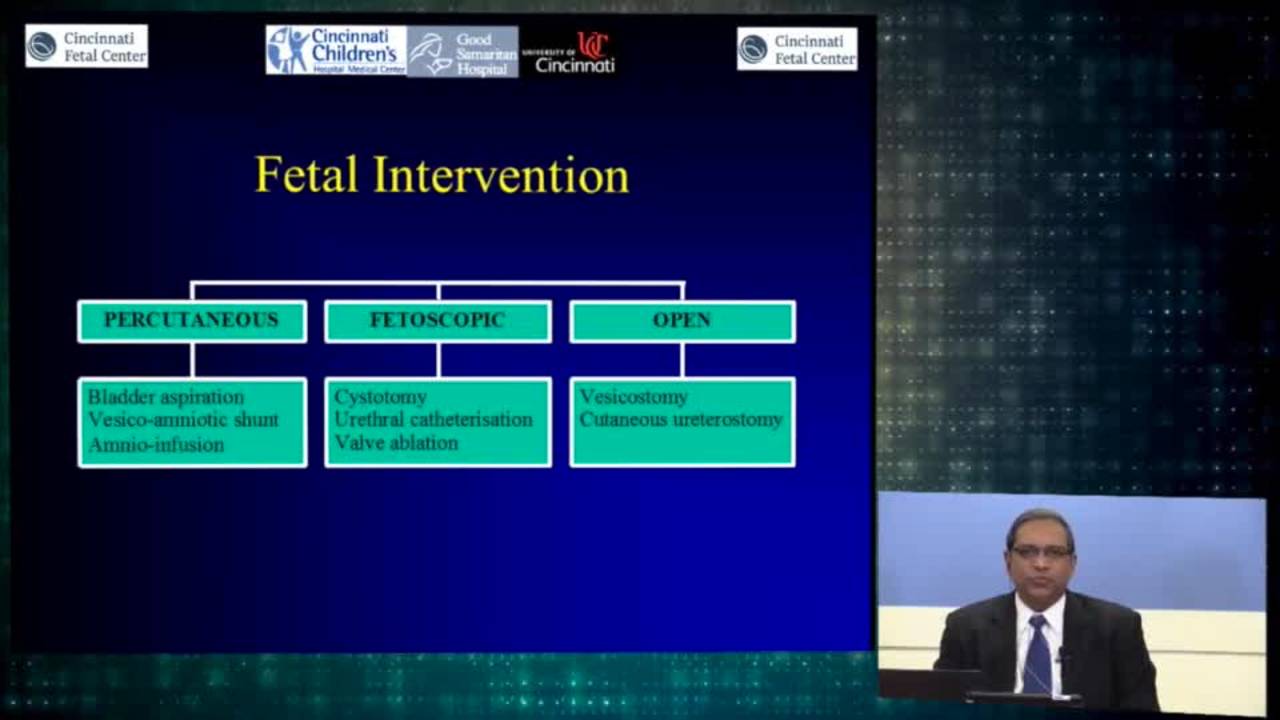
Good morning, everyone. So, um, thank you for allowing me to be part of this, uh, conference, and I think that what we're gonna talk about is that, uh, so you've now made a diagnosis of uh prenatally detected urinary tract obstruction. And I think it's important to state here that not all fetuses with urinary tract obstructions are candidates for interventions. And it might be the situation that, uh, you know, a fetus is too healthy where the risk of intervention, uh, really outweighs any possible benefit and the risk is really to the mother. And the instances where this might be important would be where the fetus has a normal amniotic fluid index, non-obstructive dilation, secondary reflux, or unilateral involvement of a UPJ obstruction. So again, you know, as, as fetal surgeons, we all are obligated to ensure that we're weighing the risks and risks to the mother because there's really no benefit to the mother, but all of the risk is accountable to the mother. There also may be a situation where the fetus might be too sick, where the intervention has minimal possibility of any benefit for the fetus and exposes the mother to all of the harm. Instances of this would be uh renal cystic dysplasia, uh, abnormal urinary parameters, and also abnormal karyotype or multiple congenital associated anomalies. As we look at how fetal intervention has really evolved, you can see that there's really 3 main categories that you can break it up into. One is the percutaneous approach, which is the placement of a shunt or vesicocentesis to make a diagnosis, get the urine for electrolyte uh association, and also for the uh karyotype analysis. It also allows for amnio infusion, which we have found is an acceptable intervention in instances where we've made a diagnosis of fetal end stage renal disease. The second and probably the more acceptable one right now is the fetoscopic procedure and on this slide you can see where there's a fetoscopic visualization of the valves and we're then able to go in and ablate these valves with a laser. And then the last, uh last, uh, category is, of course, the open fetal interventions. Now, before we talk about feetoscopic, we should ask ourselves why, what has the promise of the vasco amniotic shunt really lived up to its, uh, full potential. And it's because these are long thin tubes, and if you go back to high school physics where the resistance of the um uh flow across that tube is directly proportional to the length of the tube and inversely proportional to the radius, we're now putting a shunt into a bladder where we're trying to alleviate the obstruction. So while we will get reflux of urine out of that bladder and allows the lungs to develop. We're not really affecting the pressure, and all of the upper tract changes are related to the pressure-related changes causing apoptosis of the tubular cells and also the deformation of the developing glomeruli, so you have fewer nephronogenous genetic elements developing in those kidneys. We know from adult studies that if the pressure in a bladder exceeds 40 centimeters of water, that does injure the kidneys, and if you look at this image here, you can see that when the hydrostatic pressure in the bladder exceeds 40 centimeters of water, that equates to about 39 I'm sorry, 29 millimeters of mercury, you now have no net filtration occurring across that system. What are the pressures that are safe in a bladder for a fetus and the fetal kidneys to continue to develop, we don't know, but I think it is some it is something that we should be studying whenever we put a needle into a fetal bladder, we're trying to measure the opening pressure so we can try and use that as a predictor of outcomes for these uh upper tracts. Can I ask a quick question. Yes, um, since you bring this up, what's the normal pressure of fluid inside the uterus? The intravillous pressure that occludes venous flow in the placenta is about 23 millimeters of mercury, so it wouldn't take much. To give you basically, I mean, you, the lower end of your, if you're gonna use a shunt and it's gonna work, the lower end of that gradient has to be less than has to be less than that, so that might be a fundamental on the resting tone is probably 5 to 8 millimeters of mercury in the amniotic sap. So, but if it does this pressure need to be continuously below your threshold or if it's intermittently it rises above that threshold, will it cause problems. I think that, you know, any pressure changes that go above will cause some injury, but if you think about how the bladder fills and empties, there's periods where the bladder's empty or should be empty, and you're not exposing the upper tracts to the pressure. So at that point, profusion might resume. But uh the numbers that I uh projected in the previous slide are adult numbers. We don't have the numbers for the fetuses, so that the numbers would just be conjecture at this point. But even with those adult numbers you can see how significant our challenges in trying to alleviate the pressure, and that's why the shunts have not really provided the improvement. In renal function they have provided us with pulmonary survivors but haven't really shifted the needle in terms of renal uh outcomes on these interventions and that's where the feetoscopic interventions where we use the natural lumina of the urethra or open fetal vesicostomy where we're now making a large hole and putting the pressure in that bladder almost to zero or the uh same pressure as the amniotic fluid around the baby, uh, is gonna be a better, better intervention from that standpoint in terms of renal outcomes. Mark or Greg, have you done any anecdotal studies looking at opening pressures using um thermometers? No, I haven't, but um I guess I'm a little bit confused because if you. Put a shunt into the bladder and the bladder completely collapses. Um, now the bladder, you know, it should not be transmitting pressure back up to the kidneys as long as it's draining out through the shunts, or maybe the size of the shunt, you know, would be a contributing factor where the bigger the shunt, perhaps it would drain and decrease the pressure, but in my experience, when you put a shunt in, the upper tracts, the ureters, the renal pelvis, and collecting system significantly decompressed down to almost normal, so, um, you know, I guess. I'm a bit confused as to whether there is significant pressure within the kidney now that would actually impair filtration through the glomerular, not sure how to study that, but, you know, having seen kidneys that once you drain them with a shunt, they go back to looking like fairly normal kidneys. Uh, I just wonder if that pressure inside that kidney really is high enough to impair filtration like you suggested. How about you, Greg, and Mark, if you could pick up your phone, um, and give that a try if we can hear you a little bit louder. Greg, do you have any experiences of bladder pressure? I I've no experience, but my comment would be exactly the same as Mark's. Um, I, I'm not sure that the pressures matter because you see decompression of the bladder, um, so consistently and changes in the upper tract. So, um, I would also question the validity of the of the actual pressure measurements. OK, I, yeah, you know, so, uh, in, in the, again, a lot of this is looking at adult outcomes and then taking that back and extrapolating it to what we're seeing in the, uh, fetal, um, system. And even in adult upper tracts, when you decompress the bladder, there still is going to be some pressure in remaining in the system. You're not going to put it down to zero. We've all seen instances where we put shunts in fetuses and there's residual hydroureterronephrosis. It doesn't go away all the way in all of the cases. And I think this is a challenge, right, that uh we are dealing with a spectrum of involvement in terms of when we're intervening, how severe the involvement is, how dysplastic the upper tracts already are by the time we're intervening, and what is the impact on the bladder. Um, so I think it, you know, it's, it's not a very easy problem to discern because there's so many variables, but I don't think we can completely exclude or discount the importance of the pressure in the system, and I think that's why the open vesicostomy makes such a big difference. Hey Doctor Ryan. Can you hear me? Yes, right, yeah, yeah, uh, before we went to, um, the break, um, you are about to go into, uh, cystoscopy and why that may be, um, Um, one of the interventions that you may consider after, um, vesico amniotic shunting is not able to, you know, get you the results you want. So, why don't you, um, continue to elaborate on that before I, uh, share, um, one of the cases here, um, with a video regarding the phidoscopic, um, intervention. OK, sure, um. So I guess the the question comes up as to why, because of the poor results of the clinical trial and some of the concerns about shunting, whether cystoscopy may indeed have a role, and the theoretical reasons why it might be better is that it could allow a cyclical voiding because, uh, which is a more physiological drainage that it may help us determine the etiology, we can differentiate perhaps the PUVs from the ecclesias. It avoids the need for an amnio infusion, which is often the most tricky part of the whole procedure, and it avoids the complications of shunts, including migration, blockage, and so on. So theoretically this is why it may be better. Uh, there's not a lot of data. Most of it comes from, uh, Rodrigo Ruano's group, uh, or the French, one of the French groups, and there's only 4 papers, and this was reviewed by Katie Morris from Birmingham recently. Um, it showed that cystoscopy altered the diagnosis in about 25% to 1/3 of the fetuses, but there was no significant improvement over shunting in terms of survival. And really the data are so sparse in terms of determining effectiveness that for now we must consider cystoscopy as experimental in this particular condition. These data were recently published by the French, Brazilian and Houston groups. Where they looked at 111 fetuses who had lower urinary tract obstruction. In 60 of these, nothing was done. In 16 they shunted, and in 34 they did a cystoscopy and they looked at survival and the chance of normal renal function at 6 months of age in all the Ludo cases and also in the group of fetuses who had just had posterior urethral valve. And the bottom line essentially was that although both interventions showed improved 6 month survival rates, only cystoscopy may prevent renal function impairment at 6 months of age, so that was their conclusion. The other interesting study that's come out just very recently from the the groups in Barcelona and in Leuven in Europe, where they looked at 2 cases of fetal cystoscopy and laser ablation of the valve, they found that they could access the urethra almost all the time. And in 80% of the cases, the bladder size and the amniotic fluid returned to normal. Almost half went on to terminate the pregnancy. However, in those that were alive, they had no pulmonary hypoplasia, and in three quarters of the babies had normal renal function. Um, so these figures are, are, are quite, um, you know, I think these are quite encouraging as to the possible role of cystoscopy. However, I think we need to be very mindful of the complications. And in both of the theories that have been published, they created the urological fistula in 9 to 10% of cases. Now they, they didn't feel that the fistula really posed a major problem postnatally, but I think this is something we need to be very, very wary of. And in about 6% there was occurrence of the severe lower urinary tract obstruction. Um, the main complication of the shunting, as you know, is is is migration or blockage of the shunt. Um, and again, just, I mean, in our hands, certainly the risks of shunting include migration of the shunt. Here's one that sort of ends up around the cord, and here's one where I created a gastroschisis when we put a shunt in at 17 weeks, and this has been described by other groups as well. So, um, I think it opens the door to the role for fetoscopy and perhaps I'll hand back to the panel at this point. Thank you, Greg. Um, do you think some of the, um, the failure, uh, in the cystoscopy group is related to, uh, just patient selection or the, the specific diagnosis? I'm sorry, Phil, I, I meant to miss that question. Yeah, um, so in the cystoscopy, uh, group of patients in all of those, uh, published, uh, paper, um, although it didn't show, um, The technique that they were using and the specific diagnosis um that they encounter as a problem. Did, um, did you know um through personal communication if some of those procedures were not successful, was that related to the diagnosis itself, such as um Erythrothresia versus uh meatostenosis, or is that too late for, for the cyst cystoscopy to happen? I, I mean, I don't think so. Um, it's hard to know. I mean, there's there's such a dearth of data that have been published on this. But, um, you know, most of these kids, cystoscopy, really, the earliest we've done it, I think is around about um. I think the earliest sun is about 19 or 20 weeks. Um, so it's certainly feasible, um, and may help, uh, in, in differentiating the posterior valves from the reus. It seems to be experience of the other groups as well. They haven't really given clear data in terms of, of the entry criteria. These were all fetuses with lower urinary tract obstruction, but, but other than that, I don't think we can, we can say more. I'm not sure if that's answering your question for me. Yes, thank you. I have a question, is that, uh, you know, going back to the pressure, the main difference that you're showing between the ves magnetic shunting and the fetoscopic procedures in your slide earlier was that, um, there was a reduced incidence of renal insufficiency. The bladder cycling that you quoted as a uh uh one of the advantages of the feetoscopic procedure, that's mainly for the health of the bladder. It really doesn't impact the upper tract, so we're making a bladder that's healthier by allowing it to cycle. So the main difference there then is the pressure. I mean you. You know, you've now got a normal urethral lumen that you're allowing the urine to come out of that bladder as opposed to through a shunt. So I think that does add some evidence in favor that there really is some element of pressure related changes that are the reason for the difference, the better outcomes with the feetoscopic procedures. Yeah, no, that's a reasonable point, I think, yeah, yeah. Certainly one of the criticisms of the shunts is that we lose the cycling of the bladder, and I think you, you can better advise us how important that is. That's really important for the bladder. I mean, you know, when we're counseling families, you know, they're so focused on the upper tracts that we always tell them that, you know, you have to remember that all of this pathology is resulting from a malformed and dysfunctioning bladder. And postnatally, that's the part that a lot of parents don't understand. Why do we have to manage the bladder so aggressively. Um, Dr. Goldblum and I, we spent a lot of time educating families that, you know, if the bladder works well, then we're going to protect the remaining nephrons and so that's critical. So the cycling that uh that the feetoscopic procedures enable is really to allow for a healthier bladder to be developing. It's more physiological for the bladder. Now what about the 10% risk of of causing a fistula? Does that bother you as a urologist? You know, I, I would rather be, uh, have, have to deal with a fistula that I can repair surgically than renal dysplasia. So I think, you know, putting into the risk benefit ratio, a fistula, urinary tract fistula, something we can certainly address postnatally with minimum morbidity as opposed to renal dysplasia. Yeah, of course, the danger with the laser is that the fistula is one issue, but there's lots of other structures around there that may also be damaged. We just need to be mindful of it. I think it's promising, but. Absolutely. And you know, one thing that we've been able to do, um, in, in addition to trying to use a laser is sometimes we've just bluntly ablated the valves by putting a guide wire and pushing a catheter right out through the urethra because these valves are usually pretty flimsy, so you can just physically hydro do it, I think. Um, so, so I'm not sure just hydrodistention by itself would do it. It depends. You'd have to really generate a lot of pressure with hydrodistention, because if hydrodistention all by itself could do it, then the amount of pressure developing in the urinary tract should blow open those valves. Should be. That's a good point, right. So, um, I'm going to share with you, um, a case that we did here, uh, about 9 to 10 months ago. Um, so if, um, you can bring my slides up here. So, um, this is a patient that we saw, um. At 22 weeks gestation, and by the time that she got to us, uh, there was severe oligohydramnios and the typical keyhole signs. Uh, this, her first pregnancy and the diagnosis of uh posterior urethral valve was suspected. So, after extensive counseling, we, uh, took the patient to the operating room and attempted, um, cystoscopy. So this is the view that you'll get once your feetoscope is in the bladder, and what you're seeing here is the bladder neck that circled that funneled down, and if you go below that neck, you're going to get in the posterior urethra, and this is where the valve is. So when we Um, push a wire through the feetoscope into that region. We were able to pass the guide wire, uh, all the way out through the penis of the patient into the amniotic cavity as visualized by ultrasound, uh, side by side. So, after the wire is passed, we use a 3.5 French 8 centimeter double J shunt, which is a urethral shunt. Uh, over the guide wire and you can see that. Over here is the shun being introduced. Through the fetoscope, and then we use a 4 French uh pusher to deploy the catheter once we know that one of the J portion is outside of the um amniotic cavity. Sorry, outside of the um the baby into the amniotic cavity. And what you are seeing here is the um the other end inside of the bladder. So schematically, this is what we have. Um, so you have a fetus here that the one side of the double J remains in the bladder. And the straight part of the double J goes through the urinary tract, the, the urethra, and the next part of the J is outside of the baby. So this patient subsequently delivered. At 37 weeks with normal amniotic fluid restore and the birth weight of the baby is quite good at over 3 kg. At birth, he was urinating and now it's 9 months of age with creatinine still slowly climbing up, but hopefully, you know, this baby is going to have A course of relatively normal life during the first few years, we still don't know if babies like this, despite a successful intervention, will continue to maintain renal function, and this really went back to what Dr. Johnson and Dr. Ryan say, you know, can we maintain the renal function. That the baby had a delivery and certainly. This speaks to the, um, importance of multidisciplinary team. We have a couple of questions for you. Yeah. So tell me when you're ready. OK. Yeah. I'm ready. OK. So, the first one from Doctor McKenzie. She's wondering if you did three, if there were three bladder taps done prior to the procedure you showed. Um, no, we did not do three bladder taps, um, in this patient because if the first bladder tap and the second bladder tap are both good. And what Dr. Johnson and Dr. Ryan has shown before, if you see that kind of downward trend on the urinary analysis, you know that this is a good candidate for procedure. And also, we also have heard that. Uh, with the bladder tap, there's a chance that the bladder may rupture, um, and cause ascites to minimize your chance of a successful cystoscopy procedure, so we just try to minimize the number of bladder taps that's necessary. A, uh, another question was, could ask me if you could elaborate whether you delivered the baby out of the uterus to do the cytoscopy. Uh, no. Um, so what we did with this case is we did a maternal, uh, laparotomy to allow us, uh, the best possible position to insert the feetoscope. So, in the mom, that's only one. hole in the uterus that is the size of a 10 French cannula, so we use a check flow C catheter, which is 10 French to allow us to introduce the fetoscope into the bladder. So that's a single port procedure. And uh Doctor Reddy also wants to know about, can you talk about the anesthetic implications of, of this to the fetus, yeah. So, um, as most of the um the audience will know, uh, when it comes to cystoscopy, including uh twin nutrient transfusion syndrome, uh, a lot of times this type of procedure can be done with epidural supplemented by IV sedation and local anesthetic, and this is exactly what we did, uh, to this mom because a laparotomy, uh, is necessary. Unlike open fetal procedure that require uh deep anesthesia to completely relax the uterus, uh, cystoscopy and fetoscopic intervention does not require that degree of uterine relaxation. So for the mom, um, the risk from anesthetic is lower than open fetal intervention. I wanted to add that the fetoscopic um approaches to these, though, we are concerned about the fetal pain response and also movement. So we have been using a cocktail of vecuronium atropine, and fentanyl that's given intramuscularly prior to the Uh, initiation of the case, uh, just to allow for both the quiet, uh, motion problems that we face during fetal procedures and also to mitigate any fetal pain response. Very good point. Thank you, Bill. Yes, yeah, can I ask you a question? Sure, go ahead, Mark. Right, so, um, interesting technique, um, with the catheter, I, I noticed that you didn't really try to get around and look at the actual appearance of the obstruction. Um, so did this baby, what did this baby have cystoscopically postnatally, because perhaps this was valves and you successfully punctured through the valves with your wire. Perhaps this was a mid urethral hypoplasia, but what if this were, you know, a urethral atresia? The wire wouldn't pass, or would the wire cause a perforation, um, causing a false channel? I'm just curious as to. You know, do you try to get around that corner to look at the obstruction, or do you just try to pass the wire blindly, and if it goes easy, then it's a catheter, and if it doesn't, then it's a laser? Yeah, so, um, in this particular patient, uh, and all the other patients, uh, what is being cut out from this video is, um, we actually placed the scope all the way as close as possible to the, uh, valves in order to, uh, maximize the chance of you able to puncture or ablate the valve because, uh, this glide wire is rather flimsy as well. So if you are not. Very close to the valve is very difficult to get through the valve. So for the, for the visualization's sake, we cut that out because a lot of times when you are that close to the valve, you have minimal visualization. Um, for a good video, but, um, prior to the introduction of the wire, we always try to lean against the valves as much as possible. In this particular patient, uh, after delivery, uh, on cystoscopy, just retrograde, uh, cyst cystoscopy through the meters, what they found was there's a, a residual band. Um, as part of the posterior, uh, urethral valves. So the valve is not completely, um, ablated. Uh, and this baby had a subsequent removal of that residual valve that was left behind, um, given the, the small size of the catheter going through it. And in cases that we were not able to pass a guide wire or a blade through the valve because either valve is not the problem, but really the diagnosis is urethral atresia. Just like the series that Ruano had published from Texas, those patients, um, this maneuver is not going to be successful. So the question is, should we consider creating a fistula between, you know, the bladder and the amniotic cavity by pushing the wire through the perineum of the patient? Well, I think that's debatable as of this point whether that is a good maneuver. Yes, shaking your head. So just like us, a lot of us are shaking our head as well. Um, so that one of the questions, actually one of the poll questions is that under that kind of situation, if you cannot visualize the valve or you cannot get through the valve or ablate the valve, what should you do? Um, Should open fetal intervention be your next step under that kind of condition? Versus simply saying, OK, um, you can do the phenoscopic intervention. Your fallback option would be to leave a vesicle amniotic shunt behind. So that's what we did in some of the patients. We were confident that the um the diagnosis was urethral atresia. So in those patients, nothing to really lose because leaving the shunts behind, uh, you still have a good chance of Getting a uh a pulmonary survivor, and hopefully, you know, the shunt is still uh good enough. To allow um some of the renal function to be protected. And there's another technical question then about the the equipment used. What size feetoscope do we use? So the fetoscope that we use is a 3.3 outer sheet, and the scope itself is 1.2 millimeters. That has a side port that you can introduce a guide wire through. And um promote let me say ready Gru. So, um, once we have access to the fetal bladder, we will sometimes switch over to using a flexible ureterscope, which is a 4.9 French flexible ureterscope so we can, uh, because the fetoscope's pretty, it's semi-rigid. And as you can see, you know, the bladder neck is pretty high, so we will try and use a flexible urethroscope through a 10 French sheaths to get into the bladder, and then we have the maneuverability of the ureterscope to go around and look in the bladder, try and gain access to the bladder neck and posterior urethra. I wanted to go back uh and touch on that question about the number of serial cystocentesis, and I think Mark and Greg, you could comment on that as well. The, for many years now, I've, I've had trouble. Justifying doing 3 bladder taps, Fong talked about the complications with the rupture and the leakage that would make any intervention then impossible if the bladder is decompressed, the ability to shunt it. Um, given that in the excellent prognosis groups, the ones that you all treated in your series from 1015, 20 years ago, the percentage of end-stage fetal renal failure with oligo prior to delivery, and then the renal failure that ensues in the neonatal and infant course, uh, which often was the, the death knell for these babies until recent advances in dialysis for neonatal transplant. It made no sense to me to continue to tap the bladder whether the prognosis based on the urine electrolytes was good or bad. If the family wanted that attempt at fetal survival or newborn survival with pulmonary hypoplasia, I saw no reason to do that. And so I've become a skeptic of the value of serial cystocentesis if we're going. To push forward, and the family is accepting at least uh as they look at the problem from 24 weeks gestation on into the future life of their baby, they're willing to accept the complications of dialysis. Uh, do you see any reason to continue to do that? Does it help you in counseling them? Well, I think I would agree with you that if you get good values on your 1st and 2nd drainages, I would not do a 3 tap because there's really nothing to gain if your first one is at or below the cutoff threshold and then your second drainage is clearly below, we would not do a 3rd just for the complications that you're talking about. If the second part of your question, if I understand it correctly, you're asking, um, would you do bladder drainages after 24 weeks. Um, on a patient who just wants to get an idea of what the potential renal function in the baby is, um, to decide whether, oh, we're going to terminate or no, we're gonna continue, um, we have done that in some cases where patients just wanted. You know, hard data to say, well, these kidneys are already very damaged and that might, you know, Turn them towards one management team versus another, um, but I'm a little bit skeptical of that as well because we don't have good cutoff thresholds for fetal urine after, you know, 24 weeks. I think that's something that would need to be collected, um, before we could really use that as a predictive value, um, so, you know, we do not routinely do bladder drainages after 24 weeks. Um, just to give patients prognostic information because it's a progressive problem and at 26 weeks you could have reasonable, you know, or borderline, uh, urine values, but by 32 weeks, you know, again, it's a progressive problem and there's progressive renal injury over time. So the Pluto trial, if I read it correctly, they took bladder taps out of their protocol. Because the data seem to suggest the most powerful effect of shunting is in the poor prognosis babies to begin with. Additionally, Additionally, even with good prognosis, about 50% of these babies end up with bad renal function postnatally. And so that's really why we've made a move away from serial vesicocentesis or for that matter even a single diagnostic because we're not sure how it helps us in our management. All I can do is go back to our studies from a couple of decades ago where we were studying the urine to try to establish the cutoff threshold and uh histologically there was a very strong correlation between the severity of renal damage and the 3rd vesicocentesis or 3rd urine sampling. That we got and you know we learned that thing that the first bladder drainage is just the urine that's been in the bladder and really isn't predictive. The second is really not predictive, and the third gives you fresher urine that gives you a better predictive value as to the degree of underlying injury. So it's a bit tricky. The Pluto trial had many, many flaws. Greg pointed out several of them. And there have been tons of studies in the literature that, you know, people have just not done the renal, the urine studies and put shunts in, and my question whenever I review these papers for publication is, well, you went in blind, and when your results came out and you had bad renal outcomes. Well, that perhaps if you had done the analysis before that and selected the patients more appropriately to those who didn't have, you know, that had favorable urine, uh, electrolytes and proteins, maybe your outcomes would have been much different. You know, case in point, we published a case series of long-term follow-ups in kids that died a minimum of 5 years after they were delivered, and about a third of them went on to develop end-stage renal disease, and the other 2/3 had, you know, some renal impairment, and about half of those others had good renal function, um. But one thing we learned from that study is that the 3rd that went on developed end stage renal disease and had transplants after 5 years. If you look at their Discharged from the hospital creatinine, they actually were pretty good. And so this raises the big issue that we probably will talk about a little bit later as maybe the major renal morbidity comes postnatally and that shunting or doing laser valve ablation might give you better kidneys, and now the urologists, you know, the challenge to them is how to protect those kidneys in the long term. So um. Uh, actually, um, there's a question, uh, for you as well. So, have you seen any significant difference, um, between, uh, Patients that would. Treated with feetoscope, uh, versus patients that had a shunt from the neonatal standpoint in terms of their pulmonary function. In terms of their pulmonary function? No, I, um, I would say that we don't necessarily have enough patients that we can put some percentages on that, um, you know, to say that the ones who are feetoscope have, have, I mean, presumably the question is do they have better pulmonary survival, uh, aspects than the ones who are shunted, um, we don't really have the numbers that we can say the percentage is this versus the percentage is this from a pulmonary survivor standpoint, um, but intuitively. That is what one would expect if the fluid levels are, are tend to be better in the infants who have a fetoscopic procedure versus those who have, uh, versus those who have a shunt placement. OK, so I have a comment here, and that is that, you know, as we're looking at the results and outcomes of patients who have been shunted versus those who have had feetoscopic procedures versus those patients in whom we've done open interventions. I think we're making an unfair comparison of these interventions because I will tell you in our center, if we have a patient who we think is reasonably doing OK, uh, has obstruction but has good parameters, there's a higher chance that we're gonna offer a shunt. And in patients who are a little bit worse off, we're going to be offering them a fetoscopic procedure. So we're sub-selecting out patients who've already got more advanced disease, more advanced involvement of their kidneys, and poorer response to amniotic fluid being restored. And then for the very worst patients with, you know, poorest prognosis, we're offering the opener intervention and then we're trying to compare how are these doing to each other, where the input of the patient isn't the same. So, you know, the more aggressive the intervention. The worse off the patient is starting with at the timing of the intervention, so I think that we have to be careful in how we compare outcomes of these various interventions because we are sub selecting out more severely involved patients just because of the risk to the mother and the risk of the interventions are higher. So, promote in, in that case, do you want to just sure tail into the rest of your presentation here? So just uh continue on, you know, we talked about uh some of the uh impact of uh doing shunting versus fetoscopic procedures. And the last category, of course, is the open fetal surgery. This is nothing new, you know, Doctor Harrison, the pioneer of fetal surgery. Used this concept in 1982 when he did fetal ureterostomies. Since then, he reported on a series of eight open fetal vesicostomies. All of those procedures were successful, but there was a 50% mortality rate. And I think once he saw the mortality rate of his intervention, Doctor Harrison decided to stop, and that's when we entered the era of the shunts. There have been a few other reports we have here at the Cincinnati Children's Hospital reinitiated the concept of uh open fetal vesicostomy. Again, we reserved that because of the very, very high morbidity of this operation, both to the mother and the fetus, to our patients where we know without intervention there is a 100% mortality, and that is our patients with anhydramnius. And uh maybe not so great renal markers uh from the urine electrolytes. The problems with the open fetal vesicostomies are that the open intervention almost predisposes the mother to a very shortened gestational age afterwards so it can only go about 10 more weeks and then the operated upon uterus is very, very, very unstable and so we've had issues with preterm labor. So our own experience has been we've offered this intervention now to 6 families that have chosen to go through with it. We've unfortunately had 4 mortalities of the fetuses, and all of them were preterm deliveries of the 2 fetuses that survived to gestational, uh, to a, um, survivable gestational age, one of them actually is now 5 years old. He voids normally. He unfortunately at the time of his, uh, gestational diagnosis or prenatal diagnosis had already had a left. Dysplastic kidney that was nonfunctional postnatally, so we removed that left kidney, but his right kidney is normal. His creatinine is completely normal. He voids. He's got a normal bladder that cycles, so the open intervention in him with the vasicostomy really helped this child who without that intervention was looking at 100% mortality. Our second patient uh that survived, uh, did go on to get a kidney transplant and is doing. Well, his bladder does have some issues, and we have to manage the bladder with intermittent catheterization. So again, I think that the entry point of where we make a decision for these patients to go to an open procedure is so varied, and we are sub-selecting out the most involved patients for this intervention. But even doing that, you can see from the first patient I mentioned, I mean, he has a really phenomenal outcome. So I think that there is a role for open intervention in today's era for us to be very thoughtful about when and how we deploy that option and to go forward with that. So Doctor Ryan, you, you, I saw you shaking your head. Did you have a, an issue? I guess I do. We like issues. That's what we're here for. We want to discuss. So my, my rationale, I guess my approach to that would be, would be exactly the opposite to the way you presented it. I would argue that there is absolutely no role for open surgery for a fetus, particularly the ones in the group you've identified. And I think your own results are simply supporting that. So we would still, I mean when you pick the best of the best group and you realize that some of the data that's been shown in terms of the long term compromise, even picking those. Um, in our hands, we would not do a laparotomy under any circumstances for a fetoscopic procedure, and we most certainly would not do an open fetal surgical procedure for what is still a very, very experimental, uh, procedure. So I would argue, and I, I don't understand the rationale in saying we pick the very worst group and offer them the procedure that carries the most risk to the mother, to her subsequent pregnancy, to that pregnancy, and increases the risk of premature labor, which is going to compromise. The outcome for a baby who's already got severely compromised renal function. No, your, your points are all absolutely valid. And, you know, and, and thank you for bringing them up because, you know, we struggle with this. Um, we have only offered this, as I said, to a very select few number of patients in whom we felt that um they, they really wanted us to do something to help their fetus. We went through an ethical committee before each of these procedures, and we told them this was experimental. We did not say that there was a lot of evidence to support that this was going to help them. And in the one instance where we've got this incredibly successful outcome, I think that that was the right choice for them. Would we have gotten the same option if we had done a feetoscopic procedure? I don't know. Uh, the reason why we do the hybrid approach for some of our feetoscopic procedures where we do a laparotomy and deliver the uterus so we can get optimal targeting of the fetal bladder fetoscopically is because we have been limited by the body habitus of the mother, uh, maternal body habitus, and, and, you know, we feel like if we're going to subject them to a risky procedure, we want to make sure that we're stacking the odds in the favor of a successful outcome. Can I jump in real quick? And I have a slide here to, to share with the audience. Um, so, I see, I see the point that, uh, Doctor Ryan just um shared with us. Um, are you able to see my slide here? So I think um the paradigm definitely, you know, has shifted and um based on some of these cases reported as well as some, some of our own experiences. As you can see on the third bullet point, I agree with um Greg that, you know, this, this procedure is so complex and definitely does carry a significant maternal risks um as well as fetal risks. So perhaps. The very aggressive intervention uh should be considered in patients with really good prenatal prognostic profile that had failed fetoscopic intervention and not really picking, you know, the worst of the population uh for this rather invasive procedure because um I think the benefit from the procedure perhaps um is not going to be outweighing. Um, the maternal risk under this kind of circumstances, even in best case scenario, if you pick the, the worst patient population, um, you will still need to walk down the path of renal transplantation. So is that worth it, you know, putting a mom through all of these, um, maneuver, uh, just to get to, uh, renal transplantation. So, I think we are all trying to evaluate this particular intervention very critically and as of this point, just like fetoscopic intervention, patient selection is utmost important. We certainly don't want to offer an intervention for a wrong diagnosis or intervention that doesn't carry any significant benefit to the patient compared to less invasive procedure. So, um, with that said, I, I think we need to go back into some of the management, uh, issue that Doctor Johnson had raised, uh, before the break. Um, any question regarding some of these interventions as of this point? From the audience and from the panel. Uh, I, I think both of you make excellent points, and that is that, you know, we really need to identify a better marker of renal function, fetal renal function, you know, we still struggle with that. If we had a better marker, we need a biomarker that is going to give us a true prognostic indication of where we're starting off with. And then I think from there we could then really look at the three options that we have uh percutaneous, feetoscopic versus open. And make better decisions. Uh, I totally agree that our current algorithm where we reserve the most, uh, aggressive intervention for the worst patients. Obviously it seems to be flawed, but um it's because we know it's so risky that when we've got nothing else that we can offer them, we feel like. Uh, it's experimental. We're trying to look at the evidence and say, you know, what do we have with the open intervention 30 years from when Doctor Harrison first started using it with better tocolytics, better understanding of maternal fetal physiology, better understanding of the anesthetics, and better ability to take care of some of these premature infants. Is there a role for this intervention in today's era of fetal and perinatal medicine? All right. So, um, going back to Doctor Johnson, um, before the break, um, we were talking about some of the, the long-term follow-up and the experience that you have had with the large number of patients that, uh, you managed at, uh, Philadelphia as well as previously in, uh, Detroit. Can you share, um, with some of us, uh, how is the experience and also the multi-discipline approach, um, from your perspective? I'm sure to see if I can get my share screen up here, um. You know, I think some of some of the comments come from this long term. Study outcome study that we did of a few patients that we were able to track down and um they were all greater than 5 years of age all the way up to 12 years of age, but what we found in this population was uh you know, there was a 92% survival rate in the in the in these kids, um, the, the kids that we did lose the um um 8%, they were both from pulmonary hyperplasia, but when we broke them down. About 45% of these kids had normal renal function, uh, 22% had mild renal insufficiency that didn't require any kind of, uh, intervention, so about, about 65% of them were actually doing pretty well, but 33% or a third of them went on to develop end-stage renal disease and required transplantation. Um, the other thing that we noticed was when we looked at bladder function, uh, about, uh, 67% of them were able to spontaneously void. Um, then the 33% either used intermittent catheterization or catheterization alone, and this was with shunt only, um, so could this improve a lot with, um, with, uh, valve ablation, pedoscopic cystoscopic valve ablation? Well, perhaps it would because it would allow physiologic. Development of filling and emptying in the bladder, but what was really interesting is when we went back. And looked at these kids that were transplanted. They get their end stage renal disease was very different between groups. The valves didn't get transplanted for about 10 to 12 years. The um green belly variants or the urethral hyperplasia, um, you know, about 4 years, 4.5 years, and the urethral resia. So we went back and looked at these kids, these individual kids, and what we found was that when you look at their creatinine. At time of discharge after delivery, they actually weren't too bad. And we would have expected that, you know, long term outcomes would have been better, but some of these kids went on to develop aggressive renal injury and end stage renal disease. And when we look at these groups of kids, what we found is they're the ones that had repeated infections, that had bad refluxes that had the infamous valve bladder where you have a dysfunctional bladder. And a lot of this was related to febrile morbidity and infections that over time turned these kids that perhaps would have been in this category into progressive injury to the to the bladder um and ending ending up in in requiring dialysis and then moving into transplant and so um what's kind of interesting. Um, when I worked with the urologists here is that they accuse us of this phenomenon of, uh, you know, these, these MFM crazy people are trying to give us survivors of what would have otherwise been a lethal disease in kids with obstructive neuropathy and anhydramnio, and we've opened Pandora's box, and now the poor urologists and nephrologists are dealing with kids that they never saw before, and it looks to us like. You know, we're getting survivors, we're getting kids that have reasonable kidney function, but it's what happens to them in the subsequent 3 to 4 years that the accumulative morbidity is what is ending up with many of these kids requiring transplants. So I know the group here at CHPPS are really studying these kids and trying to come up with different interventions and following them closely. And they're finding some kids who have pretty good bladder function in the 1st 2 to 3 years of life now start to lose that function, behave more like these infamous valve bladders, and they're starting to put catheters back in for periods of time. They're going to intermittent. They're putting a catheter in overnight. They're coming up with many different management strategies that they're trying to work with and are actually finding some success that hopefully they'll start reporting. Um, in preventing this uh accumulative morbidity, so I just throw it out there to the urologists and the nephrologists on the panel, you know, what do you think about this? You know, we may be giving you pretty good kids, but we really have to figure out how to protect those kidneys, uh, after these kids are born. Mark. Yeah I got the boy. I think those are um good points and I completely belong to the camp of the accusers, um, but I also belong to the camp of the um cheerleaders because I think that. Um, you know, by definition, if you're talking about somebody who develops progressive chronic kidney disease and end-stage renal disease at age 3 or 4 years, uh, you're talking about number 1, a pulmonary survivor, and number 2, somebody we didn't have to struggle with as a 2.5 kg newborn in the neonatal intensive care unit. Um, so that being said, It is very clear that we have to be honest with these families and say our friends in maternal fetal medicine may be able to give us a baby with what has been described as a pretty good creatinine after birth, but that's a pretty good creatinine coming from a 3 4 5 kg individual and if we achieve our goal of getting these babies to grow. Develop normally pretty soon they're going to weigh 10 or 12 or 15 kg, and that's 2 or 3 times the amount of muscle mass and body size that generates creatinine, so their kidneys may get overwhelmed and their kidney disease may very well progress no matter what you do. That's not to say that you shouldn't continue to keep a very close eye on these bladders because they tend to trick you and they tend to tend to change on you. And, and that's what I'm gonna talk about later, uh, manage this chronic kidney disease appropriately. Promote just said that you know we belong to both the camp of the accusers and the cheerleaders, uh, but we're also the backup team that comes in to take care of these children once they've been delivered and um. What we are seeing is that the creatinine at the time of discharge from the hospital is very misleading. Um, as these children grow within that first year, they're tripling their birth weight, and that's when we really understand how much renal reserve they have within their kidneys. And so it's really the creatinine at year one of age that is going to have a better prognostic indication about their ultimate renal function and whether or not they're going to progress to end-stage renal disease or not. So, the number that's often quoted in the literature is if their creatinine at age one is less than one, most likely that they will not need uh renal replacement therapy. If it goes above one at age one, there's a high probability that they will need some form of renal replacement therapy. And I think that the bladder is often underestimated in terms of its importance, and we can't forget that it's really the bladder that Initiated a lot of the upper tract damage and uh uh distortion and uh sometimes, you know, even with minimal injury to the kidneys, there's gonna be a concentrating defect deficiency, so these children will have polyuria and that polyuria continues to damage the bladder, which then becomes a bad vicious cycle. The polyuria results in high storage pressures, you know, that pressure goes back up to the kidneys, damages the kidneys some more, and you've got this vicious cycle that we have to break. And we're doing that. We partner with Dr. Goebel on all of these patients. We, we actually have a very um strong multidisciplinary team that includes developmental pediatricians, nutritionists. We we're following these kids very closely and we'll get to that uh in the latter part of the discussion today where we're talking about how do we manage these patients after they've been delivered. So, uh, since we only have about 3 minutes left before we go to the break again. Um, before we close, I would like, uh, Dr. Johnson and Dr. Ryan to give a minute each of the pearls regarding fetal intervention for bladder outlet obstruction. Uh, Mark, you can start first. Perls. Well, I think the number one, number one fro is, um, not location, location, location, but in this case it's selection, selection, selection, and I think that many people that put shunts in, you know, bypass a lot of the steps, and I think early in the experience with shunting, we learned that, you know, we were shunting kids that had annelody, we were shunting kids with major anomalies. So I think case selection for any intervention you do is critical. And what, what procedure you choose, you know, I think you have to be realistic and the open fetal surgeries, I share Greg's, you know, um, viewpoints as well, you know, we do a lot of open fetal surgeries here for other birth defects. We have a loss rate of about 4%, but we have a significant prematurity, um, rate as well, so we would only target, you know, a fetus that had. A very high potential for success as opposed to a fetus that already has significant evidence for injury. So again, selection, selection, I think is crucial. Thank you, Greg. Um, I think, I suppose I would agree with Mark's points in terms of selection. I think the frustration, of course, is the treatment we can offer. Um, we've all been frustrated with the outcome with shunting. I think, I think the role for cystoscopy needs to be properly evaluated. I think it may well have a role, and we probably need to evaluate it properly. And the, the, of course, the, the big criticism is just how badly we did with the Pluto trial. Um, and, you know, can we avoid making that mistake again if we're going to evaluate the next modality, which hopefully would be cystoscopy. Um. My final thing would be, just because, you know, there's lots of things we can do, just because we can do them doesn't always mean we should do them. Um, and I think we need to be very honest with parents. I mean, we would, we would certainly use urine sampling, uh, still, but we would often use it to support what we're seeing on the ultrasound, and in many cases, these would be cases where the parents would select for either no intervention or palliation or termination. Great points, great points. Um, Todd, do you have anything to say before we go to break? No, it looks like.
Click "Show Transcript" to view the full transcription (53039 characters)
Comments