Playing from cchmc-pediatric-surgery
8 views 0 likes

Dr. CCHMC Pediatric Surgery

GCMD Space · View profile →

Biliary Atresia

Video Published 2019-01-11 Updated 2022-08-22

Timestops (52)

0:00
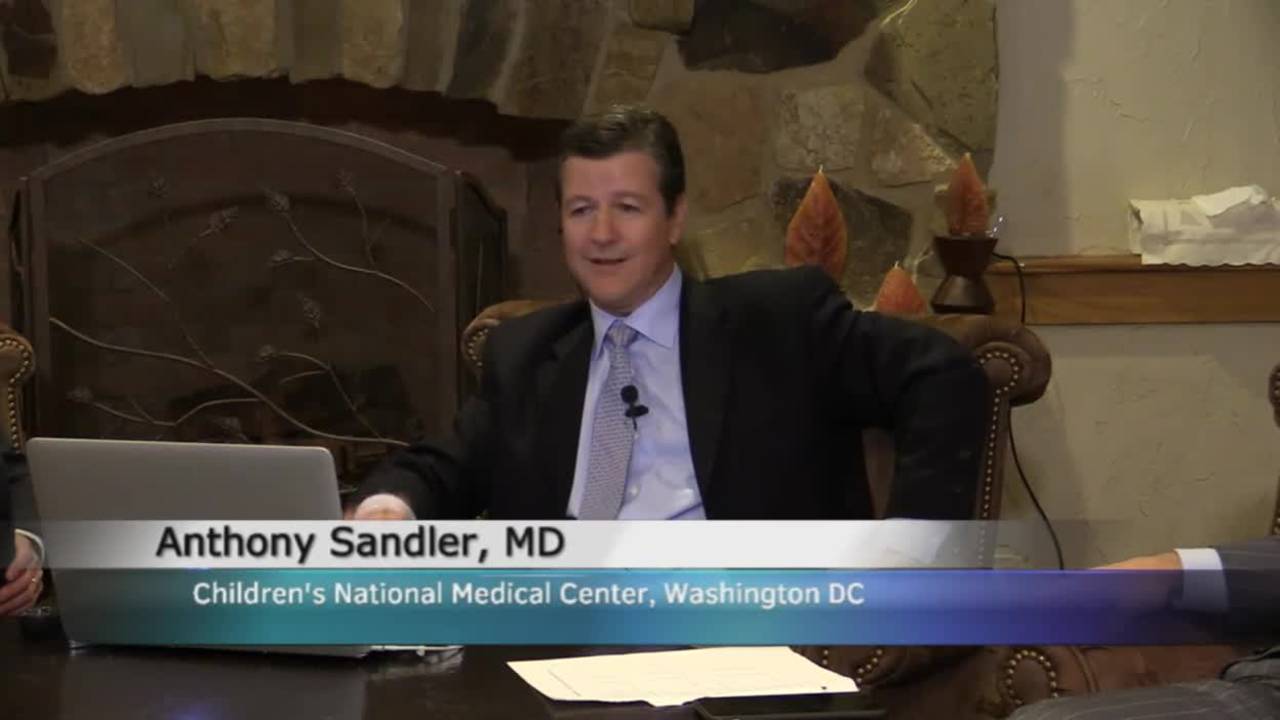
This is uh Doctor Greg Tia.
This is uh Doctor Greg Tia. Greg is the, uh, congratulations, the new uh chief of pediatric surgery at the Cincinnati Ch…
0:21
I kind of wasn't properly prepared and so there's way more s…
I kind of wasn't properly prepared and so there's way more slides that we can share with the group, however you guys wan…
0:44
Um
Um, pediatrician calls you about a 60 day old full term male with who's otherwise healthy but is noted to have persisten…
1:09
His bilirubin is up.
His bilirubin is up. Direct bilirubin is 5.8. AST and ALT are mildly elevated. He's dropping into his nadir from a hemog…
1:21
Remarkable.
Remarkable. So as we start to think about the population of infants with cholestasis, it's important to think about thin…
1:50
Now it's probably down to 10% as a whole series of forward s…
Now it's probably down to 10% as a whole series of forward steps have been made where they've recognized inborn errors o…
2:19
In this day and age
In this day and age, pediatric GI has expanded tremendously, so there's pediatric gastroenterologists at virtually every…
2:46
Well
Well, if they've had the biopsy, there was a paper published a year or so ago that said there's a scoring system, right?…
3:10
But of course not all institutions have the capacity to do p…
But of course not all institutions have the capacity to do percutaneous liver biopsies, especially in a 767 week old kid…
3:25
The jaundice chip is a technology in which blood samples und…
The jaundice chip is a technology in which blood samples undergo a kind of a gene chip, a microarray analysis looking at…
3:46
And so as a result
And so as a result, unfortunately it takes 4 to 6 weeks, so it still doesn't come back timely enough for us to be able t…
4:14
And of course ultrasound and HIDA scan are still an integral…
And of course ultrasound and HIDA scan are still an integral part of the workup. A percutaneous liver biopsy is very muc…
4:39
Ultrasound is obviously the first modality that we'll be uti…
Ultrasound is obviously the first modality that we'll be utilizing as we explore the workup for these patients, but ther…
4:57
The corollary to that
The corollary to that, of course, is the presence of a gallbladder doesn't exclude biliary atresia because the sensitivi…
5:17
Called the triangular cord sign
Called the triangular cord sign, which is something that again you have to be working with a radiology team that's prett…
5:41
So again
So again, this again is stuff that our radiology teams are working with and again depending on the experience of the hos…
6:03
And will yell at the GI people fairly significantly because …
And will yell at the GI people fairly significantly because one of the challenges with the HIDA scan is these patients, …
6:28
It concentrates into the gallbladder and then gets into the …
It concentrates into the gallbladder and then gets into the GI tract in a 15 to 30 minute period and sometimes it takes …
6:55
And that really is kind of where many centers have moved to …
And that really is kind of where many centers have moved to at this stage, which is, should you get a liver biopsy at th…
7:11
So in
So in, oh, in well, so I was at Rainbow first, and at Rainbow we did a, uh, we, we would do the liver biopsies in the op…
7:39
At our center
At our center, of course we have very experienced interventional radiologists who are routinely are doing biopsies in ki…
8:05
Then you're talking about two anesthetics
Then you're talking about two anesthetics, and of course some people will only do the biopsy at the time of the changiog…
8:34
And if you see that
And if you see that, the confirmatory, I mean the likelihood of it being biliotresia is well over 90+%. It's very rare t…
8:57
Just
Just, just because these will have been obtained preoperatively and we'll have a chance to see it and it makes our somet…
9:26
Beneficial in a population of patients in which we're fairly…
Beneficial in a population of patients in which we're fairly confident that the biopsy is consistent with biotresia, and…
9:54
So confident or you can look
So confident or you can look, yeah, or you can get into this kind of circumstance back to the slide here where you actua…
10:28
They won't have the pathonomonic finding of a bile duct plug
They won't have the pathonomonic finding of a bile duct plug, and so that's where it's actually very helpful to have a l…
10:41
And so you need experienced pathologists on top of the abili…
And so you need experienced pathologists on top of the ability to obtain the biopsy, you know, at the DC update course a…
11:10
There were all these people saying
There were all these people saying, oh yeah, our centers, we do percutaneous changiograms. Well, people are doing percut…
11:38
How confident are you?
How confident are you? So we certainly have had those circumstances where the biopsy is equivocal and then we'll watch t…
12:07
So back to the slides here
So back to the slides here, I just want to point out one thing here, which is making sure that people are all cognizant …
12:35
results for Kasaientostomy done in the United States versus …
results for Kasaientostomy done in the United States versus those done in Japan, why their outcomes may be better might …
12:58
Normally everybody thinks about the portal vein as being the…
Normally everybody thinks about the portal vein as being the hallmark for where the dissection is initiated and where yo…
13:26
So anyways
So anyways, um, just a couple of pictures for those who don't haven't seen this before, but this is a polysplenic polysp…
13:52
And so this is really oftentimes a population of patients wh…
And so this is really oftentimes a population of patients where you almost can't do a cassai in that population because …
14:19
The differential at that point in time was a cholidocal cyst…
The differential at that point in time was a cholidocal cyst versus a cystic variant of biliaryresia, and unfortunately …
14:30
odd days
odd days, 50 odd days, and at that point in time had a liver that was starting to get firm, so she went to the OR and so…
14:57
Mark Davenport wrote up the experience where in these patien…
Mark Davenport wrote up the experience where in these patients if you intervene before 30 days they have a better outcom…
15:24
And a couple of of just quick operative questions
And a couple of of just quick operative questions, which is what's the length of the rear limb that you routinely use an…
15:47
OK
OK, so just so you know, 20 is not good for a transplant team because almost always you'll lose 5 to 78 centimeters of l…
16:09
And the transplant team
And the transplant team, again, one of the few advantages of doing a transplant on a biliotresia patient is you have a p…
16:32
And then the anti-refluxing question again
And then the anti-refluxing question again, this was done long ago and there are still some centers that do it, but the …
17:03
In our place David and I,
In our place David and I, OK. And then in that respect, how many casais do you actually do a year? Well, so we always ha…
17:15
So
So, the point of that is there is actually data that came out of the UK, and this is from almost 15 years ago, and the U…
17:38
It was like a 20% difference
It was like a 20% difference, but this is as a result led to the British health services focusing all CSAs at those thre…
18:03
All right
All right, so the data for corticosteroids in biliotresia, actually there are two studies that came out of Europe, one f…
18:29
Center trial in which they had about 70 patients enrolled in…
Center trial in which they had about 70 patients enrolled in two different arms and they showed clearly that there was n…
18:57
The reality is though
The reality is though, as we studied studied biliotresia more comprehensively, there's a profile of patients with biliot…
19:22
All right
All right, I think for that we'll stop just because there's a, oh, you ended on, so there's questions for you and becaus…
19:50
I think there are certainly reports out there in which MRCP …
I think there are certainly reports out there in which MRCP is being done. And then in terms of allos, ages is still the…
20:19
That's actually fairly clear cut.
That's actually fairly clear cut. So this is where the JAG-1 mutation works for patients in which you have cholestasis a…
20:46
Any comments or questions?
Any comments or questions? Disagree with anything Greg said. All right, all right, so we'll stop there. Thank you.

Topic Overview

Dr. Greg Tiao, chief of pediatric surgery at Cincinnati Children's Hospital, discusses biliary atresia diagnosis and management. The presentation covers diagnostic workup including the role of liver biopsy, ultrasound, and cholangiography; emphasizes that percutaneous liver biopsy with pathognomonic findings (bile duct proliferation and bile plugs) can reduce reliance on intraoperative cholangiography; describes technical considerations for Kasai portoenterostomy including extended hilar dissection and 30-40 cm Roux limb length to facilitate future transplantation; and reviews evidence that postoperative corticosteroids show no benefit in the START trial despite theoretical rationale.

Key Takeaways

  • Percutaneous liver biopsy showing bile duct proliferation + bile plugs has >90% PPV for biliary atresia, reducing need for cholangiography. (8:23)
  • Extended Kasai dissection to first hepatic artery bifurcation may explain superior Japanese outcomes; polysplenia cases are most challenging. (12:26)
  • Roux limb should be 30-40 cm (not 20 cm) because 5-8 cm is lost during hilar dissection at future transplant. (15:47)
  • START trial and European studies show postoperative corticosteroids provide no benefit and may increase adverse events after Kasai. (18:03)
  • Centers performing >5 Kasai cases/year have ~20% better outcomes; UK centralized to three high-volume centers based on this data. (17:35)

Inside this episode

Kai, the Library's AI content creator, listened to this episode and mapped who's speaking, the chapters, key claims, and cases. Every item links to the exact moment in the recording.

AI-enriched

Who's speaking

  • Dr. Greg Tiao — guest
  • Speaker 2 — host
  • Speaker 3 — guest
  • Speaker 4 — guest

Chapters

  • 0:00Case Presentation and Differential Diagnosis — Introduction of a 60-day-old jaundiced infant with acholic stools and elevated direct bilirubin. Discussion of cholestasis differential diagnosis, noting that idiopathic neonatal hepatitis has decreased from 70% to 10% of cases due to improved recognition of specific etiologies including inborn errors of metabolism and progressive familial intrahepatic cholestasis (PFIC) genotypes.
  • 2:41Diagnostic Workup and Liver Biopsy — Review of diagnostic studies including biochemical analysis, jaundice chip (microarray for PFIC, alpha-1 antitrypsin, JAG1), ultrasound, HIDA scan, and liver biopsy. Discussion of institutional variation in biopsy timing and technique, with Cincinnati performing percutaneous biopsies in infants as young as 3-4 weeks. Pathognomonic biopsy findings include bile duct proliferation and bile plugs within ducts, which have >90% positive predictive value for biliary atresia.
  • 7:51Role of Cholangiography and Biopsy Interpretation — Discussion of when intraoperative cholangiography can be omitted if percutaneous biopsy is diagnostic. Emphasis on need for experienced pathologists to interpret neonatal liver biopsies. Contrast with Alagille syndrome patients who lack bile duct proliferation and bile plugs. Management of equivocal biopsies, particularly in older infants approaching 60 days of age.
  • 12:08Surgical Technique: Extended Hilar Dissection — Description of extended Kasai dissection technique as originally described, extending beyond portal vein bifurcation to first arterial branches. Comparison of US versus Japanese outcomes, suggesting more extensive dissections in Japan may contribute to better results. Discussion of polysplenia syndrome patients with pre-duodenal portal veins who often lack bile duct remnants and are poor Kasai candidates. Case example of cystic variant biliary atresia diagnosed in utero, with data from Mark Davenport showing better outcomes when correctable variants are treated before 30 days.
  • 15:25Technical Considerations: Roux Limb and Valves — Discussion of optimal Roux limb length of 30-40 cm to preserve adequate length for future liver transplantation, as 5-8 cm may be lost during hilar dissection at transplant. Anti-refluxing valves are no longer recommended as they have not proven effective.
  • 16:47Volume-Outcome Relationship and Corticosteroids — UK data showing centers performing >5 Kasai procedures annually have 20% better outcomes, leading to centralization at three centers. Review of corticosteroid trials: King's College (2 mg/kg), German group (10 mg/kg × 5 days), and START trial (Children's Network, ~70 patients) all showed no benefit and slight increase in adverse events. However, subset of patients with inflammatory gene profiles may theoretically benefit from steroids.
  • 19:23Alagille Syndrome and Closing — Brief discussion of Alagille syndrome diagnosis using JAG1 mutation testing, echocardiography for pulmonic stenosis, spine X-rays for butterfly vertebrae, and ophthalmologic examination. Emphasis that performing Kasai on Alagille patients shortens their native liver survival and accelerates need for transplantation.

Key claims

  • 1:42Idiopathic neonatal hepatitis has decreased from approximately 70% of cholestatic infants in the 1970s-1980s to approximately 10% currently due to improved recognition of specific etiologies — Speaker 2
  • 3:42The jaundice chip microarray takes 4-6 weeks to return results, too long to guide initial biliary atresia management decisions — Speaker 2
  • 4:51Absence of gallbladder on ultrasound does not conclusively diagnose biliary atresia — Speaker 2
  • 4:57Presence of a gallbladder does not exclude biliary atresia because modern ultrasound can visualize small shrunken gallbladders — Speaker 2
  • 6:03HIDA scan requires 3-5 days of phenobarbital loading, which can delay intervention into a time period potentially detrimental to Kasai outcomes — Speaker 2
  • 6:00Cincinnati Children's Hospital does not routinely use HIDA scans for biliary atresia workup — Speaker 2
  • 7:39Interventional radiologists at Cincinnati perform percutaneous liver biopsies in infants as young as 3-4 weeks without complications — Speaker 2
  • 8:23Pathognomonic biopsy findings for biliary atresia include bile duct proliferation in portal triads and bile plugs within bile ducts — Speaker 2
  • 8:34When bile plugs are seen on biopsy, the likelihood of biliary atresia is well over 90% — Speaker 2
  • 10:28Alagille syndrome patients do not have the same bile duct proliferation or bile duct plugs seen in biliary atresia — Speaker 2
  • 12:26Extended Kasai dissection goes beyond portal vein bifurcation to the first bifurcation of hepatic arteries, as originally described by Kasai — Speaker 2
  • 12:35Japanese centers may have better Kasai outcomes because they perform more extended dissections uniformly — Speaker 2
  • 13:44Polysplenia syndrome patients with pre-duodenal portal veins are most difficult for Kasai because there is often no bile duct remnant and bile ducts are all above the portal vein — Speaker 2
  • 14:57Mark Davenport's data from England shows cystic variant biliary atresia patients have better outcomes if intervention occurs before 30 days of age — Speaker 2
  • 15:14Choledochal cyst patients have pigmented stool while cystic variant biliary atresia patients become acholic — Speaker 2
  • 15:47A 20 cm Roux limb is inadequate because 5-8 cm of length is typically lost during hilar dissection at the time of liver transplantation — Speaker 2
  • 16:09Target Roux limb length should be 30-40 cm to preserve adequate length for future transplantation — Speaker 2
  • 16:32Anti-refluxing valves for Kasai have not been proven effective — Speaker 2
  • 17:35UK data shows centers performing more than 5 Kasai cases per year have much better outcomes than those performing fewer, with approximately 20% difference — Speaker 2
  • 17:38British health services centralized all Kasai procedures to three high-volume centers based on outcome data — Speaker 2
  • 18:03King's College group used low-dose steroids at 2 mg/kg and showed no benefit — Speaker 2
  • 18:17Klaus Peterson's German group used 10 mg/kg steroids for 5 days and showed no benefit — Speaker 2
  • 18:29The Children's Network START trial enrolled approximately 70 patients in two arms and showed no improvement in bile drainage with corticosteroids — Speaker 2
  • 18:42The START trial showed a slight increase in adverse events in patients who received steroids, though these were medical rather than surgical complications — Speaker 2
  • 18:57A subset of biliary atresia patients have an inflammatory gene profile in which steroids might prove beneficial despite negative trial results — Speaker 2
  • 19:39Cincinnati does not use MRCP for biliary atresia diagnosis because they have high-capacity pathology teams — Speaker 2
  • 20:12Performing Kasai on Alagille syndrome patients will shorten their natural history and lead to earlier transplantation — Speaker 2
  • 20:21For cholestatic infants where biliary atresia diagnosis is uncertain, workup includes echocardiography for pulmonic stenosis, spine X-rays for butterfly vertebrae, and ophthalmologic examination to evaluate for Alagille syndrome — Speaker 2

Cases discussed

  • 0:4460-day-old full-term male with persistent jaundice
  • 14:13Cystic variant biliary atresia diagnosed in utero

Points of disagreement

  • 15:38Optimal Roux limb length for Kasai portoenterostomy
    • Speaker 3: 20 cm Roux limb, using whatever length reaches
    • Speaker 2: 30-40 cm Roux limb to preserve adequate length for future liver transplantation, as 5-8 cm is typically lost during hilar dissection at transplant

Open questions

  • What is the role of MRCP in biliary atresia diagnosis at centers without high-capacity pathology teams?
  • Can inflammatory gene profiling identify a subset of biliary atresia patients who would benefit from postoperative corticosteroids despite negative trial results?
  • How can the US health system adopt centralization of biliary atresia surgery to high-volume centers given the evidence from the UK experience?
This episode was analyzed and enriched by Kai, the Library's AI content creator. Every item links to the moment it comes from — click a timestamp to listen in context.

Keywords

Hashtags

Transcript

Comments

Loading comments…