


From
Live Event Content
Update Course 2023 - Rapid Updates in Pediatric Trauma
With Dr. Meera Kotagal & Dr. Katie Russell · hosted by Dr. Todd Ponsky
Chapter 1 of 5 · Acute Management
Solid organ disposition
Solid Organ Injury Management - Disposition and Activity Restrictions
Expert statements on this page
No expert statements were drawn from this page.
Host summaries · secondary, not cited in answers
Educational content from recorded physician discussions — not medical advice. Talk to your (or your child's) care team about your situation.
Only a few other public items share this diagnosis — go deeper there →
Video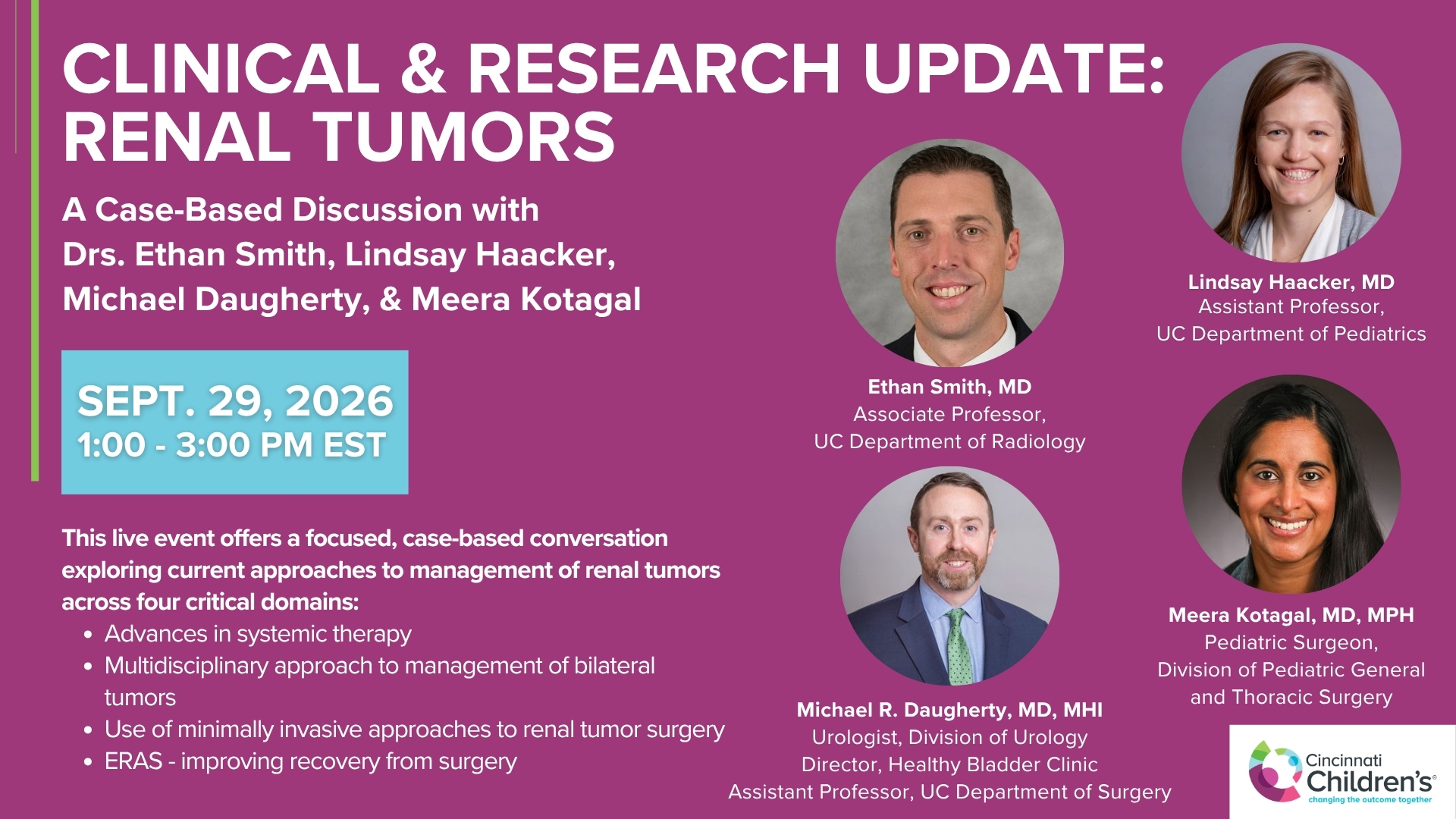
Clinical & Research Update: Renal Tumors with Drs. Ethan Smith, Lindsay Haacker, Michael Daugherty, and Meera Kotagal
71 min · Published Sep 2026
Video
Neuroblastoma with Dr. Meera Kotagal
14 min · Published Sep 2024
Video
Update Course Rewind: 2023 Top Ten Key Takeaways
16 min · Published Jun 2024
Podcast
Inguinal Hernias: Diagnosis and Management
16 min · Published Apr 2021
Video
7th Annual Pediatric Surgery Update Course 2019 - FULL SHOW
285 min · Published Jul 2020
Video
Suspected Hirschsprung's-associated enterocolitis (HAEC) Treatment Guideline...
CCHMC Pediatric Surgery · Published Jul 2019
Video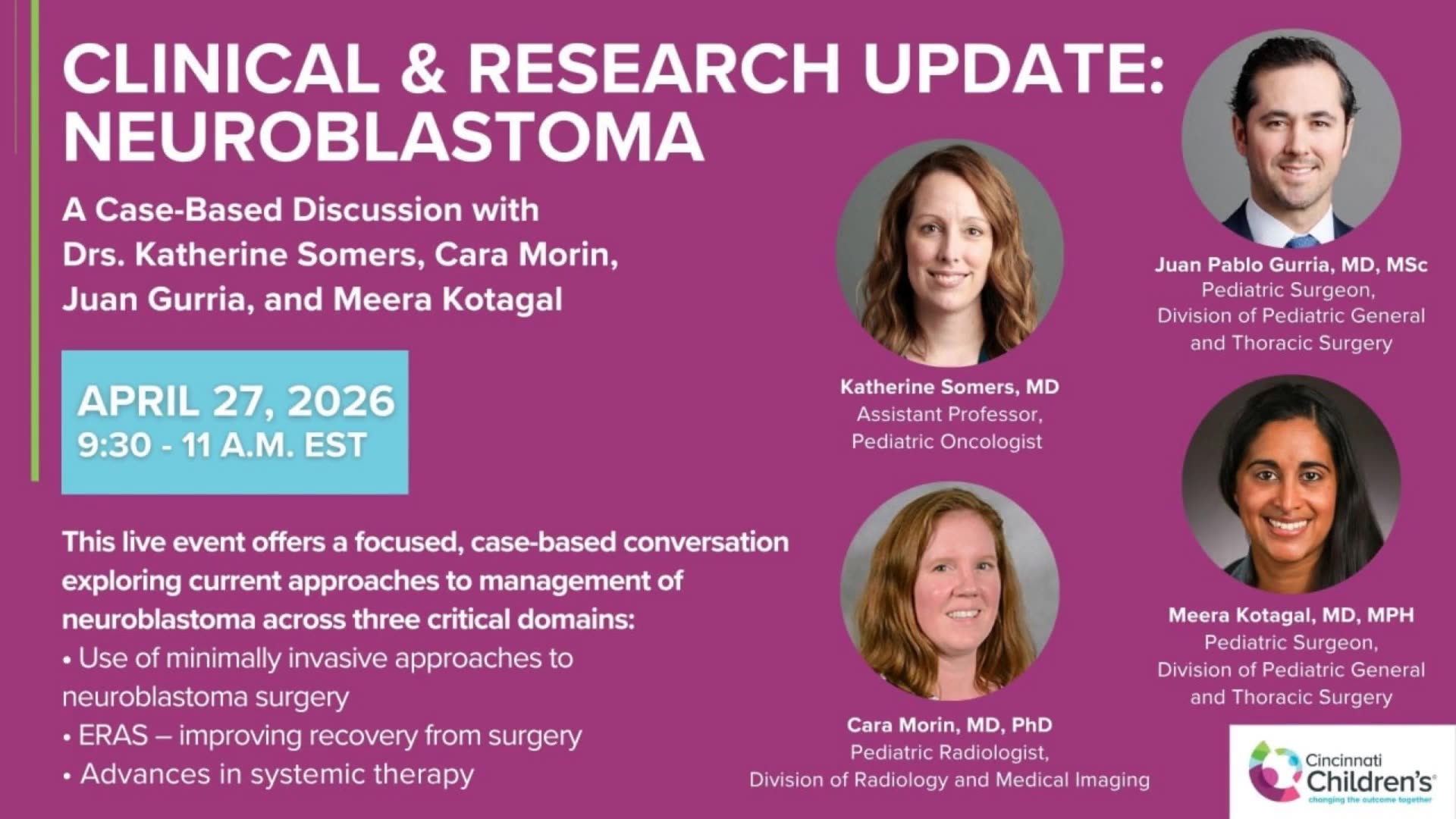
Clinical & Research Update: Neuroblastoma with Drs. Katherine Somers, Cara Morin, Juan Gurria, and Meera Kotagal
67 min · Published Sep 2026
Video
Clinical & Research Update: Sarcoma w/ Drs. Roshni Dasgupta, Joseph Pressey, Arthur Meyer, Luke Pater
66 min · Published Sep 2026
Video
2026 Laparoscopic Pediatric Hernia Repair
123 min · Published Jun 2026
Video
Beyond the Spectrum: Diagnosis, Myths & Management - Caitlin Couch & Leslie Lopez - APP Conference 2026
50 min · Published May 2026
Video
Dysautonomia: Navigating the Journey - Martha Willis - APP Conference 2026
55 min · Published May 2026
Video
Everything You Ever Wanted to Know About G-tubes But Were Afraid to Ask - Betsy Gerrein - APP Conference 2026
30 min · Published May 2026
What the experts said
Cincinnati Children's is now discharging isolated grade 1 and 2 solid organ injuries from the emergency department after 4 hours of observation if patients can tolerate oral intake.
Cincinnati Children's protocol eliminates repeat hemoglobin checks in solid organ injury patients with initial hemoglobin greater than 9.25 g/dL unless there is clinical concern.
Bed rest is only used for ICU-level patients who are hemodynamically abnormal, at least overnight until hemodynamics stabilize; all other solid organ injury patients do not require bed rest.
After implementing an MTP team at Primary Children's Hospital, balanced resuscitation compliance improved from 25% to 85% in approximately 50 patients.
Cincinnati Children's implemented routine BCVI screening approximately one year ago and has not had any delayed diagnoses since, after having at least 2 children with strokes from missed BCVI in the previous year.
Blunt cerebrovascular injury occurs in approximately 1.3% of pediatric trauma patients, similar to the rate of cervical spine injuries.
About one-third of pediatric patients with BCVI will have a stroke, and mortality can be as high as 20% if stroke occurs.
Firearm-related injury is now the leading cause of death for children in the United States.
School shootings represent a tiny percentage of pediatric firearm deaths.
In the American College of Surgeons non-fatal firearm study data, approximately 50-60% of pediatric firearm injuries are assault-related, about 30% are unintentional, and the remainder are self-inflicted.
In rural populations, self-inflicted firearm injuries are much more common, while in urban populations, assaults remain the predominant source of pediatric firearm injury.
APSA guidelines recommend that hemodynamically normal patients with solid organ injuries should be admitted to the floor rather than ICU, regardless of injury grade.
APSA guidelines recommend activity restrictions of grade plus 2 weeks for solid organ injuries, which is shorter than the previous practice of 12 weeks for grade 4 injuries.
In Chris Strack's study of grade 1 and 2 solid organ injuries with no other major organ injury, not a single patient required intervention including transfusion during hospitalization.
Patients who are more likely to fail non-operative management of solid organ injury have an initial hemoglobin less than 9.25 g/dL.
The definition of massive transfusion in pediatrics is 40 mL/kg or more of any blood product over 24 hours.
Balanced resuscitation with more FFP (closer to 1:1:1 ratio) is associated with lower mortality in pediatric massive transfusion.
New data from the blood investigators (Maddock trial group) suggests activating massive transfusion protocol after 20 mL/kg of blood within an hour if the patient remains unstable.
The Memphis criteria is the most sensitive screening tool for BCVI according to the ATOMC study.
Data on TXA use in traumatic brain injury from the TikTok trial does not support that TXA is contraindicated in pediatric traumatic brain injury.