


From
Live Event Content
Update Course 2021: PEDS COLORECTAL CONSORTIUM CONCLUSIONS
With Dr. Rebecca Rentea & Dr. Caitlin Smith
Chapter 1 of 8 · Evidence & Research
PSARP dilations
Anal Dilations Following PSARP: Evidence for Abandoning Routine Protocol
Expert statements on this page
No expert statements were drawn from this page.
Host summaries · secondary, not cited in answers
Educational content from recorded physician discussions — not medical advice. Talk to your (or your child's) care team about your situation.
Podcast
Update Course Rewind: Pediatric Colorectal Consortium 2021
14 min · Published Apr 2022
Podcast
Anorectal Malformations with Dr. Andrea Bischoff
47 min · Published Apr 2017
Video
Hirschsprung Disease: Cases and Complications
103 min · Published Feb 2015
Video
Update Course 2023 - Updates in Colorectal Pathology
27 min · Published Aug 2023
Video
Collaborative work: Complex Pediatric Anorectal Malformations 2017
Dr. Todd Ponsky · 23 min · Published Jun 2017
Video
Hirschsprung Disease: Surgical Procedures
128 min · Published Feb 2015
Video
Validation of an anorectal malformation trainer - Can a high-fidelity model simulate real life?
1 min · Published Jun 2026
Video
Complications and Long-Term Outcomes of Patients With Cloacal Malformation After Bowel Neovagina...
1 min · Published Jun 2026
Video
Safety and utility of long-acting steroid injection for management of post-operative stricture...
1 min · Published Jun 2026
Video
Association Between Social Determinants of Health and Choice of Urinary Reconstruction in Children
1 min · Published Jun 2026
Video
The Perineal Body Preserving PSARP (PPP)
11 min · Published Jun 2026
Video
Update Course Rewind 2025: Hirschsprung + ARM: Rare but Real
1 min · Published May 2026
Only a few other public items share this expert — go deeper there →
Video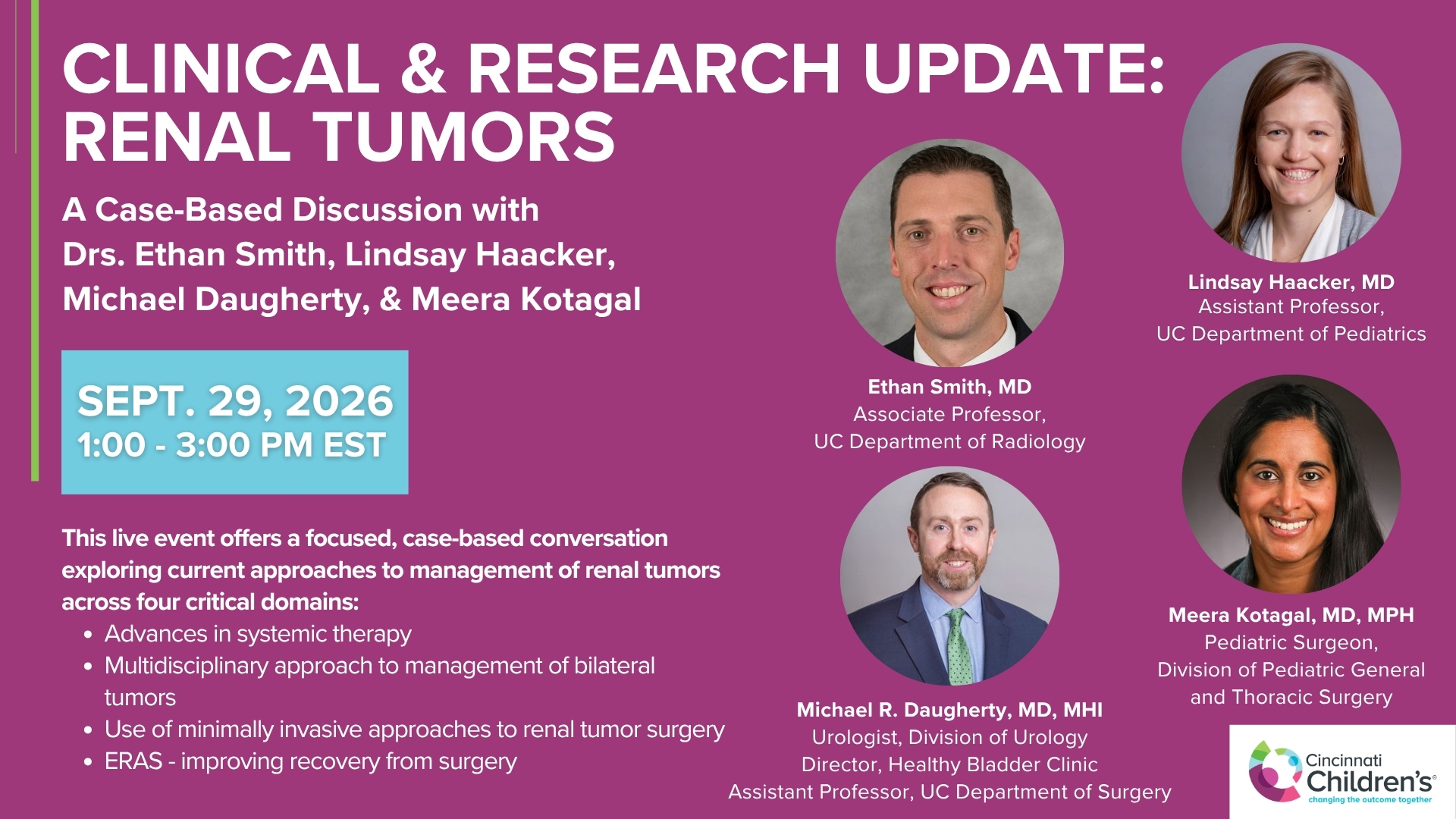
Clinical & Research Update: Renal Tumors with Drs. Ethan Smith, Lindsay Haacker, Michael Daugherty, and Meera Kotagal
71 min · Published Sep 2026
Video
Clinical & Research Update: Neuroblastoma with Drs. Katherine Somers, Cara Morin, Juan Gurria, and Meera Kotagal
67 min · Published Sep 2026
Video
Clinical & Research Update: Sarcoma w/ Drs. Roshni Dasgupta, Joseph Pressey, Arthur Meyer, Luke Pater
66 min · Published Sep 2026
Video
2026 Laparoscopic Pediatric Hernia Repair
123 min · Published Jun 2026
Video
Beyond the Spectrum: Diagnosis, Myths & Management - Caitlin Couch & Leslie Lopez - APP Conference 2026
50 min · Published May 2026
Video
Dysautonomia: Navigating the Journey - Martha Willis - APP Conference 2026
55 min · Published May 2026
What the experts said
The Heineke-Mikulicz anoplasty should be performed at the skin level; long strictures extending through the sphincter complex are not suitable for this technique.
Current practice shows approximately 5-8% of patients require strictureplasty at the two-month follow-up period when dilations are not routinely performed.
The Pediatric Colorectal and Pelvic Learning Consortium (PCPLC) is a multi-institutional consortium across the United States comprised of 17 institutions including free-standing children's hospitals.
Neonates and infants under about 3 months of age tolerate anal dilations well, but for older patients dilations become a greater psychological stressor for parents and patients.
The optimal timing for repair of low anorectal malformations is around 2-3 months, balancing the goal of keeping the fistula open without trying to increase size, while managing constipation with MiraLax to keep stool soft.
Formula-fed infants requiring caloric concentration have thicker stools and may need earlier repair, while breastfed infants can safely wait until 2-3 months; repair should be completed before starting solid foods.
Water-soluble fiber and Imodium can be used to thicken and slow ileostomy effluent before pull-through in total colonic Hirschsprung patients.
Delaying pull-through too long in total colonic Hirschsprung can result in horrible anal sphincter spasm and pelvic disease that makes maintaining a pull-through challenging.
Delayed pull-through with rectal irrigations and sending the family home is a safe alternative to neonatal operation for Hirschsprung disease when there is adequate family support.
A single-institution prospective randomized controlled trial from Nationwide compared routine anal dilations versus no dilations following PSARP, with 25 patients in each arm and 12-month follow-up.
Literature documents a component of psychological dissociation in children who undergo routine anal dilations, measured on later testing.
Stricture was defined as a Hagar dilator size of less than 10, which is 2 standard deviations below the newborn standard of Hagar size 12.
In the dilation versus non-dilation arms, strictures occurred in 3 versus 8 patients (non-significant difference), and the number of Heineke-Mikulicz anoplasties needed was equivalent between groups.
The number of re-operative surgeries was equivalent between dilation and non-dilation groups (about 2 in each group).
An NSQIP-P study of 291 patients (66 early repair under 6 days, 231 late repair 6 weeks to 8 months) found no statistically significant difference in 30-day complications between early and delayed repair of perineal and rectovesibular fistulas.
A PCPLC study of 164 patients (31 early repair under 14 days, 133 late repair after 14 days) found no difference in 30-day outcomes for perineal and rectovesibular fistula repairs.
Long-segment Hirschsprung disease is defined as any disease proximal to the rectosigmoid colon in the majority of reviewed articles.
Contrast studies are very inaccurate for determining the transition zone in Hirschsprung disease; colonic mapping with biopsies is needed.
For long-segment Hirschsprung disease, no superior operation was identified, though Duhamel and Swenson-Soave were the most commonly performed procedures.
A European study demonstrated that early operation for total colonic Hirschsprung (around 5 months) is possible if the child with an ileostomy is adequately prepared and the family learns to thicken stool, preventing complete perineal skin breakdown.
Even patients with mild and moderate anorectal malformations in the 5-12 year age group frequently require enemas and multiple bowel management strategies to maintain cleanliness for school.
A PCPLC study of 624 anorectal malformation patients found that 418 (two-thirds) were enrolled in bowel management programs, with constipation as the primary complaint.
In the PCPLC bowel management study, only 40% of anorectal malformation patients were toilet trained, and about half reported daytime stool accidents.
A PCPLC study comparing early (under 31 days) versus late (over 31 days) endorectal pull-through for Hirschsprung diagnosed under 1 month found preoperative enterocolitis rates were equivalent (about 2 in each group).
Post-operative enterocolitis rates were equivalent between early and late pull-through groups (40-50% experiencing at least one episode in both groups).
Constipation and incontinence outcomes tracked to 3.5 years were equivalent between early and late pull-through groups for Hirschsprung disease.
Transition zone level, rather than timing of pull-through, was the primary marker determining whether a Hirschsprung patient needed treatment for constipation.
In spina bifida patients, Hispanic ethnicity and public insurance are associated with lower overall continence rates.
A PCPLC study of 525 anorectal malformation patients found public insurance was associated with decreased rates of urinary incontinence, independent of clinical factors including ARM type, spine, and sacrum.
The urethral length in normal females has been measured at about 2.5 centimeters, and approximately 1.5 centimeters is needed to avoid incontinence; pulling a urethra that is too short past the bladder neck creates risk for incontinence.
A short vagina may require vaginal replacement even in an otherwise short common channel cloaca operation.
Rotational fluoroscopy and 3D reconstructions are key to making reliable anatomic measurements for cloacal reconstruction planning.