


Impact of Benign Bilateral Vocal Fold Lesions Across Childhood: Does Age Matter?
pubmed.ncbi.nlm.nih.gov shows its articles on its own site.
Read the article on pubmed.ncbi.nlm.nih.gov ↗Article · Mar 2026 · 1 min read
In brief
In brief
This prospective study examines how benign bilateral vocal fold lesions affect children across different age groups using the pediatric Voice Handicap Index. Results show that while functional and physical impacts remain consistent across ages, emotional impact increases significantly with age, particularly affecting adolescents.
Written by the GCMD Library team from the article.
Objectives: To assess correlations between age group and functional, physical, emotional, and talkativeness domains of the pediatric Voice Handicap Index (pVHI) in pediatric cohorts with and without benign bilateral vocal fold lesions (BVFL) and to further validate the utility of the pVHI in these patients. Study Design: Prospective data collection of pVHI in children with and without BVFL. Methods: Prospective pVHI data was collected from parents of children with and without benign BVFL. Data were examined for four age groups, preschool (3-4), young child (5-8), child (9-12), and adolescent (13-18). Results: A total of 182 parents filled-out the pVHI; 60 parents of children with no voice disorder and 122 with benign BVFL diagnosed via endoscopy. Among all (n=182), median pVHI subscores in the functional, emotional, and physical domains were significantly increased in BVFL patients compared to non-disordered (all P value <0.001). In patients with BVFL, age showed a direct relationship with emotional pVHI subscore (P < 0.001) but not with physical or functional pVHI subscores (P = 0.4, P = 0.8). There were no differences in talkativeness across groups. Conclusions: This study demonstrates that children with BVFL across all age groups face negative effects in the functional, physical, and emotional domains compared to those with no lesions. Of interest, the impact of a voice disorder changes as a function of age in children with BVFL. The impact of lesions in adolescents is sig
Educational content from recorded physician discussions — not medical advice. Talk to your (or your child's) care team about your situation.
Article
Laser-Calibrated System for Transnasal Fiberoptic Laryngeal High-Speed Videoendoscopy.
Alessandro de Alarcon · Published Oct 2026
Article
A Deep Learning Approach for Quantifying Vocal Fold Dynamics During Connected Speech Using Laryngeal High-Speed Videoendoscopy
Alessandro de Alarcon · Published Oct 2026
Article
Multidimensional Perceptual Structure of Pediatric Dysphonia in Children With Glottal and Supraglottal Vibratory Sources.
Alessandro de Alarcon · Published Oct 2026
Article
Influence of preoperative voice assessment on treatment plan prior to airway surgery.
Alessandro de Alarcon · Published Oct 2026
Article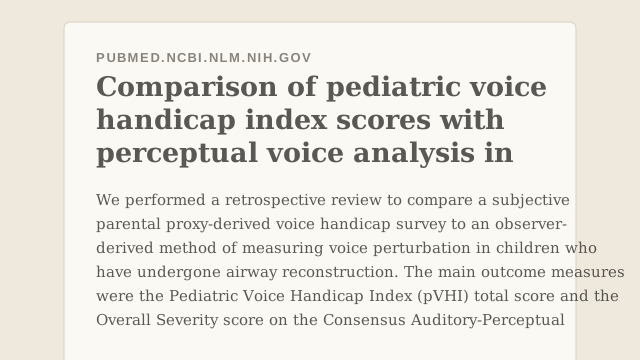
Comparison of pediatric voice handicap index scores with perceptual voice analysis in patients following airway reconstruction.
Alessandro de Alarcon · Published Oct 2026
Article
Feasibility of Clinical Endoscopy and Stroboscopy in Children With Bilateral Vocal Fold Lesions.
Alessandro de Alarcon · Published Oct 2026
Article
A multicenter study analyzing the impact of pre-existing comorbidities on laryngotracheal reconstruction (LTR) outcomes.
Alessandro de Alarcon · Published Oct 2026
Article
Practice patterns in the management of post-tonsillectomy hemorrhage: An American Society of Pediatric Otolaryngology survey.
Alessandro de Alarcon · Published Oct 2026
Article
Resources for Healthcare Professionals
Alessandro de Alarcon · Published Oct 2026
Article
Surgical Treatment of Type III Laryngotracheoesophageal Clefts: Techniques and Outcomes.
Alessandro de Alarcon · Published Oct 2026
Article
In Reference to Establishing an Endoscopic Chronic Subglottic Stenosis Rabbit Model.
Alessandro de Alarcon · Published Oct 2026
Article
Researchers, Cincinnati Children's Hospital Medical Center
Alessandro de Alarcon · Published Oct 2026