


From
StayCurrentMD
Surgical Site Infections and Perioperative Antibiotic Use in Children with Medical Complexity
hosted by Lizzy Lee, PA-C
Chapter 1 of 1 · Fundamentals
SSI Prevention in Medically Complex Children
Expert statements on this page
No expert statements were drawn from this page.
Host summaries · secondary, not cited in answers
Educational content from recorded physician discussions — not medical advice. Talk to your (or your child's) care team about your situation.
Video
El cuidado perioperatorio estandarizado reduce las infecciones del sitio quirúrgico en niños
Published Apr 2023
Video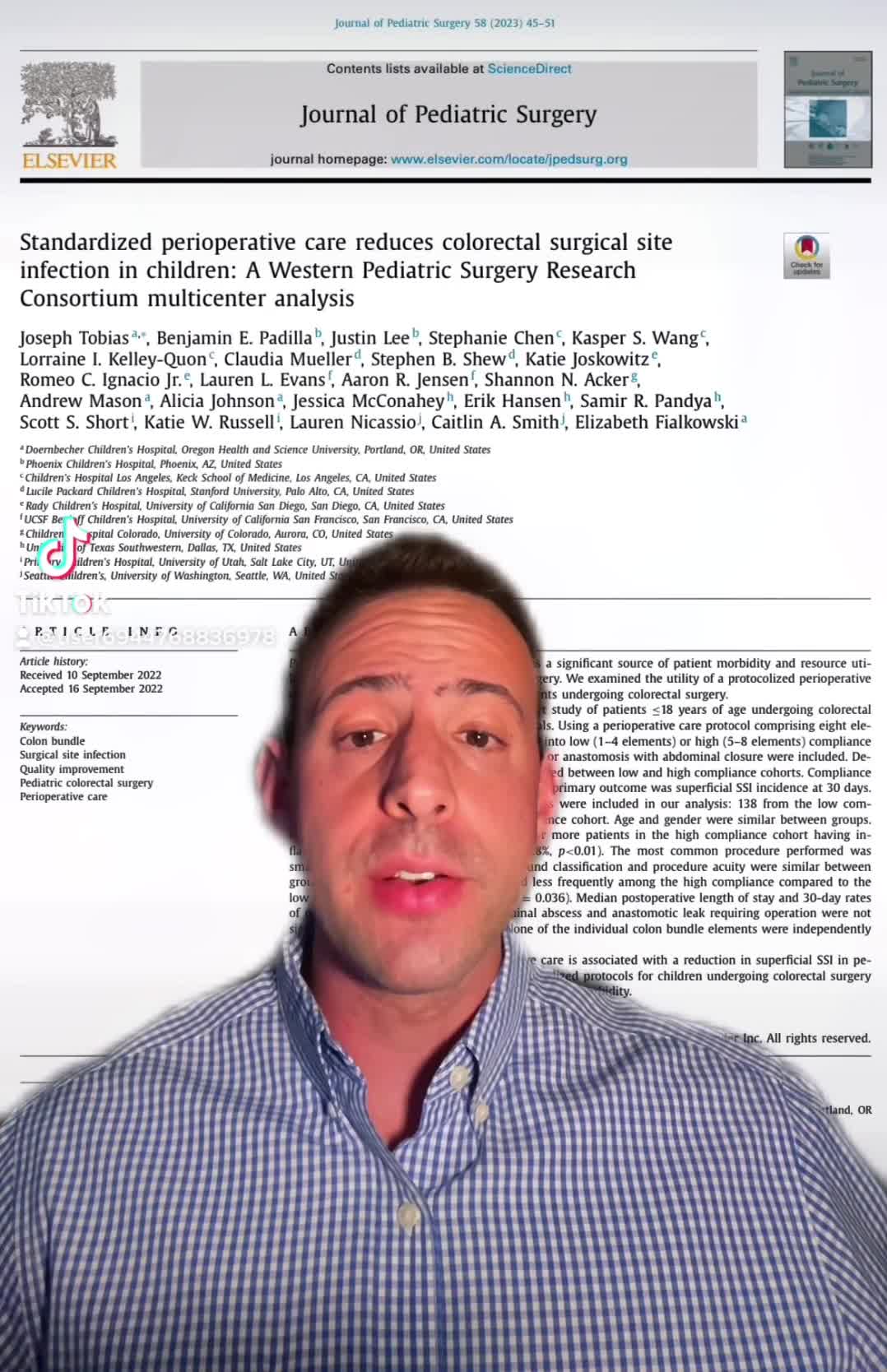
Standardized perioperative care reduces colorectal surgical site infection in children
1 min · Published Apr 2023
Video
Improve Wound Misclassification with Focused Education
Published Mar 2019
Video
MediByte - Intraoperative temperatures impact on postoperative infections
Published May 2020
Video
Update Course Rewind: Effects of Mechanical Bowel Prep on SSIs 2022
Published Jun 2023
Video
The Role of Diversion During Ileal Pouch Anal Anastomosis (IPAA) Creation in Pediatric Ulcerative Colitis - JPS
Published Feb 2024
Video
Intestinal Atresia Types Explained: Grossfeld Classification for Pediatric Surgery
1 min · Published Sep 2026
Video
Derivation and validation of the Pediatric Community-Acquired Pneumonia Severity (PedCAPS) score: A prospective cohort study
50 s · Published Sep 2026
Video
FETO for Late-Diagnosed Severe Congenital Diaphragmatic Hernia (CDH) at Cincinnati Children's with Dr. Beth Rymeski
4 min · Published Sep 2026
Video
Severe Congenital Diaphragmatic Hernia (CDH) Case: FETO Management & Unexpected Findings with Dr. Beth Rymeski
3 min · Published Sep 2026
Video
Fetoscopic Endoluminal Tracheal Occlusion (FETO) Procedure: Step-by-Step Guide with Dr. Beth Rymeski
4 min · Published Sep 2026
Video
Choledochal Cyst Types Explained: Pediatric Surgery Fundamentals
1 min · Published Sep 2026
What the experts said
Children with medical complexity face a much higher risk of surgical site infections than other patients.
The answer to preventing SSI in medically complex children is not simply giving them more antibiotics.
Standardized infection prevention practices include preoperative bathing, proper skin cleaning, screening certain patients for MRSA, and careful wound care.
The standard antibiotics used before surgery (like cefazolin) are usually enough, even for medically complex children.
One opportunity to improve care is making sure children who are not truly allergic to beta-lactam antibiotics can still receive the most effective medication.
Preventing surgical site infections takes a team of nurses, surgeons, and specialists.