


From
StayCurrentMD
Updated Course Rewind 2025: Branchial Cleft Cyst Management: Endoscopic vs. Open Surgical Approaches
With Dr. Douglas von Allmen · hosted by Dr. Jill Knepprath
Chapter 1 of 4 · Case-Based Learning
Case introduction
Introduction and Case Presentation
Expert statements on this page
No expert statements were drawn from this page.
Host summaries · secondary, not cited in answers
Educational content from recorded physician discussions — not medical advice. Talk to your (or your child's) care team about your situation.
Video
Intestinal Atresia Types Explained: Grossfeld Classification for Pediatric Surgery
1 min · Published Sep 2026
Video
Derivation and validation of the Pediatric Community-Acquired Pneumonia Severity (PedCAPS) score: A prospective cohort study
50 s · Published Sep 2026
Video
FETO for Late-Diagnosed Severe Congenital Diaphragmatic Hernia (CDH) at Cincinnati Children's with Dr. Beth Rymeski
4 min · Published Sep 2026
Video
Severe Congenital Diaphragmatic Hernia (CDH) Case: FETO Management & Unexpected Findings with Dr. Beth Rymeski
3 min · Published Sep 2026
Video
Fetoscopic Endoluminal Tracheal Occlusion (FETO) Procedure: Step-by-Step Guide with Dr. Beth Rymeski
4 min · Published Sep 2026
Video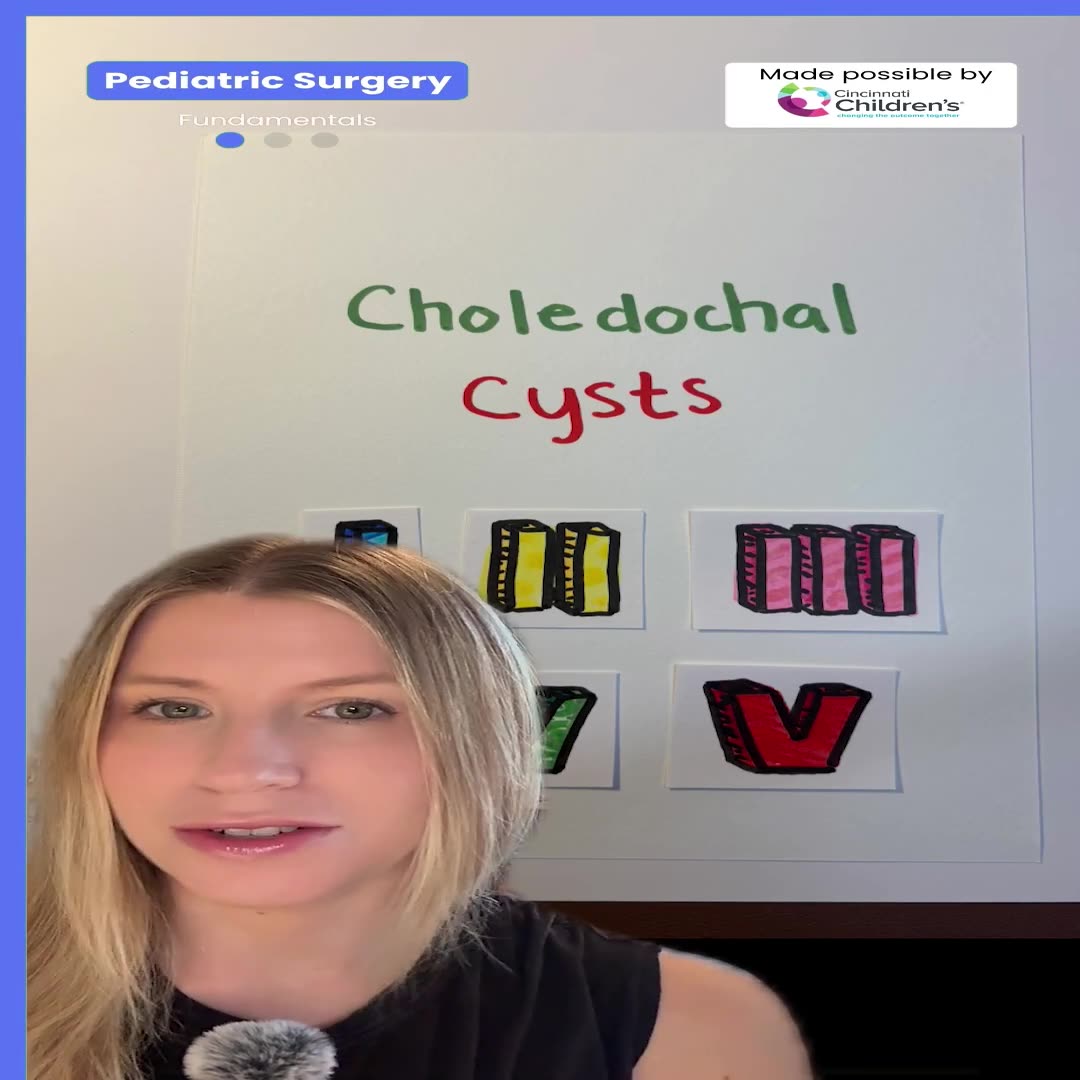
Choledochal Cyst Types Explained: Pediatric Surgery Fundamentals
1 min · Published Sep 2026
What the experts said
A 4-year-old presented with painless neck swelling after a viral illness, with CT scan showing a cystic mass extending from the thyroid up to the piriform sinus.
The patient was treated with oral antibiotics and showed improvement in the swelling of the mass.
Dr. Van Alman recommends avoiding interventions on branchial cleft cysts until ready to resolve the issue definitively.
Incision and drainage (I&Ds) can sometimes make future definitive surgery more challenging.
Type 3 and type 4 branchial cleft cysts typically have a tract going up to the piriform sinus.
A study comparing endoscopic approach versus open excision showed that the outcome of recurrence is equivalent.
Branchial cleft cyst is a congenital neck mass that forms when tissues fail to develop properly during embryonic growth.
If a branchial cleft cyst recurs after antibiotic treatment, it may require an excision.
With types 3 and 4 branchial cleft cysts that appear on the left side of the neck, you can get associated thyroiditis.
With types 3 and 4 branchial cleft cysts on the left side, you occasionally may have to perform a hemi thyroidectomy to excise the mass.
A cautery probe can be used to cauterize the sinus tract, which resolves the lesion and prevents recurrence.
Endoscopic cauterization avoids the morbidity of undergoing open surgery.
Endoscopic cauterization avoids recurrent laryngeal nerve injury.
Incision and drainage can make the definitive surgical excision more difficult down the line.
It is best to wait until ready to treat the underlying tract rather than performing incision and drainage.
Studies show endoscopic cauterization has similar recurrence rates to open surgery while reducing surgical morbidity and avoiding recurrent laryngeal nerve injury.