


From
StayCurrentMD
Remote Ischemic Conditioning (RIC) Decreases the Incidence and Severity of Necrotizing Enterocolitis (NEC) - Validation in a Large Animal Model
hosted by Dr. Alex Halpern
Chapter 1 of 1 · Evidence & Research
RIC piglet study
Remote Ischemic Conditioning for NEC Prevention in a Piglet Model
Expert statements on this page
No expert statements were drawn from this page.
Host summaries · secondary, not cited in answers
Educational content from recorded physician discussions — not medical advice. Talk to your (or your child's) care team about your situation.
Video
Availability, utilization, and barriers to bowel ultrasound for necrotizing enterocolitis...
55 s · Published Jul 2026
Video
Dr. Colleen Nofi - Best of the Best in Pediatric Surgery 2025
Dr. Todd Ponsky · 8 min · Published Mar 2025
Video
Mina Yeganeh, BSc - Best of the Best in Pediatric Surgery 2024
Dr. Todd Ponsky · 6 min · Published Feb 2024
Video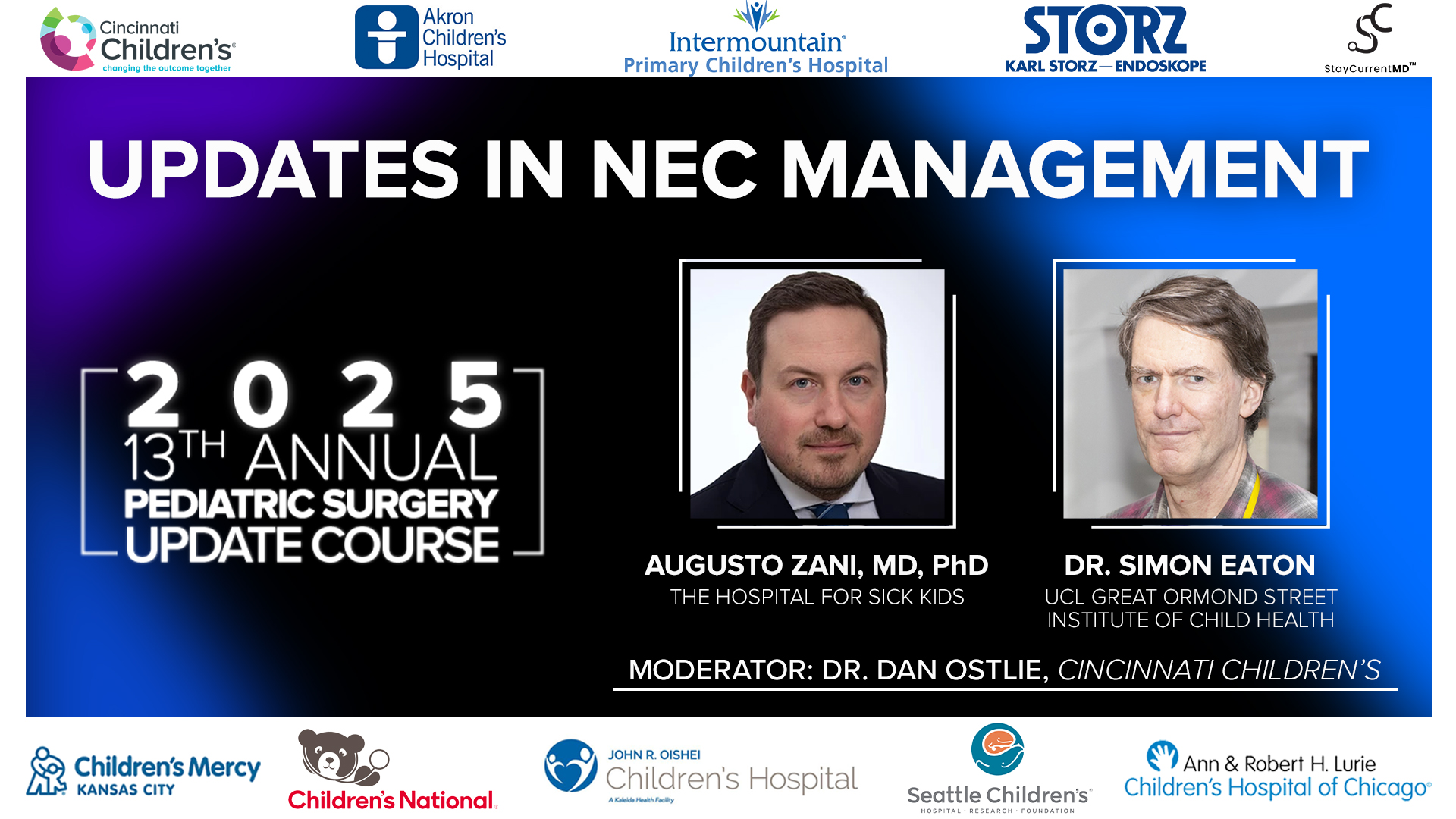
2025 Pediatric Surgery Update Course - Updates in NEC Management
26 min · Published Aug 2025
Video
Association of Exclusive Breast Milk Intake and Outcomes in Infants With Uncomplicated Gastroschisis: A National Cohort Study
56 s · Published Aug 2024
Video
Routine contrast enema prior to stoma reversal seems only required following treatment for necrotizing enterocolitis: An evaluation of the diagnostic accuracy of the contrast enema
56 s · Published Apr 2023
Video
Impact of social determinants of health on outcomes in pediatric short bowel syndrome...
43 s · Published Aug 2026
Video
Advancements in Pediatric Intestinal Failure: Innovative Therapies and Improved Outcomes
17 min · Published Aug 2026
Podcast
Update Course Rewind: Omphalocele & Gastroschisis 2020
Miguel Guelfand · 15 min · Published Jul 2026
Video
Update Course Rewind 2025: Updates in NEC Management
11 min · Published Jul 2026
Video
Malrotation and Volvulus with Trinity
Dr. Steve Rothenberg · 8 min · Published May 2026
Video
Malrotation Infant
Dr. Steve Rothenberg · 9 min · Published May 2026
Video
Intestinal Atresia Types Explained: Grossfeld Classification for Pediatric Surgery
1 min · Published Sep 2026
Video
Derivation and validation of the Pediatric Community-Acquired Pneumonia Severity (PedCAPS) score: A prospective cohort study
50 s · Published Sep 2026
Video
FETO for Late-Diagnosed Severe Congenital Diaphragmatic Hernia (CDH) at Cincinnati Children's with Dr. Beth Rymeski
4 min · Published Sep 2026
Video
Severe Congenital Diaphragmatic Hernia (CDH) Case: FETO Management & Unexpected Findings with Dr. Beth Rymeski
3 min · Published Sep 2026
Video
Fetoscopic Endoluminal Tracheal Occlusion (FETO) Procedure: Step-by-Step Guide with Dr. Beth Rymeski
4 min · Published Sep 2026
Video
Choledochal Cyst Types Explained: Pediatric Surgery Fundamentals
1 min · Published Sep 2026
What the experts said
RIC has been shown to decrease rates of necrotizing enterocolitis in a rat model.
Gadal used an established piglet NEC model to test RIC.
Piglets were randomly assigned to receive RIC or serve as controls.
RIC was initiated at 24 hours of life and consisted of 4 cycles of 4 minutes of arterial occlusion followed by reperfusion.
Cycles were repeated every 24 hours in the low frequency group and every 12 hours in the high frequency group.
38 piglets were randomized into the control group, 26 into the low frequency group, and 22 into the high frequency group.
High frequency RIC significantly reduced the incidence of NEC when compared to controls.
Low frequency RIC did not significantly reduce the incidence of NEC.
High frequency RIC protects against NEC in a piglet model.