


From
Live Event Content
Dr. Colleen Nofi - Best of the Best in Pediatric Surgery 2025
With Dr. Colleen Nofi
Chapter 1 of 4 · Fundamentals
eCIRP background
Introduction and Background on eCIRP in NEC
Expert statements on this page
No expert statements were drawn from this page.
Host summaries · secondary, not cited in answers
Educational content from recorded physician discussions — not medical advice. Talk to your (or your child's) care team about your situation.
Video
Availability, utilization, and barriers to bowel ultrasound for necrotizing enterocolitis...
55 s · Published Jul 2026
Video
Remote Ischemic Conditioning (RIC) Decreases the Incidence and Severity of Necrotizing Enterocolitis (NEC) - Validation in a Large Animal Model
59 s · Published Apr 2025
Video
Mina Yeganeh, BSc - Best of the Best in Pediatric Surgery 2024
Dr. Todd Ponsky · 6 min · Published Feb 2024
Video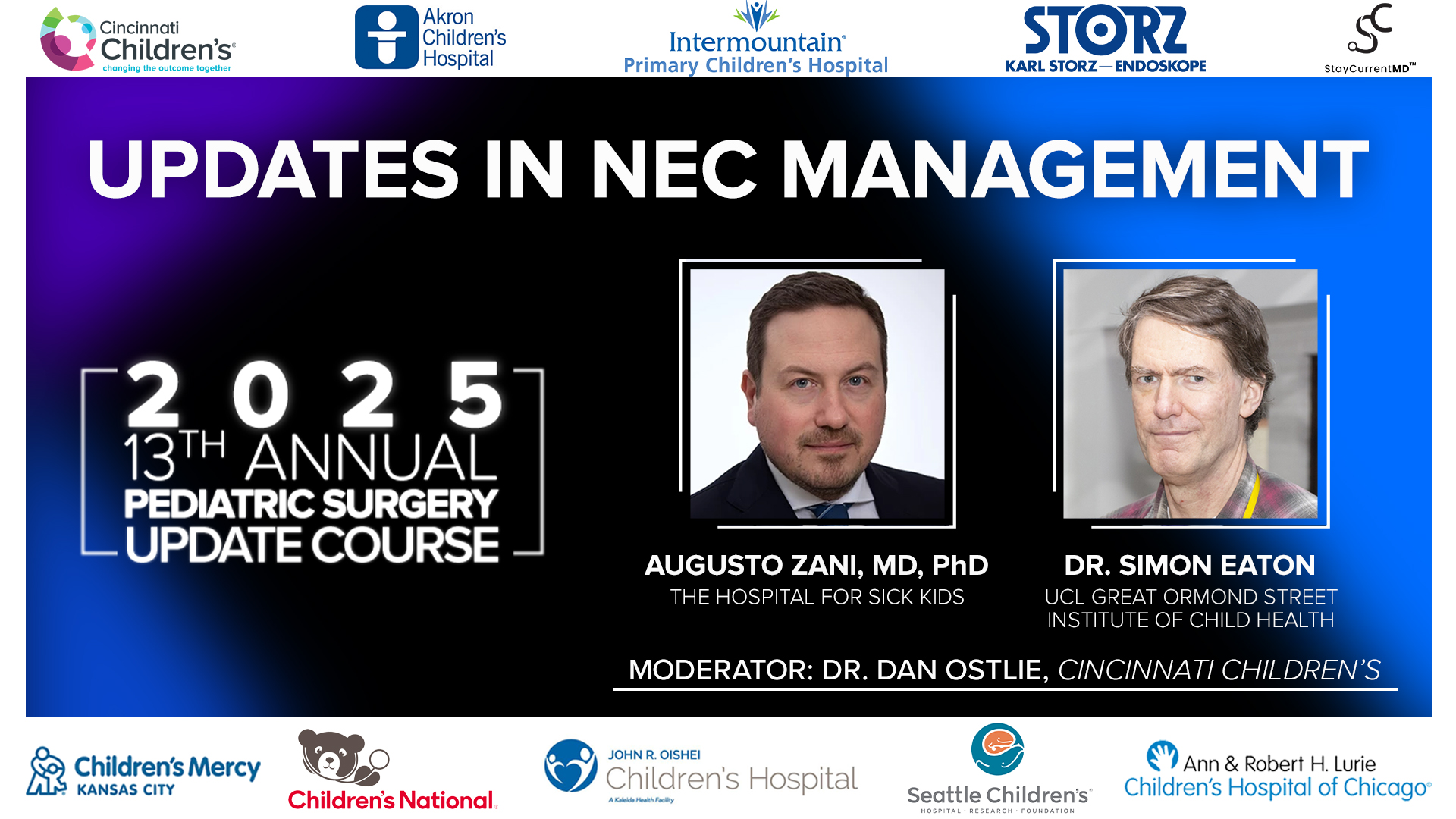
2025 Pediatric Surgery Update Course - Updates in NEC Management
26 min · Published Aug 2025
Video
Association of Exclusive Breast Milk Intake and Outcomes in Infants With Uncomplicated Gastroschisis: A National Cohort Study
56 s · Published Aug 2024
Video
Routine contrast enema prior to stoma reversal seems only required following treatment for necrotizing enterocolitis: An evaluation of the diagnostic accuracy of the contrast enema
56 s · Published Apr 2023
Video
Impact of social determinants of health on outcomes in pediatric short bowel syndrome...
43 s · Published Aug 2026
Video
Advancements in Pediatric Intestinal Failure: Innovative Therapies and Improved Outcomes
17 min · Published Aug 2026
Podcast
Update Course Rewind: Omphalocele & Gastroschisis 2020
Miguel Guelfand · 15 min · Published Jul 2026
Video
Update Course Rewind 2025: Updates in NEC Management
11 min · Published Jul 2026
Video
Malrotation and Volvulus with Trinity
Dr. Steve Rothenberg · 8 min · Published May 2026
Video
Malrotation Infant
Dr. Steve Rothenberg · 9 min · Published May 2026
Only a few other public items share this expert — go deeper there →
Video
Clinical & Research Update: Renal Tumors with Drs. Ethan Smith, Lindsay Haacker, Michael Daugherty, and Meera Kotagal
71 min · Published Sep 2026
Video
Clinical & Research Update: Neuroblastoma with Drs. Katherine Somers, Cara Morin, Juan Gurria, and Meera Kotagal
67 min · Published Sep 2026
Video
Clinical & Research Update: Sarcoma w/ Drs. Roshni Dasgupta, Joseph Pressey, Arthur Meyer, Luke Pater
66 min · Published Sep 2026
Video
2026 Laparoscopic Pediatric Hernia Repair
123 min · Published Jun 2026
Video
Beyond the Spectrum: Diagnosis, Myths & Management - Caitlin Couch & Leslie Lopez - APP Conference 2026
50 min · Published May 2026
Video
Dysautonomia: Navigating the Journey - Martha Willis - APP Conference 2026
55 min · Published May 2026
What the experts said
Necrotizing enterocolitis is a devastating gastrointestinal disease impacting premature infants whose pathophysiology is driven by complex pathways that are not completely understood
NEC has limited treatment options and an unacceptably high morbidity and mortality risk
Under biologic conditions, CIRP is found inside the cell where it acts as an RNA chaperone protein
In states of cellular stress such as sepsis, CIRP escapes outside the cell
Once released from the cell, extracellular CIRP acts as a DAMP by enhancing the release of cytokines and chemokines and amplifying the inflammatory cascade
MOP3 (MFGE8 derived oligopeptide 3) is an eCIRP scavenging peptide that removes eCIRP from circulation to reduce inflammation
CIRP knockout protected pups from NEC severity with preservation of intestinal villi architecture
CIRP knockout mice subjected to NEC showed reduced intestinal inflammation as measured by mRNA levels of IL-6 and TNF-alpha in the small bowel
CIRP knockout pups had reduced fluorescent dextran leakage indicating preserved intestinal barrier function compared to wild-type NEC pups
CIRP knockout pups subjected to NEC had 100% survival whereas wild-type pups had only 65% survival in the same model under the same conditions
MOP3 treatment reduced circulating eCIRP levels in NEC pups compared to vehicle
Reduction in eCIRP with MOP3 treatment correlated with reduction in systemic inflammatory markers including IL-6 and TNF-alpha
MOP3 treatment protected against NEC severity with preservation of intestinal villi
MOP3 treatment reduced intestinal inflammation in NEC as measured by mRNA levels of IL-6 and TNF-alpha
MOP3-treated pups had significantly reduced fluorescence intensity indicating protection of the intestinal barrier compared to vehicle-treated NEC pups
Murine pups subjected to NEC and treated with MOP3 had 80% survival compared to only 50% survival in vehicle-treated pups
eCIRP exacerbates NEC pathogenesis by increasing inflammation and intestinal injury
MOP3 protects against NEC pathogenesis by scavenging eCIRP and preventing deleterious downstream impacts
MOP3 is effective in other models of ischemia-reperfusion injury in the gut
The therapeutic benefit of MOP3 is not at the same level as complete CIRP knockdown
The murine NEC model uses a 4-day protocol with continuous stressors including LPS, formula gavage, and hypoxia
MOP3 treatment was administered once per day at the beginning of the model, ongoing with the NEC insult