
Aspiration
Everything in the library about aspiration — built automatically from the recorded discussions that name it
Educational content from recorded physician discussions — not medical advice. Always talk to your child's care team about your child's situation.
Content of this collection
Evidence & Research
2 items


Best of the Best APSA Winner
Watch →
The APSA winner at the Best of the Best in Pediatric Surgery event on April 8th, 2022 was Nathan Rubalcava with his presentation "A contrast challenge is safe in children with adhesive small bowel obstruction- a multi-institutional review".
video9:46 · Apr 2022
APSA - A contrast challenge is safe in children with adhesive small bowel obstruction- a multi-institutional review - Nathan Rubalcava
Watch →
Listen to Nathan Rubalcava gave his presentation of "A contrast challenge is safe in children with adhesive small bowel obstruction- a multi-institutional review" at the first ever Best of the Best in Pediatric Surgery event.
video8:44 · May 2022
In-Depth Reviews
1 item
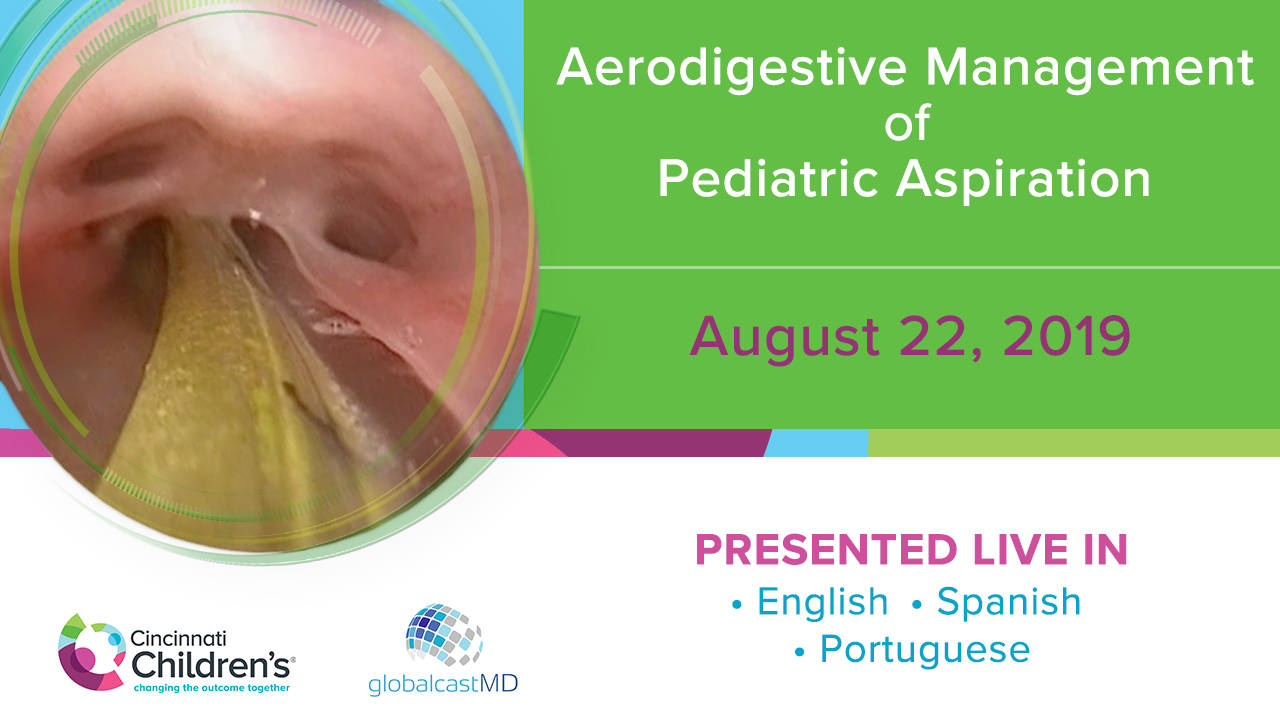
Aerodigestive Management of Pediatric Aspiration - FULL SHOW
Watch →
The Aerodigestive and Esophageal Center at Cincinnati Children’s is internationally known for our team approach to caring for children with airway and esophageal disorders. We have the multidisciplinary expertise to treat even the most comp
video157:09 · Jul 2020
Summaries and takeaways+ Show
The doctors in this collection+ Show
All expert statements+ Show
Every expert statement below comes from the recorded discussions, with its speaker and moment.
Aerodigestive Management of Pediatric Aspiration - FULL SHOW
Aspiration is defined as any solid or liquid matter passing below the vocal cords, though some define it as requiring pulmonary compromise in addition to passage below the cords.
host_summaryCatherine Hart0:16 ↗
Aspiration can be silent with no clinical indication, or obvious with coughing, choking, and sputtering.
host_summaryCatherine Hart0:39 ↗
Children with CHARGE syndrome have 80 to 90% prevalence of aspiration at some point in their lifetime and should be assumed to aspirate until proven otherwise.
host_summaryCatherine Hart1:51 ↗
Children with severe neurologic compromise regardless of etiology should be assumed to aspirate until demonstrated otherwise.
host_summaryCatherine Hart2:01 ↗
The clinical significance of aspiration depends on the quantity—small isolated events are usually cleared by host defenses (cough, mucociliary transport), while large or repeated events overcome host defenses.
host_summaryCatherine Hart2:32 ↗
A single aspiration event of caustic substance can have lifelong consequences.
host_summaryCatherine Hart3:06 ↗
Chronic pulmonary aspiration is defined as repeated aspiration into the lower airways causing pulmonary injury or chronic respiratory disease, with consequences determined by frequency, magnitude, nature of material, and effectiveness of host defenses.
clinicalCatherine Hart3:31 ↗
Four major groups aspirate: premature babies, those with neurologic disabilities, those with airway disease (anatomic, dynamic, or functional), and those with gastrointestinal disorders.
clinicalCatherine Hart4:34 ↗
Syndromes with significant swallowing dysfunction include CHARGE, Cri-du-chat, Möbius syndrome (cranial nerve abnormalities), and craniofacial defects like Pfeiffer, Crouzon, and Treacher Collins.
host_summaryCatherine Hart5:02 ↗
Dysphagia can occur in any of the four swallowing phases (oral preparatory, oral transit, pharyngeal, esophageal) and can result in aspiration or retrograde flow into the nasal cavity.
host_summaryClaudia Schweiger6:09 ↗
Children who aspirate may present with breathing difficulties during feeding (increased respiratory rate, bradycardia, tachycardia, cyanosis, apnea, desaturation), coughing/choking during or after swallowing, frequent congestion after meals, noisy or wet vocal quality, prolonged meal times, food refusal, or vomiting.
host_summaryClaudia Schweiger6:48 ↗
Children with associated obstructive airway symptoms (snoring, retractions, stridor, desaturation) should undergo airway endoscopy to look for anatomic causes of dysphagia.
clinicalClaudia Schweiger10:17 ↗
Video swallow study (VFSS) and functional endoscopic evaluation of swallowing (FEES) are complementary tests that show different things and evaluate different parts of the swallow—it is important to explain to families they are not the same test.
clinicalSandra Stinnett16:33 ↗
A radionucleotide spit scan (placing radioactive tracer on tongue) can test for saliva aspiration but involves radiation and is a one-off window in time.
host_summaryMichael Rutter17:21 ↗
Impedance probe is the best test for gastroesophageal reflux but is not necessarily widely available.
clinicalMichael Rutter18:05 ↗
Medication for reflux generally stops acid but does not stop reflux events.
host_summaryMichael Rutter18:31 ↗
CT scanning is excellent for evaluating long-term consequences of aspiration but shows damage already done (tells about the past, not the present) and requires anesthesia, radiation, and radiologic expertise.
clinicalMichael Rutter19:23 ↗
Lipid-laden macrophages are the most commonly used aspiration biomarker, with a lipid-laden macrophage index >90 or >20% of macrophages containing lipid suggesting aspiration.
host_summaryCatherine Hart44:25 ↗
Elevated lipid-laden macrophages are not pathognomonic of aspiration—they can result from natural airway debris (dead neutrophils, macrophages from inflammation) or circulation after bleeding or airway surgery.
clinicalCatherine Hart45:56 ↗
Lipid-laden macrophages are a limited tool because aspirated material has variable lipid content (saliva has no lipid), there is variable time between aspiration and BAL sampling affecting lipid metabolism, and individuals have variable rates of lipid catabolism.
clinicalCatherine Hart46:38 ↗
Having a tracheostomy tube changes the dynamics of laryngeal elevation but most studies show it does not create aspiration.
host_summaryCatherine Hart48:08 ↗
Decanulation should not proceed until the child has proven capacity to clear their airway through a prolonged capping trial that includes going through illnesses without needing the tracheostomy for clearance.
clinicalCatherine Hart49:10 ↗
Speaking valves help with airway clearance by allowing glottic closure for better cough and creating positive end-expiratory pressure that distends airways, even if they do not decrease aspiration coming in.
clinicalCatherine Hart49:56 ↗
CHARGE patients frequently need tracheostomy or interventions for salivary aspiration at young age but often develop compensatory strategies over time and can be decannulated as they mature.
clinicalSandra Stinnett50:54 ↗
The pulmonologist's role in the aerodigestive team is to protect children from developing irreversible long-term pulmonary sequelae while managing anatomic abnormalities or waiting for maturity.
opinionCatherine Hart51:44 ↗
Medical management of functional aspiration should target five aspects: decrease aspiration events, improve airway clearance, address quality of aspirated material, control inflammation, and treat or prevent infections.
clinicalCatherine Hart58:16 ↗
Positive pressure ventilation (CPAP or BiPAP) can decrease aspiration events, especially during sleep in patients with reflux aspiration, even in patients who do not need it for gas exchange or ventilation.
clinicalCatherine Hart65:45 ↗
Cuff tubes cannot stop aspiration because inflating the cuff enough to decrease leak causes unacceptable tracheal injury or dilation.
clinicalCatherine Hart64:56 ↗
Passy-Muir valves should never be used during sleep because they allow inhalation through the tracheostomy but not exhalation, risking obstruction from mucus accumulation, and they cause over-drying of secretions leading to mucus plugging.
clinicalCatherine Hart66:39 ↗
For airway clearance, comorbidities that compromise clearance include tracheobronchomalacia, airway compression/stenosis/hypoplasia, restrictive lung disease (neuromuscular, chest wall deformities, scoliosis), and vocal cord or diaphragmatic dysfunction/paralysis from esophageal or cardiac surgery.
host_summaryCatherine Hart60:11 ↗
What's new+ Show