


From
StayCurrentMD
Journal of Pediatric Surgery Article Review: Q1 (Jan-Mar) 2024
With Dr. Romeo Ignacio & Dr. Mark Davenport & Dr. Scott Short & Dr. Bruce Jaffray · hosted by Dr. Cecilia Gigena & Dr. Em Gootee
Chapter 1 of 4 · In-Depth Reviews
Appendicitis antibiotics
Antibiotic cessation in complicated appendicitis
Expert statements on this page
No expert statements were drawn from this page.
Host summaries · secondary, not cited in answers
Educational content from recorded physician discussions — not medical advice. Talk to your (or your child's) care team about your situation.
Video
Quick Literature Updates Ep 24
4 min · Published Nov 2025
Video
Unanticipated consequences of COVID-19 pandemic policies on pediatric acute appendicitis surgery
Published Jul 2023
Podcast
Journal Club: Appendicitis in 2021
15 min · Published Aug 2021
Video
Journal of Pediatric Surgery Article Review: March 2022
Dr. Todd Ponsky · Published Apr 2022
Video
Update Course Rewind: Part 2 Non-Pectus Uses of Cryoanalgesia 2024
Lurie Children's Hospital · 4 min · Published Jun 2025
Video
Update Course Rewind: Part 1 Non-Pectus Uses of Cryoanalgesia 2024
4 min · Published Jun 2025
Video
Update Course Rewind: 2024 Top Ten Key Takeaways
Dr. Todd Ponsky · 18 min · Published Jun 2025
Podcast
Journal of Pediatric Surgery Article Review: 1st Quarter (Jan-Mar) 2025
16 min · Published May 2025
Video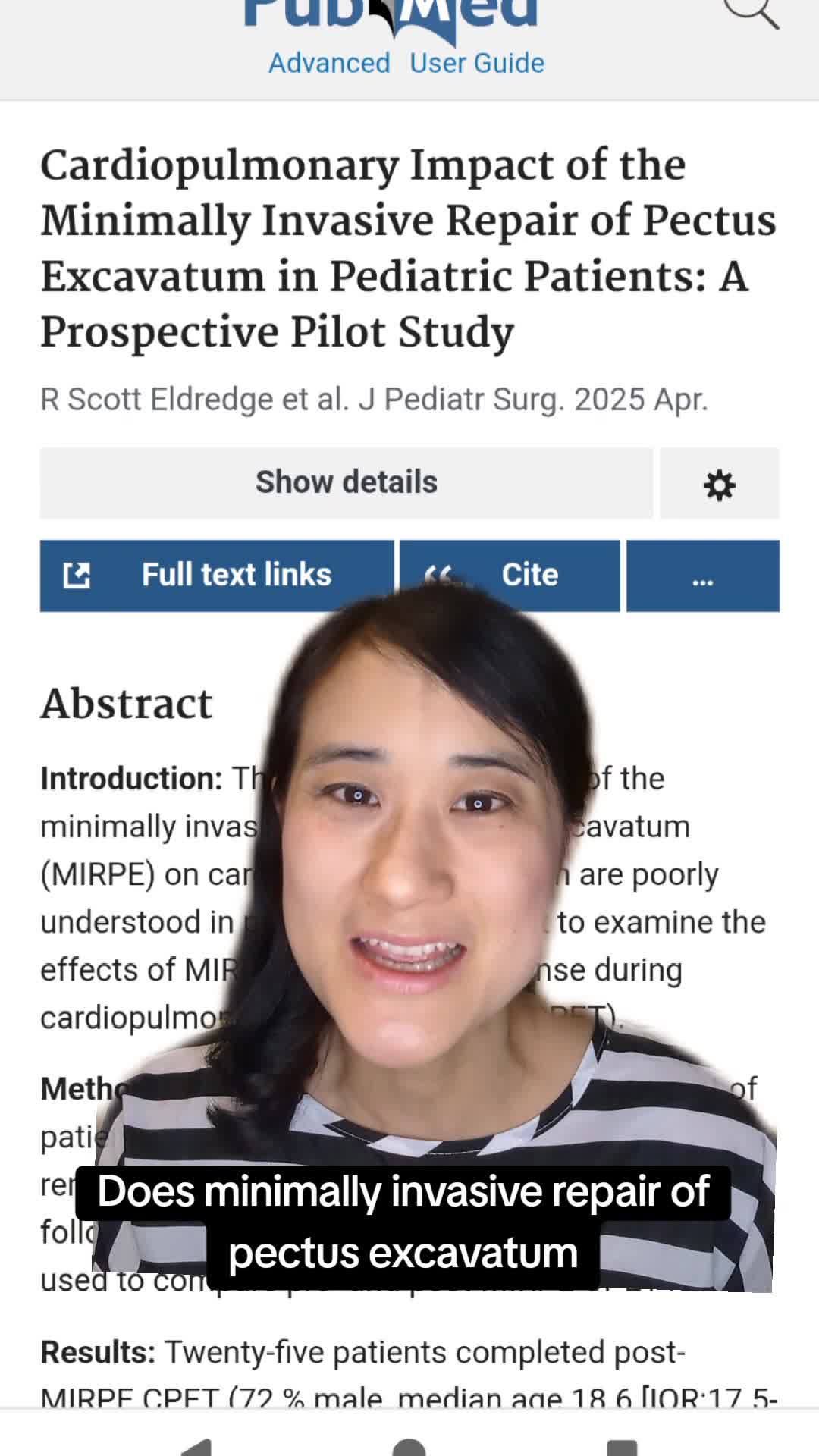
Cardiopulmonary Impact of the Minimally Invasive Repair of Pectus Excavatum in Pediatric Patients: A Prospective Pilot Study
55 s · Published Apr 2025
Video
Vacuum Bell Therapy for Pectus Excavatum: Long-term Experience at a Single Center
58 s · Published Apr 2025
Only a few other public items share this expert — go deeper there →
Video
Intestinal Atresia Types Explained: Grossfeld Classification for Pediatric Surgery
1 min · Published Sep 2026
Video
Derivation and validation of the Pediatric Community-Acquired Pneumonia Severity (PedCAPS) score: A prospective cohort study
50 s · Published Sep 2026
Video
FETO for Late-Diagnosed Severe Congenital Diaphragmatic Hernia (CDH) at Cincinnati Children's with Dr. Beth Rymeski
4 min · Published Sep 2026
Video
Severe Congenital Diaphragmatic Hernia (CDH) Case: FETO Management & Unexpected Findings with Dr. Beth Rymeski
3 min · Published Sep 2026
Video
Fetoscopic Endoluminal Tracheal Occlusion (FETO) Procedure: Step-by-Step Guide with Dr. Beth Rymeski
4 min · Published Sep 2026
Video
Choledochal Cyst Types Explained: Pediatric Surgery Fundamentals
1 min · Published Sep 2026
What the experts said
The appendicitis study compared two cohorts defined by time frame before and after near uniform implementation of stopping antibiotics at discharge.
The appendicitis study challenges the tradition of giving antibiotics and possibly too much antibiotics after discharge.
The next step for the appendicitis study is to roll it out to the Western Pediatric Surgery Research Consortium to study it on a broader scale.
The esophagus has a great intrinsic blood supply and can be mobilized right down to the diaphragm and right up to the thoracic inlet and will stay alive.
Many cases being put forward for lengthening are because surgeons get cold feet about attempting a primary anastomosis.
The Newcastle series is a pushback series which extols relatively conventional open surgery and begs the question as to what role lengthening procedures have in those with long gaps.
Unless an experienced surgeon says after maximum mobilization they genuinely can't get the esophagus together, esophageal lengthening is not required.
If esophaguses were being anastomosed with excess tension and repairs were failing, there would be a very high incidence of esophageal replacement, which is not seen in the Newcastle series.
The appendicitis study looked at deep space organ infections, length of stay, readmissions, and use of CT scans as outcomes.
The appendicitis study had 185 patients in the home antibiotic group and 121 patients in the no home antibiotic group.
There was no significant difference in deep organ space infection requiring intervention between home antibiotic and no home antibiotic groups for complicated appendicitis.
There was no difference in length of stay between home antibiotic and no home antibiotic groups for complicated appendicitis.
Secondary outcomes including C. diff infections, superficial site infections, length of stay, post-operative CT imaging, and readmission showed no difference between antibiotic groups.
The esophageal atresia study is a 25 year experience describing 220 consecutive infants with esophageal atresia in Newcastle.
The esophageal atresia study had 215 patients, 13% had complex esophageal atresia, and of those 25 patients survived the repair.
Of the 25 complex esophageal atresia survivors, 14 patients were type A and 11 patients were type C.
Type C esophageal atresia is the most common type and means esophageal atresia with a distal fistula; type A means pure esophageal atresia with no fistula to the trachea.
Of the 25 complex esophageal atresia patients, 18 had delayed primary anastomosis and 7 had esophageal replacement.
Two of the esophageal replacements were salvage procedures following a failed traction.
Only 4 patients with esophageal atresia were potentially treatable by traction.
In cases where traction techniques had not been attempted, the native esophagus was retained in 80% of cases.
The median time to esophageal continuity in the Newcastle series was 77 days.
Management of complex esophageal atresia without lengthening procedure can result in a similar rate of retention of the native esophagus but with significantly less morbidity.
The pectus study is a prospective cohort study from a single center in Phoenix aiming to quantify long-term hyperesthesia and neuropathic pain after minimally invasive repair of pectus excavatum with cryoablation.
The pectus study selected patients under 21 years of age who presented for bar removal between November 2021 and May 2023.
Testing for cold and soft touch and pinprick was performed just before bar removal.
The pectus study enrolled 47 patients with a median bar dwell time of approximately 2.9 years.
Patients had a median of 2 bars placed, and almost 81% were secured with pericostal sutures.
Almost half of the pectus patients had some degree of hypoesthesia, with T5 being the most common dermatome affected.
The area with hypoesthesia was less than 5% of the entire surface that was treated with cryo.
Neuropathic symptoms were identified by only 13% of pectus patients, and none required treatment.
In the long term after minimally invasive repair of pectus excavatum with cryo, many patients will experience some chest wall hypoesthesia limited to one or two dermatomes, and chronic symptomatic neuropathic pain is very rare.
Pericostal sutures used to secure bars can damage nerves.