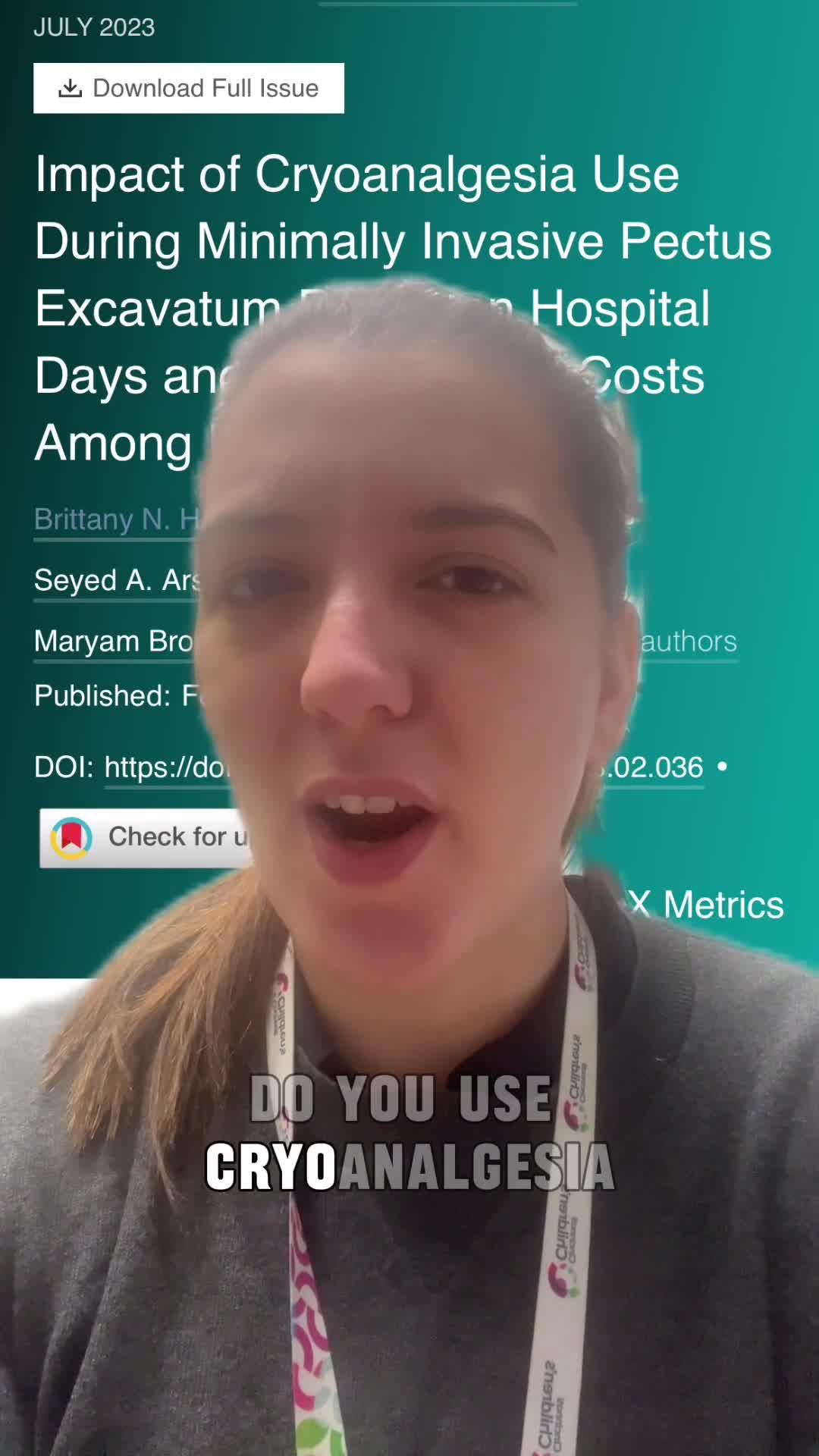
Hello everyone. Welcome back to another episode of the Stay Current podcast. I'm Cecilia Genna. I'm I'm Gdy, and we are research fellows at Cincinnati Children's Hospital. And along with Stay Current, we are sharing knowledge to improve child health around the globe. So today we have the July episode of the JPS podcast, which is the PPS episode. PABPS is Pacific Association of Pediatric Surgeons. And for that, we talked to the editor, Doctor Mary Brindle, who helped us choose these articles. I'm Mary Brindle. I'm a pediatric surgeon at Alberta Childers Hospital in Calgary, Alberta, Canada. So for today, we have 3 articles. The first one is about the impact of cryoalgesia. For pectus excavatum repair, the second one is about the chest tube management after a lung resection, and the third one is about hair reduction for pyelonidal disease that reduce recurrences. The articles are listed and linked in the description below. Follow along and read with us. The first article that we have is Impact of cryoanesthesia use during minimally invasivefectus excavatum repair on hospital days and total hospital cost among pediatric patients. And this is by Doctor Hedge, who is also a trainee, and the senior author is Doctor, Doctor Sao from Houston. She was Doctor Brindle, the editor that helped us choose this article. What they tried to see is how cryoanalgesia impacted in hospital days and hospital costs. Basically, the study was done 2011 to 2021, and they compared patients who had used cryo analgesia versus those who hadn't. They gather 44 patients, 29 of them had cryo analgesia, and what they found is that the ones that did have cryo had less hospital days. A 3.0 days versus a 5.4 days, and what was surprising for me is that the hospital costs were um a little bit cheaper in the ones that use cryonesthesia. It's less than $1000 difference between them. And this is incredibly expensive equipment. So with the fact that you're actually able to not just make that cost up and make it equivalent, but you're actually able to save costs, I think it's a very meaningful argument. Yes, true. And then you see this decrease in complication rates, a 70% decrease, so you go from about 33% complication rate for these patients down to 17%. So, I mean, I think it's a super. Valuable study. I really enjoy it. Um, it's one of the reasons why I liked it. Yes, um, I used to do PECU surgery back in Argentina, and I think that when you do PEC now you kind of must do cryo cause it really changed outcomes in patients. I don't think they look at it in this paper, but normally they also have less opioid use after the hospital. Yeah, so they didn't address that here, but in the next episode of August, we have two articles talking about the opiate requirements with cryo, so stay tuned to listen to August JPS. The 2nd paper of today is chest tube Management Following lung resection in pediatric Patients. A retrospective analysis. We talked to the first author in this paper. My name is Jamie Schnuck, and I am a 3rd year general surgery resident now at the University of Washington here in Seattle. They performed a cross-sectional study of pediatric patients undergoing lung resection to characterize chest tube practices and clarify the utility. And so this study looked at 130 lung resections that were done between 2013 and 2022. And this is Doctor Mary Bridle, 130 procedures met inclusion criteria, 59 of them were lobectomies, uh, they call them group 1, 19 of them diagnostic bed resections. These are group 2 and 52 of the excisional ventricular sections. These are group 3. Patients were less than 21 years of age, and our exclusion criteria really was if the patient had a spontaneous pneumothorax, and 75% of the group one patients had no air leak, and median chest tube duration was 2 days. In the group two, which was diagnostic bed sections, Nearly 90% of them had no air leak, and median chest tube duration was 1 day. In the last group, which was excisional wedge resections, 80% of them had no air leak, and median chest tube duration was 1 day. Yeah, I actually was pretty surprised that most chest tubes were removed on the first day after surgery, and a majority of those patients did not have an air leak either. And so the question that raises in my mind is, did they need the tube at all? Especially for diagnostic wedges that almost 90% had no air leak. And so, hey, let's find out which ones are like in less risk of having it and that. Just don't need a chest tube. One thing that makes it a little bit tough is that balance between those patients who might need a chest tube if you don't put it in, that need for an intervention that you had to planned versus this much larger potential benefit, more patients uh impacted who might never need the chest tube at all. So how do you balance a patient who needs to go back emergently for a procedure? Yeah, I wonder what their future. Goals are regarding this study are in the process of getting out another paper right now. Um, we did a survey actually on all of the pediatric surgeons that are in the Western Consortium of Pediatric Surgery, and the survey that we sent out was just about surgeon attitudes around chest tube management. I think the ultimate goal would be to take this one step further and see if we can do something prospectively. The 3rd paper for today is increasing amount of hair reduction using laser correlates with lower probability of recurrence in patients with pyelonidal disease. And we talked to the senior author in this paper. My name is Bill Chu. I'm an associate professor at Stanford University, uh working at Lucille Packard Children's Hospital. And they wanted to see how the laser ablation reduces a recurrence in patients with pyelonardial disease. And they look at the patients who've been presenting with pyelonidal disease between 2019 and 2022. So this is a retrospective study, but the data are actually were actually all prospectively gathered. So they had 198 patients, and they divided them according to the skin types. So they have 21 patients with skin types 1 and 2, 156 with skin times 3 and 4, and 21 with uh skin times 5 and 6, and of them, around 151 had dark color hair. So the patients that come to our clinic, they will get a picture taken of the extent of the pelonidal disease, but also the amount of hair that is in that area, and the patients will get started on shaving, abilation, um, and then subsequently and started on laser abilation. What they found is that to reach a 75% of hair reductions. Require a mean of 4.8 to 6.8 laser relation sessions. Dependent on different skin hair characteristics, and also dark hair and skin types 5 and 6 were associated with higher recurrence rates, and their recurrence rate was 6%. Here's what Doctor Brindle had to say. So, I mean, it's not, it's not just a one-time thing, and it also like it costs money. So that's the other thing where I think doing the study is important because right now, uh, a lot of insurance agencies will cover it, you know, in Canada, you do need to sort of uh advocate to the health systems to cover it. So having this data that shows its effectiveness, I think is actually, it's really useful to have. Yeah, I mean, it's, it's good to have something that adds to pyelonial disease, like to the knowledge of that, this and midline visive repair, I think it will change the treatment for our patients. Great. That was everything for today. But before we summarize, let's hear what Doctor Brindle had to say, because I think all three of them are, are really interesting. They were all chosen as the Pabst Award winners at our annual conference. And I will also say that each one of them, I think is important in the evolution of pediatric surgery, not necessarily like the revolution of it, but I think they're all really important for how we manage sort of day to day. Pediatric surgical care. Awesome. So now we are ready to summarize. We talked about the impact of cryoanalgesia in hospital days and um hospital costs, and we realized that cryo analgesia uh helps to reduce the hospital days significantly and doesn't increase um the hospital costs being even a little bit cheaper than the other one. Then we talk about the test tube management and What were the chances of having an air leak after um lobectomy, a diagnostic wedge, or even an excisional wedge, and we realized that more than 80% in wedges and almost 75% of lobectomies didn't had an air leak, so maybe in the future we can start by not even placing a chest tube after one of them. And finally, we talked about the laser ablation in pyonialysis, and how that helps to reduce recurrences, and how depending on your skin type and hair color, you will need more or less sessions to have a Recurrence rate reduced. Also, if you're interested in uh laser relation and effects of the recurrence of pyonardal disease, we have our podcast Casebooks Journal Review Palal Disease that we released earlier this year that we talked with uh Jose Campos around the case and uh the most important question is in the case management. So if you want to go check it out, it's a linked in the description below.
Comments