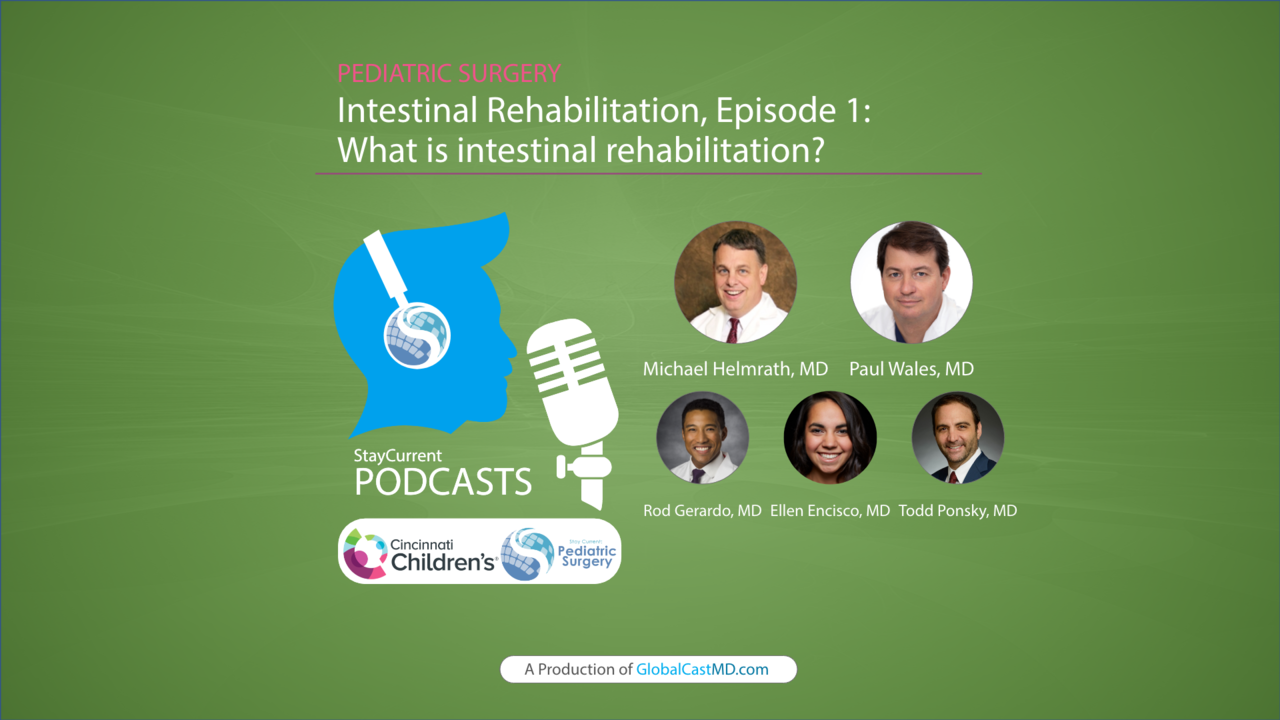
Intestinal Rehabilitation, Episode 2: Overwhelming intestinal damage, Part 1

Published:
Intestinal Rehabilitation, Episode 2: Overwhelming intestinal damage, Part 1 podcast cover art
7 Views
0 Likes
0 Shares
0 Comments

StayCurrentMD

View profile →

Intestinal Rehabilitation: From Crisis Management to Lifelong Care

Episode 2 of 13 in Intestinal Rehabilitation. The through-line across the whole series and where this episode fits in it. Written by Kai from every episode in the series and reviewed before publishing.

Series arc · AI-written, human-reviewed

The through-line

This eleven-episode series argues that intestinal failure in children is no longer a death sentence but a manageable chronic condition—provided the surgical, medical, and nutritional decisions made in the first hours and months are guided by an understanding of intestinal biology rather than visual assessment at laparotomy [e2p1-c23]. The series builds a case for conservative early management, aggressive enteral feeding, multidisciplinary coordination, and patience with the adaptive process [e1-c3]. Survival in major programs now exceeds 90%, and fewer than 2% of patients die from liver disease, yet the path from neonatal catastrophe to enteral autonomy depends on clinicians resisting the impulse to resect aggressively, predict outcomes prematurely, or intervene surgically without understanding what the next three operations will require [e2p2-c3][e4p1-c4].

The progression: from acute crisis to chronic optimization

Episodes 1–2: The foundational argument. The series opens by defining intestinal failure and rehabilitation as a coordinated, time-dependent process requiring enteral nutrition and measured in months to years [e1-c1][e3p1-c2]. Episode 2 immediately confronts the highest-stakes decision: what to do when a preterm infant's bowel appears dead at laparotomy. The answer—clinical observation over visual prediction—sets the tone for the entire series [e2p1-c24]. Helmrath introduces the 50% rule: focal necrosis under 50% of bowel length warrants resection for good adaptive potential, but diffuse necrosis over 50% demands proximal decompression and time [e2p1-c1][e2p1-c14]. The mechanism is liver protection through duodenal decompression, not salvage of questionable bowel [e2p1-c8]. Part 2 extends this to outcomes: ultra-short gut survival is 90–95%, and patients with remnant ileum or colon adapt better than expected [e2p2-c3][e2p2-c7]. The critical teaching is that the 30-week preterm gut has profound regenerative capacity if given luminal nutrition during the steepest growth period—35 weeks gestation to 6 months postnatal [e2p2-c4][e3p1-c23].

Episodes 3–4: The biology and mechanics of adaptation. Episode 3 shifts from crisis to biology. Adaptation is structural (mucosal hypertrophy, angiogenesis, bowel dilation) and functional (slowed motility, upregulated transporters), driven by intraluminal nutrients interacting with trophic peptides [e3p1-c3][e3p1-c4][e3p1-c5]. The ileum adapts better than jejunum because it produces GLP-2, GLP-1, and PYY, which slow motility and signal the liver [e3p1-c8][e3p1-c21]. The colon becomes critical when small bowel remnant falls below 50% of expected length, providing energy from short-chain fatty acids [e3p1-c27]. The new definition of enteral autonomy—independence from parenteral support for 12 weeks with adequate growth and hydration—reframes success around the child's biology, not the calendar [e3p1-c15][e3p2-c23]. Episode 4 translates this into surgical strategy. The STEP procedure works not by creating new bowel but by tapering dilated segments to restore motility [e4p1-c8][e4p2-c1]. Absorptive capacity improves over six months as inflamed mucosa heals [e4p2-c5]. The technical details matter—perpendicular staple lines, 2–2.5 cm caliber, crotch sutures, avoidance of duodenal stapling—but the philosophy matters more: surgery is a game of chess requiring planning two and three steps ahead, and the first operation in the first week of life has lifelong consequences [e4p1-c4][e4p2-c30].

Episode 5: Pharmacologic augmentation. The literature review on teduglutide introduces the only FDA-approved trophic peptide for children. At 0.05 mg/kg, 69% of patients achieved 20% TPN reduction and 10% discontinued TPN entirely [e5-c8][e5-c9]. The mechanism—improved fluid and electrolyte management at the epithelial layer despite GLP-2 receptors not being on enterocytes—underscores that adaptation is a systems problem, not a local one [e5-c17][e5-c18]. The drug requires enteral stimulation to work; the light switch is feeding, the dimmer is the hormone [e5-c13]. This episode also surfaces a recurring theme: fluid management, not calorie absorption, is often the limiting factor in weaning TPN [e5-c15][e5-c20].

Episodes 6–8: Managing complications and the long game. Episode 6 addresses cholestasis, historically a 25–50% mortality driver, now under 2% [e6-c5]. The shift reflects better lipid management (SMOF allows conventional dosing with hepatoprotection), aggressive enteral feeding, and recognition that a bilirubin of 2 mg/dL is transient and does not warrant intervention [e6-c11][e6-c14][e6-c18]. The teaching moment: after jejunostomy takedown, bilirubin and liver enzymes rise transiently as enterohepatic circulation resumes—this is normal, not failure [e6-c19][e6-c20]. Episodes 7 and 8 tackle refeeding in neonates and older children. The neonatal strategy is counterintuitive: high stoma output is an indication to feed, not withhold feeds, because damaged bowel transitions from secretory to absorptive phase only with luminal nutrition [e7-c2][e7-c3]. Breast milk is ideal, but the common mistake is isocaloric TPN reduction when advancing enteral feeds—children with sick intestines do not absorb all calories provided, and total volume may need to expand beyond 140 mL/kg [e7-c10][e7-c13]. For older children who lose bowel to volvulus, the challenge is maintaining nutrition through puberty when energy demands spike; some require temporary return to parenteral support, but marginal gut function often suffices once growth is complete [e8-c21][e8-c22][e8-c24].

The synthesis: what emerges from the whole

Three themes recur across the series, each building on the last. First, time is the variable clinicians control. The gut doubles in length between 35 weeks gestation and one year, and motility matures only with enteral feeding [e4p1-c5][e4p1-c6]. Surgical decisions that preserve bowel length and enable early feeding during this window determine whether a child reaches autonomy [e3p1-c32]. Second, the liver is the gatekeeper. Cholestasis, once a death sentence, is now a manageable complication, but only if duodenal decompression is achieved and enteral feeding is prioritized [e6-c21][e6-c9]. Third, motility trumps length. Very short bowel patients with excellent peristalsis can come off TPN; longer bowel with poor motility cannot [e4p1-c10]. This is why gastroschisis patients underperform despite adequate length—the enteric nervous system is damaged—and why NEC patients do better than expected—they were fed before injury, initiating motility [e4p1-c16][e4p1-c20].

The series also tracks an evolution in surgical philosophy. Early episodes emphasize what not to do: do not resect based on visual assessment, do not create stomas that lose abdominal domain, do not perform STEP in the first year if motility has not matured [e2p1-c23][e2p1-c18][e4p1-c19]. Later episodes shift to what to do: place a G-tube at the first operation for feeding versatility, use Blake drains for proximal decompression, plan staged procedures rather than attempting comprehensive repair [e7-c29][e2p1-c23][e4p2-c9]. The unifying principle is that intraoperative decisions have lifelong impact, and the surgeon's role is not to be the hero but to set up the next operation [e4p2-c30][e4p2-c29].

What the series does not cover

The series is silent on intestinal transplantation beyond acknowledging it as part of the continuum of care [e2p1-c2]. It does not address the psychosocial burden on families managing home TPN, central line care, or the transition to adult care. Neurocognitive outcomes are mentioned optimistically—most children are "running and playing"—but the series does not quantify deficits or explore educational support needs [e2p2-c12]. The role of the microbiome is acknowledged (shifts to acid-producing flora, bacterial overgrowth as a driver of staple-line ulcers) but not deeply explored [e3p1-c28][e4p2-c12]. Finally, the series does not grapple with resource disparities: the multidisciplinary model described requires subspecialty access, home nursing, and insurance coverage that many families lack.

The argument the series makes

Intestinal failure is a chronic disease of childhood, not an acute surgical problem. The first four months of life are when care is most uncoordinated and surgical decisions most consequential [e4p1-c4]. Success requires resisting the impulse to do everything at the first operation, trusting the regenerative capacity of the neonatal gut, feeding early and aggressively despite high output, protecting the liver through duodenal decompression, and planning surgeries in sequence rather than isolation. The outcome—over 90% survival, 60–80% enteral autonomy, normal growth in most—is achievable, but only if clinicians allow the child's clinical trajectory, not their visual assessment or institutional tradition, to guide care [e3p1-c19][e2p1-c24].

Inside this episode

Kai, the Library's AI content creator, listened to this episode and mapped who's speaking, the chapters, key claims, and cases. Every item links to the exact moment in the recording.

AI-enriched

Who's speaking

  • Ellen — host
  • Michael Helmrath — guest
  • Rod Gerardo — host
  • Paul Wales — guest

Chapters

  • 0:00Introduction and Clinical Scenario — Hosts introduce Drs. Helmrath and Wales discussing preterm infants with overwhelming small bowel loss. The clinical dilemma: bowel appears dead intraoperatively, requiring decision on resection vs. observation. Evolution of surgical approach over two decades discussed.
  • 3:00Clinical Observation Over Prediction — Helmrath argues against predetermining care based on visual assessment of bowel viability. Emphasizes allowing clinical course to guide management rather than predicting outcomes. Identifies overwhelming sepsis as the only absolute contraindication to conservative management.
  • 5:20Liver Protection Strategy — Discussion of liver disease as primary limiting factor after acute sepsis. Helmrath advocates duodenal decompression via retrograde tube as key intervention to protect liver function. Analogy made to elevated bilirubin in duodenal atresia from foregut obstruction.
  • 7:34Bowel Regeneration and the 50% Rule — Helmrath describes technique of proximal control with drain allowing distal bowel regeneration over 6-8 to 12 weeks. Introduces 50% threshold: focal necrosis under 50% should be resected; diffuse necrosis over 50% managed conservatively. Challenges traditional teaching to resect all dead bowel immediately.
  • 10:29Outcomes and Diagnosis-Specific Considerations — Helmrath reports 70-80% salvage rate with conservative approach when bowel initially appears dead. Notes necrotizing enterocolitis has best outcomes due to microvascular disease pattern. Encourages consultation with Cincinnati team to change culture of immediate aggressive resection.

Key claims

  • 9:27The inflection point of bowel loss requiring prolonged TPN is about 50% — Michael Helmrath
  • 2:38Intestinal transplant is not experimental therapy but part of the continuum of therapy for a child with short bowel syndrome — Paul Wales
  • 6:14Babies born with duodenal atresia or very proximal jejunal atresia are born with elevated direct or conjugated bilirubins — Paul Wales
  • 7:34A 30-week-old baby's gut is in a highly developmental phase and its ability to regenerate is much more profound than a full term baby and certainly a one year old baby — Michael Helmrath
  • 8:04The distal bowel, the ileum, can be salvaged by ileocecal blood flow — Michael Helmrath
  • 8:17Bowel regeneration with proximal control occurs over 6, 8, 12 weeks based on the liver getting better — Michael Helmrath
  • 5:57When the liver is inflamed and has high bilirubin, it's in a catabolic state — Michael Helmrath
  • 5:49Decompressing the duodenum is needed to protect the liver — Michael Helmrath
  • 5:32Giving fish oils and just trying to improve the bilirubin is not enough to protect the liver — Ellen
  • 4:31In the very acute time after bowel infarction, the risk is dying of sepsis and multi-organ failure — Paul Wales
  • 4:44Intermediate and longer term complications include intestinal failure associated liver disease, recurrent sepsis, or line problems — Paul Wales
  • 5:02Success in the last two decades is because we're way better at preventing sepsis and liver disease — Paul Wales
  • 6:42Factors affecting liver function include prematurity, sepsis, choice of TPN, and presence or absence of enteral nutrition — Paul Wales
  • 9:35If bowel necrosis is focal and less than 50%, the best option is to remove that bowel — Michael Helmrath
  • 9:44The adaptive potential for a child with less than 50% bowel loss is really great, especially if they have preserved ileum — Michael Helmrath
  • 10:00When bowel appears dead in a mosaic pattern with parts terrible, parts bad, and maybe a little good, proximal control with a drain and time to heal gives opportunity to come back later — Michael Helmrath
  • 10:14Not all bowel will survive and it will become islands of mucosa that need to be tubularized and put back together again — Michael Helmrath
  • 10:59Stomas lose abdominal domain and lose bowel down the road — Michael Helmrath
  • 11:11The percentage of kids that do well with proximal drain therapy when looking at dead gut is more than 70 to 80% — Michael Helmrath
  • 11:45Kids with necrotizing enterocolitis have the best outcomes because it's a microvascular disease — Michael Helmrath
  • 3:34There is an algorithm of children that have overwhelming sepsis where surgery cannot salvage these patients and there is no life saving option — Michael Helmrath
  • 3:41Many babies will rally without having their bowel removed, which allows them an opportunity — Michael Helmrath
  • 3:11Mistakes are commonly made because surgeons think they can predict the future with their eyes — Michael Helmrath
  • 3:11The first line of treating a baby with overwhelming catastrophe is to allow the clinical scenario to drive the direction of care and not predetermining care based on what surgeons believe will happen — Michael Helmrath
  • 1:17The outlook has changed and what's gone hand in hand with that is a bit more of an aggressive approach to surgical resection — Paul Wales
  • 1:39Comorbidities such as neurologic status, pulmonary function, cardiac function, or significant genetic or chromosomal anomaly factor into decision making about how to proceed — Paul Wales
  • 2:20The conversation with the family and understanding of the family's wishes is important to figure out if the baby is salvageable or not salvageable — Rod Gerardo

Points of disagreement

  • 8:47Approach to bowel that appears dead intraoperatively
    • Rod Gerardo: Classical teaching from general surgery residency is when you see dead gut you have to cut it out, possibly with second-look laparotomy
    • Michael Helmrath: If more than 50% appears dead in a mosaic pattern, use proximal drain for decompression and allow time for regeneration rather than immediate resection

Open questions

  • What is the optimal timing for returning to the operating room after initial drain placement to assess bowel viability?
  • How do you determine when the liver has recovered sufficiently to proceed with bowel reconstruction?
  • What are the specific technical details of retrograde drain placement for duodenal decompression?
  • At what point does ongoing clinical deterioration indicate that conservative management has failed and more aggressive intervention is needed?
This episode was analyzed and enriched by Kai, the Library's AI content creator. Every item links to the moment it comes from — click a timestamp to listen in context.
Written for:

Topic overview

Two pediatric surgeons at Cincinnati Children's discuss the management of preterm infants with overwhelming small bowel loss from conditions like necrotizing enterocolitis or volvulus. They advocate allowing clinical observation rather than immediate aggressive resection when more than 50% of bowel appears necrotic, emphasizing proximal duodenal decompression via retrograde drain to protect liver function and permit bowel regeneration over 6-12 weeks. The speakers report salvage rates exceeding 70-80% with this approach in babies whose bowel initially appeared dead, contrasting with traditional teaching to resect all non-viable bowel immediately.

Key takeaways

  • Proximal duodenal decompression protects liver function and enables bowel regeneration over 6-12 weeks in preterm infants. (5:49)
  • Salvage rates exceed 70-80% when using proximal drain therapy for bowel that initially appears necrotic in preterm infants. (11:11)
  • Preterm gut has profound regenerative capacity; clinical observation rather than immediate resection allows bowel recovery. (3:11)
  • Bowel loss <50% has great adaptive potential, especially with preserved ileum; >50% requires prolonged TPN support. (9:27)
  • Stomas lose abdominal domain and bowel length; proximal control avoids this complication in mosaic necrosis patterns. (10:00)

Keywords

Hashtags

Transcript

Click "Show Transcript" to view the full text (13222 characters)

Comments

Loading comments...