
Hirschsprung Disease Part 2
With Dr. Mark Levitt · hosted by Dr. Todd Ponsky · Marc Levitt
Educational content from recorded physician discussions — not medical advice. Talk to your (or your child's) care team about your situation.
Podcast
Hirschsprung Disease Part II with Dr. Marc Levitt
44 min · Published Apr 2017
Podcast
Hirschsprung Disease Part 2
Marc Levitt · 44 min · Published May 2015
Podcast
Colorectal Quiz: Episode 46
Marc Levitt · 29 min · Published Apr 2025
Video
Bowel Management for Hirschsprung's Disease Patients: Pediatric Bowel...
Dr. Todd Ponsky · 34 min · Published May 2013
Podcast
Colorectal Quiz: Episode 46
Marc Levitt · 29 min · Published Apr 2025
Video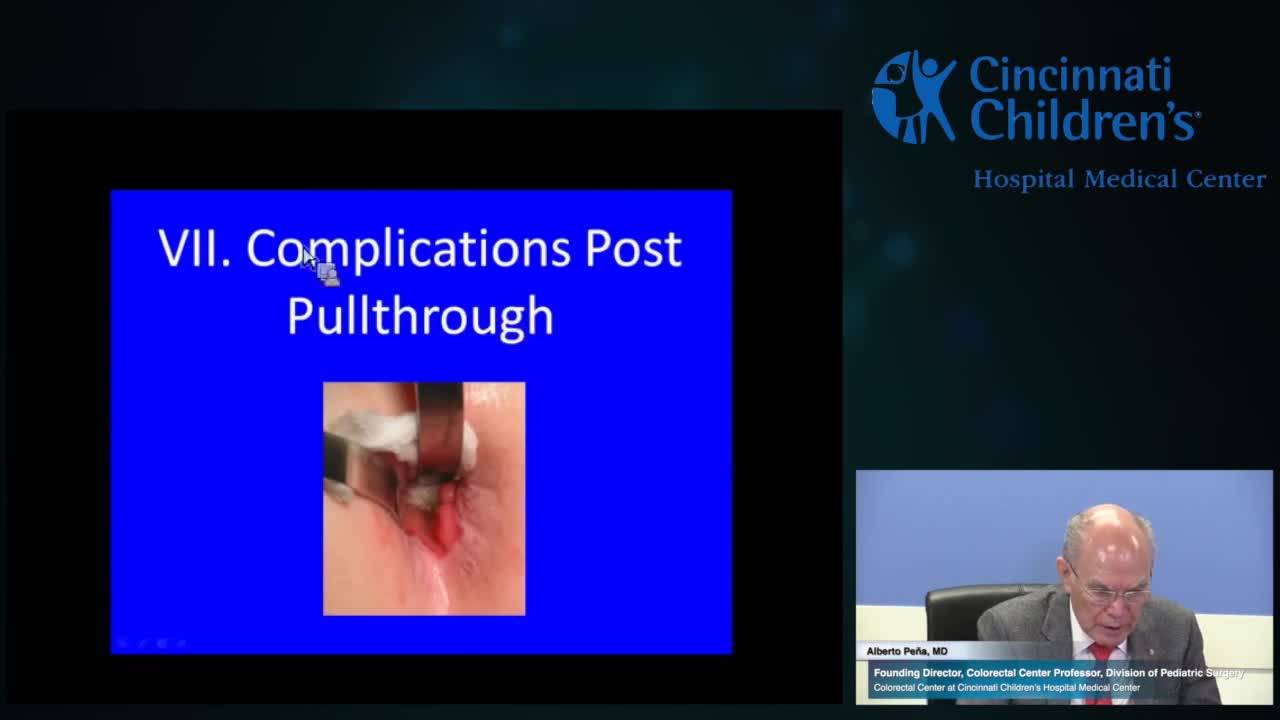
Outcomes and Complications in Hirschsprung Disease
105 min · Published Nov 2018
Podcast
(500) Days of Summer (classic Movie Review: Zooey Deschanel, Joseph Gordon-Levitt, Marc Webb) by The Cory Baker Show
Marc Levitt · Published Aug 2026
Video
Meeting with Marc Levitt: Clinical Discussion with Ivon Martinez
Marc Levitt · Published Jul 2026
Video
Introducing Dr. Marc Levitt: Pediatric Colorectal Surgeon Profile
Marc Levitt · Published Jul 2026
Video
Integrated Care Concept in Pediatric Colorectal Surgery by Marc Levitt
Marc Levitt · Published Jul 2026
Video
Patient Outreach and Communication in Pediatric Colorectal Surgery
Marc Levitt · Published Jul 2026
Video
Keynote Address on Pediatric Colorectal Surgery by Dr. Marc Levitt
Marc Levitt · Published Jul 2026
Podcast
Colorectal Quiz: Episode 49 - Collaborating for Kids: Colorectal & Pelvic Solutions (with a Little Help from AI)
Marc Levitt · 40 min · Published Jul 2025
Podcast
Colorectal Quiz: Episode 49 – Collaborating for Kids: Colorectal & Pelvic Solutions (with a Little Help from AI)
40 min · Published Jul 2025
Podcast
Colorectal Quiz: Episode 43
Marc Levitt · 23 min · Published Jan 2025
Podcast
Colorectal Quiz: Episode 43
Marc Levitt · 23 min · Published Jan 2025
Podcast
Colorectal Quiz: Episode 40
Marc Levitt · 18 min · Published Nov 2024
Podcast
Colorectal Quiz: Episode 40
Marc Levitt · 18 min · Published Nov 2024
Video
Colorectal and Pelvic Reconstruction Techniques with Dr. Marc Levitt
Marc Levitt · Published Jul 2026
Video
Dr. Marc Levitt on the CTO Mission in Pediatric Colorectal Surgery
Marc Levitt · Published Jul 2026
Video
Introduction to Dr. Marc Levitt's Pediatric Colorectal Surgery Practice
Marc Levitt · Published Jul 2026
Video
Andrea Kesar Discusses Marc Levitt's Contributions to Pediatric Colorectal Surgery
Marc Levitt · Published Jul 2026
Video
Addressing Ministers of Health: Pediatric Colorectal Surgery Advocacy and Global Healthcare Priorities
Marc Levitt · Published Jul 2026
Video
The History of International Colorectal Surgery Team Development
Marc Levitt · Published Jul 2026
What the experts said
The vast majority of Hirschsprung patients do extremely well after pull-through with normal emptying and bowel control.
Problem patients divide into two types: obstruction patients (cannot empty) and soiling patients (lack control).
Enterocolitis after well-done pull-through is common in babies because they have very tight sphincters capable of staying tight for many hours.
After about age one, patients should learn to empty and relax sphincters with normal bowel movement pattern; persistent enterocolitis after age one requires evaluation.
Evaluation of post-pull-through obstruction involves contrast study of colon and examination under anesthesia.
Anatomic causes of post-pull-through obstruction include: distal stricture, obstructing cuff, Duhamel pouch dysfunction, twisted pull-through (up to 360 degrees), and dilated distal segment.
Pathologic cause of obstruction: pull-through not done to ganglionated bowel with normal-sized nerves (transition zone bowel with nerves >40 microns will not function).
Treatment for enterocolitis: rule out stricture with Hagar dilators (not finger in babies), provide IV hydration and IV metronidazole, perform rectal irrigations 2-3 times daily.
Irrigation technique: 10-20 cc/kg saline through size 20-22 Foley catheter, instill and let drip out, move tube to wash colon interior.
Metronidazole has same efficacy IV or PO because both routes depend on biliary excretion into colon.
In diverted colon (with ileostomy), flagyl will not work for colitis because drug exits via ileostomy; vancomycin enemas are needed.
Literature reports 15-20% of patients have enterocolitis episode within first year after pull-through; after one year, persistent enterocolitis warrants anatomic or pathologic investigation.
On contrast study, look for cuff as indentation in presacral space (pull-through should hug sacrum); cuff can divert pull-through forward.
Soave cuff is outside the pull-through lumen and cannot be detected intraluminally with endoscopy; must be felt on digital exam or seen on lateral contrast view.
On EUA, use fifth digit to feel along sacral hollow for rubbery thick rubber-band structure (cuff) outside the pull-through.
Biopsy should be taken above dentate line by about 1 cm and sent for permanent section (not frozen) to assess ganglion cells and nerve size in redo situations.
Transition zone pull-through (ganglion cells present but hypertrophic nerves) in symptomatic patient requires redo pull-through to healthy ganglionated bowel.
Redo pull-through approach: prone and supine, transanal dissection preserving anal canal and dentate line, full-thickness dissection of pull-through, removal of cuff, may require laparotomy/laparoscopy for mobilization to healthy bowel.
For persistent cuff: dissect between bowel and cuff, then dissect cuff in Swenson plane; remove posterior-lateral ring (not entire circumference) to break obstruction while avoiding anterior injury to urethra/vagina.
Successful myectomies likely work by cutting the cuff rather than internal sphincter; myectomy technique varies widely between surgeons.
Myectomy can cause permanent incontinence by damaging skeletal muscle; Dr. Levitt strongly argues against myectomy in favor of targeted cuff removal or Botox.
Post-pull-through sphincter problems are relatively rare compared to anatomic causes; most obstruction is not sphincter-related.
Botox acts as temporary myectomy; preferred over permanent myectomy because it wears off as children learn sphincter coordination (typically by 4-8 weeks with laxative support).
Anorectal manometry can confirm sphincter dysfunction (failure to relax) and distinguish sphincter-only high tone (1 cm) from sphincter-plus-cuff (3-4 cm of high tone).
Botox can temporarily improve cuff obstruction if injection migrates to cuff level, but patient will not achieve long-term improvement without cuff removal.
For twisted pull-through: dissect in Swenson plane to peritoneal reflection, usually via open laparotomy (not laparoscopy) due to adhesions, preserve sigmoid arcade, deliver bowel into abdomen and re-pull through untwisted.
Redo Duhamel is the hardest Hirschsprung reoperation due to pelvic fibrosis from stapled connection of two lumens.
Redo Duhamel technique: start transanal, dissect around both pull-through (posterior) and original rectum (anterior), go to abdomen for deep pelvic dissection with St. Mark's retractor, connect planes, remove pouch and mated segment, redo as Swenson.
All Hirschsprung patients should be able to empty spontaneously and be clean; concept that patients improve over many years into teenage years is wrong.
By definition, Hirschsprung patients are born with normal anal canal and normal (if anything, too strong) sphincters; no Hirschsprung patient is born with missing anal canal or weak sphincter.
Soiling Hirschsprung patients with lost anal canal or weak sphincters have iatrogenic injury; causes are starting transanal dissection too low (invading dentate line) or overstretching during dissection.
Overstretching was common with aggressive transabdominal deep pelvic dissection; now recurring with too-aggressive transanal dissection; laparoscopy avoids deep transanal work.
Soiling evaluation: determine original surgery type, assess sphincter patency (visual, digital, manometry), assess dentate line integrity; perform digital exam as patient goes to sleep to test squeeze.
Contrast study in soiling patient serves as 'poor man's colonic manometry': narrow non-dilated pull-through suggests hypermotility; dilated pull-through suggests hypomotility.
Four soiling scenarios: (1) intact anatomy + non-dilated colon (hypermotile) → slow with loperamide, constipating diet, water-soluble fiber; (2) intact anatomy + dilated colon (hypomotile) → laxatives, possibly bridge enemas; (3) destroyed anatomy + non-dilated colon → small enemas + anti-motility; (4) destroyed anatomy + dilated colon → large enemas.
Capacity for bowel control is determined by intact sphincters and anal canal; patients with capacity can usually be managed medically; those without capacity need enema programs.
Surgical management (Malone appendicostomy or cecostomy) is only for patients without capacity for bowel control.
Methodical evaluation with contrast study and examination under anesthesia reveals solvable pathology in most problematic pull-through patients.