
Colorectal Quiz: Episode 46
With Dr. Jason Frischer & Dr. Lily Chang & Dr. Mark Levitt & Dr. Christy Raylan · hosted by Dr. Philippa Jalius · Marc Levitt
Educational content from recorded physician discussions — not medical advice. Talk to your (or your child's) care team about your situation.
Podcast
Colorectal Quiz: Episode 46
Marc Levitt · 29 min · Published Apr 2025
Podcast
Hirschsprung Disease â PediaCast 287
Marc Levitt · 38 min · Published May 2014
Video
Bowel Management for Hirschsprung's Disease Patients: Pediatric Bowel...
Dr. Todd Ponsky · 34 min · Published May 2013
Podcast
Hirschsprung Disease Part I with Marc Levitt
59 min · Published Apr 2017
Podcast
Hirschsprung Disease Part 2
Marc Levitt · 44 min · Published May 2015
Podcast
Hirschsprung Disease Part I with Marc Levitt
59 min · Published Apr 2017
Podcast
(500) Days of Summer (classic Movie Review: Zooey Deschanel, Joseph Gordon-Levitt, Marc Webb) by The Cory Baker Show
Marc Levitt · Published Aug 2026
Video
Meeting with Marc Levitt: Clinical Discussion with Ivon Martinez
Marc Levitt · Published Jul 2026
Video
Introducing Dr. Marc Levitt: Pediatric Colorectal Surgeon Profile
Marc Levitt · Published Jul 2026
Video
Integrated Care Concept in Pediatric Colorectal Surgery by Marc Levitt
Marc Levitt · Published Jul 2026
Video
Patient Outreach and Communication in Pediatric Colorectal Surgery
Marc Levitt · Published Jul 2026
Video
Keynote Address on Pediatric Colorectal Surgery by Dr. Marc Levitt
Marc Levitt · Published Jul 2026
Podcast
Colorectal Quiz: Episode 47
Marc Levitt · 22 min · Published May 2025
Podcast
Colorectal Quiz: Episode 47
Marc Levitt · 22 min · Published May 2025
Podcast
Colorectal Quiz: Episode 43
Marc Levitt · 23 min · Published Jan 2025
Podcast
Colorectal Quiz: Episode 43
Marc Levitt · 23 min · Published Jan 2025
Video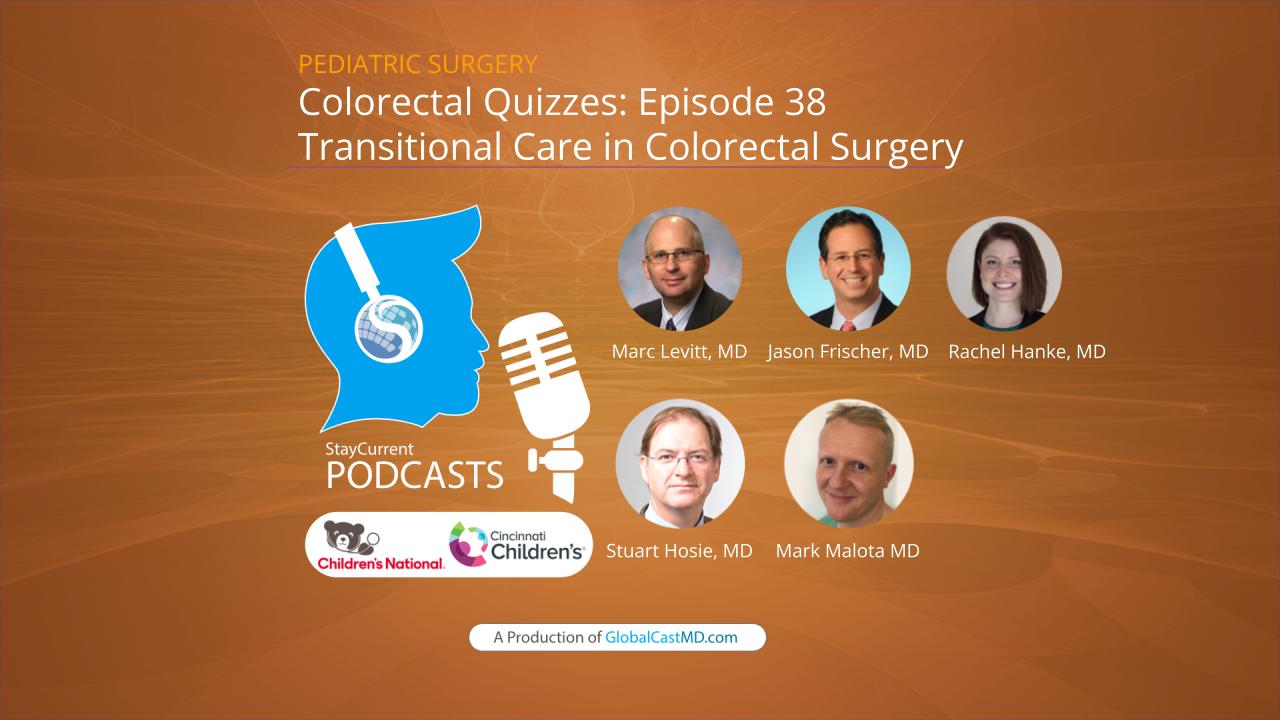
Colorectal Quiz Episode 38: Transitional Care in Colorectal Surgery
25 min · Published Mar 2024
Podcast
Colorectal Quiz Episode 37: The Yancey-Soave story of the original surgical descriptions for Hirschsprung disease
20 min · Published Apr 2023
Video
Dr. Marc Levitt on the CTO Mission in Pediatric Colorectal Surgery
Marc Levitt · Published Jul 2026
Video
Addressing Ministers of Health: Pediatric Colorectal Surgery Advocacy and Global Healthcare Priorities
Marc Levitt · Published Jul 2026
Video
Colorectal and Pelvic Reconstruction Techniques with Dr. Marc Levitt
Marc Levitt · Published Jul 2026
Video
Andrea Kesar Discusses Marc Levitt's Contributions to Pediatric Colorectal Surgery
Marc Levitt · Published Jul 2026
Video
Introduction to Dr. Marc Levitt's Pediatric Colorectal Surgery Practice
Marc Levitt · Published Jul 2026
Video
The History of International Colorectal Surgery Team Development
Marc Levitt · Published Jul 2026
What the experts said
Trisomy 21 is associated with approximately 50 times higher incidence of Hirschsprung disease compared to non-trisomy 21 patients, with about 5-10% of trisomy 21 patients having Hirschsprung disease.
Not all children with trisomy 21 have their underlying Hirschsprung disease identified early in life; patients with trisomy 21 and constipation are still referred later for rectal biopsy.
In patients presenting with signs of sepsis and suspected Hirschsprung, the approach is to treat first with rectal irrigations (20 mL/kg three times daily) and IV metronidazole, asking questions later.
Free air is an indication to go directly to the operating room rather than attempting irrigations first.
In Hirschsprung disease with perforation, the cecum perforates due to Laplace's law, and this confidently indicates the transition zone is probably around the hepatic flexure because the right colon becomes very dilated with nowhere to empty.
In anorectal malformation patients with perforation, the sigmoid colon perforates as a linear longitudinal tear along the tenia.
When a baby goes to OR with free air and a perforation is found in the cecum, this strongly suggests Hirschsprung disease and should prompt rectal biopsy; most such patients would receive an ileostomy.
Proper irrigation technique requires breaking the cycle of physiologic obstruction at both the sphincter level and in the aganglionic segment by getting a tube across and allowing egress of stool, because stasis leads to bacterial overgrowth, translocation, and sepsis.
An irrigation involves instilling small aliquots of warm saline (20-40 mL at a time), then evacuating that saline by withdrawing with a catheter rather than just infusing into the colon lumen.
Cold saline should not be used for irrigations in small children because it can significantly change the child's temperature.
Hirschsprung disease is almost never an emergency operation, and irrigations usually win the day.
On contrast enema, a rectosigmoid ratio less than one is indicative of Hirschsprung disease.
Sawtoothing visible in the rectum on contrast enema represents hyperperistalsis and is very classic for Hirschsprung disease, particularly when associated with enterocolitis.
Definitive pathologic diagnosis of Hirschsprung disease requires absence of ganglion cells on 100 levels and presence of hypertrophic nerves greater than 40 microns.
Frozen section can only definitively rule out Hirschsprung disease (by showing ganglion cells), but cannot definitively confirm it, because confirmation requires 100 levels with no ganglion cells anywhere.
Calretinin staining is used as confirmatory testing: if calretinin is present, ganglion cells are nearby; if calretinin stain is absent, this further confirms Hirschsprung disease.
In a patient who has recovered from enterocolitis with successful irrigations and is being fed, the appropriate approach is to send them home on irrigations and return for definitive operation in 1-2 months.
The minimum wait time after treating enterocolitis before performing definitive Hirschsprung surgery should be 4 weeks, possibly even longer.
If a patient with Hirschsprung disease is clinically improving with irrigations but cannot be fed, diversion is reasonable to allow enteral nutrition and growth.
When performing leveling biopsies, the optimal strategy is to go directly to the sigmoid (the money shot) rather than doing multiple unnecessary biopsies; if frozen section shows ganglion cells there, no other biopsies are needed.
If mapping the colon without frozen section available, the entire colon should be mapped (left colon, transverse colon, and hepatic flexure/right colon), because incomplete mapping can lead to incorrect conclusions about the extent of disease.
Pull-through should not extend past the hepatic flexure into distal ascending colon because Soave pull-throughs do not succeed very well with that anatomy.
If the transition zone is beyond the hepatic flexure (anything less than full right colon), the patient should have their colon removed with ileoanal or ileoduhamel anastomosis rather than attempting a pull-through.
The appendix should not be biopsied during Hirschsprung mapping because it is not helpful, and many patients' appendixes are aganglionic; the appendix should be saved for potential future use.
Frozen section interpretation must be done carefully in the setting of active enterocolitis because inflammation can prevent accurate reading of ganglion cells.
In resource-limited settings without frozen section availability, the strategy is to bring up the dilated portion of colon (more likely to be functional) rather than ileostomy, because ileostomy patients may not have quick enough access to medical care if they become dehydrated.
Modern telemedicine allows surgeons in resource-limited settings to perform segmental biopsies and H&E stains, then send microscope images via Zoom for remote evaluation of ganglion cells; by pure numbers, 80% of cases are rectosigmoid Hirschsprung, so this approach saves many colons.
In settings where patients can be kept well hydrated with easy healthcare access, ileostomy is preferred over colostomy for diversion because divided colonic mesentery becomes shortened and inflamed, making subsequent pull-through technically difficult to achieve adequate reach.
When performing ileostomy for Hirschsprung diversion, frozen section should be done on the ileostomy to ensure it will function.
Performing an elegant pull-through technique that preserves the anal canal and avoids overstretching sphincters will still result in some enterocolitis, because preserving continence mechanism means preserving the inability to relax the internal sphincter, making patients susceptible to enterocolitis.
Patients who had Hirschsprung surgery with overstretched sphincters developed fecal incontinence but never got enterocolitis, demonstrating that destroying sphincters prevents enterocolitis (though this is obviously not a desirable outcome).
A published study showed that Botox injection at one month post-operatively did not prevent enterocolitis in Hirschsprung patients.
The Cincinnati protocol now applies Botox at the anal sphincter at the time of restoring intestinal continuity; prospective data collection is ongoing with patients in the mid-30s, though some patients in the protocol have definitely developed enterocolitis, so it is not 100% foolproof.
Families should be sent home with irrigation equipment and taught how to irrigate before the pull-through surgery, with parents practicing the technique so they know how to do it, because having a catheter go through the anastomosis post-op day 5 when ready for discharge can cause issues.
The septic source in Hirschsprung disease is not the dilated bowel itself but the Hirschsprung enterocolitis, making IV metronidazole critical.
Literature from the PCPLC and Michael Rollins shows that delayed definitive surgery for Hirschsprung disease (approximately 3 months out) has similar outcomes to earlier surgery, supporting that it is safe to wait as long as irrigations are successful and the patient is growing and healthy.
When going to OR electively for pull-through and finding no ganglion cells in sigmoid or left colon, the surgeon should not proceed with pull-through that day but should biopsy transverse colon and hepatic flexure, perform ileostomy with frozen section confirmation, and return another day for definitive surgery with permanent sections.