
Pregnancy in a Fontan Patient: New Horizons in Medical and Surgical Fontan...
With Dr. Dr. Anisa Chowdhury & Dr. Dr. Nicole Brown · hosted by Dr. Dr. Veldman · StayCurrentMD
Part of
Single Ventricle / HLHS 37 items
Cued at 5:06 · stops at 5:51 · press play
Educational content from recorded physician discussions — not medical advice. Talk to your (or your child's) care team about your situation.
More about tricuspid atresia
same diagnosisVideo
Case Review Dynamic Assessment of the Fontan Part II: New Horizons in Medical...
CCHMC Pediatric Surgery · 14 min · Published Jul 2017
Video
Malrotation Rapid Fire Session: Update Course 2015
8 min · Published Jul 2017
Video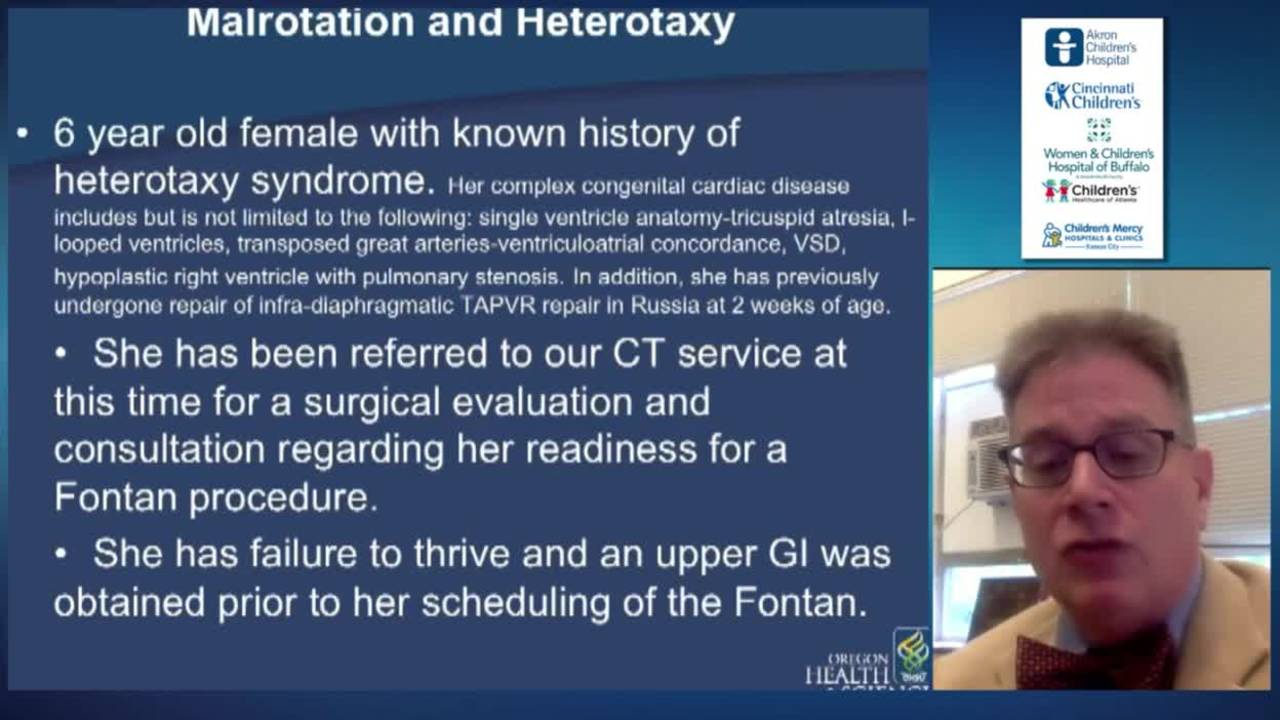
Malrotation - Volvulus - Meconium Ileus - Solid Organ Injury: Update Course 2015
27 min · Published Nov 2018
Video
Update on Surgical Practice and Current State on Fontan Conversion Surgery:...
CCHMC Pediatric Surgery · 25 min · Published Jul 2017
Only a few other public items share this expert — go deeper there →
Video
Pediatric Surgical Oncology Research Collaborative (PSORC): Studying Rare Pediatric Tumors
56 s · Published May 2026
Video
Update Course Rewind 2025: Hirschsprung + ARM: Rare but Real
1 min · Published May 2026
Video
Update Course Rewind 2025: Hirschsprung + ARM: Rare but Real
1 min · Published May 2026
Video
Pooling Patients to Study Rare Pediatric Tumors: An Introduction to PSORC
56 s · Published May 2026
Video
The fetal frontier: A review of current and emerging fetal therapies for genetic diseases
44 s · Published May 2026
Video
Indocyanine green assists with sentinel lymph node mapping in pediatric and adolescent patients
1 min · Published May 2026
What the experts said
The patient underwent coarctation repair and PA banding at 2 days of life via end-to-end anastomotic repair after resection of coarc segment, plus left carotid to left subclavian artery side-to-side anastomosis
The patient underwent right modified Blalock-Thomas-Taussig shunt at 6 weeks of age, bidirectional Glenn at 6 months, and 20mm extracardiac Fontan at 4 years of age
The Fontan fenestration spontaneously closed and patient had transcatheter coil and vascular plugging of veno-venous collaterals at approximately 10 years of age
On 2006 catheterization, Fontan pressures were 12 mmHg and left ventricular end-diastolic pressure was 5 mmHg, both normal
Patient was lost to follow-up from age 16 to 21 years until presenting pregnant in first trimester
Lisinopril is teratogenic and should be stopped in pregnancy
Patient had 3 prior miscarriages and was told to use Depo-Provera contraception but only had 1 injection in past 3-4 years
Patient had baseline NYHA class 2-3 dyspneic symptoms (short of breath climbing one flight of stairs or walking 2 blocks) with no change during first couple trimesters of pregnancy
Patient's oxygen saturation was low-normal at 92% on room air
Echocardiogram showed mildly reduced left ventricular systolic function with estimated LVEF 45-50%
Patient had mild polycythemia with hemoglobin of 17, indicative of probable intermittent desaturations likely from venous collaterals
Patient was classified as WHO class 3 risk, indicating significantly elevated risk of both maternal morbidity and mortality during peripartum period
Management included aspirin 162 mg daily; stronger anticoagulation not pursued given unremarkable thrombophilia profile
Beta blocker was considered if LV function remained depressed on subsequent visits
Normal pregnancy causes decreased systemic vascular resistance, decreased PVR, increased heart rate, drop in blood pressure mid-pregnancy that rises again, and increase in cardiac output by about 50% and blood volume by 25%
Risk of thrombosis is about 6 times normal during pregnancy and as high as 11 times normal in first 6 weeks postpartum
During labor without analgesia, cardiac output may increase by about 30% during each contraction; with regional analgesia this is mitigated to some degree
It takes about 6 months for cardiac output to return to non-pregnant levels postpartum
Miscarriage rate among Fontan single ventricle patients is about 46%
In a systematic review of about 198 pregnancies in 110 Fontan women, there were no maternal deaths
In Fontan pregnancies, SVT occurs in about 8.9% and heart failure in about 5%
Most Fontan women deliver between 26 and 36 weeks gestation, not making it to term (37 weeks)
Risk of congenital heart disease in fetus of Fontan mother is probably between 3-10%
WHO class 3 indicates significantly increased risk of maternal mortality or severe morbidity; in Fontan pregnancy it is more the morbidity that is concerning, not the mortality
Fontan women should be followed in a multidisciplinary care unit with serial echocardiograms
Higher-risk Fontan patients include those with significant NYHA functional class deterioration, residual cyanosis, pulmonary hypertension, arrhythmias, multi-organ failure, or protein-losing enteropathy; these should be classified as class 4 and advised against pregnancy
Warfarin is concerning from aspect of teratogenicity, especially in first trimester
Aspirin seems reasonable for most Fontan pregnant patients
For Fontan patients at higher thrombotic risk (arrhythmias, prior clot, low cardiac output), therapeutic anticoagulation should be considered
Delivery should be at tertiary care center where highest level of cardiac, OB, anesthesia, and neonatal care is available
Left lateral decubitus position improves systemic venous return in pregnant Fontan patients
Fontan patients should be kept adequately hydrated but avoid fluid overload
Vaginal delivery with epidural is the preferred method for most Fontan women from cardiovascular perspective
Oxytocin should be used at lowest effective dose to avoid significant hemodynamic fluctuations
Fontan women should stay in hospital for up to about a week postpartum because that is how long it takes for hemodynamics to settle back out
Estrogen-containing contraceptives should be avoided in Fontan women because of increased thrombogenicity
Pneumoperitoneum required for laparoscopic tubal ligation may be detrimental for Fontan patients
Subdermal contraceptive implants are lowest risk, requiring only local anesthesia
The aspirin dose of 162 mg in this patient was based on aspirin resistance testing
Many centers use full anticoagulation in pregnant Fontan patients by definition, but this carries risk of antepartum and postpartum hemorrhage