
QUAD #1: Cervical Tracheopexy with Dr. Alessandro de Alarcon
With Dr. Alessandro de Alarcon · hosted by Dr. Todd Ponsky · StayCurrentMD
Cued at 3:33 · stops at 4:18 · press play
Educational content from recorded physician discussions — not medical advice. Talk to your (or your child's) care team about your situation.
Video
QUAD #2 Thoracoscopic Tracheopexy with Dr. Aaron Garrison
CCHMC Pediatric Surgery · 7 min · Published Jan 2024
Video
Esophageal Surveillance Practices in Esophageal Atresia Patients
Published Jul 2023
Video
Posterior Tracheopexy For Severe Tracheomalacia
Dr. Todd Ponsky · 2 min · Published Feb 2018
Video
Posterior Tracheopexy For Severe Tracheomalacia
Dr. Todd Ponsky · 2 min · Published Feb 2018
Video
QUAD Conference Commercial
1 min · Published May 2022
Video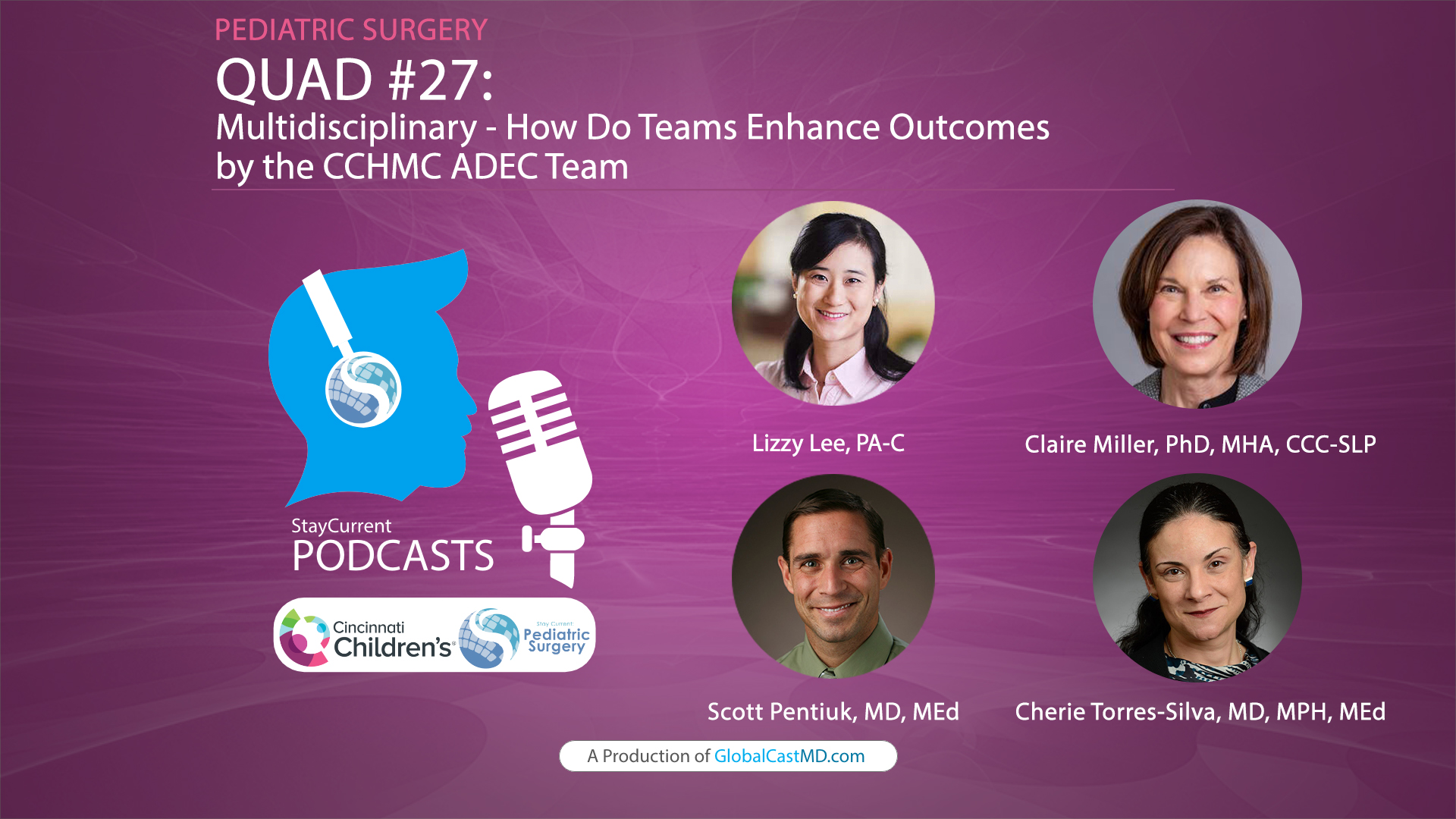
QUAD #27 - Multidisciplinary - How Do Teams Enhance Outcomes by the CCHMC ADEC Team
CCHMC Pediatric Surgery · 10 min · Published Apr 2025
Only a few other public items share this expert — go deeper there →
Video
Pediatric Surgical Oncology Research Collaborative (PSORC): Studying Rare Pediatric Tumors
56 s · Published May 2026
Video
Update Course Rewind 2025: Hirschsprung + ARM: Rare but Real
1 min · Published May 2026
Video
Update Course Rewind 2025: Hirschsprung + ARM: Rare but Real
1 min · Published May 2026
Video
Pooling Patients to Study Rare Pediatric Tumors: An Introduction to PSORC
56 s · Published May 2026
Video
The fetal frontier: A review of current and emerging fetal therapies for genetic diseases
44 s · Published May 2026
Video
Indocyanine green assists with sentinel lymph node mapping in pediatric and adolescent patients
1 min · Published May 2026
What the experts said
Cincinnati Children's typically uses a combined cervical and thoracic approach for esophageal atresia cases.
Required intraoperative equipment includes a neck tray, MLB tray, and Maloney dilators or NG tubes.
Flexible bronchoscopy during the operation is key, and endotracheal tube placement must allow visualization during the procedure.
Nasotracheal intubation is often used with the cuff positioned high, sometimes almost at the glottis.
A NIM tube is preferred when possible to prevent injury to recurrent nerves or provide awareness when approaching them.
The surgical approach uses subplatysmal flaps and addresses anterior compression as needed.
Aortopexy and innominate artery pexy can be added at the same time as the cervical procedure.
The Cincinnati team has learned not to be afraid of mobilizing the esophagus, which is important for the procedure.
Stitches are sometimes placed in the trachea to pull it up and out of the way for visualization of the posterior aspect and spine.
The team uses 3-0 prolene sutures and places all stitches before securing them down.
Suture placement is performed under spontaneous ventilation conditions.
A patient who had prior thoracoscopic tracheopexy with dysphagia from torqued esophagus underwent the combined approach and became symptom-free.
Outcome measures include follow-up endoscopy, pulmonary function tests when patients are old enough, and imaging.
At 36 months follow-up, imaging may still show tracheomalacia, but patients can be symptomatically better.
The team is still learning what measures should define good versus bad outcomes.
Managing complications including swallowing dysfunction and vocal fold paralysis is part of postoperative care.
Preoperative testing includes dynamic CT imaging, pulmonary function tests, microlaryngoscopy and bronchoscopy, and flexible bronchoscopy.
The cervical approach can assist thoracoscopic procedures by removing residual or regrown large thymus tissue.
In the lateral approach, the surgical team works on the side of the airway to find the esophagus.
Pediatric surgeons identify the recurrent nerve for the ENT team to help prevent injury.
The esophagus is mobilized above the level where the team aims to perform the pexy, making suture placement easier.
A pulmonologist assists with flexible endoscopy through the endotracheal tube to visualize inside the trachea while stitches are placed.
The combined approach is valuable for complicated cases or patients needing additional operations for symptom relief.
Otolaryngology involvement is important both during the procedure and in follow-up due to potential complications.