
Outcomes and Complications in Hirschsprung Disease
With Dr. Alberto Peña & Dr. Risto Rintala & Dr. Luis de la Torre · hosted by Dr. Todd Ponsky & Dr. Andrea Bischoff · StayCurrentMD
Cued at 13:30 · stops at 14:15 · press play
Educational content from recorded physician discussions — not medical advice. Talk to your (or your child's) care team about your situation.
Video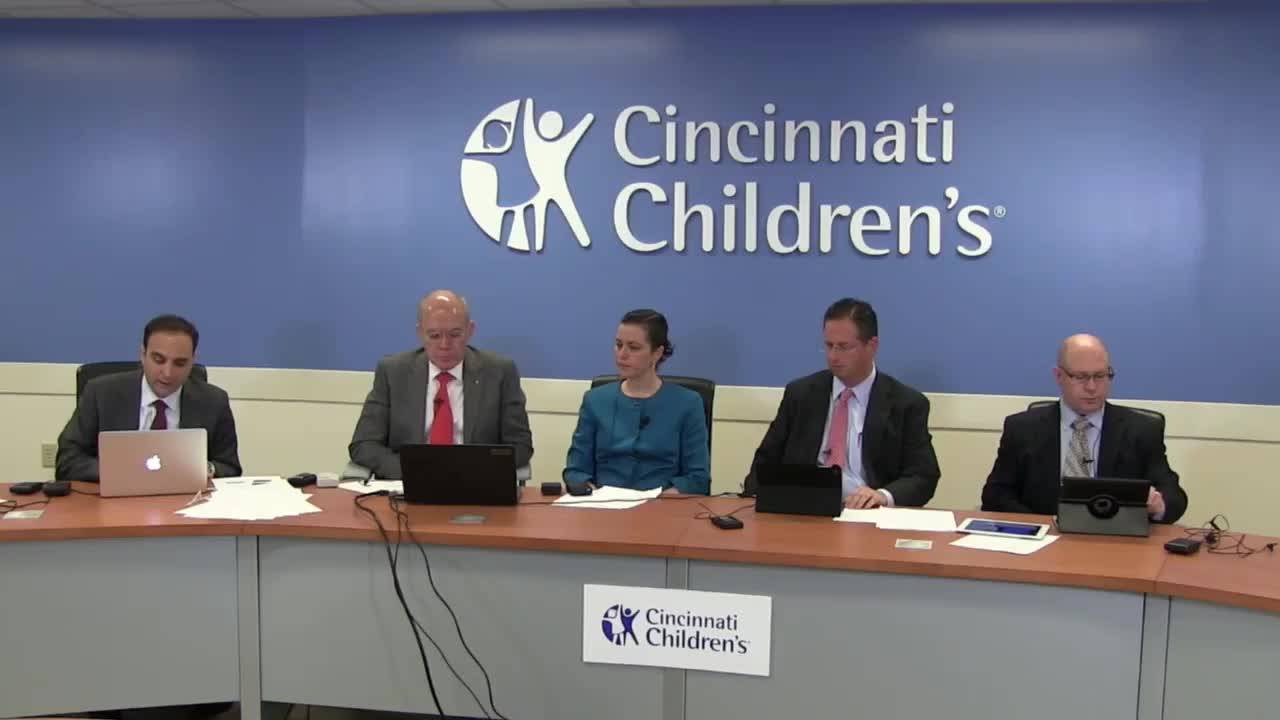
Hirschsprung Disease: Cases and Complications
103 min · Published Feb 2015
Podcast
Colorectal Quiz: Episode 46
Marc Levitt · 29 min · Published Apr 2025
Podcast
Colorectal Quiz: Episode 46
Marc Levitt · 29 min · Published Apr 2025
Podcast
Hirschsprung Disease Part 2
Marc Levitt · 44 min · Published May 2015
Podcast
Hirschsprung Disease Part II with Dr. Marc Levitt
44 min · Published Apr 2017
Video
Hirschsprung Disease: Surgical Procedures
128 min · Published Feb 2015
Video
Radiology and Image Diagnosis of Hirschsprung Disease
44 min · Published Nov 2018
Video
Surgical Procedures for Hirschsprung Disease
128 min · Published Nov 2018
Video
Cloaca - Prental Imaging & Diagnosis - Counseling
Dr. Todd Ponsky · 36 min · Published Nov 2018
Podcast
Cloacal Exstrophy with Dr. Alberto Peña
53 min · Published Apr 2017
Video
Pediatric Surgical Oncology Research Collaborative (PSORC): Studying Rare Pediatric Tumors
56 s · Published May 2026
Video
Update Course Rewind 2025: Hirschsprung + ARM: Rare but Real
1 min · Published May 2026
Video
Update Course Rewind 2025: Hirschsprung + ARM: Rare but Real
1 min · Published May 2026
Video
Pooling Patients to Study Rare Pediatric Tumors: An Introduction to PSORC
56 s · Published May 2026
Video
The fetal frontier: A review of current and emerging fetal therapies for genetic diseases
44 s · Published May 2026
Video
Indocyanine green assists with sentinel lymph node mapping in pediatric and adolescent patients
1 min · Published May 2026
What the experts said
Dr. Peña has more re-operation cases than primary procedures because most pediatric surgeons believe they can operate on Hirschsprung disease, so he receives referrals for complex cases but usually not for primary Hirschsprung.
Complications and sequelae are classified into three categories: non-preventable (enterocolitis), partially preventable (constipation), and preventable (dehiscence, strictures, perianal/urogenital fistulas).
The rule is to resect not only the aganglionic segment but as much as possible the dilated portion of the colon.
Finland can conduct long-term follow-up studies because all Finns have a social security number allowing tracking of patients and access to their complete medical history from national records.
In a population-based study of 143 adult Hirschsprung patients (operated 1960-1986), the mean bowel function score was 17.1 compared to 19.1 in controls (p<0.05), with only 25% of patients scoring full 20 points versus 50% of controls.
30% of adult Hirschsprung patients report frequent soiling, 2% had accidents, and 10% had complications requiring treatment.
Overall gastrointestinal quality of life in adult Hirschsprung patients appears comparable to controls, though 22% had scores lower than 110 indicating poor GI quality of life.
Increasing age was the only significant predictor of poor functional outcome in adult Hirschsprung patients, and age was inversely related to bowel score in patients but not controls.
Patients with aganglionosis extending beyond 50 centimeters of terminal ileum have exceptional difficulty achieving functional bowel continuity or autonomy, and poor long-term survival without transplantation.
If aganglionosis is limited to the colon, the outlook for bowel function after pouch-anal anastomosis is reassuring, although obstructive symptoms and enterocolitis are frequent but manageable with Botox and metronidazole.
In Finland, patients with total colonic aganglionosis are routinely tested for RET mutations.
Dr. Peña has never documented a case where a patient he operated on returned with symptoms, was re-biopsied, and was found to have aganglionosis in the pull-through area that previously had normal ganglion cells.
Dr. Peña resects 5 cm proximal to the last positive biopsy site when the bowel is not dilated.
With no anal canal, there will be no bowel control, and liquid stool with no bowel control is tragic; the quality of life is seriously affected.
The key part of evaluation for fecal incontinence after Hirschsprung surgery is examination under anesthesia to determine if the anal canal has been damaged.
If the anal canal is preserved, there is more chance of bowel control, though no guarantee; if damaged, the patient will most likely need enemas for life (bowel management for fecal incontinence).
In Hirschsprung disease, a patient may have a stricture and yet suffer from terrible diarrhea; stricture and stasis of stool in the colon produces secretory diarrhea even with normal ganglionic bowel.
A beautiful scar from limited exposure is nothing compared to the tragic complications that can result from inadequate exposure during surgery.
Midline incisions are preferable to transverse incisions for colonic surgery because they can be extended if needed and provide excellent exposure for mobilizing splenic and hepatic flexures.
The priority in surgery is to finish the operation happy; the happiness of the surgeon at the end of the procedure is very important, the family feels it, and you sleep well.
Laparoscopy is minimally invasive but provides even better exposure than open surgery; small umbilical incisions compromise exposure.
Colitis in Hirschsprung disease is always associated with obstructive symptoms; future research should focus on obstructive etiologies.
In Hirschsprung disease, anal dilations are started 1 month after surgery (deeper anastomosis) compared to 14 days in anorectal malformations (skin-level anastomosis); dilations begin only if a ring-like anastomosis is palpable on digital rectal exam.
Enterocolitis is such a bad complication that babies sometimes die between home and hospital; prophylactic management is preferred over having patients return with distention and enterocolitis two weeks post-operatively.
Enemas consist of giving fluid with ingredients that irritate the bowel to provoke contraction; they are contraindicated in Hirschsprung disease because the disease involves absent normal peristalsis.
Irrigation means passing a tube through the rectum; liquid stool comes out through the tube lumen, and only a small amount of saline is passed to clear the tube.
For Hirschsprung dilations, start with a Hegar size close to the goal (e.g., size 12 if goal is 13), advancing weekly, because the anastomosis is usually adequate; this differs from anorectal malformations where you start with very small dilators.
Dilations are performed twice daily with diaper changes; the dilation also provokes bowel movements in babies.
The association between Hirschsprung disease and anorectal malformations is extremely uncommon; Dr. Peña has seen only two demonstrated cases in his career.
Many patients with anorectal malformations suffer from constipation; surgeons accustomed to suspecting Hirschsprung in constipation cases have taken biopsies showing no ganglion cells (which can occur in normal children for various reasons) and performed pull-throughs, leaving patients incontinent.
Before making a Hirschsprung diagnosis and embarking on a pull-through in a patient with anorectal malformation, think carefully—most likely it is not Hirschsprung; many patients suffer from constipation but very few have Hirschsprung.
For patients with hypermotility (tendency to diarrhea) and fecal incontinence, bowel management consists of 250 mL saline-only enemas; laxatives are contraindicated as they worsen incontinence.
Laxatives do not produce immediate, predictable bowel movements; they cause multiple unpredictable bowel movements, making fecally incontinent patients worse.
Giving laxatives to force bowel movements while simultaneously giving drugs to decrease bowel motility (like Imodium) is giving drugs with opposite effects that do not work.
Constipation is partially preventable; if a very dilated piece of bowel is left, even if ganglionic, patients will likely suffer from constipation because very dilated colon suffers from hypomotility.
Many institutions assess pull-through specimens using only a longitudinal strip rather than examining the full circumference of the proximal margin; the interface between ganglionic and aganglionic bowel can be irregular and project 2-4 cm longer along one part of the circumference.
A survey of Canadian pediatric surgeons found nearly half resect 4 centimeters or less from the biopsy site, and about 10% resect right at the site of positive biopsy, creating high risk of pull-throughs in the transition zone.
Prophylactic postoperative irrigations (3 times per day for the first month with oral Flagyl, tapering over 3 months) can prevent enterocolitis after pull-through; a Salt Lake City study demonstrated this approach.