
Update Course 2023 - Updates in Colorectal Pathology
With Dr. Caitlin Smith & Dr. Julia Groski · Live Event Content
Cued at 10:44 · stops at 11:29 · press play
Educational content from recorded physician discussions — not medical advice. Talk to your (or your child's) care team about your situation.
Podcast
Colorectal Quiz: Episode 46
Marc Levitt · 29 min · Published Apr 2025
Video
Update Course 2021: PEDS COLORECTAL CONSORTIUM CONCLUSIONS
36 min · Published May 2022
Podcast
Colorectal Quiz: Episode 46
Marc Levitt · 29 min · Published Apr 2025
Podcast
Complications of Anorectal Malformations with Dr. Marc Levitt
48 min · Published Jan 2017
Video
2025 Pediatric Surgery Update Course - Updates in Colorectal: Debunking Dogma
30 min · Published Aug 2025
Video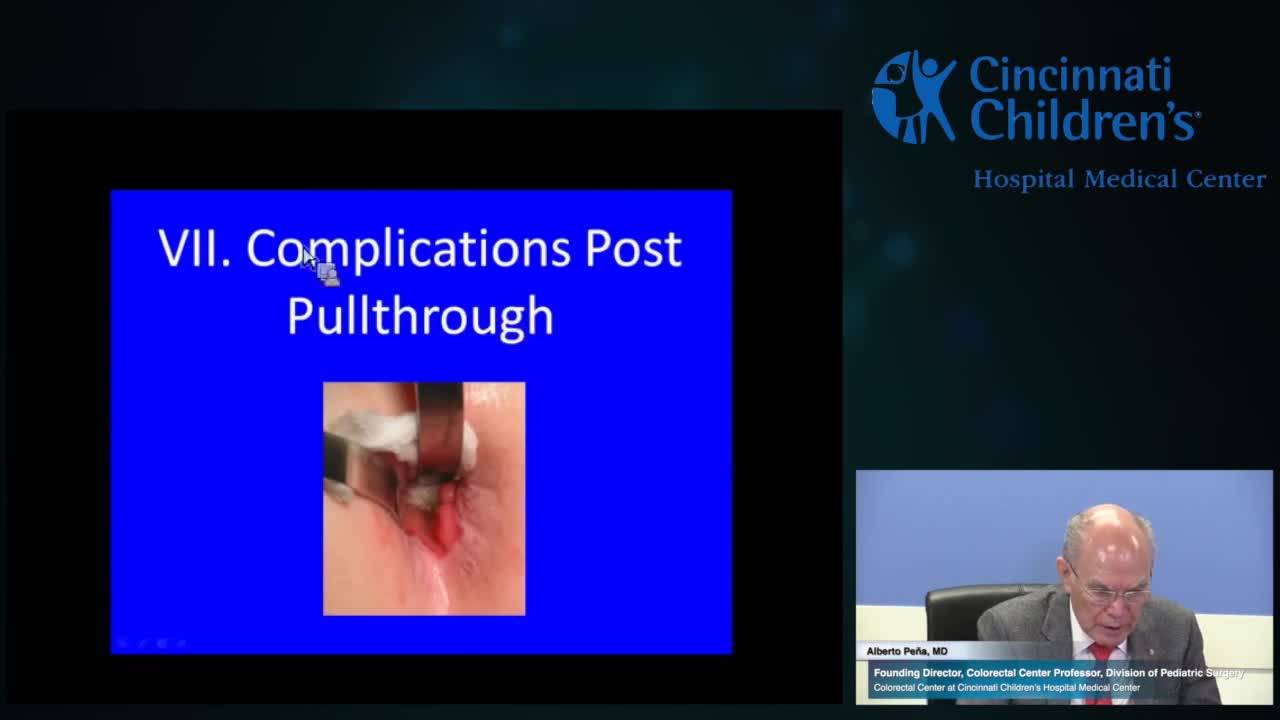
Outcomes and Complications in Hirschsprung Disease
105 min · Published Nov 2018
Only a few other public items share this expert — go deeper there →
Video
Mental Health and Gun Safety in Pediatrics - Catherine Neyer - APP Conference 2026
48 min · Published May 2026
Video
Overview of the Surgical Management of Acute and Chronic Pancreatitis in Children with Dr. Juan Gurria
66 min · Published Apr 2026
Video
Clinical & Research Update: Pediatric Liver Tumors - A Case-Based Discussion with Drs. Katherine Somers & Alex Bondoc
69 min · Published Apr 2026
Video
Beyond ChatGPT_ AI Tools You’re Not Using (But Should) - Vail, CO
Dr. Todd Ponsky · 97 min · Published Jan 2026
Video
Beyond ChatGPT: AI Tools You’re Not Using (But Should)
Dr. Todd Ponsky · 109 min · Published Oct 2025
Video
2025 Pediatric Surgery Update Course - Updates in Lap Chole and Cholecystitis Management
18 min · Published Aug 2025
What the experts said
Strictureplasty is appropriate only for skin-level strictures, not for longer strictures or anything deeper than skin level; patients with longer strictures should undergo redo pull-through.
Strictureplasty for skin-level stricture takes approximately 20 minutes, patients usually go home same day, and converts a Hagar 10 to Hagar 13; no dilations are performed after strictureplasty.
Babies generally tolerate dilations well, but for patients over 6 months (especially approaching 12 months), dilations are often not successful and stricture may develop anyway.
A prospective observational trial through the Pediatric Colorectal and Pelvic Learning Consortium will begin in the next few months to follow patients and describe findings regarding dilation practices in a larger cohort.
Smith sees PSARP patients 2-4 weeks postoperatively, sizes the anoplasty in office, and discusses dilation options at that visit; if anoplasty looks good, dilations are skipped.
Groski does not routinely discuss dilations preoperatively if patient has a colostomy, knowing they will return to operating room for colostomy closure, which is an appropriate time for strictureplasty if needed.
Strictures can develop in both dilated and non-dilated groups; causes include tension, ischemia, and a band formation at the suture anastomosis between epidermis and mucosa.
In resource-limited settings where patients cannot afford to return for a second surgery, routine dilations may be preferable to prevent strictures requiring additional procedures.
For Hirschsprung disease patients with recurrent enterocolitis after pull-through, first rule out mechanical obstruction by ensuring no stricture on rectal exam, normal contrast enema, and pathology review showing no transition zone on pull-through specimen.
Every baby with Hirschsprung disease has a poorly functioning sphincter by nature of the disease.
Groski uses 100 units of Botox in 1 mL saline, injected in 3-4 aliquots at the dentate line, avoiding anterior injection near the genitourinary tract.
Smith uses 100 units of Botox in 1 cc saline, divided into 4 aliquots of 25 units each.
Pharmacies often state that 100 units of Botox exceeds weight-based dosing recommendations for pediatric patients, but 100 units has been shown to be safe and is commonly practiced.
To maintain continence, the dentate line must be preserved, which requires leaving a small amount of aganglionic internal sphincter.
Babies with Hirschsprung disease outgrow enterocolitis as their external sphincter matures and is able to overcome the internal sphincter, and as they are potty trained, assuming no surgical problem and all aganglionic bowel has been resected.
The physiology of Hirschsprung disease creates a colon that acts like a 'pond' with poor emptying and motility issues, allowing bacterial overgrowth if the colon is not diligently cleared.
Preventing enterocolitis requires increasing and improving clearance of stool from the colon to maintain flow like a 'river' rather than allowing stagnant stool.
Total colonic Hirschsprung disease has a significantly higher rate of enterocolitis after pull-through compared to shorter segment disease, which is counterintuitive given less colon for bacterial colonization.
Children with trisomy 21 have a much higher rate of enterocolitis after Hirschsprung pull-through, without a well-understood explanation.
Enterocolitis in a diverted colon is theoretically possible with a tight stoma that is not emptying well, but speakers have not personally seen this occur.
There is discussion of whether colectomy should be performed at the time of total colonic Hirschsprung diagnosis due to enterocolitis risk, but speakers have historically left the colon in place and removed it at pull-through.
A cautionary case occurred where a surgeon performed colectomy for presumed total colonic Hirschsprung at an outside hospital, but final pathology showed the colon was not aganglionic.
Not all patients need prophylactic Botox at the time of pull-through, but there may be a subset of patients with predisposition to enterocolitis who would benefit from Botox as part of treatment strategy.
The perineal body is important for sexual function and obstetric outcomes in the future, making preservation important for female ARM patients.
For patients undergoing dilations without diversion, the perineal body seeing stool immediately postoperatively creates high risk for postoperative infection; perineal body-sparing technique helps avoid this.
A 2021 prospective randomized controlled trial at Nationwide Children's Hospital compared routine dilation versus no dilation after PSARP in 50 patients (25 per arm), all primary repairs under 2 years old, with 12-month follow-up and PSARP performed at average 5 months of age.
In the Nationwide dilation trial, stricture (defined as Hagar 10 or less) occurred in 3/25 patients in the dilated group and 8/25 in the non-dilated group.
In the non-dilated group of the Nationwide trial, most strictures were managed with strictureplasty at the time of colostomy closure, so only 3 of 8 patients with strictures required a separate anesthetic.
Keith Jorgeson taught that if you don't dilate at 2 weeks in the office, you will develop a stricture.
Most studies on Botox for Hirschsprung disease are single-institution and retrospective, with limitations due to high phenotypic variance in disease presentation and severity.
Data suggests prophylactic Botox has not been shown to decrease the risk of enterocolitis.
Botox has been shown to decrease length of stay in patients admitted for enterocolitis and potentially decrease hospitalizations in patients with recurrent obstruction or enterocolitis.
Two variations of perineal body-sparing PSARP have been published in 2023, one from Boston and one from DC, with slightly different techniques.
The Boston perineal body-sparing technique uses a slight posterior sagittal extension of the incision with silks marking the sphincter.
The DC perineal body-sparing technique uses an incision straight through the sphincter alone, completely preserving the perineal body skin.