12 views 0 likes

Dr. Todd Ponsky

Pediatric Surgery · View profile →

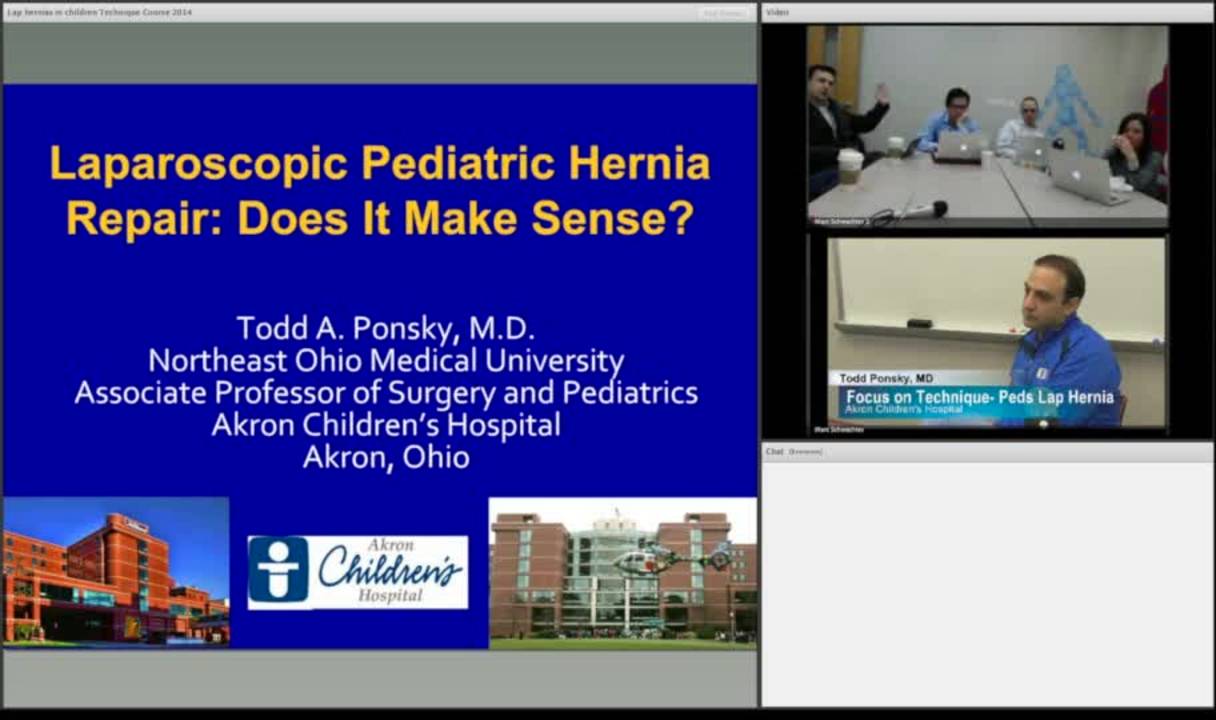
Laparoscopic Pediatric Hernia Repair: Online Course 2017

Video Published 2018-09-16 Updated 2026-08-01

Timestops (8)

Topic Overview

An interactive online course on laparoscopic pediatric inguinal hernia repair techniques, led by Dr. Todd Ponsky at Akron Children's Hospital. The discussion covers clinical decision-making for hernia diagnosis and management, compares open versus laparoscopic approaches, and details the Takahara percutaneous technique with peritoneal injury. Key clinical points include the role of peritoneal injury rather than permanent suture in repair durability, management of incarcerated hernias without reduction attempts, and emerging evidence for laparoscopic high ligation in adolescents and adults with indirect hernias. The faculty debate contralateral exploration, optimal suture materials, and whether patent processus vaginalis closures spontaneously close.

Key Takeaways

  • Peritoneal injury, not permanent suture, drives repair durability: 100% vs 17% closure at 4 weeks in rabbit model. (44:33)
  • Laparoscopic repair allows direct OR management of incarcerated hernias without reduction attempts—inflammation doesn't complicate repair. (22:28)
  • Modern laparoscopic hernia repair achieves ≤1% recurrence across multiple large international studies. (27:39)
  • Open repair's most common recurrence mechanism is iatrogenic direct hernia from cord traction disrupting the floor. (24:51)
  • Postoperative hydroceles after laparoscopic repair are extremely rare and almost never require intervention. (1:07:18)

Inside this episode

Kai, the Library's AI content creator, listened to this episode and mapped who's speaking, the chapters, key claims, and cases. Every item links to the exact moment in the recording.

AI-enriched

Who's speaking

  • Todd Ponsky — host
  • Mark — guest
  • Ian Mitchell — guest
  • Jeff Gander — guest
  • Luis Zia Saya — guest
  • Abby Schlager — guest
  • Speaker 7

Chapters

  • 0:00Introduction and Course Overview — Dr. Ponsky introduces the fourth or fifth annual hernia course at Akron Children's Hospital, welcomes international participants, and introduces faculty including Ian Mitchell, Jeff Gander, and research fellows.
  • 3:00Clinical Scenarios and Decision-Making — Interactive polling on management of suspected hernias without physical findings, incidentally discovered patent processus during other procedures, contralateral exploration practices, and timing of NICU hernia repairs. Faculty share varied approaches.
  • 15:28Open vs. Laparoscopic Repair Arguments — Comparison of traditional open repair advantages (proven track record, low recurrence) versus laparoscopic benefits (avoiding cord manipulation, nerve-dense incision, easier anatomy in difficult cases). Discussion of the 'ocean argument' that laparoscopic view remains clear regardless of external complexity.
  • 28:16Laparoscopic Techniques Overview — Review of multiple laparoscopic approaches: CK Young's curved needle technique, LILS (laparoscopic intracorporeal ligation and suturing), SEAL technique (percutaneous internal ring suturing), and the Takahara/Patkowski percutaneous method. Discussion of pros and cons of each.
  • 45:00Peritoneal Injury Research and Current Technique — Presentation of rabbit model research demonstrating that peritoneal injury, not permanent suture, is critical for durable repair. At 4 weeks, 100% of injury-plus-suture repairs remained closed after suture removal versus 17% of suture-alone repairs. Detailed demonstration of current technique with anterior peritoneal cautery.
  • 56:40Hydrocele Management and Sac Excision — Discussion of communicating versus non-communicating hydroceles. Presentation of laparoscopic non-communicating hydrocele repair case with sac drainage and partial excision. Debate over complete sac excision (Raquelme technique) versus high ligation approaches.
  • 71:40Adolescent and Adult Hernias — Survey data showing pediatric surgeons perform high ligation while adult surgeons use mesh for identical cases. Discussion of bimodal hernia distribution and inflection point around age 29 when direct hernias emerge. Presentation of prospective trial in Norway studying laparoscopic high ligation in adult indirect hernias.
  • 90:00Q&A and Telementoring Demonstration — Audience questions on floor evaluation, recurrence management, smallest patient size, and portless techniques. Brief demonstration of telementoring technology used to train Norwegian surgeons remotely. Course concludes with invitation to next day's update course.

Key claims

  • 17:05In a rabbit model, grabbing the vas deferens once with pickups obliterates it — Todd Ponsky
  • 18:00A study by Zendejas in Journal of American College of Surgeons found 5% infertility rate after hernia repair, matching the general population — Todd Ponsky
  • 18:23A study in Andrologia found markedly reduced semen quality in 8500 patients in fertility clinics who had prior hernia repairs, with morphology problems — Todd Ponsky
  • 24:51The most common cause of recurrence after open indirect hernia repair is development of a direct hernia — Todd Ponsky
  • 27:39Recent large studies from multiple countries show laparoscopic hernia repair recurrence rate of approximately 1% or less — Todd Ponsky
  • 44:16In rabbit model at 2 weeks, 75% of suture-alone repairs opened when suture was removed, but 87% of injury-plus-suture repairs stayed closed — Todd Ponsky
  • 44:33In rabbit model at 4 weeks, only 17% of suture-alone repairs stayed closed after suture removal, but 100% of injury-plus-suture repairs were reperitonealized — Todd Ponsky
  • 44:58Braided non-absorbable sutures worked best in rabbit hernia repair model compared to dissolvable or monofilament — Todd Ponsky
  • 85:45A retrospective two-center study (Kansas City and Rainbow) found 1.9% recurrence rate with open high ligation in adolescents — Todd Ponsky
  • 83:03There is a bimodal distribution of hernias with peaks in infancy and older adulthood, with few adolescent cases — Todd Ponsky
  • 83:38Direct hernias start developing around age 29, suggesting a change in floor integrity at that age — Todd Ponsky
  • 93:39Felix Shear's ultrasound study showed no deficiency in testicular blood flow after laparoscopic hernia repair in babies — Todd Ponsky
  • 10:56Wit Holcomb published in 1994 that contralateral patent processus presents in 30-40% of cases — Todd Ponsky
  • 11:05There is a 4 times greater risk of developing a hernia if a patent processus vaginalis is present — Todd Ponsky
  • 11:17The risk of metachronous hernia is 3-11% — Todd Ponsky
  • 41:48In open hernia repair, the stitch likely dissolves (when using Vicryl) and the repair works because the cut sac ends scar together — Todd Ponsky
  • 42:14Munther Haddad from Leeds published a series on open division of the sac without ligation with the same recurrence rate as traditional repair — Todd Ponsky
  • 42:27When ligating the sac, you create a new smaller hernia sac that still vaginates into the muscle — Todd Ponsky
  • 5:51The most common thing mistaken for a hernia is the testicle riding up into the groin — Todd Ponsky
  • 22:28With laparoscopy, incarcerated hernias can be taken directly to OR without reduction attempts, as the repair is not harder when inflamed — Todd Ponsky
  • 52:05In babies, single knot ligation is preferred over double ligation to reduce risk of suture granuloma due to thin subcutaneous tissue — Todd Ponsky
  • 80:28The NIH study quoted 30% chronic pain rate after adult mesh hernia repair, though expert hernia surgeons claim their rates are lower — Todd Ponsky
  • 25:35In open repair, pulling up the cord may take fibers of the floor and cause a direct hernia, especially in premature infants with very thin floors — Todd Ponsky
  • 25:55Adult general surgeons doing Lichtenstein repairs always cover the floor with mesh even for indirect hernias because pulling up the cord disrupts the floor — Jeff Gander
  • 63:40CK Young in Hong Kong has done approximately 2000 laparoscopic hernia repairs with ligation alone (no injury) with very few recurrences — Todd Ponsky
  • 67:18Postoperative hydroceles after laparoscopic hernia repair are extremely rare, with almost no cases requiring intervention — Todd Ponsky
  • 10:18A patient had a patent processus identified incidentally years prior, then presented with groin pain and at laparoscopy the patent processus was gone — Todd Ponsky
  • 17:41The groin has a very high density of nerves, making it a problematic location for incisions — Todd Ponsky

Cases discussed

  • 21:09Incarcerated hernia in infant reduced laparoscopically
  • 24:31Recurrent hernia after open repair presenting as direct hernia
  • 70:21Non-communicating hydrocele repair
  • 98:27Recurrent hernia after laparoscopic SEAL repair
  • 90:28Recurrent hernia in large military patient
  • 67:44Reactive hydrocele after laparoscopic hernia repair

Points of disagreement

  • 3:24Management of 8-year-old with history of groin bulge but no physical findings
    • Ian Mitchell: Give option of laparoscopy or wait for photograph, usually wait
    • Jeff Gander: Wait for photograph to avoid general anesthetic if no hernia present
    • Luis Zia Saya: Confident in physical exam silk glove sign, would explore if felt
    • Todd Ponsky: With good history and fullness/asymmetry, would proceed to laparoscopy
  • 6:29Management of incidentally discovered patent processus during other surgery
    • Jeff Gander: Initially fixed them, now leans toward not fixing due to 'dirty knowledge' that may never become symptomatic
    • Luis Zia Saya: Would not fix during appendectomy due to infection risk, would tell parents and operate later
    • Ian Mitchell: Scrubs out, discusses with family, and returns to fix it
    • Todd Ponsky: Initially fixed them, now does not after being embarrassed at conference
  • 8:49Contralateral exploration during unilateral hernia repair
    • Jeff Gander: Uses 70-degree scope through sac to look at contralateral side
    • Luis Zia Saya: Looks at contralateral side and fixes if patent processus present
    • Ian Mitchell: Does not trust contralateral look, does not explore
    • Todd Ponsky: Does not look at contralateral side, 'why eat tomorrow's lunch today'
  • 12:13Timing of NICU hernia repair
    • Jeff Gander: Previously fixed before discharge, now randomizing in trial to immediate vs 55 weeks corrected age, personally recommends later repair
    • Luis Zia Saya: Sends home and repairs when bigger
    • Ian Mitchell: Fixes before discharge due to risk of losing patients to follow-up
    • Todd Ponsky: Fixed before discharge, now randomizing in trial
  • 14:07Repair technique for 6-year-old with reducible left inguinal hernia
    • Jeff Gander: Open repair with laparoscopic contralateral look
    • Luis Zia Saya: Laparoscopic repair
    • Todd Ponsky: Laparoscopic repair with Takahara technique
  • 88:04Evaluation of inguinal floor integrity
    • Todd Ponsky: Easier to evaluate laparoscopically by observing bulging with insufflation
    • Ian Mitchell: Open evaluation is subjective, laparoscopic is more objective
    • Cannot evaluate unless you palpate it, laparoscopic evaluation insufficient
  • 75:39Need for peritoneal closure after complete sac excision
    • Todd Ponsky: Prefers to close peritoneum with suture after sac excision
    • Suggests just burning the sac without suture closure may be sufficient

Open questions

  • Do patent processus vaginalis spontaneously close in older children and adults, or was the case presented an anomaly?
  • What is the true long-term recurrence rate of laparoscopic hernia repairs in adulthood (20-30 year follow-up)?
  • Is peritoneal injury alone sufficient for durable repair, or is permanent suture necessary?
  • What is the optimal suture material - absorbable or non-absorbable?
  • At what age or hernia size should high ligation be abandoned in favor of floor repair with mesh?
  • Why do hernias show bimodal distribution with few adolescent cases?
  • Are adult indirect hernias pathophysiologically different from pediatric indirect hernias (acquired defects vs congenital patent processus)?
  • What is the true rate of testicular atrophy after open versus laparoscopic repair in premature infants?
  • Does complete sac excision provide better outcomes than high ligation with peritoneal injury?
  • What is the mechanism of repair - permanent suture, scar formation from injury, or seton-like erosion?
  • Can floor integrity be adequately assessed laparoscopically or is palpation necessary?
This episode was analyzed and enriched by Kai, the Library's AI content creator. Every item links to the moment it comes from — click a timestamp to listen in context.
Written for:

Direct Hernia After Open Indirect Repair: When the Floor Fails

The patient case from this episode, retold from presentation to outcome with the decisions made along the way. Written by Kai from the episode transcript and reviewed before publishing.

For the care team · Case narrative · AI-written, human-reviewed

The Recurrence

A patient presented to a county hospital with a recurrent groin hernia after open indirect inguinal hernia repair 24:51. At laparoscopy, the original indirect repair remained intact — the internal ring was closed, the high ligation held — but a new defect had opened medially: a direct hernia through the floor of the inguinal canal 24:51.

This is not an isolated case 24:51. When pediatric patients return with recurrence after open indirect hernia repair, the most common finding is not failure of the original repair but emergence of a direct hernia 24:51. Three explanations exist: coincidence (the patient simply developed an unrelated direct hernia), misdiagnosis (the original pathology was direct, not indirect, and the wrong repair was performed), or iatrogenesis — the repair itself damaged the floor 24:51.

The Mechanism

The third explanation appears most likely, particularly in premature infants 25:35. In a preterm neonate, the transversalis fascia forming the floor of the inguinal canal is nearly translucent 25:35. During open repair, the surgeon isolates the hernia sac by pulling the spermatic cord structures cephalad to separate them from the peritoneal sleeve 25:35. In doing so, fibers of the floor may be inadvertently elevated with the cord, creating a new defect 25:35.

This is not speculation unique to pediatric surgery 25:55. Adult general surgeons performing Lichtenstein repairs routinely place mesh over the entire floor even for clearly indirect hernias, operating on the assumption that mobilizing the cord disrupts floor integrity 25:55. The mesh compensates for damage the dissection itself creates 25:55.

The rabbit model offers a sobering parallel: grasping the vas deferens once with pickups obliterates it 17:05. If a single grasp destroys a structure in an animal model, what does sustained traction on a premature infant's spermatic cord — with its gossamer-thin surrounding fascia — do to the floor beneath it 25:35?

The Decision Point

The question, then, is not whether open repair can cause direct hernias, but whether an alternative approach avoids the problem 25:35. Laparoscopic repair does not require an inguinal incision, does not mobilize the cord, and does not place traction on floor fibers 25:35. The internal ring is closed from within, under direct visualization, without disturbing the anatomy lateral or medial to it 25:35.

But laparoscopic repair introduces its own risks: it converts an extraperitoneal operation into an intraperitoneal one 27:39. Recent multicenter studies report laparoscopic recurrence rates of approximately 1% or less 27:39, but these are short- to medium-term outcomes 27:39. The bimodal distribution of hernias — peaks in infancy and older adulthood, with few adolescent cases — suggests that some defects may not declare themselves for decades 83:03.

Direct hernias begin appearing around age 29, an inflection point that implies a change in floor integrity independent of congenital patency 83:38. Whether this represents delayed failure of childhood repairs or a separate acquired process remains unknown 83:38. A retrospective two-center study of adolescents undergoing open high ligation found a 1.9% recurrence rate 85:45, but follow-up was limited and did not extend into the third decade when floor failure accelerates 83:38.

What the Case Changes

This case argues that the choice of repair is not neutral 24:51 25:35. Open repair, particularly in premature infants with fragile tissue planes, may trade one hernia for another — closing the internal ring at the cost of weakening the floor 25:35. Laparoscopic repair avoids that trade-off but introduces intraperitoneal risk and requires technical proficiency that not all centers possess 27:39.

The transferable judgment is this: recurrence after indirect hernia repair should prompt laparoscopic evaluation before reoperation 24:51. If the original repair is intact and a new direct defect has appeared, the surgeon must consider whether the first operation caused the second hernia 24:51 25:35. In that scenario, repeating the same approach risks repeating the same injury 25:35. The floor, once compromised, may not tolerate further dissection 25:35.

For surgeons committed to open repair, the lesson is gentleness 25:35. Minimize cord mobilization 25:35. Avoid sustained traction 25:35. Recognize that in the smallest patients, the floor is not a robust structure but a membrane under tension, and that pulling on the cord may pull the floor with it 25:35. For surgeons adopting laparoscopic technique, the lesson is that avoiding one complication does not eliminate all risk — it shifts the risk profile 27:39.

The patient in this case required repair of a hernia the first operation may have created 24:51 25:35. That is the cost of not accounting for floor integrity when choosing technique 25:35.

Takeaways from this story

  • Most recurrences after open indirect repair present as new direct hernias, not failure of the original high ligation
  • Mobilizing the cord in preterm infants may elevate floor fibers with it, creating direct defects in tissue too thin to tolerate traction
  • Adult surgeons routinely mesh the floor even for indirect hernias because cord mobilization disrupts floor integrity
  • Laparoscopic repair avoids floor trauma but converts an extraperitoneal operation to intraperitoneal with recurrence rates near 1%

Keywords

Hashtags

Transcript

Comments

Loading comments…